| Quick Answer The dropped third strike rule lets a batter run to first base when the catcher fails to catch strike three, but only if first base is unoccupied, or if there are two outs. In every other case the batter is simply out. The ball stays live, so the batter still has to be tagged or thrown out at first, and the pitcher is credited with the strikeout either way. |
A batter misses at strike three, then sprints to first while half the crowd yells and the other half looks confused. The dropped third strike, also called the uncaught third strike, belongs to the same small family as infield fly, rules written to stop one side gaining a cheap advantage. Here is exactly when it applies.
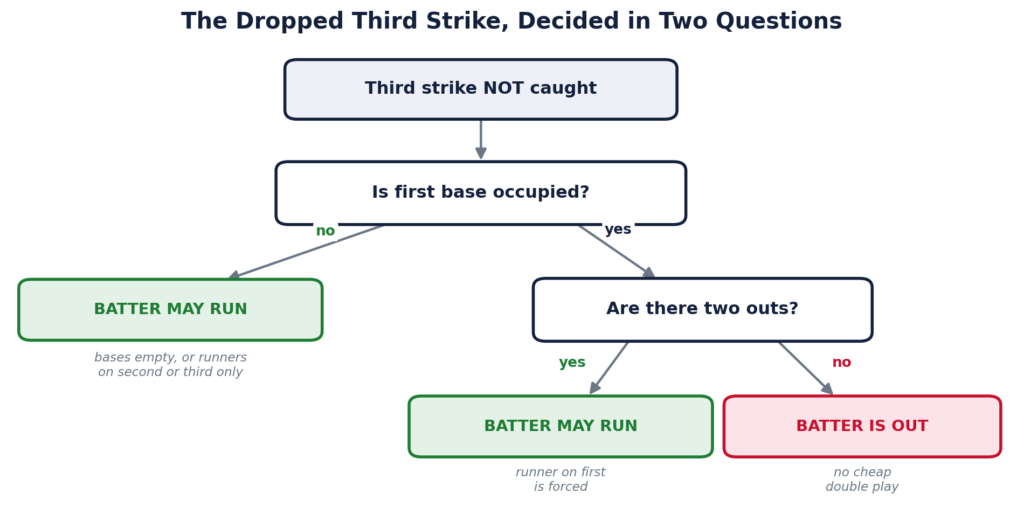
Two questions decide everything: is first base occupied, and are there two outs? Nothing else matters, not the inning, not whether the batter swung. This is the catcher’s rule more than anyone’s, and handling it cleanly is part of the catcher’s job. The flowchart below settles it in two steps.
When the Rule Applies (It Is Not Always)
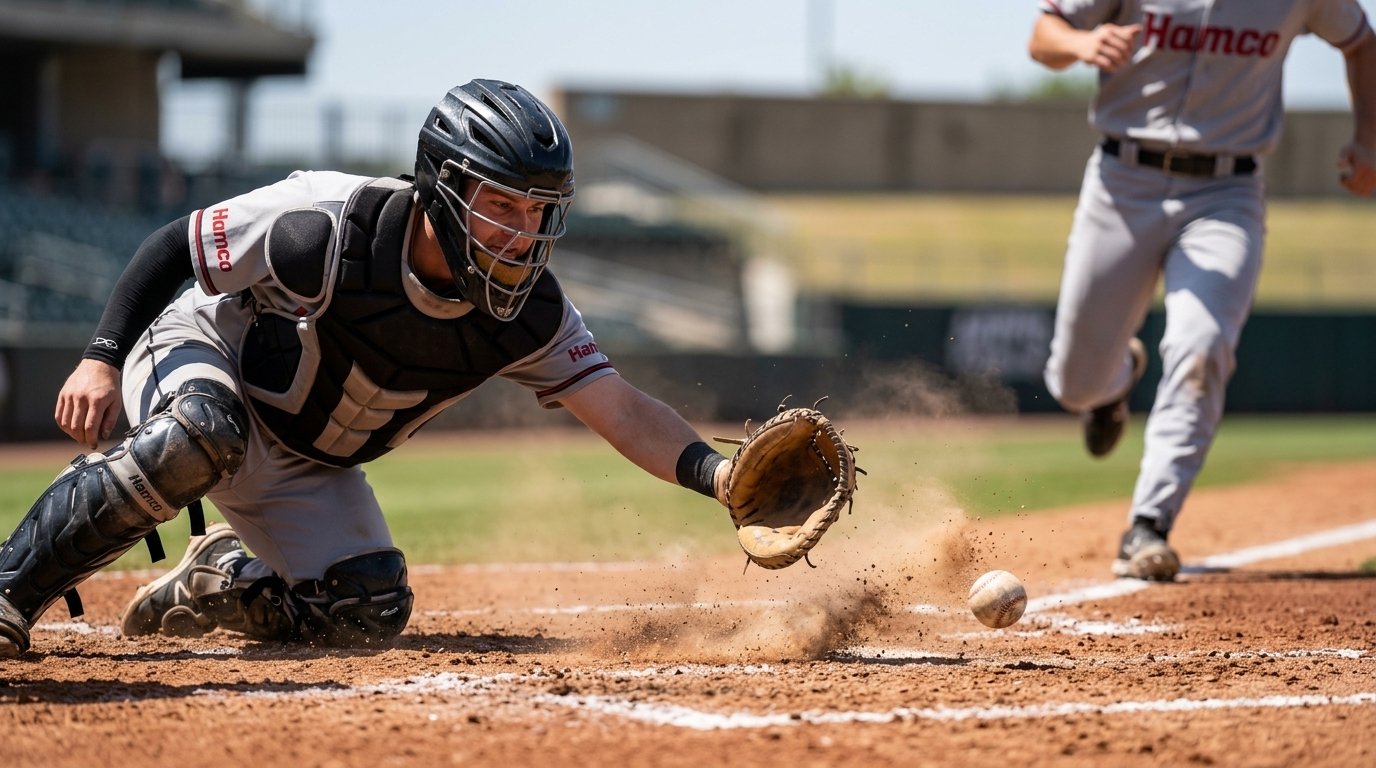
Official Rule 5.05(a)(2) says the batter becomes a runner when a third strike is not caught, providing first base is unoccupied, or first base is occupied with two out. That is the whole rule. Two details trip people up. Not caught covers more than a clean drop: a pitch that hits the dirt first counts as an uncaught third strike even if the catcher gloves the short hop. And the batter is not safe, only eligible, since the ball is live and the defense still has to tag them or beat them to first base.
Without the restriction, a catcher with a runner on first could deliberately drop strike three, throw to second for the force out, then on to first, turning one strikeout into a free double play. Baseball closed that loophole in 1887. The same logic sits behind the balk rule, which stops pitchers deceiving runners.
The Four Scenarios
Every dropped third strike lands in one of four buckets. A runner on second or third changes nothing, because first base is all the rule cares about.
| Situation | Outs | The Batter | Why |
| Bases empty | Any | May run | First base is unoccupied |
| Runners on second or third only | 0 or 1 | May run | First base is still unoccupied |
| Runner on first | 0 or 1 | Out automatically | Stops a cheap force double play |
| Runner on first | 2 | May run | A double play is no longer possible |
What the Batter Does in Each Case
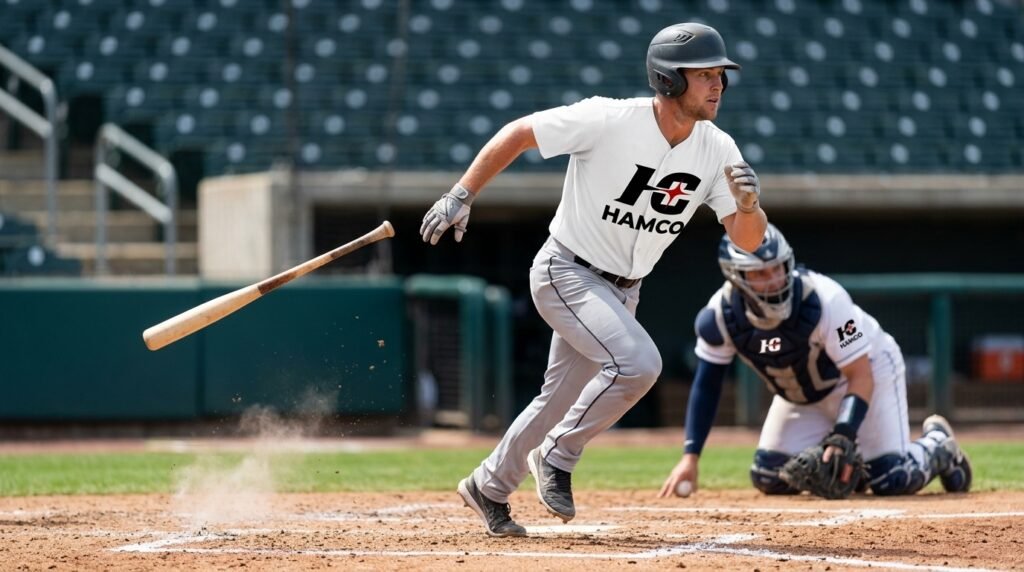
If the rule is live, run. Do not look at the umpire, just go, because the catcher is often still hunting the ball. If first base is occupied with fewer than two outs, you are out.
Here is the detail that costs teams a base every season. A batter eligible to run forfeits that right once they leave the dirt circle around home plate. Three steps toward the bench and the chance is gone. That is why many coaches teach young hitters to run on any third strike not caught: when the rule does not apply the batter was out anyway, and when it does the team gains a free runner.
What the Catcher Does in Each Case
Block first, find the ball second, then think about the play. When the batter is eligible to run, the simplest out is usually a tag, since they are standing right in front of you, with the throw to first as backup. If the batter is automatically out, there is no play to make on them, but the ball is live, so retrieve it fast and keep the runners honest.
One situation catches catchers out every year: bases loaded with two outs. The batter becomes a runner, which forces the runner on third, so there is no need to throw anywhere. Pick the ball up and step on home plate for the force out. It ends the inning, and catchers still panic and throw to first instead.
The Most Common Little League Misapplication
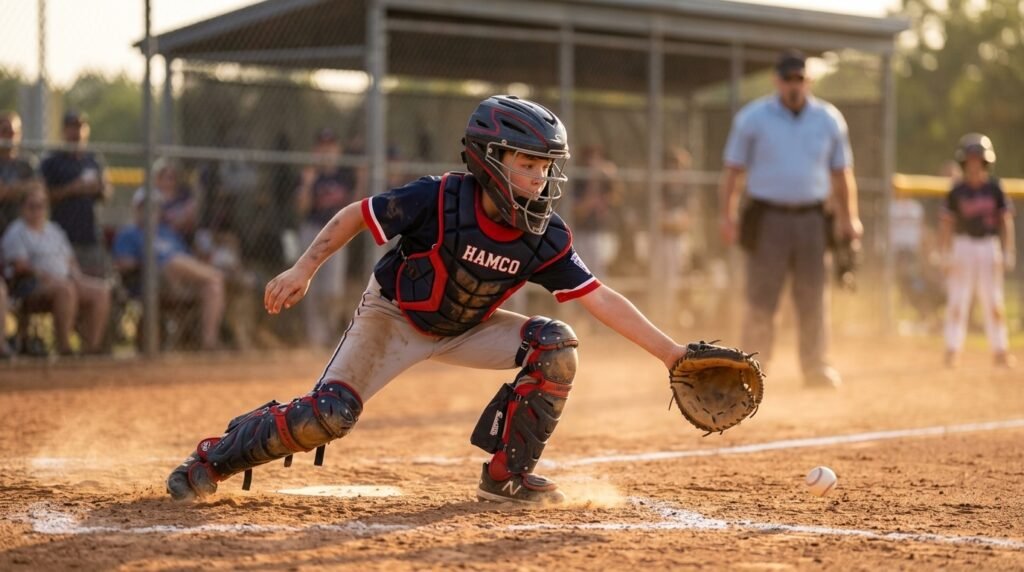
The biggest mistake is assuming the rule works the same at every level. It does not. In Little League it applies in the Major Division and above, including Intermediate 50/70, Junior, Senior, and Big League. It does not apply in Minor League or Tee Ball, where the batter is out on strike three regardless, because young catchers cannot reliably handle a ball in the dirt.
Two things make this worse. Little League expanded the rule downward into Majors in recent years, so anyone who learned it did not apply in youth ball is working from outdated information. And a local league may still elect the Minor League version in Majors, so it can be switched off even where it normally applies. Check your own rule book rather than assuming, since our guide to Little League rules covers how much varies by division, the same way levels differ on college baseball innings.
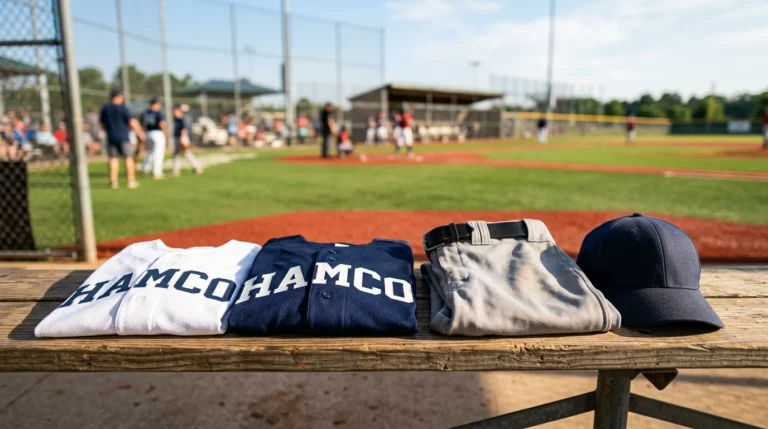
Catchers chew through gear faster than anyone, and blocking balls in the dirt is exactly why. Our baseball uniforms use durable sublimated fabric with reinforced knee panels that survive a season of dropping into the dirt. Outfit the roster in matching baseball gear with custom numbering, a free mockup, and about a three week turnaround.
Frequently Asked Questions
Q: What is the dropped third strike rule?
A: It lets the batter run to first when strike three is not caught, but only if first base is unoccupied or there are two outs. Otherwise the batter is out automatically.
Q: Can a batter always run on a third strike not caught?
A: No. With a runner on first and fewer than two outs the batter is out immediately, which stops the catcher from dropping the ball on purpose for a cheap double play.
Q: Does a pitch that bounces count as an uncaught third strike?
A: Yes. A ball that hits the dirt before reaching the mitt counts as uncaught even if the catcher gloves the short hop cleanly.
Q: Does the pitcher still get the strikeout?
A: Yes. The strikeout is credited either way, which is how a pitcher can record four strikeouts in one inning if a batter reaches on the play.
Q: Does the dropped third strike apply in Little League? A: In the Major Division and above, yes. It does not apply in Minor League or Tee Ball, and a local league can elect to switch it off in Majors, so check your rule book.