A batter pops the ball up, an infielder camps under it, and before the ball even lands the umpire throws his arm up and calls the batter out. Half the crowd groans in confusion and somebody mutters about the infield fly rule like it is some dark art. It is not. It is one of the few baseball rules that sounds baffling for two seconds and then makes sense forever. Here is the infield fly rule explained in plain terms, including the exact test the umpire runs in his head. For the wider context, our full baseball rules guide covers the calls that trip up parents and new fans the most.
The Exact Conditions That Trigger the Rule
The rule only applies when three things are true at once. Miss any one and there is no infield fly.
First, there must be runners on first and second, or the bases loaded. First and second being occupied is what creates the force situation the rule neutralizes. A runner on first alone does not count, and neither does a runner on second or third alone.
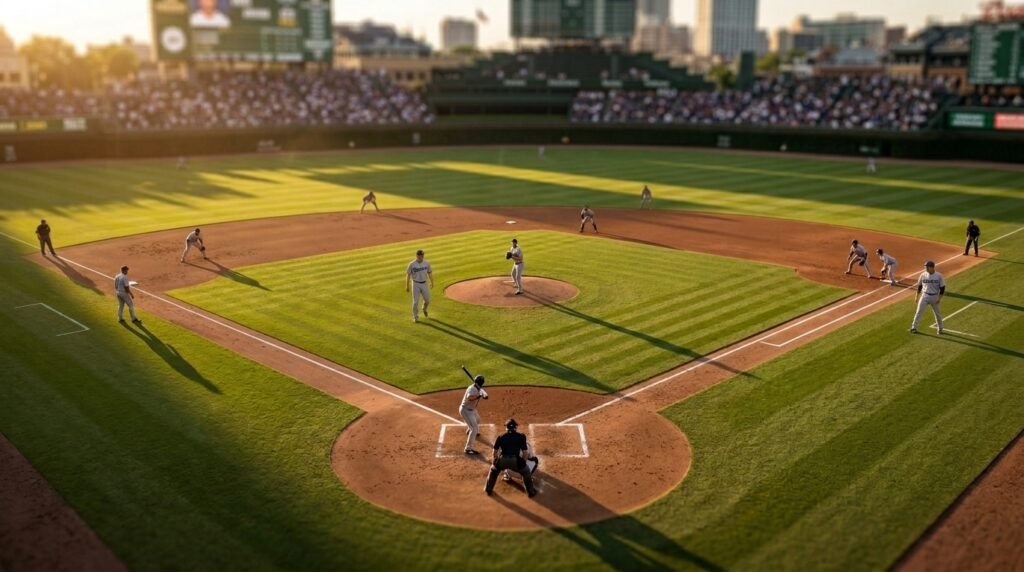
Second, there must be fewer than two outs. With two outs the rule is pointless, so it does not exist.
Third, the batter must hit a fair fly ball, not a line drive and not a bunt, that an infielder can catch with ordinary effort. That phrase, ordinary effort, is the entire judgment call, and we will come back to how slippery it is.
When all three line up, the umpire declares the batter out the instant he judges the ball catchable, whether or not anyone catches it. The conditions are identical at every level, even where other rules diverge (college, for example, has its own quirks on game length, covered in college innings rules).
Why the Rule Exists: The Cheap Double Play It Prevents
The rule exists to stop a defense from cheating its way into an easy double play, and once you see the trick it prevents, the whole thing clicks.
Picture runners on first and second with one out and no infield fly rule. A batter pops up an easy fly. The runners cannot stray far from their bases, because if the ball is caught they have to get back to tag up, so they freeze near the bag. Now the infielder simply lets the ball drop on purpose. Because there is a force play, he scoops it, flips to third for one out, and third throws to second for another. The defense just turned a routine pop fly into a double play, and the runners were trapped by physics with no way to prevent it.
The infield fly rule kills that loophole by calling the batter out automatically. With the batter already out, the force is gone, the runners are no longer compelled to do anything, and dropping the ball gains the defense nothing. It is one of baseball’s smartest pieces of rulemaking, written purely to protect runners from a trap they cannot escape. The dropped third strike rule comes from the same family of thinking, closing a different loophole around uncaught balls.
The Umpire’s Signal and What Runners Do Next
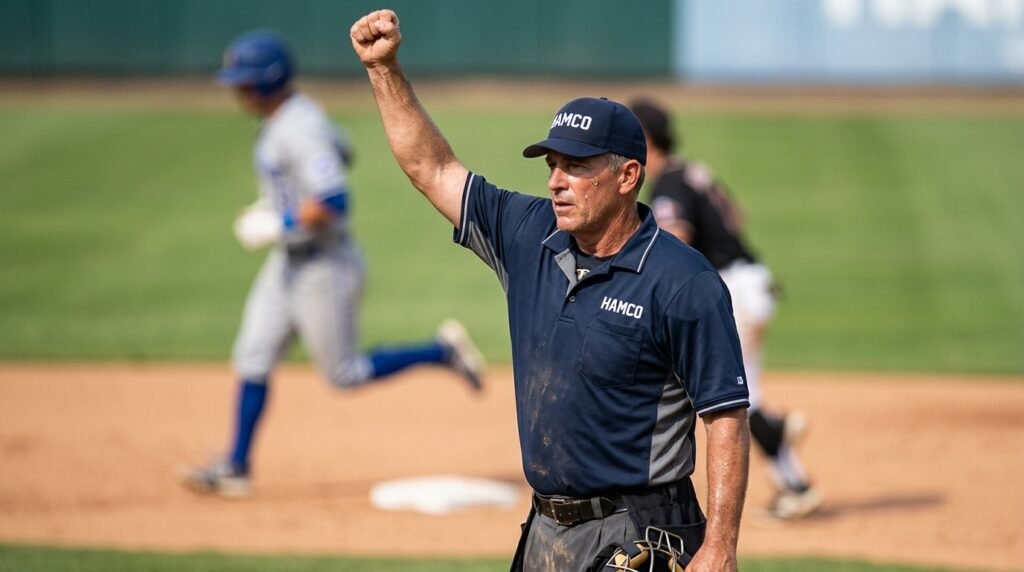
When the umpire judges the ball an infield fly, he raises one arm straight overhead, often with a closed fist, and shouts “Infield fly, batter is out.” Near a foul line he calls “Infield fly, if fair,” because a ball that lands foul is just a foul ball.
Here is the part that confuses people most: the ball is still live. The batter is out, but the runners are not, and play continues. Runners may advance at their own risk, exactly as on any caught fly: if it is caught they must tag up, if it drops they can run but are not forced to. In practice most stay put, because there is no upside to the risk. Nothing about the runners changes except that the cheap double play is now off the table. The rule applies in youth ball too, though enforcement gets shakier the younger the level, and the Little League rule book is worth a read if you coach or score at that level.
When the Rule Does NOT Apply
Plenty of pop ups are not infield flies, and knowing the exceptions keeps you from yelling at the umpire for the wrong reason. It does not apply to line drives, which the rule explicitly excludes. It does not apply to bunts, even one that pops high into the air. And it does not apply to foul balls, which is the whole reason for the “if fair” version of the call.
It also does not apply with a runner on first only, with two outs, or with the bases empty, because none of those create the trap the rule was written to prevent. This is a separate idea from a balk rule call, which people often lump in as another mysterious umpire decision, but the two have nothing in common beyond confusing the bleachers.
The Famous 2012 Braves and Cardinals Wild Card Example
If you want proof that “ordinary effort” is a genuine gray area, look no further than the first ever National League Wild Card game, played at Turner Field on October 5, 2012.
In the eighth inning, with the Braves trailing the Cardinals 6 to 3, one out, and runners on first and second, Andrelton Simmons popped a ball into shallow left field. Cardinals shortstop Pete Kozma drifted out toward the outfield grass, called for it, then peeled away at the last instant. The ball dropped untouched and Turner Field erupted, thinking the bases were loaded. Except left field umpire Sam Holbrook had already signaled infield fly. Simmons was out, the rally was gutted, fans hurled debris onto the field, and the game stalled for about 19 minutes. The Braves protested. Joe Torre, running baseball operations that night, denied it on the spot as a judgment call. Atlanta lost 6 to 3, in what turned out to be Chipper Jones’ final game.
No sugar coating: the call is still argued today, and both sides have a point. By the letter of the rule, Holbrook was within his rights, since depth into the outfield does not matter, only whether an infielder could have caught it with ordinary effort, and Kozma did camp under it. But critics note two real problems: Kozma had to run well into shallow left, which stretches “ordinary effort,” and Holbrook did not raise his arm until the ball was more than halfway down, when the rule says the umpire should declare it immediately. It was, at best, a technically defensible call made at the worst possible moment, and it remains the textbook example of why this rule lives or dies on umpire judgment. Postseason baseball is full of these strange corners, the same way a perfect game sits at the rare and beautiful end of the spectrum.
The Short Version
The infield fly rule is simple once you hold three facts: runners on first and second (or loaded) with fewer than two outs, a catchable fair fly ball, and the batter is out automatically so the defense cannot fake a double play. The only hard part is the umpire’s judgment on “ordinary effort,” and as 2012 proved, even the pros fight about that. Learn the three conditions and the call will never confuse you again.
Frequently Asked Questions
What is the infield fly rule?
It is a rule that calls the batter out automatically on a catchable fair fly ball when there are runners on first and second (or the bases loaded) with fewer than two outs. It stops the defense from dropping the ball on purpose to get a cheap double play.
When does the infield fly rule apply?
Only when three things are true at once: runners on first and second or the bases loaded, fewer than two outs, and a fair fly ball an infielder can catch with ordinary effort. Miss any one and the rule does not apply.
Is the ball dead on an infield fly?
No. The ball stays live. The batter is out, but runners may advance at their own risk, just as on any other fly ball. They are simply no longer forced to run.
Does the infield fly rule apply to line drives or bunts?
No. The rule excludes line drives and bunts entirely. It applies only to ordinary fly balls.
Why is the infield fly rule so controversial?
Because it hinges on whether an infielder could catch the ball with ordinary effort, which is a judgment call. The disputed 2012 Braves and Cardinals playoff call is the most famous example of that gray area.
If you coach or run a team that prides itself on knowing the rules cold, dress the part. Our custom baseball uniform sets pair game jerseys and pants in one order and ship in under three weeks with full customization.
Prefer to build the look piece by piece? Start with our full button baseball jerseys for the classic on field look, or browse the complete range of custom baseball uniforms built to last a full season.Coaching a team that knows its rules? Custom uniforms in under three weeks.