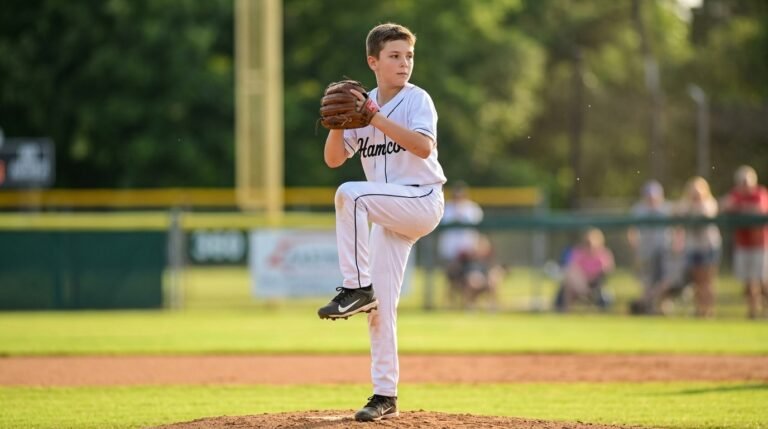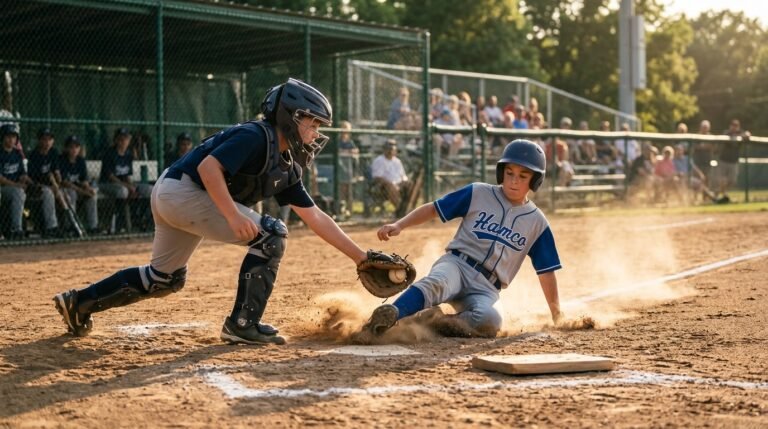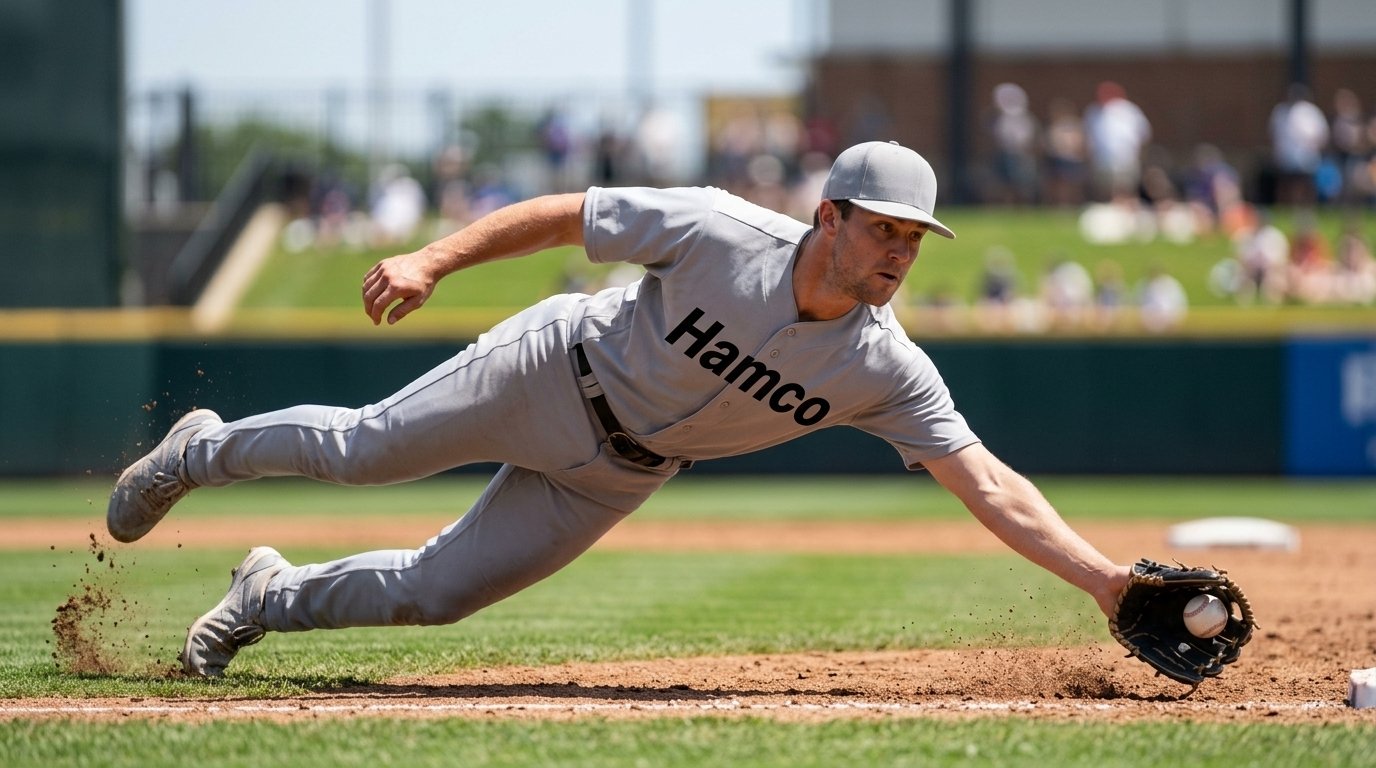
| Quick Answer The shortstop plays between second and third base, roughly 12 to 15 feet behind the baseline, and is position 6 in the scorebook. Because most hitters are right handed and pull the ball, the shortstop fields more ground balls than any other infielder. The job needs range to both sides, the strongest arm in the infield, clean double play footwork, and the field IQ to set the defense before every pitch. |
Ask a coach where the best athlete on the team plays and the answer is almost always shortstop. There is a reason our position difficulty ranking puts it second only to catcher: no other spot asks a player to cover so much ground, throw so far, and think so fast, all on the same play. So what does a shortstop do? Everything the infield needs, usually at once. Here is the honest picture of playing shortstop, and what coaches are really watching when they put a kid there.
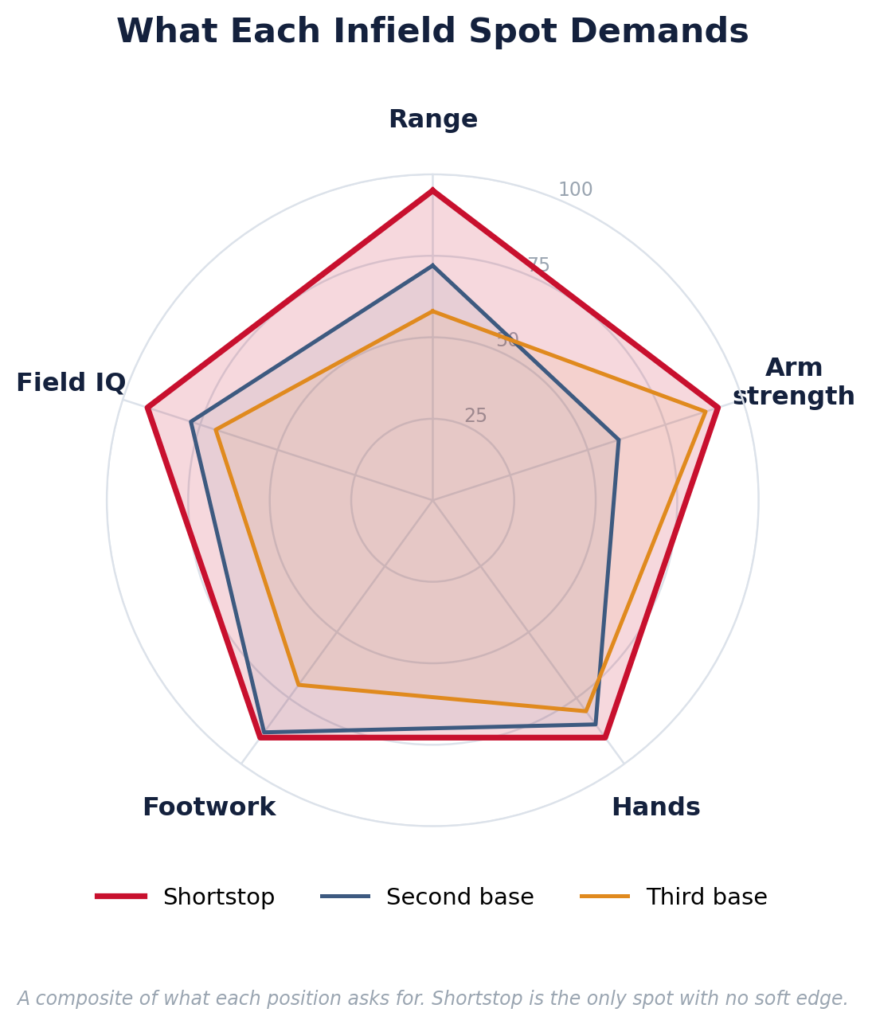
This shortstop position baseball guide starts from one idea: the spot is the infield’s control tower, and the only place where a weak tool shows up immediately, because the position never lets a player hide. If catcher is the toughest job overall, a point we make in our guide to the catcher’s role, shortstop is the hardest pure fielding job on the diamond. The chart shows why, comparing what each infield spot actually demands.
Why Shortstop Sees the Most Ground Balls of Anyone
This is not opinion, it is a consequence of how hitters are built. The large majority of hitters are right handed, and right handed hitters pull the ball to the left side of the field. That sends the heaviest traffic straight into the shortstop’s zone, which is why the shortstop fields more ground balls than any other infield position. Add the geography and the gap widens further: the shortstop covers from the hole between third base and short, across the middle, and behind second base on balls the second baseman cannot reach. That is the largest slice of fair territory any infielder owns.
The volume is the whole argument for putting your best glove there. More chances means more chances to save runs, and more chances to give them away. It also means more of everything else: covering second base on steals, working as the cutoff man on throws from left field, backing up third base on throws from the catcher, and calling off outfielders on shallow pop flies. When the infield fly gets called, the shortstop is usually the fielder camped under it.
The Arm Requirement, and How Much of It Can Be Trained
The throwing arm is the tool that decides who stays at shortstop and who moves, because the position demands the strongest arm in the infield and the reason is geometry. A throw from deep in the hole travels farther than the throw from third base to first, which is already about 127 feet across the diamond. Now add the clock. At high school level and above, a hitter reaches first base in just over four seconds. That is the entire window to read the ball off the bat, get to it, field it, transfer it, and deliver a throw across the diamond on a line. A second baseman never faces that math.
Here is the honest part about arm strength. It is trainable, and more trainable than most parents think, since long toss programs, better throwing mechanics, and learning to use the lower half and core rather than arming the ball all add real velocity. But it is not infinitely trainable, and some players simply will not develop a shortstop arm no matter how much work they put in. That is not a failure, it is information. A player with soft hands, quick feet, and an average arm is a very good second baseman, and pretending otherwise helps nobody. A proper glove matters here too, since shortstops use a shallower pocket for quicker transfers, which our youth baseball gear guide covers.
Footwork on the Double Play
The double play is the most valuable defensive play in baseball, and the shortstop is involved in nearly all of them. Two jobs, two sets of footwork. Feeding is the simpler one: on a ball hit to the shortstop’s left, near the bag, the feed is an underhand toss with the chest square to the target, and from deeper in the hole it becomes a firm sidearm throw. The rule is the same either way, deliver it chest high and lead the second baseman toward first base.
Turning the pivot is where shortstops get hurt and where innings get lost. The shortstop comes across the bag to receive the feed from second base, touches the bag, and clears toward the outfield side to get away from the incoming runner while still throwing on a line to first. Do not stand on the bag and wait. Do not catch the ball flat footed. The clean version looks unhurried, and the rushed version ends with a throw in the dugout. One practical note that decides positioning: play double play depth any time there are fewer than two outs and first base is occupied, since a step or two in changes whether the play is even possible.
Communicating With Second Base, Third Base, and the Pitcher
Infield communication is the shortstop’s job, and it happens out loud. Before every pitch there is a short list to settle: how many outs, who covers second on a steal, who takes a ball up the middle, whether the corners are in for a bunt, and where the cutoff sets up on a ball to the gap. The shortstop and second baseman decide coverage on steals with a quiet sign behind the glove, generally with the shortstop covering when a right handed hitter is up and the second baseman covering against a left handed hitter, because of where the ball is likely to go.
With the pitcher, the communication is about timing and holding runners. The shortstop is the one sneaking behind a runner on a pickoff play at second base, so the two have to agree on the count and the move before it happens. That coordination also has a rule attached, since a pitcher who starts a motion and does not complete it correctly gets called for the balk rule, which hands the runner a free base. A shortstop who talks constantly makes the whole defense look faster than it is. A quiet shortstop makes everyone slower.
Reading the Pitch and Shifting Before It Lands
This is the part of playing shortstop that nobody in the stands notices and every good coach grades. The shortstop knows what pitch is coming, because the catcher’s sign is visible from the middle infield, and that knowledge is worth a step and a half of range. A breaking ball to a right handed hitter is far more likely to be pulled, so the shortstop creeps a step toward third base before the pitch even lands. An outside fastball to that same hitter is more likely to go the other way, so the shortstop cheats back toward the middle.
The same anticipation applies to the runner and the situation. Move a step closer to the plate against a fast runner, which trades a little range for a faster release. Adjust for a pull heavy hitter, and be ready to take the whole left side when the third baseman shifts. The honest way to think about it is this: range is not only how fast you move, it is where you started. A shortstop who reads the pitch is already two steps into the play while a shortstop who waits is still reacting.
What Coaches Look For at Tryouts
Tryouts are short and coaches decide fast, often within a handful of ground balls. They are not really watching whether a player catches the ball, since most players at a tryout will catch a routine grounder. They are watching how. The table below is what actually gets graded, alongside the mistakes that quietly move a player off the shortstop list.
| What They Watch | What Good Looks Like | The Red Flag |
| First step | An explosive crossover the instant the ball is struck | Standing flat footed, waiting to see where it goes |
| Hands | Soft, giving with the ball and working through it | Stiff hands that stab at the ball and fight it |
| Arm from the hole | Carries on a line, thrown on the run when needed | Has to plant and crow hop on every single throw |
| Backhand | Comfortable to the glove side, clean transfer out | Circling around every ball to stay in front of it |
| Double play feed | Chest high, accurate, and on time to the pivot | Rushing the feed and sailing it past second base |
| Between pitches | Talking, setting the infield, resetting every pitch | Going quiet and drifting once the inning drags |
Two more honest notes. First, coaches watch what a player does between reps, not just during them, because a kid who resets, talks, and stays engaged in a boring drill will do it in the seventh inning. Second, the ball off a fungo bat is not the ball off a live bat, so if you want an accurate read on a young shortstop, watch them in a real game or at a travel tournaments weekend where the pace is game speed and the pressure is real.
A shortstop moves more than anyone in the infield, so the uniform has to move too. Our custom baseball jerseys are cut full button with room through the shoulders for the throw from the hole and a clean athletic fit that does not bunch when a player goes to the backhand. Outfit the roster in matching baseball team apparel with custom numbering, a free mockup, and about a three week turnaround.
Frequently Asked Questions
Q: What does a shortstop do in baseball?
A: The shortstop fields ground balls between second and third base, covers second on steals and double plays, works as a cutoff man on throws from the outfield, and directs the infield’s positioning.
Q: Why is shortstop considered the hardest infield position?
A: It covers the most ground, sees the most ground balls, needs the strongest infield arm, and carries the mental job of setting the defense before every pitch.
Q: Where does a shortstop stand?
A: Between second and third base, roughly 12 to 15 feet behind the baseline, with the exact depth adjusted for the hitter, the runner’s speed, and whether a double play is in order.
Q: What number is the shortstop in the scorebook?
A: Position 6. That is why a routine ground ball double play is written as 6 to 4 to 3, from shortstop to second base to first base.
Q: Can you play shortstop without a strong arm? A: At younger levels yes, but the arm becomes the limiting factor as the diamond grows. Arm strength is trainable to a point, and a player with great hands and an average arm is often a better fit at second base.