| Quick Answer To order team uniforms without a fit or deadline disaster, work in seven steps. Build a roster sheet with name, number, cut, and size for every player. Size by chest measurement against the vendor’s chart, not T shirt sizes, and order about 25 percent extra. Set the budget from published prices, which start at $29.99 to $46.99 per jersey and $59.99 to $79.99 per set in 2026, then use bulk tiers, since the published practice jersey table drops 18 percent from 1 to 24 pieces to 101 plus. Check the vendor’s minimum, mockup fee, turnaround, and refund policy before you commit. Approve a mockup, then count back from game one: about seven weeks for a direct maker with three week production, 12 to 13 weeks for a dealer program at 6 to 8 weeks. |
Most first uniform orders go the same way. A group text asks for sizes and much of the roster answers with a T shirt size. The order goes in three weeks before the opener. Two kids play the first game in last year’s jersey. This guide is the process that prevents that, in the order the steps happen. It uses published numbers for sizing, pricing, and timing as of September 2026. It covers the ordering side only. For colors, fonts, and layouts, our team uniform design guide is the companion piece.
One thing up front. Hamco makes uniforms, so the process figures here are ours and are published on our pages. The vendor policy examples come from other companies’ published pages, cited when named. Where a number depends on the vendor you choose, we say so. Start with the tool most orders skip: a real size chart with chest measurements, because sizing is where team uniform orders go wrong first.
Step 1: Build the Roster Sheet Before You Talk to Anyone
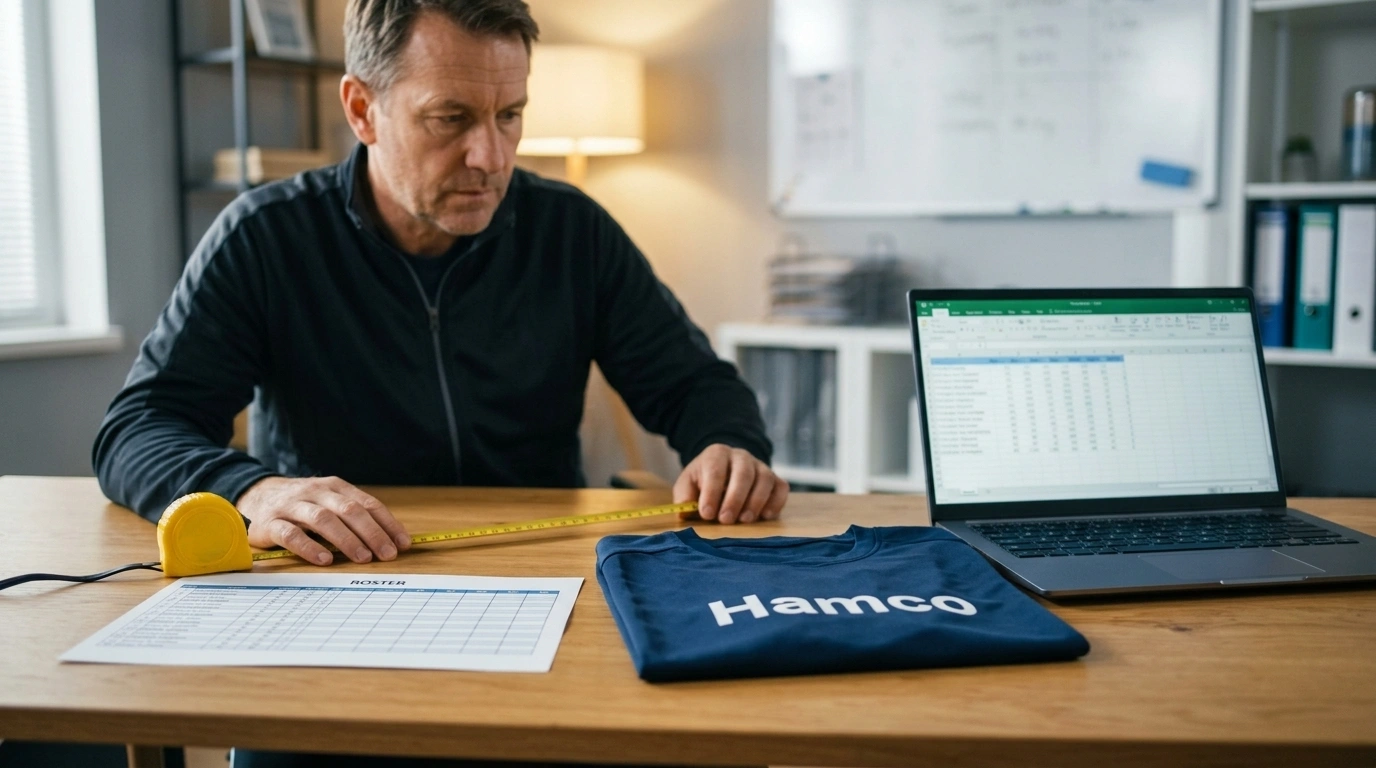
The roster sheet is the order. A team jersey exists to identify its wearer by name, number, and team colors, so the roster sheet is where the uniform is defined. Everything a vendor needs to produce a jersey lives on one row. The player, the number, the exact spelling of the name to print, the cut, the size, and a notes column for the exceptions. Build it in a shared spreadsheet, have a second person confirm every line, and lock it before the mockup stage. Adding a player after approval usually means a second production run at any vendor. A misspelled name on an approved proof is the buyer’s mistake, not the printer’s. Here is a jersey order form template you can copy.
| Player | Jersey number | Name on back | Cut | Size | Qty | Notes |
| A. Rivera | 7 | RIVERA | Women’s | M | 1 | Chest 37 in, sized up over pads |
| J. Okafor | 23 | OKAFOR | Men’s | XL | 1 | Long torso, custom length |
| M. Chen | 4 | CHEN | Youth | YL | 1 | Growth spurt, current chest 33 in |
| T. Walsh (GK) | 1 | WALSH | Men’s | L | 1 | Goalie cut, contrast color |
| Extras | 00, 12, 15 | Blank | Mixed | M, L, XL | 5 | Roster plus 25 percent for the season |
Copy this layout into a spreadsheet. The Notes column and the Extras row are the two things most order forms leave out and most reorders are caused by.
Step 2: Team Uniform Sizing, Done by Measurement
Team uniform sizing fails for one reason: people guess. And the stakes are published. Custom orders are made to the chart within a 10 percent tolerance, and there are no exchanges for a wrong size selection. Measure every player’s chest at the fullest point, tape parallel to the floor, and match the number to the vendor chart. Published youth charts run YS at a 26 to 28 inch chest and YM at 29 to 31. YL is 32 to 34 and YXL is 35 to 37. Adult men’s runs XS 32 to 34, S 35 to 37, M 38 to 40, and L 41 to 43. Then XL 44 to 46, 2XL 47 to 49, 3XL 50 to 54, and 4XL 55 to 60. The published youth chart starts at YS, so ask for measurements if you need a smaller size. Sport pages list up to adult 4XL and the sizing chart page lists up to adult 5XL. Women’s charts run about two inches smaller at each size and are cut on female patterns. Never order women’s teams from a men’s chart. Four rules on top of the chart. Size to today’s measurement, not the season end guess. Size up one step for anything worn over pads. When a player sits between two sizes, order the larger one, which is the published guidance. Ask for the vendor’s custom sizing on long torsos and goalies, which the sizing chart page offers at no extra charge. Use a virtual fitting session if one is offered. And order roster plus about 25 percent. That is the extras habit equipment managers use, published on the practice jerseys page linked in Step 3. Jerseys rotate through the wash, and a midseason call up gets a matching jersey.
Step 3: Set the Budget From Published Prices
Budgets built on guesses get rejected by boosters. Build yours from published starting prices, per player, then add extras. These are the direct maker starting prices read on live pages this month, by sport.
| Sport | Jersey from | Set from | Published note |
| Baseball | $29.99 | $79.99 | 2 button $34.99, full button $39.99 |
| Softball | $29.99 | $79.99 | Set card reads jersey and shorts; pants from $39.99 |
| Volleyball | $36.99 | $79.99 | Cuts $36.99 to $39.99; spandex shorts $36.99 |
| Basketball | Set only | $59.99 | No standalone plain jersey listed; reversible jersey $39.99, reversible set $89.99, shorts $29.99 |
| Ice hockey | $39.99 | $79.99 | Set card reads jersey and socks; reversible $79.99 |
| Wrestling | $46.99 singlet | n/a | Compression shorts $36.99 |
| Football practice | $44.99 at 1 to 24 | n/a | $36.99 at 101 plus, all in |
Verified September 2026. Starting prices from the live Hamco sport pages. Set contents follow each product card. Volume tiers at 1 to 24, 25 to 50, 51 to 100, and 101 to 500 plus lower the per item price.
Now the bulk math, because team jerseys in bulk are where budgets stretch. The published tier table on our football practice jerseys page runs $44.99 each at 1 to 24 pieces and $42.99 at 25 to 50. It drops to $39.99 at 51 to 100 and $36.99 at 101 plus. That is $8 per jersey, about 18 percent, between the smallest and largest tier. So a 22 player roster ordering 28 jerseys with extras sits in the 25 to 50 tier. Two age groups ordering together often cross into the next tier. Bulk team jerseys also share one dye batch, which keeps the whole program one shade of blue. Then check whether the price is all in. Some vendors include names, numbers, logos, mockup, and shipping. Others publish separate fees that add $50 to $125 before the first jersey prints. The $50 art setup and $125 design fee on Boombah’s full dye page are the published example.
Step 4: Vet the Vendor on Four Published Policies
Two vendor models matter here. A direct maker designs and produces the uniforms itself, as Hamco does, and publishes its own prices and timelines. A dealer program is a local or online dealer that sells a big brand’s uniforms and passes your order to that brand’s factory. The dealer sets the minimum and the timeline. Before any mockup, read four things on the vendor’s own pages, because they decide the season more than the fabric does. Minimum order: published minimums in this market range from none to the 20 sets Blue Chip Wrestling publishes for Under Armour packages. Small order fees exist too, such as Boombah’s $25 fee under 10 per style and Rox Volleyball’s $50 fee under 10. Mockup fee: Rox charges a $100 mockup deposit, credited to the order. Boombah sends the mockup only after the order is placed. Both are on those same pages. Turnaround: published windows run from about three weeks to Blue Chip’s 6 to 8 weeks from art approval and payment. The return policy sometimes states a longer average than the sales page. Wooter’s return policy says 20 to 25 business days, against 3 to 4 weeks on its sport pages. Refunds: most custom apparel is non returnable everywhere, so the mockup approval is your only protection. Our sport roundups, such as the best softball uniform companies comparison, cite each of these policies vendor by vendor.
Step 5: The Mockup Is the Contract
At a direct maker the mockup is free and arrives within 12 hours on US business days once you send colors, logo, and roster. Revisions are unlimited before approval. Use them. Check every number against the roster sheet, every name spelling, and the cut per player. Check the league rules for number size and contrast too, such as the NFHS basketball rules on 6 inch back and 4 inch front numbers. What you approve is what prints. A design that differs from the approved proof gets recut free under a design match guarantee. A proof you approved with the wrong number does not. When the sheet and the mockup agree, start the custom order and note the approval date, because the production clock starts there.
Step 6: Count Back From Game One
Timelines fail because coaches count forward from today instead of back from the first game. Here is how two vendor models land on the same first game date, using only published production windows.
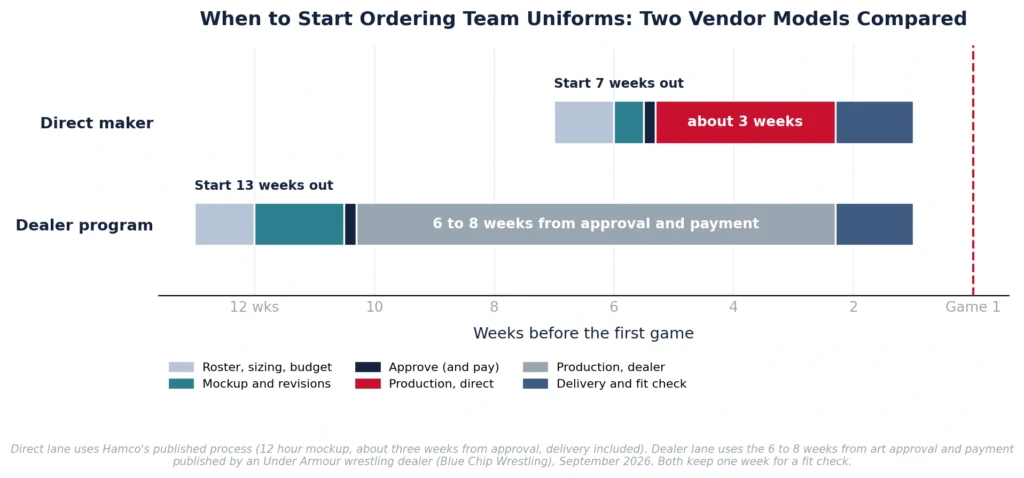
A direct maker with a published three week window needs about seven weeks total. One for roster and sizing, one for mockup and revisions, three for production, and one to two for delivery and a fit check. A dealer program that publishes 6 to 8 weeks from art approval and payment needs 12 to 13 weeks. The payment date, not the approval date, starts its clock. Fall sports order in June. Winter sports order by early September. Spring sports order before the holidays. Rush options exist at most vendors for tournament deadlines, but a rush order is a plan that already failed. Wooter’s return policy, linked in Step 4, publishes a rush fee of $350 or 20 percent of the order.
Step 7: Receive, Check, and Store the Reorder File
Open the boxes the day they land and check three things against the roster sheet: count, numbers, and sizes. Fit check every player in the first week. Read the published policy before you assume anything. Custom orders are made to the size chart within a 10 percent tolerance, and there are no exchanges for incorrect size selections. A defect caught inside the 14 day window is replaced free. A wrong size you picked is a reorder, which is why Step 2 is measured, not guessed. Then save the approved mockup, the roster sheet, and the vendor’s order number in one folder. Next season’s order is this season’s file with three changes. A no minimum maker will reorder one jersey for a new player at the published price from that same file. Care starts on day one too, and our guide on how to wash a jersey is worth forwarding to every parent with the pickup message.
If you want the process above to run on one screen, send your roster sheet, colors, and logo. A free mockup comes back within 12 hours with unlimited revisions. Published prices start at $29.99 per jersey, with no minimum, free US shipping, and delivery in about three weeks. It works the same way across every sport, from custom baseball uniforms to wrestling singlets. Then hold any vendor, including us, to the four policies in Step 4.
Frequently Asked Questions
Q: How far in advance should a team order uniforms?
A: Count back from the first game. A direct maker with a published three week production window needs about seven weeks. One for roster and sizing, one for the mockup and revisions, three for production, and one to two for delivery and a fit check. A dealer program that publishes 6 to 8 weeks from art approval and payment needs 12 to 13 weeks.
Q: How do you size a whole team for uniforms?
A: Measure every player’s chest at the fullest point with the tape parallel to the floor. Match it to the vendor’s chart, not a T shirt size. Youth runs YS at a 26 to 28 inch chest through YXL at 35 to 37. Adult runs XS at 32 to 34 through 4XL at 55 to 60. Size to current measurements, size up over pads, order the larger size when between two, and order about 25 percent extra. Custom orders are not exchanged for wrong size picks, so measure first.
Q: How much do team uniforms cost per player?
A: Published starting prices in September 2026 run $29.99 to $46.99 for a jersey or singlet. A jersey and bottom set runs $59.99 to $79.99, before volume tiers. Bulk tiers matter: the published practice jersey table drops from $44.99 at 1 to 24 pieces to $36.99 at 101 plus, about 18 percent.
Q: What should a jersey order form include?
A: Player name, jersey number, the exact name to print, cut (men’s, women’s, or youth), size, and quantity. Add a notes column for goalie cuts, long torsos, or custom lengths. Add a row for blank extras with spare numbers, and get one parent or captain to confirm every line before you send it.
Q: Can I add a player after the uniforms are ordered?
A: At a no minimum maker, yes. A single jersey reorders at the published price, and a saved design file keeps the color batch consistent. The baseball page publishes reorder add ons shipping in 7 to 10 days at the same flat pricing. At vendors with minimums, one jersey can trigger a fee or a full minimum run. Order extras up front and check the reorder policy before you choose a vendor.