

A rugby jersey and a football jersey look alike, but they do different jobs. A football jersey goes over shoulder pads, so it is cut long and loose in a lighter fabric. A rugby jersey is worn with no pads, so it is cut closer, in a heavier fabric, with stronger seams and a real collar. This guide compares fabric, seams, fit, collar and numbering. It also shows what to look for in a custom rugby uniform for your program.
Rugby vs Football Jersey: The Core Differences
Rugby and football jerseys differ in four primary ways: fabric weight and construction, sleeve design, collar style, and the absence of equipment integration features. Football jerseys are worn over or with substantial protective padding: shoulder pads, rib pads and back plates. The padding shapes the garment’s fit, sleeve design and overall construction. Rugby jerseys are worn without padding in most formats and must be self-sufficient as standalone garments in a high-contact environment.
This difference means rugby jerseys are built from heavier, more abrasion-resistant fabric than football jerseys. The additional fabric weight and construction reinforcement in rugby jerseys compensates for the absence of protective padding by providing the garment itself with greater resistance to the tearing and stretching forces that occur during scrums, tackles, and ball-carrier contact.
Materials and Fabric in Rugby Jerseys vs Football Jerseys
Rugby jerseys traditionally use a heavier polyester or polyester and cotton blend fabric with a tighter weave than football jerseys. Most modern rugby jerseys are polyester. It handles sweat better and weighs less, but keeps the structure that sets a rugby jersey apart. A Hamco Sports match rugby jersey is about 220 to 240 GSM.
Football jerseys use lighter-weight moisture-wicking polyester optimized for speed, breathability, and comfort under padding. The lighter construction is appropriate for football because the protective pads absorb contact forces rather than the jersey. A football jersey used for rugby can wear out quickly, at the seams first, under rugby’s contact demands.
Construction and Durability Differences
Rugby jersey seam construction is reinforced at every contact point. Shoulder seams, side seams, collar attachment points and sleeve attachments all use reinforced stitching. Players grab, pull and twist the jersey in every scrum, ruck, maul and tackle. Every Hamco Sports rugby jersey and every pair of Hamco Sports rugby shorts has reinforced, double-stitched seams, shoulder seams included. Some competition-level rugby jerseys use bonded seams rather than sewn seams to eliminate raised seam ridges that provide grip points for opponents.
Football jersey construction, while durable within the context of padded football play, does not incorporate the seam reinforcement, collar reinforcement, or fabric weight necessary for rugby’s contact environment.
Fit and Sizing Differences
Rugby jerseys fit closer to the body than traditional football jerseys to minimize excess fabric that opponents can grab during contact. The close fit is achieved through design rather than stretch-to-fit spandex blends used in some other sports uniforms. Rugby jerseys tuck into shorts and should stay tucked during play. A cut that is too long or too loose gives an opponent something to grab.
Football jerseys are cut longer and looser to fit over shoulder pads and other protective equipment. A football jersey worn without pads hangs excessively on the body, making it look oversized and providing exactly the fabric excess that rugby jersey design works to eliminate.
Collar Styles in Rugby vs Football Jerseys
The most visually distinctive difference between rugby and football jerseys is the collar. Rugby jerseys traditionally feature a robust button-up collar or a reinforced polo collar that provides both visual distinction and some neck protection in tackle and scrum situations. The traditional rugby collar is structural and substantial. It does not fold flat against the body like a soft athletic jersey collar.

Football jerseys have minimal or no collar construction. The neck opening is usually a simple round neck or V-neck without structural reinforcement, so it sits flat over the shoulder pads. Football jersey neck openings would look and feel incorrect in a rugby context.
Once you’ve selected the right rugby jerseys for your program, the next step is putting together a complete preseason plan. Our coach’s guide to rugby season preparation and team building walks through the 8 to 12-week framework that successful coaches use to build conditioning, tactics, and team culture before the first match.
Custom Rugby Uniforms Design
A custom rugby jersey should have reinforced seams, a collar style that suits your club, a closer fit than a football jersey, and a fabric weight suited to contact play without pads.
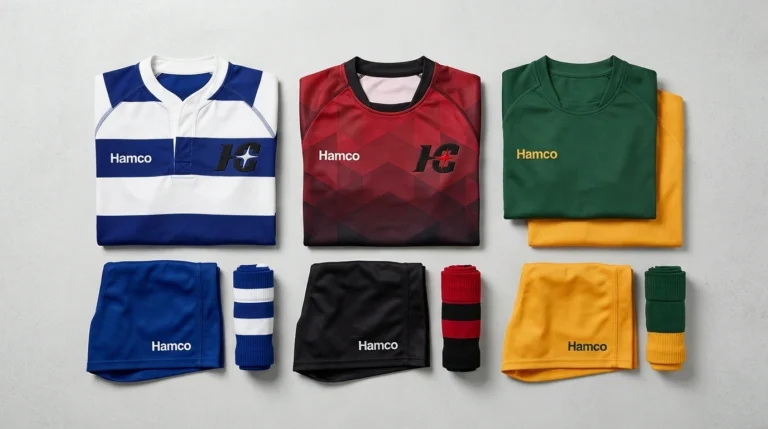
Rugby jersey design traditionally features horizontal stripes. Modern custom rugby jerseys can use any sublimated design: geometric panels, color blocking, gradients and detailed graphics.
Design custom rugby jerseys and complete rugby kits at hamcospo.com/custom-rugby-uniforms/ with a free design mockup within 12 hours and no minimum order.
Frequently Asked Questions
Can I use a football jersey for rugby?
Not recommended. Football jerseys lack the construction reinforcement, appropriate collar, and fabric weight necessary for rugby’s contact demands. Using football jerseys in rugby wears them out quickly.
What is the traditional collar style for rugby jerseys?
The traditional rugby collar is a button-up polo-style collar with two to three buttons at the neck opening. Modern competitive rugby jerseys use reinforced V-collars or polo collars in various styles. The collar should be structural rather than merely decorative.
Do rugby jerseys need player numbers?
Yes. Rugby jerseys are numbered on the back, and in rugby union the traditional numbering runs 1 through 15, with each number tied to a playing position. Check your league’s rules for front numbers or other requirements.
How are custom rugby jerseys sized?
Rugby jersey sizing uses chest circumference as the primary measurement. Rugby jerseys should fit closer to the body than American football jerseys. Order based on your chest measurement rather than sizing up for a roomier fit.
What is the difference between rugby union and rugby league uniforms?
Rugby union and rugby league use similar jersey construction, but the numbers mean different positions. Union numbers run 1 to 15, with 15 at fullback. League numbers run 1 to 13, with 1 at fullback. Rugby sevens uses union-style jerseys, often with short sleeves.
Sources: World Rugby Regulation 15.1 (union players numbered 1 to 15 for international matches, number 15 is the full back); Rugby League International Laws of the Game, Law 3 (players numbered 1 to 13, number 1 is the full back). Checked November 4, 2026.
A rugby jersey and a football jersey each suit their own game. Put one in the other’s place and you get the wrong fit, the wrong construction and the wrong collar. Order rugby jerseys for rugby, and your players are ready from the first match.


1 thought on “Rugby Jersey vs Football Jersey: Materials, Fit and Key Differences”
Comments are closed.