Quick Answer
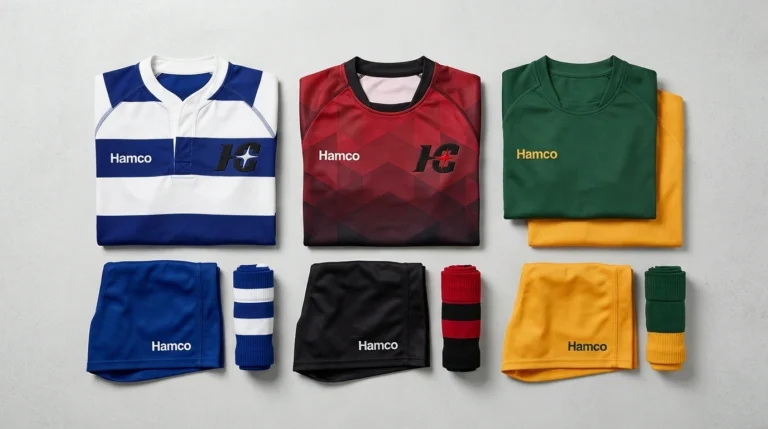
A rugby shirt is a shirt built for rugby: a stiff fold over collar, a short placket with two or three rubber buttons, a heavy knit body and, very often, horizontal hoops in club colors. Classic cotton versions weigh about 310 to 475 GSM and use a woven twill collar. Modern match jerseys are lighter polyester at about 180 to 280 GSM, cut tight, and many drop the collar so a tackler has less to grab.
What is a rugby shirt? It is two things at once, and most of the confusion online comes from mixing them up. On the pitch it is a match jersey, a piece of kit that has to survive tackles, rucks and rain. Off the pitch it is the heavy cotton collared shirt with hoops that sits in clothing stores next to the polos. They share a name and an ancestor, but they are built for different jobs. This guide covers the shirt itself: what it looks like, where each part came from, what it is made of and why the collar is the part that tells the whole story. If you want the comparison with gridiron kit, our rugby jersey vs football jersey guide already covers fit, padding and fabric side by side, so we do not repeat it here.
We make rugby kit for clubs, schools and college sides, so we have a stake in this topic. Every Hamco number below comes from a product page in our custom rugby uniforms range, read on October 22, 2026. Every fact about history and fabric links to the museum, law book or brand page it came from. Where a source is thin, we say so instead of filling the gap.
What is a rugby shirt?
A rugby shirt, also called a rugby jersey or rugby top, is the upper half of a rugby kit. Traditionally it had long sleeves and a buttoned opening “in a similar style to polo shirts but with a stiffer collar”, in the words of Wikipedia’s rugby shirt entry, and it was made of thick cotton. The short version: it is a shirt designed to be pulled, soaked and stretched without falling apart.
The rule book asks surprisingly little of it. Law 4 of the World Rugby laws says a player wears a jersey, that its sleeve must reach at least halfway from the shoulder point to the elbow, and that no clothing may carry buckles, clips, rings, hinges or zippers. Nothing in the law requires a collar, and nothing in it bans one. So the collar on a rugby shirt is a choice, which is exactly why it is worth understanding.
What does a rugby shirt look like? The parts, one by one
- Collar. A fold over collar, usually white or a contrast color. On classic shirts it is cut from woven cotton twill rather than the knit body. Twill barely stretches, so the collar keeps its shape after years of washing. Both Withernot and Reigning Champ list a cotton twill collar on their heavyweight rugby shirts.
- Placket and buttons. A short opening with two or three buttons. Traditional buttons are rubber, so a hard pull opens them instead of tearing them off. Some fashion labels now use shell or plastic buttons, which look sharper and forgive less.
- Body. A heavy knit. Classic shirts use thick cotton jersey; match jerseys use polyester.
- Hoops. Horizontal bands of club colors. Not every rugby shirt has them, but they are what most people picture.
- Seams. Double stitching at the shoulders, side panels and collar join, the places that take the most pull in a tackle.
- Cuffs and hem. Ribbed cuffs on long sleeve classics and a longer tail hem that stays tucked in during play.
A short history of the rugby shirt, told through its collar
The shirt came out of Rugby School in Warwickshire. According to the World Rugby Museum, white was the default color for sport at the school, and in 1846 the first formal rule on match dress put one side in white and the other in stripes. That is the earliest written trace of the striped look. When England met Scotland at Raeburn Place on 27 March 1871 for the first international, England wore white with a red rose sewn on the chest, and the museum holds the only known surviving jersey from that match.
Those early shirts were cotton and occasionally wool, buttoned at the neck, and they behaved badly in rain. The museum estimates a cotton jersey could hold up to 3 kg of water in wet conditions. Here is how the shirt changed from there.
| Year | What changed | Why it matters |
|---|---|---|
| 1830s | Rugby School pupils play in white; colored caps tell the sides apart | The shirt starts as school sportswear, not purpose built kit |
| 1846 | First formal rule on match dress: one side in white, one in stripes | The striped look is written down for the first time |
| 1871 | First international, England in white with a sewn on red rose | School kit becomes national kit |
| 1895 onward | Rugby league’s V neck arrives soon after the Northern Union forms | The first real split from the collared shirt |
| 1897 | Numbers on jersey backs first used, New Zealand v Queensland | The back of the shirt gets a job |
| 1950s | Bold colors with contrasting collars become a style statement on and off the pitch | The collar turns into the shirt’s signature |
| 1967 | The International Rugby Board rules jerseys are numbered front to back | Numbers 1 to 15 now map to positions |
| 1980s | Ralph Lauren takes the hooped shirt to a fashion audience; on the pitch collars shrink and polyester arrives | Fashion shirt and match jersey start to part ways |
| 1995 | Rugby union turns professional; technical tops replace cotton | The cotton collared shirt becomes a heritage piece |
| 2003 | England’s World Cup shirt drops the button collar: tight, stretchy, 62% cotton, 34% polyester, 4% spandex | The modern collarless match jersey is born |
Two rows in that table matter more than the rest. The 1967 numbering rule is why a number 9 is always the scrum half; our rugby positions guide maps all 15 numbers to their jobs. And 2003 is the year the collar lost its place in elite rugby. The Rugby Journal tells the story that Clive Woodward wanted shirts that were impossible to grab after Scottish defenders held Jason Robinson’s shirt in the 2002 Six Nations. England had worn button up collars until that year, per the museum, and Nike’s new shirt was 154 grams lighter dry and 362 grams lighter wet than cotton. England won the World Cup in it, and the rest of the top level followed.
Why does the collar matter?
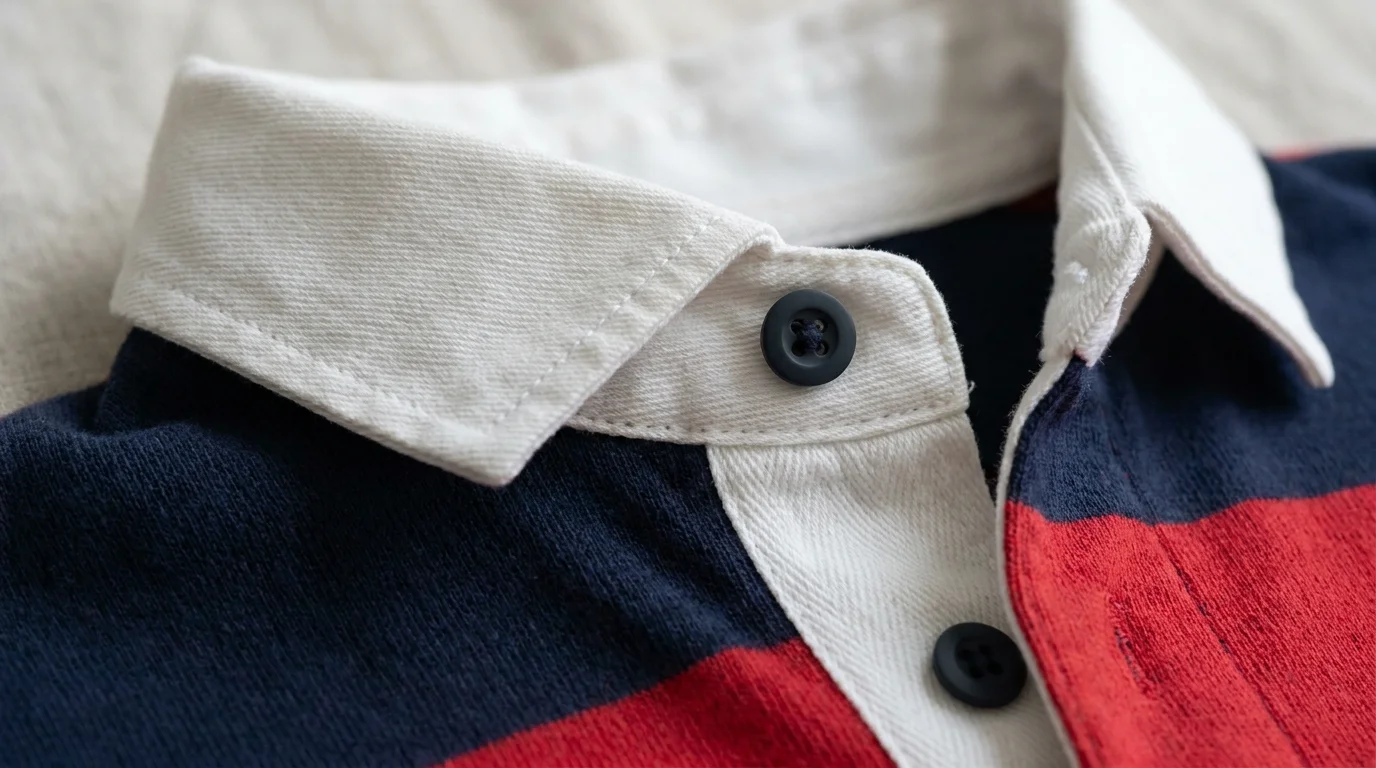
Because it is the one part of the shirt that does three different jobs depending on where you wear it.
- On the pitch, it is a handle. Anything a defender can close a fist around slows a runner down. That is the whole reason elite match kit went collarless in 2003, and it is why most club match jerseys today are round neck or V neck. Our round neck classic jersey is described on its own page as having “zero grab points” for exactly this reason.
- Off the pitch, it is the identity. Take the stiff twill collar off a heavy hooped cotton shirt and what is left is a striped sweatshirt. The collar is what makes people say rugby shirt. Ivy Style notes the early collar was stark white for visibility, and that contrast collar is still the look in every clothing store.
- For clubs, it is a signal. Heritage clubs, old boys sides, college teams and social rugby keep the collar because it reads as tradition. If you want that look in a jersey that still has to survive contact, the build matters. Our traditional 2 button collar jersey uses a fold down collar with a reinforced placket and a bar tacked collar join, which is the stitch that stops a collar tearing away from the body.
One honest note on buttons. Our collared jersey pages list the placket and the reinforcement but do not say what the buttons are made of. If rubber matters to your club, ask for it on the quote rather than assuming it. And remember that the trade off with a collar in a contact game is grip, not legality: Law 4 allows it.
What fabric is a rugby shirt made of?
There are two honest answers. Classic and fashion rugby shirts are heavy cotton jersey, often with no stretch at all; Withernot’s product page puts it plainly: “No polyester. No stretch.” Match jerseys are polyester, which Wikipedia notes is preferred in play because it is slippery, harder to grip and absorbs less water and mud. Cotton and polyester blends sit in between and are mostly sold to supporters. The real gap between the two kinds of rugby shirt is weight.
The heaviest cotton shirt in our sample weighs about twice as much per square metre as our XV match jersey, and well over twice our sevens jersey. That weight is what makes a cotton rugby shirt hang well and feel substantial on a cold day. It is also why nobody plays a wet game in one any more. If you own either kind, wash it cold and inside out; our guide on how to wash a jersey covers the details, and heavy cotton is the one that shrinks if you ignore it.
Match rugby jersey vs classic rugby shirt vs polo
People search all three as if they were the same shirt. They are not. Here is what separates them, using published specs and prices read on October 22, 2026.
| Match rugby jersey | Classic cotton rugby shirt | Polo shirt | |
|---|---|---|---|
| Body fabric | Polyester; Hamco XV about 240 to 280 GSM, sevens 180 GSM | Heavy cotton jersey, 310 to about 475 GSM in our sample | Pique knit; Hamco rugby polo about 210 GSM, 60/40 poly cotton |
| Collar | None, or a small reinforced collar; round and V necks are common | Stiff woven cotton twill, often white or contrast | Soft knit collar; Hamco’s is taped so it holds its shape |
| Buttons | None on round or V necks; two on a traditional 2 button build | 2 to 3, traditionally rubber | 2 to 3, usually plastic or shell |
| Fit | Close and athletic, cut to tuck in | Boxy and relaxed | Regular |
| In the rain | Sheds water and dries fast | Soaks it up; historic cotton held up to 3 kg | Fine for a sideline, not for play |
| Best for | Matches and training | Casual wear, club socials, heritage events | Coaches, travel days, functions |
| Price we found | Hamco $34.99 to $44.99 each, all in | $118 and $138 USD, C$128, at the three brands sampled | Hamco $29.99 to $39.99 each, all in |
So, are rugby shirts and polo shirts the same? No. A polo is a lighter pique shirt with a soft collar, made for warm weather and tennis courts. A rugby shirt is heavier, has a stiffer collar and was built to be grabbed. The overlap is the collar and placket, which is why the two get confused.
How to style a rugby shirt
This is the honest version, not a mood board. A rugby shirt is a heavy, casual shirt, and it looks best when you treat it that way.
- Get the shoulder right first. The shoulder seam should sit on your shoulder bone. Classic shirts are cut boxy, so size for your chest, not your waist, and expect heavy cotton to shrink a little if it ever sees a hot wash.
- Keep the trousers simple. Straight jeans, chinos or cords. The hoops are the loud part of the outfit; let them be the only loud part.
- Wear it untucked. The long tail hem was made for staying tucked during a game, but heavy cotton bunches at the waistband. Untucked looks cleaner.
- Layer over, not under. A white T shirt underneath with the collar out works; so does a denim jacket, chore coat or overcoat on top. A sweater over a rugby shirt is usually too much fabric.
- Pick one bold hoop color. Two club colors plus a white collar is the classic. Three or more hoop colors tips into costume.
- Do not expect a match jersey to do the same job. A tight polyester jersey clings where a cotton rugby shirt drapes. Wear match kit to the club and the cotton shirt to dinner.
For full disclosure: Hamco does not make a heavyweight 100% cotton fashion rugby shirt. Our collared jerseys are about 240 GSM polyester built for play, and our polo is the closest thing we make to off pitch wear.
Custom rugby shirts for teams: which collar to order

For a club, the right collar depends on what the shirt has to do. These are the Hamco builds that cover each job, with the published price at 1 to 24 pieces and at 101 plus.
| Hamco build | Neck | 1 to 24 | 101 plus | Best for |
|---|---|---|---|---|
| Round neck classic jersey | Round neck, no grab points | $42.99 | $34.99 | Full contact match kit |
| V neck rugby jersey | V neck, grab free | $44.99 | $36.99 | Match kit with a league style neckline |
| Traditional button collar jersey | Button placket collar | $44.99 | $36.99 | Heritage clubs, college and old boys sides |
| Traditional 2 button collar jersey | Fold down collar, 2 button placket, bar tacked | $44.99 | $36.99 | Clubs that want a collar built for contact |
| Rugby polo shirt | Taped collar, 3 button placket | $39.99 | $29.99 | Coaches, travel days, club functions |
| Rugby practice jersey | Breathable micro mesh | $42.99 | $34.99 | Training sessions |
Every build in that table has no minimum order, a free mockup within 12 hours and production of about three weeks from design approval, per the product pages. If you are weighing us against other makers, our comparison of the best places to get custom rugby team uniforms lists six of them with prices, minimums and turnaround, including the ones that beat us on heritage. Measure your squad with the sizing chart, choose hoop colors from our best jersey color combinations guide, and if the club is new, start with a name from our list of rugby team names. Our team uniform design guide walks through the layout, and when you are ready, send your colors, crest and roster through the request a quote form.
FAQ: What Is a Rugby Shirt?
Why do rugby shirts have a collar?
Because the first rugby shirts were adapted from collared school shirts, and the collar stayed as the game grew. A woven twill collar holds its shape, and early ones were white for visibility. Most modern match jerseys drop it because it gives a tackler something to grab.
Why do rugby shirts have rubber buttons?
Rubber buttons give way under a hard pull instead of snapping off or digging into a player. They became the traditional choice on collared rugby shirts and many heavyweight cotton shirts still use them.
Are rugby shirts and polo shirts the same?
No. A polo is a lighter pique shirt, about 200 GSM, with a soft knit collar. A classic rugby shirt is heavy cotton jersey, about 310 to 475 GSM, with a stiff twill collar and rubber buttons.
What fabric are rugby jerseys made of?
Match jerseys are polyester, about 180 to 280 GSM, because it is harder to grip and sheds water. Classic and fashion rugby shirts are heavy cotton jersey with a woven cotton twill collar.
Can you wear a rugby shirt casually?
Yes. A cotton rugby shirt is casual wear today. Wear it untucked with straight jeans or chinos, layer a jacket over it and size by your chest. A tight polyester match jersey does not drape the same way.