
Quick Answer
Volleyball jersey design comes down to three decisions: the cut, the number layout, and the libero contrast. Numbers must be at least 4 inches on the front and 6 inches on the back. They sit centered, in a solid color that clearly contrasts with the jersey. The libero wears a jersey with a different dominant color from the rest of the team. The common cuts are racerback, sleeveless, short sleeve, cap sleeve, and long sleeve. Sublimation prints any pattern, gradient, or number of colors at one price, so the design itself costs nothing on a direct order. Hamco’s published 2026 prices for a sublimated volleyball jersey with names, numbers, and logo included run $42.99 to $48.99 on orders under 25. At 101 or more they fall to $36.99 to $39.99. Other vendors publish different prices and fee structures, so compare the full order cost, not the list price.
Most volleyball jersey design goes wrong in the same two places. The number is too small or too close to the jersey color, and the libero jersey does not contrast enough for the referee. Everything else, the stripes, the fades, the crest, is taste. This guide covers the layouts that work for club and school programs and the rules that limit them. It also covers what a finished jersey costs in 2026. Every cut discussed here is on our custom volleyball uniforms page, and every price comes from a product page you can open.
This is a design article, not a rulebook. The number sizes, libero contrast, and placement rules below are the parts that shape a layout. For the full set, including undergarments, logos, and the 2026 to 2027 changes, read our volleyball uniform rules guide. Where a claim below comes from USA Volleyball, the NFHS, or a product page, a numbered source follows it. Where it is our opinion, we say so.
What Makes a Volleyball Jersey Design Work on the Court?
A good volleyball uniform design passes three tests before anyone judges the look. First, the number reads from the stand. USA Volleyball requires front numbers of at least 4 inches and back numbers of at least 6 inches, and recommends 6 and 8 inches[2]. The stroke must be solid, at least three quarters of an inch wide, and clearly contrast with the jersey[2]. Second, the libero is identifiable at a glance. The libero jersey must clearly contrast with, and have a different dominant color from, the teammates’ jerseys[2]. Third, the cut matches the roster. A racerback that looks sharp on a 16s club team is a hard sell for a school program. Schools often want boys’ and girls’ teams in one design. One useful detail from USA Volleyball’s 2026 guidance: at nationally sanctioned events uniforms must be identical except for sleeve length and the libero[16]. A club can mix sleeve lengths on one design without breaking that rule.
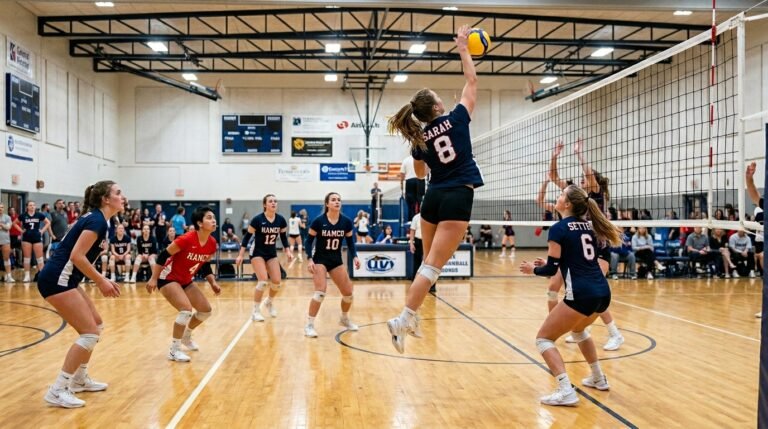
The libero rule is the one that shapes the color story. The position was introduced internationally in 1998, reached the NCAA in 2002, and most U.S. high schools added it between 2003 and 2005[5]. Since then every volleyball jersey design has been two designs: the team jersey and its inverted twin. Plan both from the first sketch, not after the mockup is approved.
Which Volleyball Jersey Cut Should You Design Around?
The cut decides where the design can go. A racerback has no sleeves and a Y shaped strap across the upper back. The number and name sit lower on the back panel. On our custom volleyball racerback jerseys the chest, sides, and lower back are fully open for decoration. The only restriction is no large patches across the upper back Y strap itself[6]. A short sleeve or long sleeve jersey adds sleeve panels for a second color, a sponsor, or a stripe. A cap sleeve crewneck sits between the two and adds polish without restricting arm movement[10]. The table lists each cut with its published 2026 price and the layouts it suits.
| Cut | Price at 1 to 24 / 101+ | Fabric (published) | Where the design can go | Best for |
|---|---|---|---|---|
| Racerback tank | $42.99 / $36.99 | ~160 GSM 4 way stretch polyester knit | Side panel graphics, chest logo, number and name below the Y strap; no large patches on the strap | Girls’ and women’s club teams that want the lightest cut |
| Sleeveless | $42.99 / $36.99 | ~160 GSM 4 way stretch polyester knit | Chest, sides, and full back open; side panels and back graphics | Programs that want a tank without the Y back |
| Short sleeve | $44.99 / $37.99 | ~160 GSM 4 way stretch polyester knit | Adds sleeve panels for a second color or sponsor mark | Boys’, girls’, youth, and mixed programs on one design |
| Crewneck cap sleeve | $44.99 / $37.99 | ~160 GSM 4 way stretch polyester knit | Shoulder panel contrast, chest crest, back number | Teams that want a fitted look with sleeves |
| Long sleeve | $48.99 / $39.99 | ~160 GSM 4 way stretch polyester knit | Collar to cuff sublimation; sleeve stripes, full arm graphics | Liberos, cold gyms, and players who want arm coverage |
| Uniform set (jersey + shorts) | $89.99 / $79.99 | Jersey and shorts sublimated in the same run | Side stripes on the shorts can continue the jersey side panel | Any program that wants a matched kit from one order |
Prices are per piece from each Hamco product page on September 23, 2026. The two figures are the 1 to 24 tier and the 101 to 500+ tier. Names, numbers, team logo, a 12 hour mockup, and shipping are included at every tier, with no minimum order. Sources 6 to 11.
Where Do Numbers, Names, and Logos Go on a Volleyball Jersey?
Numbers are centered side to side on the front and the back. USA Volleyball recommends the upper half of the jersey. A number may not extend below the waist or tuck into the shorts[2]. The NFHS is moving the same way. From July 1, 2029, the front number on a high school jersey must be centered on the upper half of the top. That removes the old measurement from the shoulder seam and neckline[3]. Design to that standard now and the jersey stays legal through the change.
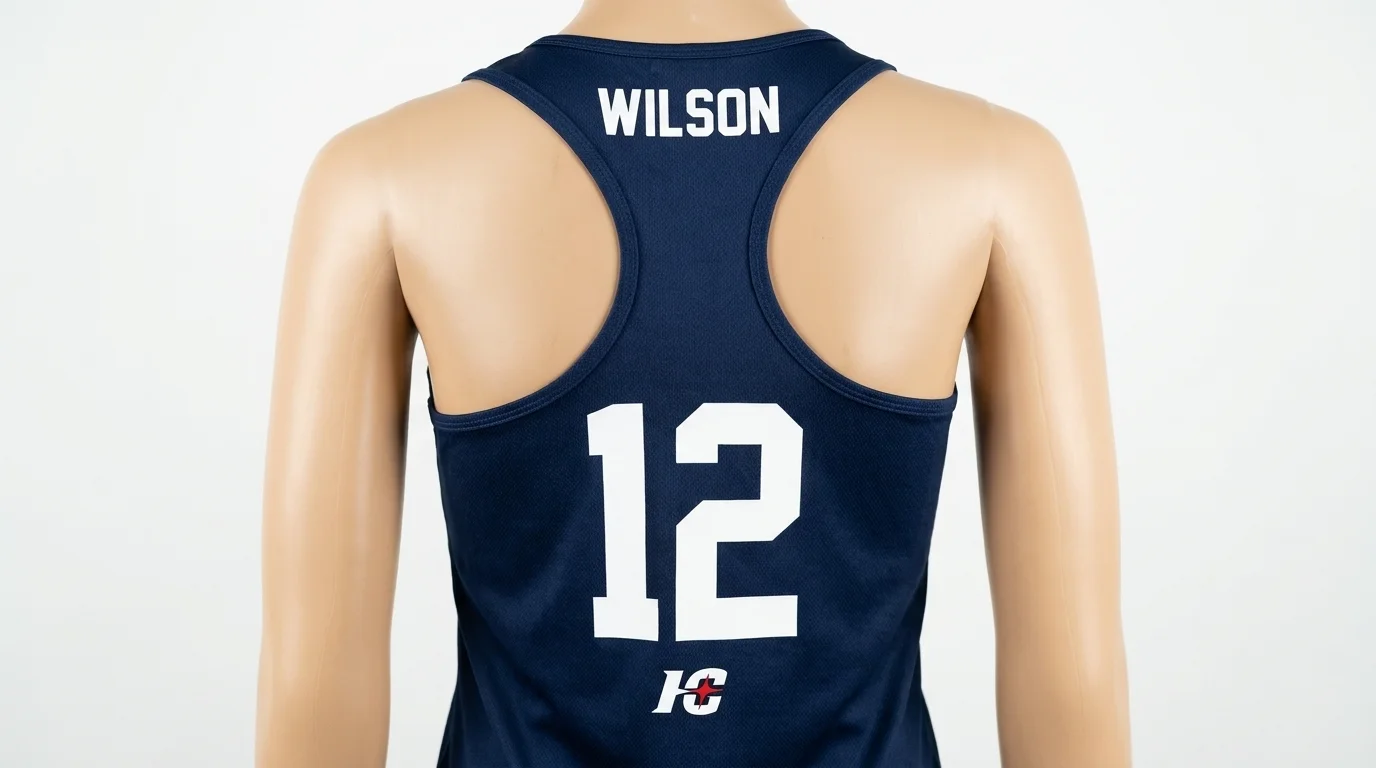
Logos and team names can go anywhere on the jersey under three conditions. The number stays legal, the number stays readable, and the contrast between the team jersey and the libero jersey is not affected[2]. USA Volleyball’s placement guide puts the team name above the number and the player name below it[2]. A number may carry a border, and the border does not have to contrast[2]. Numbers 1 to 99 are legal in club play; 0 and 00 to 09 are not[2]. On the font, pick readability over style. Our guide to jersey number fonts suggests Tourney or Oswald for volleyball because indoor viewing distances are shorter, but readability still comes first[14]. USA Volleyball’s 2026 guidance goes further. Block fonts are most preferred, and a font with breaks in the lines does not count as a legal Arabic numeral[16].
8 Volleyball Jersey Ideas and Layouts That Work in 2026
These are the layouts we see approved most often, with the case for and against each. Cool volleyball jerseys are not the ones with the most going on. They are the ones where the number, the crest, and one idea are visible from the far baseline. Before you pick colors, our best jersey color combinations guide covers what survives gym lighting. Its volleyball advice is blunt. Black and gold holds up, and magenta and white is gaining ground for women’s programs. Yellow with white loses its contrast under fluorescent light[13].
1. Solid body, contrast number block
The base is one team color, the number sits in a solid contrasting field, and the crest goes on the chest. Try it if your program has a strong two color identity. Skip it if the second color is close in value to the first; a grayscale photo will show you.
2. Side panel fade
A gradient runs from the team color at the chest to a darker or lighter shade at the side seams. Sublimation prints the fade at no extra cost. Try it on a racerback or sleeveless cut where the side panels are large. Skip it if the fade runs behind the number and lowers its contrast.
3. Y strap accent
The racerback strap prints in the contrast color and the body stays solid. The number sits below the strap on the back panel. Try it for a clean club look with one accent. Skip patches or a crest on the strap; that area is off limits on our racerback[6].
4. Split tone
Left and right halves in two colors, split at the center line. Try it if you want an unmistakable look on broadcast and photos. Skip it unless the number is fully inside one color field; a number that straddles the seam fails the contrast test on one side.
5. Geometric or chevron pattern
A repeating pattern at low contrast across the body with the number in a solid field. Try it for club programs that want a modern print. Skip a high contrast pattern; it competes with the number, and a referee checks the number first.
6. Shoulder and sleeve panels
Only on sleeved cuts. The shoulders and sleeves carry the second color or a sponsor mark, and the body stays clean. Try it for school programs that need boys’ and girls’ teams on one design. Skip it if your sponsor art is small and busy; a sleeve is a small canvas.
7. Tonal crest with a hem band
A large tone on tone crest across the body, a solid band at the hem, and a plain number. Try it for schools that want tradition without a stripe kit. Skip it if the crest sits behind the front number.
8. Inverted libero twin
Not a separate idea but a rule. Whatever you pick, design the libero version at the same time by swapping the dominant and accent colors. Try it always. Skip near matches such as black with navy or red with maroon, which USA Volleyball lists as failing contrast[2].
Club Teams vs School Teams: What Changes in the Design?
The same volleyball uniform designs do not fit both programs, and the difference is not taste. Club teams order for one age group and sell the look to families. They play under USA Volleyball rules, where uniforms at nationally sanctioned events must be identical except for sleeve length and the libero[16]. School teams inherit colors and outfit several squads. They play under NFHS rules, where the libero’s bottoms may be any color from the 2026 to 2027 season[4]. The table shows where the design decisions split.
| Design factor | Club teams (USAV) | School teams (NFHS) |
|---|---|---|
| Colors | Free choice. Test the palette under gym lighting and in grayscale before approving | Fixed by the school. Design inside the palette; use a tonal pattern for variety |
| Cut | Racerback or sleeveless for most girls’ clubs; sleeve length may differ across the roster under USAV 4.3.5 | One sleeved cut that works for boys’, girls’, JV, and varsity on the same template |
| Number layout | USAV recommends 6 inch front and 8 inch back for easier officiating; 4 and 6 are the minimum | Center the front number on the upper half now; NFHS makes that the rule from July 1, 2029 |
| Libero | Different dominant color; submit the pair for USAV approval before national events | Top must contrast; from 2026 to 2027 the libero bottoms may be any color |
| Sponsors | Common on sleeves, sides, or the hem band; allowed if the number stays legal and readable | Check school and state association policy before adding any sponsor mark |
| Reorders | Rosters change yearly; keep the template on file so a single jersey matches | Order home and libero jerseys in the same run so colors match across squads |
Rule points from USA Volleyball’s uniform requirements and 2026 guidance and the NFHS rule change announcements, sources 2 to 4 and 16. The recommendations in the Colors, Cut, and Reorders rows are ours.
How Do You Design a Libero Jersey That Passes Inspection?
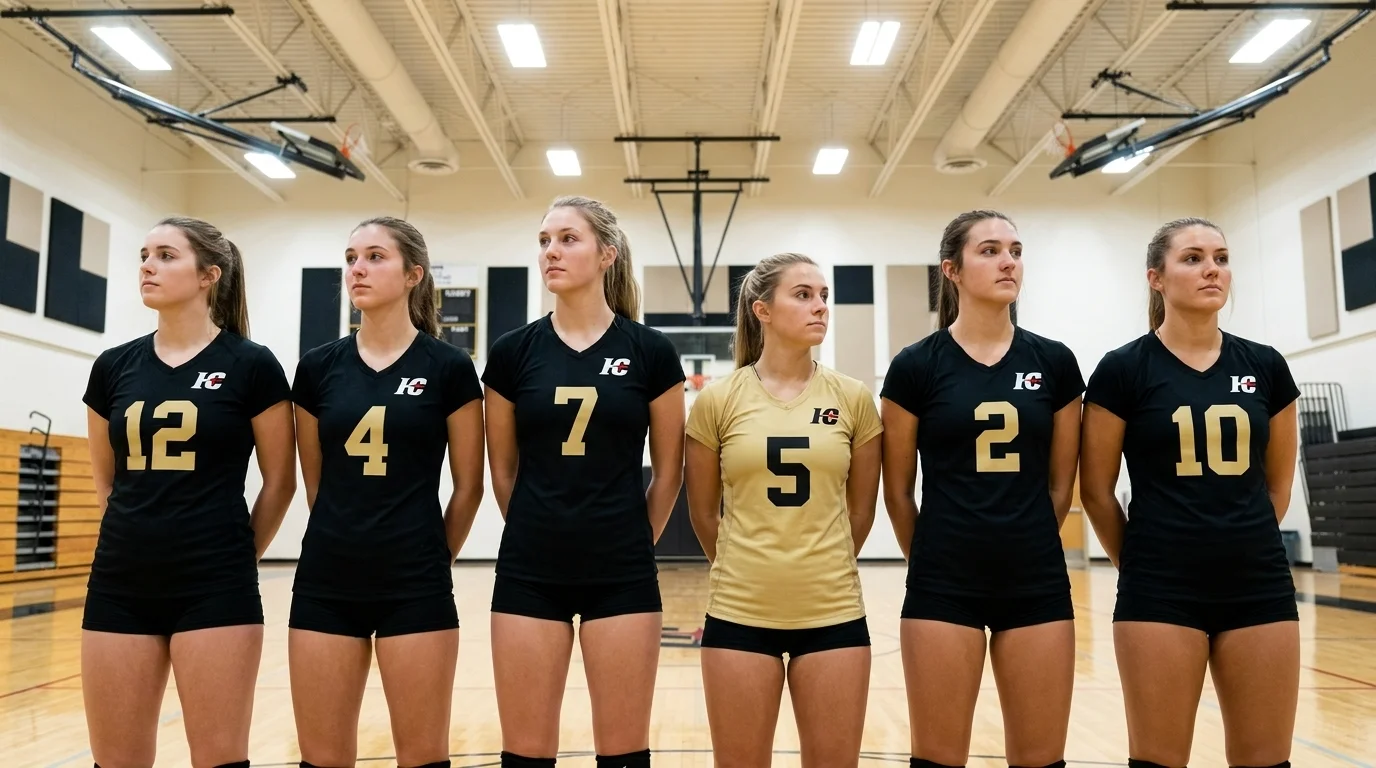
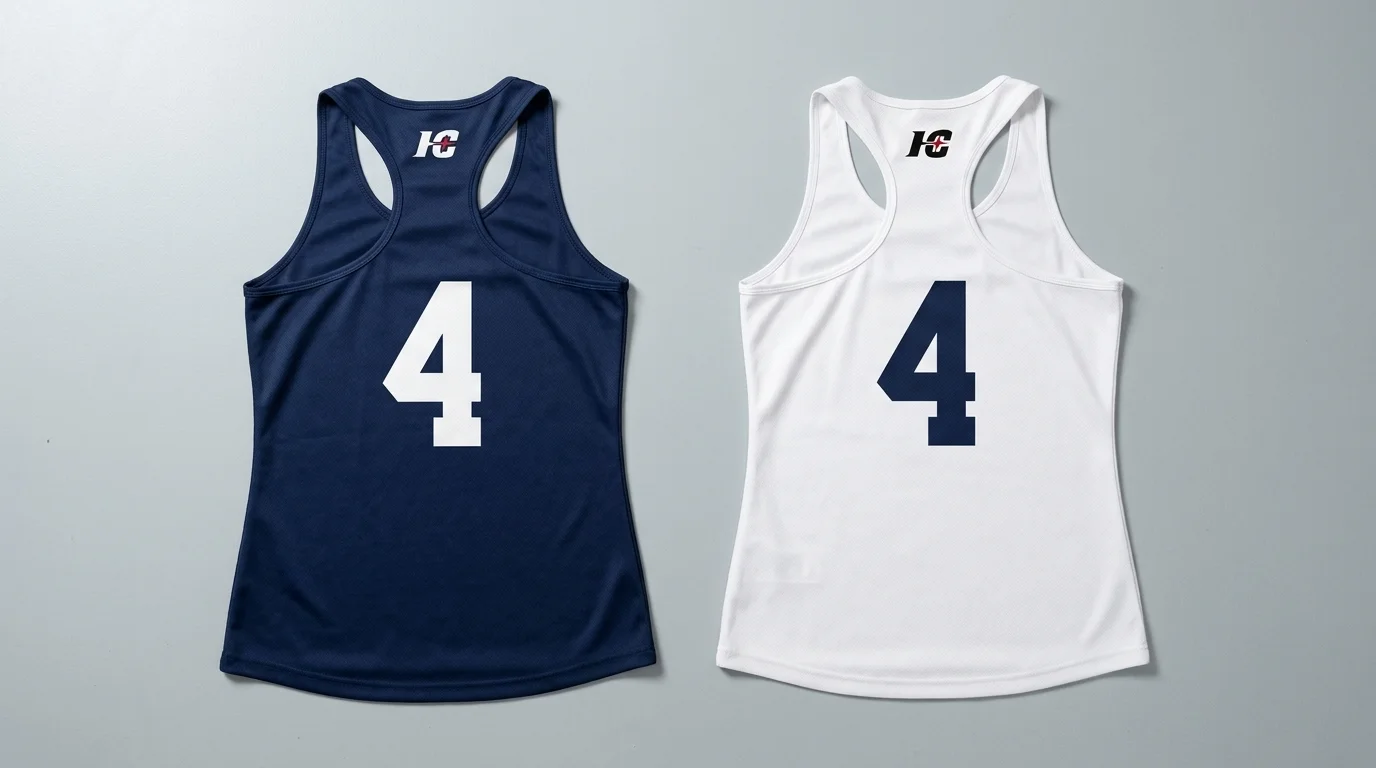
Swap the dominant color and keep everything else. If the team jersey is navy with a white number, the libero jersey is white with a navy number. Same crest, same font, same number size. USA Volleyball lists combinations that fail any standard of contrast. They include black with navy, red with maroon or burgundy, black with dark green, white with light yellow, and navy with maroon[2]. Its own test is to photograph both jerseys and convert the image to grayscale. If you cannot tell which is which, change one[2]. Combinations in the margin, such as black with gray, are decided by event policy, and USAV recommends carrying a second, clearly contrasting jersey[2].
Cut can differ from the team jersey. Many liberos want arm coverage for floor work. A single contrasting long sleeve volleyball jersey can be added to any size team order with no separate process or price penalty[9]. From 2026 to 2027, an NFHS team may designate up to two liberos, with one on the court at a time[4]. Order two contrast jerseys if your program uses both.
What Does a Custom Volleyball Jersey Design Cost in 2026?
On a sublimated jersey the design is free and the fabric is the cost. Any number of colors, a gradient, or a photo print costs the same as a solid jersey. The ink is pressed into the polyester in one pass. The chart compares the per jersey cost of a 12 jersey order, a common volleyball roster, using published prices only.
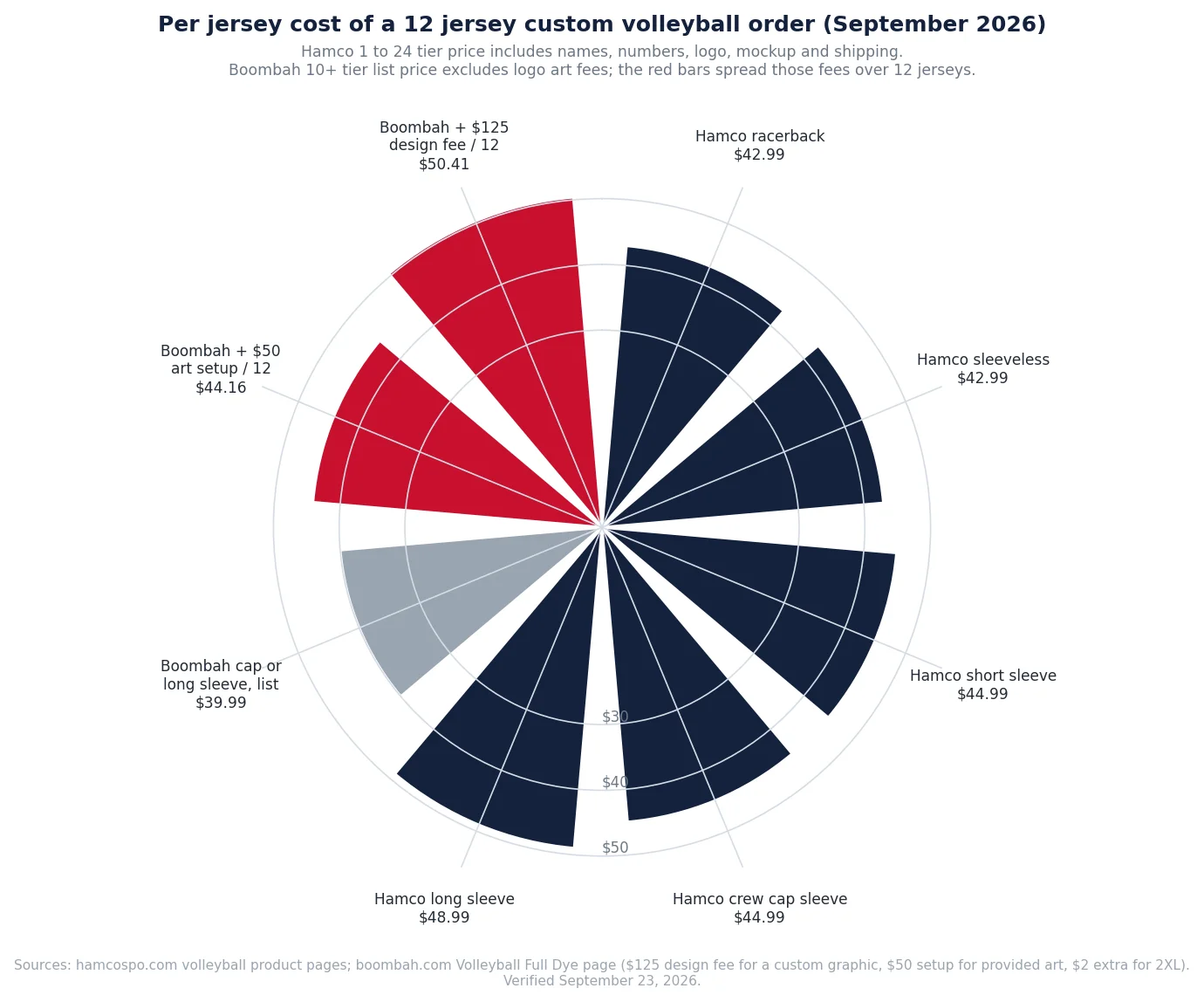
Chart: per jersey cost of a 12 jersey custom volleyball order at published September 2026 prices. Hamco bars are the 1 to 24 tier with names, numbers, logo, mockup, and shipping included. Boombah’s Full Dye long sleeve and cap sleeve jerseys list at $39.99 at 10 or more. That rate includes its stock logo styles and excludes custom or provided logo art. The red bars add its $50 setup fee for provided artwork or its $125 design fee for a custom graphic, spread across 12 jerseys.
The math for a 12 player club team: 12 racerback jerseys at $42.99 come to $515.88 with names, numbers, and logo included[6]. A full volleyball uniform set with matching shorts is $89.99 per player at the same tier, or $1,079.88 for the roster. Both pieces are sublimated in the same run, so the color is consistent top to bottom[11]. Boombah’s Full Dye volleyball jerseys are $49.99 each at 1 to 5, $44.99 at 6 to 9, and $39.99 at 10 or more. They come in long sleeve and cap sleeve only[12]. That price excludes custom logos or provided art. A custom graphic carries a $125 design fee and provided artwork a $50 setup fee. 2XL adds $2, and fluorescent colors add $5 per garment[12]. To be fair to that price, Boombah’s flat rate does include a front logo from its own logo styles. Names, numbers, or sponsors on the back are included too. The fees apply only when you bring your own artwork or want a custom graphic drawn[12]. On 12 jerseys with provided artwork that is $529.88, or $44.16 each. The fabric is different too. Boombah’s Full Dye jersey is a 7 oz, 90 percent polyester 10 percent spandex knit[12]. That works out to roughly 237 GSM, heavier than our ~160 GSM jersey[6]. Heavier fabric holds up longer and runs warmer; lighter fabric moves better in a hot gym. At 25 or more players the comparison shifts again, so run the numbers for your own roster size and cut.
Two things a price comparison hides. Boombah’s Full Dye sizes run XXS to 2XL[12]; our volleyball jerseys run XS to 4XL at one price[6]. And lead times differ. Boombah lists 2 to 3 weeks for Full Dye production[12]; our standard production is 3 weeks from mockup approval, with rush available[6]. If you are comparing more vendors, our volleyball uniform companies roundup covers the field.
Can You Design Your Own Volleyball Jersey Online?
Yes, but be clear about what a volleyball jersey designer tool does. A browser based custom volleyball jersey maker lets you drag colors onto a template and see a rough preview. It does not check number size, libero contrast, or whether the fade runs behind the number. Our process is different and, in our opinion, better for a team order. You send colors, logo, cut, and a rough idea. A designer sends a professional mockup within 12 hours, and you request unlimited revisions until you are satisfied before anything goes into production[6]. There is no setup fee, no design charge, and no minimum, so a one jersey test order is possible[6].
Whichever route you take, the brief matters more than the tool. A complete brief has seven lines, and a designer can turn it into a legal mockup on the first pass.
Cut and sizes: the jersey style from the table above, plus a size list. Sleeved cuts if boys’ and girls’ teams share the design.
Two colors, one accent: the dominant color, the number color, and one accent. Write down the libero version as the swap.
Number spec: 4 inch front and 6 inch back minimum, solid stroke, upper half, centered. Ask for 6 and 8 inches if you play USAV events.
Names: team name above the number, player name below it. Skip player names if the jerseys will be reused next season.
Crest and sponsors: vector files, not screenshots. Say where each mark goes and confirm the number stays clear.
Pattern or fade: one idea, at low contrast, away from the number field.
Deadline: count back three weeks from the first match for standard production and add a week for mockup rounds.
If you need the pieces around the jersey, we have guides for those too. Read what sublimation printing is to understand why the design cost is zero. Use the sports logo maker guide if the club has no crest yet. Browse volleyball team names if the program is brand new. The beach game is a separate design problem. Two piece kits use a heavier 220 GSM stretch fabric, built for sun glare rather than gym lighting[15].
Frequently Asked Questions
What size do numbers need to be on a volleyball jersey?
At least 4 inches tall on the front and 6 inches on the back. The stroke is solid, at least three quarters of an inch wide, and clearly contrasts with the jersey. USA Volleyball recommends 6 inches front and 8 inches back. Numbers are centered side to side, on the upper half of the jersey.
What color should a libero jersey be?
A different dominant color that clearly contrasts with the team jersey. The simplest design is the inverted twin: swap the base and number colors and keep the crest and font. Avoid black with navy, red with maroon, black with dark green, white with light yellow, and navy with maroon.
Which volleyball jersey cut is best for a school team?
A sleeved cut, short sleeve or cap sleeve, because one template can serve boys’, girls’, JV, and varsity teams. Racerbacks suit girls’ club programs that order for one age group at a time.
How much does a custom volleyball jersey cost in 2026?
Hamco’s published price for a sublimated jersey, with names, numbers, and logo included, is $42.99 to $48.99 at 1 to 24 pieces. At 101 or more they run $36.99 to $39.99. A Hamco jersey and shorts set is $89.99 at 1 to 24. Boombah’s Full Dye jerseys list at $39.99 at 10 or more with its stock logo styles included. Bringing your own logo or ordering a custom graphic adds $50 to $125 in art fees.
Can I design my own volleyball jersey with any number of colors?
Yes. Sublimation prints gradients, patterns, and unlimited colors at the same price as a solid jersey. The limits are the rules, not the printer. The number must stay solid and contrasting, and the libero jersey must keep a different dominant color.
Sources
- Hamco Sports, Volleyball Uniform Rules: The Complete 2026 Guide
- USA Volleyball, Uniform Requirements and Reminders for 2024 to 2025 Competition (PDF, revised September 20, 2024)
- NFHS, Volleyball Rules Changes 2025 to 26 (January 31, 2025)
- NFHS, Libero Rules Adjusted in High School Volleyball (press release, February 5, 2026)
- Wikipedia, Volleyball (Libero section)
- Hamco Sports, Custom Volleyball Racerback Tank Top Jerseys
- Hamco Sports, Custom Volleyball Sleeveless Jerseys
- Hamco Sports, Custom Volleyball Short Sleeve Jerseys
- Hamco Sports, Custom Volleyball Long Sleeve Jerseys
- Hamco Sports, Custom Volleyball Crewneck Cap Sleeve Jerseys
- Hamco Sports, Custom Volleyball Uniform Sets
- Boombah, Volleyball Full Dye (custom pricing page)
- Hamco Sports, Best Jersey Color Combinations for Every Sport
- Hamco Sports, Best Jersey Number Fonts Used in Pro Sports
- Hamco Sports, Custom Volleyball Uniforms (category page)
- USA Volleyball, Uniform Requirements, Rules and Regulations with Uniform Feedback Q/A (PDF, January 2026)

3 thoughts on “Volleyball Jersey Design: Ideas & Layouts for Club and School Teams (2026)”