
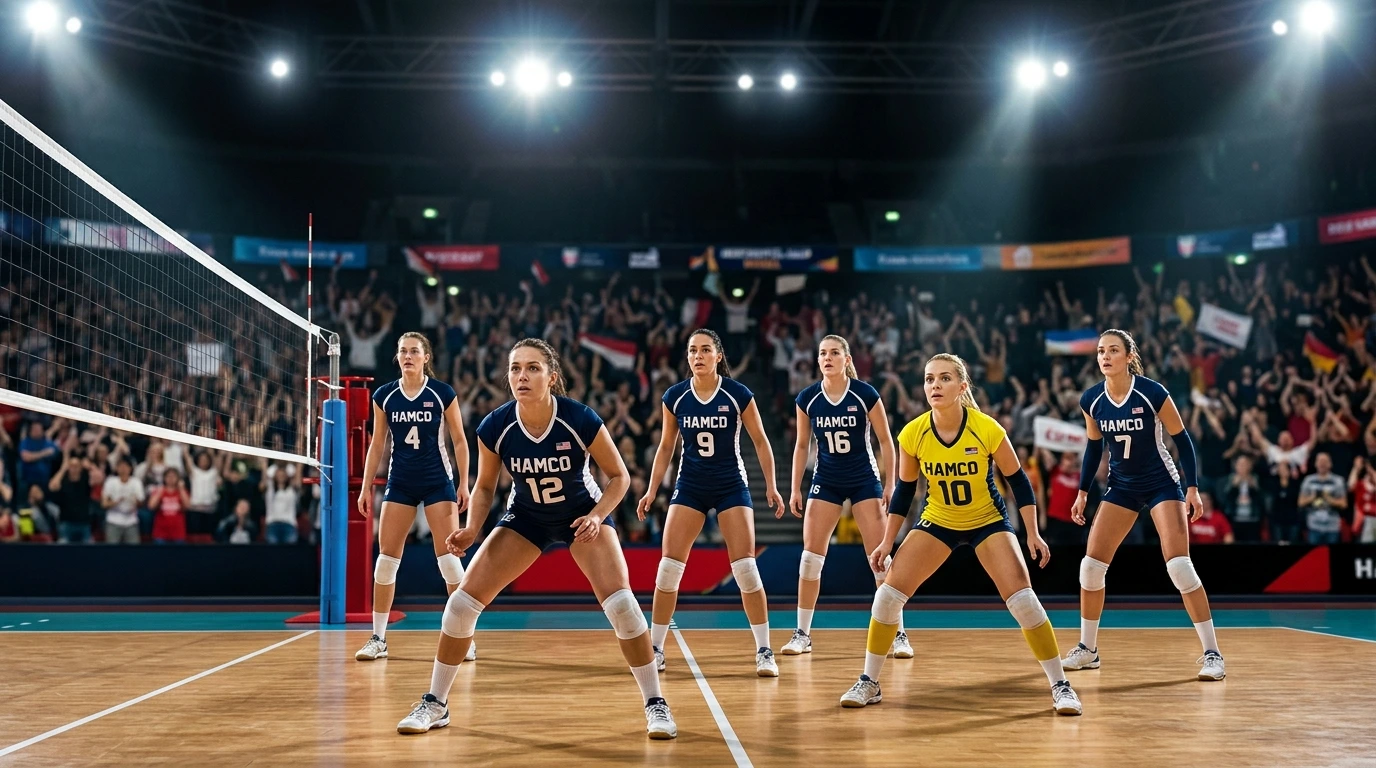
Every season, a coach somewhere finds out the hard way that a uniform they thought was legal actually isn’t. A number that’s half an inch too small. A libero jersey that doesn’t “clearly contrast” in the referee’s judgment. Any one of these can trigger an unnecessary delay penalty at the worst possible moment, and the team pays for it on the scoreboard.
Volleyball uniform rules aren’t complicated, but they vary between NFHS, USAV, NCAA, and FIVB, and the small details matter more than most people realize. This guide breaks down the current rules for the 2025-26 and 2026-27 seasons, including jersey number requirements, libero rules, the latest rule changes, and what actually gets teams penalized.
Looking to equip your team with compliant, custom-designed gear that meets every current standard? Browse our full range of Custom volleyball uniforms for jerseys, shorts, and libero sets built to current NFHS and USAV specifications.
Quick Reference: Volleyball Uniform Rules at a Glance
If you need the one-minute version, here are the core requirements that apply to most organized play in the United States:
- All team members must wear like-colored uniform tops and like-colored bottoms, with the libero as the only exception
- Numbers must be 4 inches minimum on the front and 6 inches minimum on the back, in a solid contrasting color
- Legal numbers are 1 to 99 (NFHS is eliminating leading zeros starting in 2028)
- The libero must wear a jersey that clearly contrasts with the rest of the team
- Uniforms must be free of hard items like buttons, zippers, and snaps
- Manufacturer logos are limited to a single logo of 2.25 square inches or less per piece
- Jewelry is generally prohibited, with narrow exceptions for small post-style studs
- Headbands cannot exceed 2 inches in width
That covers about 90% of enforcement situations. The rest of this article walks through each category in detail, including the differences between governing bodies and the changes taking effect for the 2026-27 season.
Which Volleyball Uniform Rules Apply to You?
Before looking at specific requirements, it helps to know which rule book your match is being played under. The four most common bodies are:
NFHS (National Federation of State High School Associations) governs high school volleyball in all 50 U.S. states. If you’re playing varsity, JV, or freshman-level volleyball in a public or most private U.S. high schools, NFHS rules apply.
USAV (USA Volleyball) governs club volleyball and qualifies teams for national-level competition. AAU tournaments also reference USAV uniform requirements. Most junior club volleyball and adult amateur volleyball in the U.S. runs under USA Volleyball uniform rules.
NCAA governs college volleyball. NCAA rules are similar to NFHS but with some specific differences in number size, placement, and logo requirements.
FIVB (Fédération Internationale de Volleyball) governs international play, including the Olympics, World Championships, and top-tier professional leagues.
If you coach or play at multiple levels, you’ll need to check which set applies to each competition before ordering uniforms or approving a design. Teams regularly get caught buying a set that’s legal for one level but fails inspection at another.
NFHS Volleyball Uniform Rules (High School)
The NFHS covers every detail of what high school players can wear on the court. Here are the requirements that matter most in enforcement.
Uniform tops
Uniform tops (except the libero’s) must be like-colored across the entire team. “Like-colored” means the dominant color pattern is the same, even if there are small differences in trim or accent. A team cannot mix, for example, a navy-dominant top on one player with a white-dominant top on another.
Tops must be free of any hard or unyielding items. That means no buttons, zippers, snaps, or fasteners that could cause injury during a dive or collision. Traditional athletic jerseys handle this by default, but some custom designs add zippered collars or decorative fasteners that fail inspection.
Jerseys can hang below the waist or be tucked in, and midriffs cannot be exposed during play. Sleeve length must be consistent across the team (short-sleeve, long-sleeve, or sleeveless), though this is one of the most common points of confusion for teams ordering custom sets.
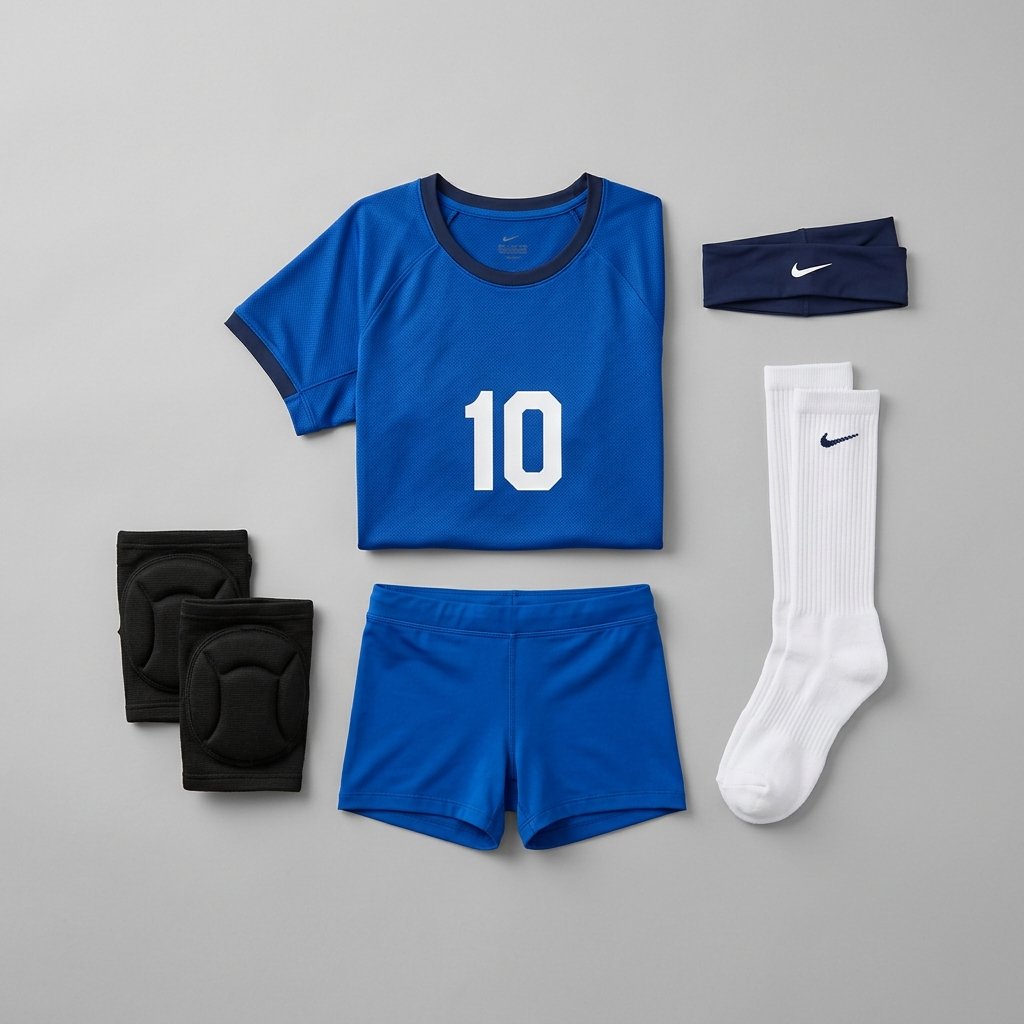
Uniform bottoms
All team members (again, except the libero starting in 2026-27) must wear bottoms of the same color. Style can vary slightly between players, meaning one player can wear spandex while another wears longer shorts, as long as the color matches. This flexibility is often overlooked by coaches who assume every player needs an identical bottom.
Numbers on uniform bottoms are optional, but if present, they must match the number on the top.
The 2026-27 libero bottom change
One of the most important recent updates for high school play: starting in the 2026-27 season, the libero’s uniform bottoms may be any color and no longer have to match the team’s bottoms. The libero top still must contrast with teammates, but the bottom is now fully flexible. This is a significant change from prior seasons when libero bottoms were required to match the team.
Volleyball Jersey Number Rules
The volleyball jersey number rules are the single most-enforced category of the entire uniform code. Referees check numbers before every match, and illegal numbers are one of the top reasons for uniform-related penalties.
Legal number range (the volleyball jersey number limit)
Legal numbers run from 1 to 99 under NFHS, USAV, NCAA, and FIVB rules. Numbers 0 and 00 are not permitted in USAV play. Under NFHS rules, numbers with a leading zero (01, 02, 03, and so on) will become illegal beginning in 2028, but are currently still allowed through the 2027 season.
Each player on the roster must have a unique number. Duplicates are not allowed, even if one of the duplicated players is the libero.
Number size
Front number minimum: 4 inches tall Back number minimum: 6 inches tall Number stroke width: 0.75 inches minimum at the narrowest point Number border width: 0.5 inches maximum
Some governing bodies recommend larger numbers than the minimum. USAV, for example, recommends 6-inch front numbers and 8-inch back numbers for easier officiating. These recommendations are common in higher-level club and national competition even though they’re not strictly required.
Number color and contrast
Numbers must be a plain, solid Arabic numeral. The color of the number must clearly contrast with the jersey base color. This is where teams most often run into trouble. A dark gray number on a black jersey, for example, will fail inspection because the contrast isn’t sufficient for officials to read the number at distance.
Shadows, outlines, gradients, and decorative effects on numbers are generally prohibited. Borders are allowed but cannot exceed the maximum border width, and the core of the number still has to contrast clearly with the jersey.
Prohibited color combinations under USAV and most other bodies include black on navy, red on maroon, navy on black, navy on maroon, and white on light yellow. If you aren’t sure whether your combination is legal, convert a photo to grayscale. If the number and the jersey look too similar in monochrome, the combination is likely non-compliant.
Number placement
Numbers must be centered side-to-side on both the front and the back of the jersey. They’re recommended to be placed on the upper half of the jersey body and cannot extend into decorative trim or panels in a way that breaks the number’s readability.
Starting July 1, 2029, the NFHS is eliminating the old prescriptive measurement that required the number to be exactly 5 inches below the shoulder seam. Going forward, the number simply needs to be centered on the upper half of the uniform top. This is an easier standard to design around and accommodates more custom layouts.
How Are Jersey Numbers Assigned in Volleyball?
One of the most common questions from new players and parents is how are jersey numbers assigned in volleyball. The short answer: more freely than in most other sports.
Unlike football or basketball, volleyball doesn’t have any positional number requirements. A setter doesn’t have to wear a specific number range. A middle blocker isn’t restricted to certain digits. Any player can wear any legal number from 1 to 99, as long as no teammate has the same number.
Common conventions (not rules):
- Team captains often wear single-digit numbers, especially 1 or 7
- Setters frequently choose smaller numbers (1, 2, 3, 4)
- Middle blockers often choose larger numbers (10 and up)
- Seniors typically get first pick of numbers within a team
- New players often inherit numbers left by graduating players
Clubs and high schools usually assign numbers before the season starts. Some programs let players request specific numbers, while others assign them based on seniority or position. Once assigned, a player must wear the same number throughout the tournament or season, with limited exceptions for blood-rule replacements or a damaged jersey.
The most popular jersey numbers in competitive volleyball (based on NCAA Division I data) are 4, 3, 2, and 1, with No. 4 being the single most commonly worn number. This reflects the convention of small numbers going to setters and captains.
Libero Uniform Rules
The libero is the single biggest source of uniform rule confusion in the sport. Because the position requires a contrasting jersey, officials have more to check and more margin for judgment. Here’s what you need to know.
The contrast requirement
The libero must wear a uniform top that “clearly contrasts” with the dominant color(s) of the rest of the team. The goal is for officials and spectators to immediately identify the libero on the court.
“Clearly contrasts” means more than just a different shade. Under USAV rules, combinations like black and navy, red and maroon, dark green and black, navy and maroon, and white and light yellow are explicitly prohibited because they aren’t distinctive enough. The libero jersey must use a dominant color that makes up more than 25% of the top and is visually distinct from the team’s dominant color.
Clearly contrasts” means more than just a different shade. If you need help choosing a shade that will pass inspection, our guide on the best jersey color combinations walks through which pairings hold up under arena lighting and which ones get flagged.
Libero numbers
The libero’s number must follow all the same number requirements as teammates. Same size (4 inches front, 6 inches back minimum), same contrast requirements, same placement. The only difference is the background color of the jersey.
Multiple liberos
Under the 2026-27 NFHS and current USAV rules, a team may designate up to two liberos per match, but only one can be on the court at a time. If a designated libero is injured or disqualified, the team can replace that player with the second designated libero or re-designate a new one, depending on the specific rule and circumstances.
2026-27 libero bottom flexibility
As covered earlier, the libero’s bottom no longer has to match the team’s bottom color starting in the 2026-27 NFHS season. The top must still clearly contrast with teammates.
Undergarments
Undergarments visible beneath the uniform have their own set of volleyball uniform rules that have evolved over the past two seasons.
NFHS undergarment rules (current): Team members may wear black, white, or gray undergarments in addition to undergarments that match the predominant color of the uniform top or bottom. All team members (other than the libero) who wear an undergarment must wear the same color. This is a change from older rules that only allowed matching-color undergarments.
USAV undergarment rules: Similar in spirit. The color must either match the predominant color of the uniform or fall into one of the allowed neutral colors (black, white, gray). Players on the same team wearing undergarments must all wear the same color choice.
In practice, this is one of the most common points where teams get called out. A player wears black compression shorts under a navy uniform while teammates wear navy. Under the older rules this was illegal, but under the updated rules it may be fine as long as every player wearing undergarments wears the same color. Check your exact rule book version before the season.
Logos, Patches, and Customization
Customization is allowed, but it’s bounded. The general volleyball jersey rules on logos and decorations:
Manufacturer logos: A single manufacturer logo is permitted on each piece of the uniform. Maximum size is 2.25 square inches with no dimension exceeding 2.25 inches. This applies to the jersey, the shorts, and any warm-up apparel worn during play.
School, club, or team identification: School name, nickname, logo, mascot, or a player’s name may appear on the uniform top or bottom. These typically don’t have a strict size limit under NFHS rules but cannot interfere with the visibility of the player’s number.
American flag: One American flag, not exceeding 2 inches by 3 inches, may be worn on each piece of uniform apparel.
Commemorative or memorial patches: By state association adoption, commemorative or memorial patches up to 4 square inches may be worn without compromising the uniform’s integrity. This is the rule that allows teams to add a patch honoring a deceased teammate, coach, or community member during a season.
Sponsor logos: In USAV club play, sponsor logos are allowed with specific restrictions. Not all players on a team need to have the same sponsor logo, but if multiple players do, the logo must be identical in size and position. NFHS high school play generally does not permit commercial sponsor logos beyond the single manufacturer logo.
Accessories, Jewelry, and Hair Equipment
Jewelry: Most jewelry is prohibited during play. Under NFHS rules, small secured stud or post jewelry is allowed above the chin (ears, nose). Necklaces, bracelets, rings, and dangling earrings are not permitted.
Medical and religious medals: Must be removed from chains and secured beneath the uniform.
Headbands: Legal but must be no wider than 2 inches.
Hair accessories: Undecorated flat clips up to 2 inches long are permitted. Beaded hair accessories are allowed if secured.
Knee pads and shoes: Not considered part of the uniform under most rule codes and don’t have to be identical across the team. This is one reason teams can mix and match knee pad styles based on player preference.
Concussion headbands: Permissive use is allowed under NFHS rules. Players who want to compete while wearing a concussion-protection headband may do so.
Body and face paint: Visible body and face paint or glitter is not allowed during regular season and tournament play. Permanent tattoos are exempt.
Penalties for Illegal Uniforms
Wearing an illegal uniform results in an “unnecessary delay” penalty, administered as an administrative yellow card for the first offense and an administrative red card for subsequent offenses in the same set.
The practical consequences:
- Player wearing illegal uniform tries to enter the set: Team assessed unnecessary delay. Player cannot enter until the uniform is replaced or made legal.
- Player wearing illegal uniform discovered during play: Team assessed unnecessary delay. Player must be removed until the uniform is corrected. If a time-out remains, the player may stay in if the uniform is fixed during the time-out.
- Team cannot field six players in legal uniforms at match start: The opposing team is awarded a loss of rally/point at the beginning of the match, and the state association is notified.
These penalties stack fast, and losing a point before the first serve is an avoidable disaster. The fix is simple: check your uniforms before the season, and again before every match.
2025-26 and 2026-27 Volleyball Uniform Rule Changes Summary
The NFHS and USAV have rolled out a cluster of changes over the past two rule cycles. Here are the ones you’ll actually notice on the court.
Already in effect (2025-26):
- Undergarments may now be black, white, or gray in addition to matching the predominant uniform color
- Small secured stud or post jewelry is allowed above the chin (NFHS)
- Multiple contacts on the second contact no longer result in an automatic fault
- Textured volleyballs may be adopted by state associations starting in 2026-27
Taking effect 2026-27:
- Libero uniform bottoms may be any color (NFHS)
- State associations may adopt textured volleyballs for both boys and girls
- Up to two liberos may be designated per match (NFHS aligned with USAV)
- Double whistle warning between sets moves to 2 minutes 30 seconds (4:30 with intermission)
Future changes (already announced):
- Beginning 2028: NFHS eliminates leading-zero uniform numbers (01, 02, etc.)
- Beginning July 1, 2029: Uniform number placement requirement changes from “exactly 5 inches below shoulder seam” to “centered on the upper half of the uniform top”
These are the USAV uniform rules 2026 and NFHS updates that coaches are most likely to be asked about during pre-season meetings.
Volleyball Uniform Rules by Governing Body: Quick Comparison
| Element | NFHS (High School) | USAV (Club/USA Volleyball) | NCAA (College) | FIVB (International) |
| Legal numbers | 1-99 (no leading 0 after 2028) | 1-99 (no 0 or 00) | 1-99 | 1-99 |
| Front number min | 4 inches | 4 inches (6 recommended) | 4 inches | Similar standard |
| Back number min | 6 inches | 6 inches (8 recommended) | 6 inches | Similar standard |
| Libero contrast | Required, NFHS-defined | Required, USAV-defined | Required | Required |
| Libero bottoms | Any color (2026-27) | Must match team | Must match team | Must match team |
| Manufacturer logo max | 2.25 sq in | Similar | Similar | Specific FIVB rules |
| Sponsor logos | Generally no | Yes with restrictions | Restricted | Allowed |
This is a summary. Always check the current rule book of your specific governing body for the authoritative version.
Common Uniform Mistakes That Get Teams Penalized
After reading thousands of rule interpretations and talking to officials, a handful of mistakes come up over and over. Avoiding these will keep your team out of the penalty column.
Buying jerseys with decorative number effects. Gradients, shadows, and drop shadows on numbers fail inspection almost every time. Keep numbers solid.
Picking a libero color that’s “different” but not “contrasting.” Black and navy fails. Red and maroon fails. Pick a libero jersey that would be easy to distinguish from your team jersey in a grayscale photo.
Ignoring the undergarment color match. If one player wears black compression shorts and another wears white, both get flagged. Coordinate before the match.
Adding too many custom patches. A memorial patch is fine. Three patches plus sponsor logos plus a mascot on the sleeve starts to exceed limits.
Using hard fasteners. Decorative buttons, zippers, or snaps on custom jerseys are not allowed for safety reasons.
Forgetting numbers on alternate uniforms. Some teams have alternate or throwback jerseys. These still need to meet every rule in this guide, including number size and contrast.
read about how to care for volleyball uniforms
FAQ: Volleyball Uniform Rules
What is the volleyball jersey number limit?
Legal numbers run from 1 to 99 under NFHS, USAV, NCAA, and FIVB rules. Numbers 0 and 00 are not permitted in USAV play. Beginning in 2028, NFHS rules will also prohibit leading-zero numbers (01, 02, etc.).
How do volleyball teams assign jersey numbers to players?
Numbers are assigned by the team or program rather than by rule. Any player can wear any legal number (1-99) as long as no teammate has the same number. There are no positional requirements, though conventions exist: setters and captains often wear single digits, middle blockers often wear larger numbers.
Can the libero wear a different color jersey in volleyball?
Yes, the libero must wear a jersey that clearly contrasts with the rest of the team’s uniform top. This is a core requirement, not an option. The contrast must be strong enough that officials and spectators can immediately identify the libero on the court.
Are sponsor logos allowed on high school volleyball uniforms?
Generally no under NFHS rules. Only a single manufacturer logo up to 2.25 square inches is allowed. Commemorative or memorial patches up to 4 square inches may be permitted by state association adoption.
What is the USAV uniform rules 2026 update?
Key 2025-26 and 2026-27 USAV updates include clarified libero replacement procedures when two liberos are designated, continued alignment on contrasting libero jerseys, and adoption of textured volleyballs. Number rules and core uniform requirements remain largely unchanged.
What makes a volleyball uniform illegal?
Common reasons include illegal number size, insufficient number-to-jersey contrast, libero jersey that doesn’t clearly contrast with teammates, mismatched uniform tops or bottoms between players, hard fasteners on the uniform, prohibited jewelry, or improperly placed numbers.
What’s the penalty for wearing an illegal volleyball uniform?
The penalty is an unnecessary delay, administered as an administrative yellow card for the first offense in a set and a red card for subsequent offenses. If a team cannot field six players in legal uniforms at match start, the opposing team is awarded a loss of rally/point.
Do volleyball knee pads have to match across the team?
No. Knee pads (along with shoes and socks) are generally not considered part of the uniform under NFHS and most USAV rules, so they don’t have to be identical across teammates.
How often do volleyball uniform rules change?
The NFHS and USAV update their rule books annually. Major uniform-specific changes happen every two to three seasons. Subscribe to your governing body’s rule change announcements to stay current on volleyball jersey rules and broader uniform updates.
Conclusion
Volleyball uniform rules are manageable once you know the system. The biggest mistakes come from assuming the rule book hasn’t changed or that a custom design element is fine because “nobody will notice.” Officials do notice, and unnecessary delays at tournament time are the kind of thing that costs matches. Check your rule book, order compliant uniforms, and audit your sets before the season starts.

2 thoughts on “Volleyball Uniform Rules: The Complete 2026 Guide”