
By the Hamco Sports team
A strong basketball jersey design is a high-contrast color system, numbers that read from the top row and pass your league’s rules, and a jersey and shorts designed as one set. Hamco Sports builds yours on a free mockup within 12 hours, with unlimited changes, and nothing is made until you approve it.
Your basketball jersey design says more about your program than your record does. The sections below take the decisions in the order they matter, from the five elements and the rule zones to ideas, shorts, mistakes and the process from idea to approved mockup.
What makes a great basketball jersey design?
A great basketball jersey design comes down to five things working together: a high-contrast color palette, readable typography, a balanced layout, breathable sublimated fabric and a fit that works across the whole roster. Skip one and the whole uniform feels off, however good the logo is.
A sixth test sits on top of all five for school teams: the design has to pass the rule book at the scorer’s table. A jersey that looks great in the mockup but carries a pattern across a high school torso, or a number the league doesn’t allow, gets flagged before tip-off.
What basketball jerseys ask of a design (that other sports don’t)
Basketball uniforms are the most exposed in team sports. There is no helmet, no shoulder pads and no jacket on top, so every seam, font and color choice is visible from the back row and to the courtside camera. Ten players stand on the floor in a jersey and shorts, all visible at the same time.
The exposure creates three working rules:
- The jersey and shorts are one outfit. A strong jersey over generic shorts looks borrowed, so design the set together.
- Every graphic has to work in motion and at distance. Test the mockup small and slightly blurred, not only full size on a big screen.
- Contrast is not optional. Officials read numbers from across the court, and the rule books define how big and how clear those numbers must be.
When you plan your jersey, you are deciding how your team is seen for the next two or three seasons. Our breakdown of the best jersey color combinations shows which palettes photograph well and which fall flat.
The five elements every solid basketball jersey design gets right
Start with the silhouette, because it sets the canvas for the other five decisions. Sleeveless is the default at every level, short sleeves are mostly a shooting-shirt or practice look, and a reversible jersey gives two looks in one piece for rec and youth teams. You can see every style our design team works with on our custom basketball jerseys page.
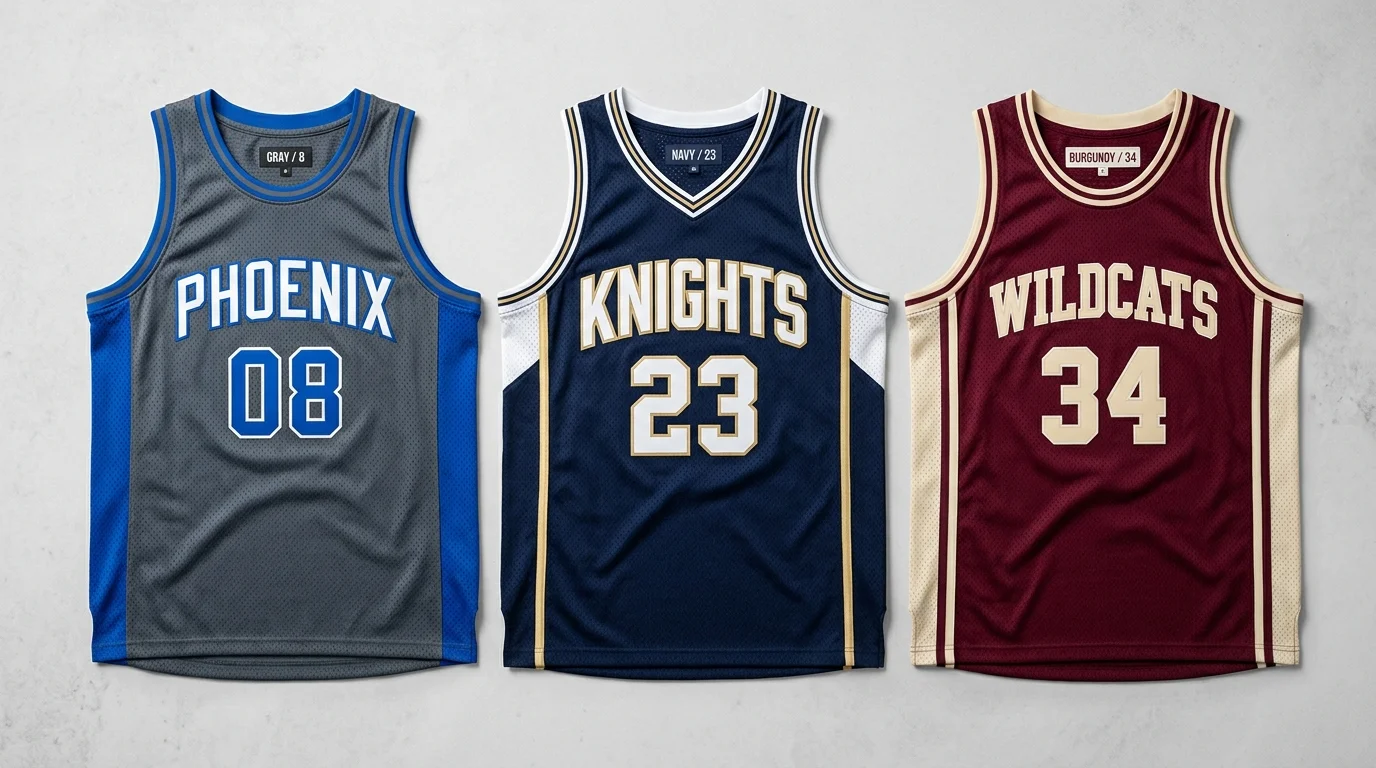
1. A color palette that photographs well
Two colors work. Three colors work if you commit to a clear order: one dominant, one secondary, one trim. Four colors almost never work, and on a high school jersey the number itself is limited to three colors.
The rule book makes some color choices for school teams. Under the NFHS uniform guidelines, the home jersey is white and the away jersey is a dark color that clearly contrasts with white, and gray only counts as an away color when it is at least 70 percent of the way to black. College rules differ, so check the current NCAA rules book.
Palettes that hold up, with the rule note for each:
| Palette | Why it works | Rule note |
|---|---|---|
| Navy, white, gold | Highest contrast of the classic sets | Navy away, white home, gold in the number border and inserts |
| Black, red, white | Readable everywhere; strong for travel programs | Keep red to one number border or insert |
| Royal blue, orange, white | High energy under bright lights | Orange numbers on royal pass the contrast test |
| Burgundy, cream, gold | Heritage feel that photographs well | Cream is not white, so it can’t be an NFHS home jersey |
| Slate gray, electric blue, black | Current, clean look | Slate usually fails the NFHS gray rule; use a black body with slate inserts |
Avoid two colors of similar brightness: a navy number on a black body disappears on video. Test your combination on a phone screen before you approve it. If it looks muddy on a small display, it will look muddy in every photo your team gets tagged in.
2. Typography that reads from the back row
Pick the number font first, because numbers are the one thing the official, the scorer and the opponent all need to read. Block fonts and condensed sans-serifs work best; heavily stylized scripts and fussy serifs on numbers don’t. Save the personality for the team wordmark across the chest.
High school numbers have hard minimums: at least 4 inches tall on the front and 6 inches on the back, with a stroke at least 3/4 inch wide, in plain Arabic numerals that match front and back, with no more than three colors. Since the 2024-25 season the number can’t be the same color as the jersey. Many teams go larger so the number reads on game film, and nothing in the NFHS sheet stops you.
Check the digits as well as the size. High school play allows only the digits 0 to 5 in each position: legal numbers are 0–5, 00, 10–15, 20–25, 30–35, 40–45 and 50–55, so 23 is legal and 7 or 18 is not, and one roster can’t carry both 0 and 00. College has allowed every number from 0 to 99 since the 2023-24 season. Youth and AAU leagues set their own number rule, so ask before a player picks a number.
Names stay simple: uppercase, condensed, straight or arched across the shoulder blades, and at least 1 inch from the number (the NFHS minimum). Pairings that keep working are collegiate block numbers with a condensed sans name, or a vintage serif number with a matching serif name for heritage programs. Our guide to the best jersey fonts shows which number fonts stay readable at 6 inches.
3. Layout that respects the body
The chest wordmark usually sits about two inches below the collar, and front numbers are smaller than back numbers. Side panels should taper or follow the curve of the torso, not run straight down like a strip of tape. On a high school jersey, side inserts also have a size limit (see the rule zones below).
Oversized graphics are the most common layout mistake. A logo that fills the whole chest looks bold in the mockup and loud in person. Restraint is what makes a design look built rather than slapped together.
4. Materials and construction
Hamco Sports basketball jerseys use 160–180 GSM Airweave mesh with full dye sublimation. The dye becomes part of the fabric, so the design won’t crack or peel the way a printed layer can. Lighter fabric breathes better in a summer tournament gym, and heavier fabric holds its shape; the 160–180 GSM range is built to balance the two.
Sublimation also means the number of colors in your design doesn’t change the price. Sublimated names, numbers and logos are included in the per-player price. If you want sewn tackle twill numbers or names instead, tackle twill is $5 per name and $5 per number.
5. Fit that works for your actual roster
Basketball cuts run two main ways: a standard athletic fit that is slightly relaxed, and a tapered competitive fit. Tapered fits look sharper but punish players outside the average build, so a roster with mixed body types is usually better served by the standard cut. Hamco Sports basketball uniforms come in men’s, women’s, girls’ and boys’ cuts, so a girls’ program gets a girls’ pattern rather than a resized men’s jersey.
Check the fit before you commit a full roster. Ask for free sample jerseys or fabric swatches and have a player or coach try one on. One sample costs nothing next to reordering a whole set.
What can you design on a basketball uniform? The rule zones
Before colors or fonts, learn the zones a referee checks. The NFHS basketball uniform guidelines split a high school jersey into areas with different freedom, and college plays under the NCAA basketball rules book instead. Youth, rec and AAU leagues usually write their own rules or borrow the NFHS ones, so check your league page before you commit.
| Zone | NFHS high school |
|---|---|
| Torso (front and back body) | One solid color, no designs in the fabric. White at home, a dark color away |
| Above the neckline (collar to shoulder seam) | No color or design limits, except identifying names |
| Side inserts | Any color or design, centered below the armpit, at most 4 inches wide including trim, the same width on every jersey |
| Armhole trim | Up to 1 inch around the arm opening |
| Numbers | Front at least 4 in, back at least 6 in, stroke at least 3/4 in, no more than three colors, not the jersey color (since 2024-25). Legal numbers: 0–5, 00, 10–15, 20–25, 30–35, 40–45, 50–55 |
| Logos | One apparel brand logo up to 2¼ sq in; a school or conference logo at the neckline or in a side insert; US flag up to 2 × 3 in |
College (NCAA) uniforms follow a different rule book with its own zones; check the current NCAA basketball rules book before you design a college set.
On a high school jersey the body is a solid block, so personality comes from the shoulder area, the side inserts and the shorts. In AAU, gradients and patterns are usually fine, but players still need a clean number for tournament film.
Sublimation basketball jersey design: why it changed everything
Sublimation is the default for basketball jersey design because it can print almost anything: gradients, photographic patterns, full-color logos, detailed side panels and custom inside-collar tags. None of it adds cost the way extra colors or extra layers do with other decoration methods. Our guide to what sublimation printing is explains the process.
For teams, that means three practical advantages:
- Design freedom without a budget penalty. A jersey with a complex gradient costs the same as one with two flat colors, so use that freedom to make the design distinctive.
- A lighter feel on the body. There are no heavy stitched patches or thick print layers, so players wear the design instead of carrying it.
- Color that stays. Because the dye is in the fabric, the graphics won’t crack or peel. Wash the set cold and inside out, and see our guide on how to wash a jersey for the rest.
The trade-off is that sublimation shows every flaw in a source file. A grainy logo or a badly drawn font will look grainy on the jersey too. If your logo was made in a slide program a decade ago, now is the time to redraw it, and if your team doesn’t have a logo yet, our designers create one at no extra cost. Our free sports logo maker guide shows what a clean, sublimation-ready file looks like.
Unique basketball jersey design ideas and 2026 trends worth borrowing
A unique basketball jersey design doesn’t need every idea below. Pick one or two, keep the rest of the jersey clean, and check where each one is legal at your level.
Hometown storytelling
Jerseys that reference something specific about your town or school give a design a story. A coastal town might work wave lines into the side panel; a mountain school could pull a topographic line behind the wordmark. The story doesn’t need to be obvious. It needs to be there. On a high school jersey, keep it in the side inserts or above the neckline.
Asymmetric design elements
Most jerseys mirror left to right. One angled side stripe, an offset chest graphic or a single shoulder accent makes a design look current. On a high school jersey the side inserts must be the same width on every jersey and no wider than 4 inches, so the asymmetry has to live above the neckline or on the shorts (check your state association’s shorts rules).
Custom inside-collar tags
The inside of the back collar is wasted space on most jerseys. Programs that care about details put a motto, a founding year or the senior class year there. Players notice, and the tag never touches a rule zone.
Gradient fades
A gradient running from the shoulders to the hem looks premium and only works because of sublimation. Gradients are fine for AAU, rec and adult teams. On a high school torso they are not, because the body must be one solid color. For a school team, put the gradient on the shorts (check your state association’s shorts rules), the shooting shirt or the warm-up.
Pattern overlays
Faint geometric or organic patterns under the main design read as detailed up close and solid from a distance. Honeycomb, brushstroke, halftone, topographic and faint pinstripe patterns all work. The key word is faint: if the pattern is the first thing you notice, it is too strong.
Where each 2026 trend is legal
| 2026 trend | AAU, rec, adult | High school (NFHS) |
|---|---|---|
| Gradient fades | Yes | Not on the torso |
| Asymmetric side panels | Yes | Above the neckline; shorts if your state allows |
| Heritage block typography | Yes | Yes |
| Muted earth palettes with one bright accent | Yes | Home must be white, away dark |
| All-over sublimated patterns | Yes | Side inserts and shoulder area only |
| Minimal blank canvas | Yes | Yes |
College (NCAA) uniforms follow a different rule book with its own zones; check the current NCAA basketball rules book before you design a college set.
If a trend you like isn’t legal at your level, move it to the shorts, the shooting shirt or the warm-up. Those pieces carry no torso rule. Our basketball jersey template ideas post has more layouts by cut.
Shorts: the other half of the uniform
Shorts are where a high school program gets its pattern back, because the NFHS uniform sheet’s solid-torso rule covers the jersey; check your state association’s shorts rules before you order. The strongest designs echo the jersey’s color system at the waistband and side panel, use the side seam as a design line, and match the jersey hem treatment at the leg opening. Keep the back cleaner than the front.
Mid-thigh is the common cut, and a league may set its own rule, so ask before you order a retro length. Design custom basketball shorts in the same mockup as the jerseys, so both pieces are approved against the same colors.
Basketball jersey and uniform design by level
The right basketball jersey design depends on who sets the rules and who is watching. A rec league, a high school varsity program and an AAU travel team each design for a different audience.
| Level | Design priorities | Rules that apply |
|---|---|---|
| Youth rec | Big clear numbers, bright contrast, durability; reversible if the league doesn’t supply home and away | League rules; many copy NFHS numbers. See youth basketball rules by age group |
| AAU and travel | More freedom: fades, patterns, bold wordmarks, but still a solid, high-contrast number for film | Event rules vary by organizer and are usually looser than NFHS |
| High school varsity | Continuity with the school’s history; solid body, personality in inserts, shoulders and shorts | The NFHS uniform guidelines in full |
| College | Program identity, numbers 0 to 99 | The current NCAA basketball rules book |
| Adult leagues | Custom wordmarks and unusual palettes | Usually only matching jerseys and readable numbers |
Two ordering facts matter by level. High school athletic directors can pay the way their district requires, because purchase orders are accepted. Leagues outfitting many teams, each with its own design, get the price tier of the combined quantity across all teams, so a league’s smallest team pays the same per player as its largest.
Mistakes that ruin otherwise solid designs
The same errors show up season after season, and most of them are avoidable at the mockup stage.
- Putting everything on one jersey. Team name, mascot, city, year, motto, sponsor and nickname all at once. If you can’t decide what matters most, the design will show it.
- Numbers too thin to read. A trendy thin number font looks good in the mockup and disappears into the jersey from the bleachers. Stroke weight matters more than personality.
- A pattern across a high school torso. It breaks a rule, not a taste preference, and it is one of the first things an official checks.
- A number the league doesn’t allow. In high school, any number with a 6, 7, 8 or 9 is illegal.
- Four colors. The design gets busy, and the number can’t legally carry four colors in high school play anyway.
- Jerseys and shorts from different suppliers or orders. Two separate orders rarely match exactly, so order both pieces together from one supplier.
- Home and away designed as strangers. Your light and dark sets should look like one family: the same wordmark, number font and panel structure, with the color logic flipped.
- Side inserts that change width across sizes. On a high school jersey they must be the same width on every jersey and no wider than 4 inches.
- Approving the mockup too fast. Sit with it for 24 hours. Look at it on a phone, a laptop and a printed page, because designs that work on a big screen sometimes fall apart small.
The basketball jersey design process in 7 steps
The fastest way to a jersey you’ll keep for several seasons is to make the decisions in a fixed order:
- Define the program identity. A rec league wants warmth and easy-to-find numbers, a varsity program wants continuity, and a travel team wants to look current on a tournament floor.
- Lock the color system. One dominant, one secondary, one trim, checked against your league’s home and away rules.
- Choose the silhouette. Sleeveless, short sleeve or reversible, in the cut that fits your roster.
- Design inside the zones. Decide what the shoulder area, the side inserts and the shorts carry; on a high school jersey, the body stays solid.
- Plan the numbers first, then the names. Check size, stroke and digits against your league’s rules before you pick a name font.
- Extend the design to the shorts. Waistband, side panel and hem echo the jersey.
- Send it to our design team. Start your order in the Start Custom Order form with your colors, logo and roster. Our in-house designers in the USA send a free mockup of home and away within 12 hours, with unlimited changes, and nothing is made until you approve it.
Practical ordering tips most teams learn the hard way
Plan backward from your first game. Uniforms are ready 2–3 weeks after design approval, then ship to US teams in 3–5 days, with free shipping anywhere in the USA. Add time for mockup review and roster changes, and aim to have the uniforms in hand at least a week before your first game so there is room for fit questions. If your date is tight, ask for a free rush on request, when production allows.
Lock your roster before you approve. Adding three players two weeks later means a second production run, so collect every name, number and size first. Send the size chart to players or parents early, and use a sample to settle any fit question before the order goes in.
Get the name and number list signed off by every player or parent. Once the dye is in the fabric, the only fix for a misspelling is a new jersey. Tell your design team which rule book you play under, so the mockup is built to it.
Order in the quantity you actually need. With no minimum order, a single replacement jersey or a four-player 3-on-3 roster is as welcome as a full league.
Bringing it all together
A great basketball jersey design comes from a few decisions made in the right order: a palette that photographs well and passes your league’s color rules, numbers that read at distance, a layout with restraint, sublimated fabric, a fit for your actual roster, and shorts designed with the jersey. Programs that keep a core design for several seasons, and rotate an alternate set for variety, build an identity players want to wear and opponents remember.
Frequently asked questions
What makes a unique basketball jersey design stand out?
A unique basketball jersey design usually combines one distinctive element, such as an asymmetric shoulder accent, a custom wordmark or a faint pattern overlay, with restraint everywhere else. Piling on ideas is the most common mistake. One or two memorable touches on a clean base read as confident, while five competing ideas read as cluttered.
Is sublimation better than traditional printing for basketball jerseys?
For most teams, yes. Sublimation dyes the design into the fabric, so it allows unlimited colors and patterns at the same price, feels lighter and won’t crack or peel. Sewn tackle twill still suits a heritage look; with Hamco Sports, tackle twill is $5 per name and $5 per number.
How long does it take to design and order custom basketball jerseys?
Plan on about five to six weeks from first contact to game day. Hamco Sports sends a free mockup within 12 hours, with unlimited changes. Uniforms are ready 2–3 weeks after design approval and ship to US teams in 3–5 days, and the rest of the time covers your review and roster changes. A free rush on request, when production allows, can help with a tight date.
How much does a custom basketball jersey design cost?
The design itself costs nothing extra at Hamco Sports: the mockup is free with unlimited changes, sublimated names, numbers and logos are included in the per-player price, and if your team doesn’t have a logo yet, our designers create one at no extra cost. You pay the per-player price of the uniform, with no minimum order. Our custom basketball uniforms cost guide covers the price tiers.
What are the number rules for a high school basketball jersey?
Under the NFHS uniform guidelines, numbers must be at least 4 inches tall on the front and 6 inches on the back, with a stroke at least 3/4 inch wide, in plain Arabic numerals with no more than three colors, and not the same color as the jersey. Only the digits 0 to 5 are legal, so numbers run 0–5, 00 and 10–55 without a 6, 7, 8 or 9. College has allowed 0 to 99 since the 2023-24 season.
Can a high school basketball jersey have a gradient or pattern?
Not on the torso. The NFHS guidelines require the body of a high school jersey to be one solid color with no designs in the fabric. Patterns and gradients are allowed above the neckline and in side inserts up to 4 inches wide. The solid-torso rule covers the jersey, so the shorts are the usual place for a pattern; check your state association’s shorts rules first. AAU, rec and adult leagues usually allow gradients across the whole jersey.
Ready to see your design on a jersey?
Send your colors, logo and roster, and our design team returns a free mockup of your home and away set within 12 hours, with unlimited changes. No minimum order, sublimated names and numbers included, and free shipping anywhere in the USA.
How we made this guide: written by the Hamco Sports team from our own design process, the NFHS basketball uniform guidelines (checked October 2026) and our product pages. College rules are summarised only where we could confirm them. Our uniforms are designed in the USA and made overseas in our own factory.

7 thoughts on “Basketball Jersey Design 2026: A Guide for Coaches and Teams”