

Youth basketball rules vary significantly by age group, and understanding those differences is essential for coaches, parents, and league administrators who want to run programs that are developmentally appropriate and genuinely educational. The court is smaller for younger players, the basket is lower, the ball is lighter, and the rules are simplified to allow children to learn the game at a pace matched to their physical and cognitive development. This complete guide to youth basketball rules by age group covers every key regulation from under-six recreational programs through eighth-grade competitive leagues, including court dimensions, basket heights, game length, foul rules, and youth basketball jersey requirements for 2026.
Rules that match the size and attention span of each age group give young players a real chance to dribble, pass and score. Programs that use adult rules for young children, such as full-size courts, ten-foot baskets and complex defensive rules, produce frustration rather than development.
Youth Basketball Age Division Overview
Most youth basketball leagues group players by school grade or birth year. The NBA and USA Basketball youth guidelines have playing rules for three youth age groups: 7 and 8, 9 to 11, and 12 to 14. They also recommend 3 on 3 half-court games for young players. Ages five and six have no rule sheet, so your league sets their format. The sections below give the sizes for each age.
Court Dimensions by Age Group in Youth Basketball
Court size is one of the most impactful modifications for young basketball players. A full-size court is 84 or 94 feet long and 50 feet wide, sized for grown athletes. Placing seven-year-olds on a full-size court produces long stretches of disorganized ball movement and exhausted players.
For players under seven, each league sets its own court. Ages seven and eight play on a 50 by 42 foot court, set up as a cross-court game on a full-size floor, under the ages 7 and 8 rule sheet. Ages nine through eleven use a 74 by 50 foot court. Ages twelve through fourteen use a full-size court, 84 or 94 feet by 50 feet.
Basket Height Adjustments by Age
Lowering the basket for younger players is one of the single most effective developmental modifications in youth basketball. Children forced to heave shots toward a ten-foot basket develop poor mechanics: launching motions, two-handed pushes and inaccurate shots that become hard habits to break.

Ages seven and eight use an eight-foot basket under the NBA and USA Basketball youth guidelines. Ages nine through eleven use a nine-foot basket where the gym allows it. Full ten-foot baskets start at age twelve. Players under seven aren’t covered by the guidelines, so their league picks the height.
Ball Size Guidelines for Youth Basketball
Ball size matters enormously for young players’ ability to grip, control, and shoot with proper mechanics. Size 3 mini basketball (22 inches circumference) and size 4 youth basketball (25.5 inches circumference) are common first balls for players under seven, a range the NBA and USA Basketball youth guidelines don’t cover. Size 5 junior basketball (27.5 inches circumference) is the guideline ball for ages seven and eight. Size 6 basketball (28.5 inches circumference) is the guideline ball for boys and girls ages nine through eleven, though some retail size charts, such as Basketball for Coaches, still list a size 5 for that age, so check which ball your league uses. Size 6 stays the official women’s and girls’ ball from age twelve. Size 7 official basketball (29.5 inches) is the ball for boys from age twelve and for all men’s competitions from high school through professional.
Basketball size by age, with hoop height and court size
| Age | Ball size | Circumference | Basket height | Court | Source |
| Under 7 | Size 3 or size 4 (set by your league) | 22 in or 25.5 in | Set by your league | Set by your league | Retail ball size charts |
| 7 and 8 | Size 5 | 27.5 in | 8 ft | 50 × 42 ft | NBA and USA Basketball youth guidelines |
| 9 to 11 | Size 6 (size 5 on some retail charts) | 28.5 in | 9 ft | 74 × 50 ft | NBA and USA Basketball youth guidelines |
| 12 to 14, girls | Size 6 | 28.5 in | 10 ft | 84 or 94 × 50 ft | NBA and USA Basketball youth guidelines |
| 12 to 14, boys | Size 7 | 29.5 in | 10 ft | 84 or 94 × 50 ft | NBA and USA Basketball youth guidelines |
| High school | Girls size 6, boys size 7 | 28.5 in, 29.5 in | 10 ft | Full court | NBA and USA Basketball ages 12 to 14 sizes; check your state association |
Rules checked November 7, 2026 against the NBA and USA Basketball rule sheets for ages 7 and 8, ages 9 to 11 and ages 12 to 14 (2018), and the NFHS high school rules chart for the 2025 to 2026 season. Under 7 ball sizes from the Basketball for Coaches size chart.
Game Length and Quarter Rules
Shorter games match the attention span and stamina of younger players. The NBA and USA Basketball youth rule sheets use four 8-minute periods for every age from 7 to 14, with 1 minute between periods. The NFHS timing rules for the 2026 to 2027 season set four 8-minute quarters for high school teams and four 6-minute quarters for younger teams that play by NFHS rules. Your league’s rule sheet has the final say, so check it before the season.
Under the NBA and USA Basketball youth sheets, an extra period lasts 2 minutes for players 7 and 8 years old or 9 to 11 years old, and 4 minutes for players 12 to 14 years old. High school varsity overtime is 4 minutes under NFHS overtime rules, and lower levels may play half the length of a regular quarter. Extra periods keep going until the tie is broken.
Foul Rules for Youth Basketball by Age Group
High school players foul out on their fifth foul, personal or technical, under NFHS rules. The youth rule sheets don’t list a foul limit, so check your league’s rules. Calling every minor incidental contact as a foul in games featuring eight-year-olds interrupts the game flow and confuses players who are still learning what contact is and is not allowed.
Defensive rules change with age. The NBA and USA Basketball guidelines allow only player-to-player (man-to-man) defense for ages seven through eleven, so there is no zone. Under the ages 7 and 8 sheet, players may not press at all. The ages 9 to 11 sheet lets teams extend man-to-man full court only in the fourth period and extra periods. From age twelve, the ages 12 to 14 sheet leaves zone and press defense to the coach, but a team ahead by 25 points or more may not press.
Custom Basketball Uniforms for Youth Programs
Custom sublimated basketball jerseys allow unlimited color combinations and design elements, so every program can have its own look. Reversible jerseys are two layers sewn together, with team colors on one side and a contrasting color on the other, so one jersey covers games, scrimmages and practice.
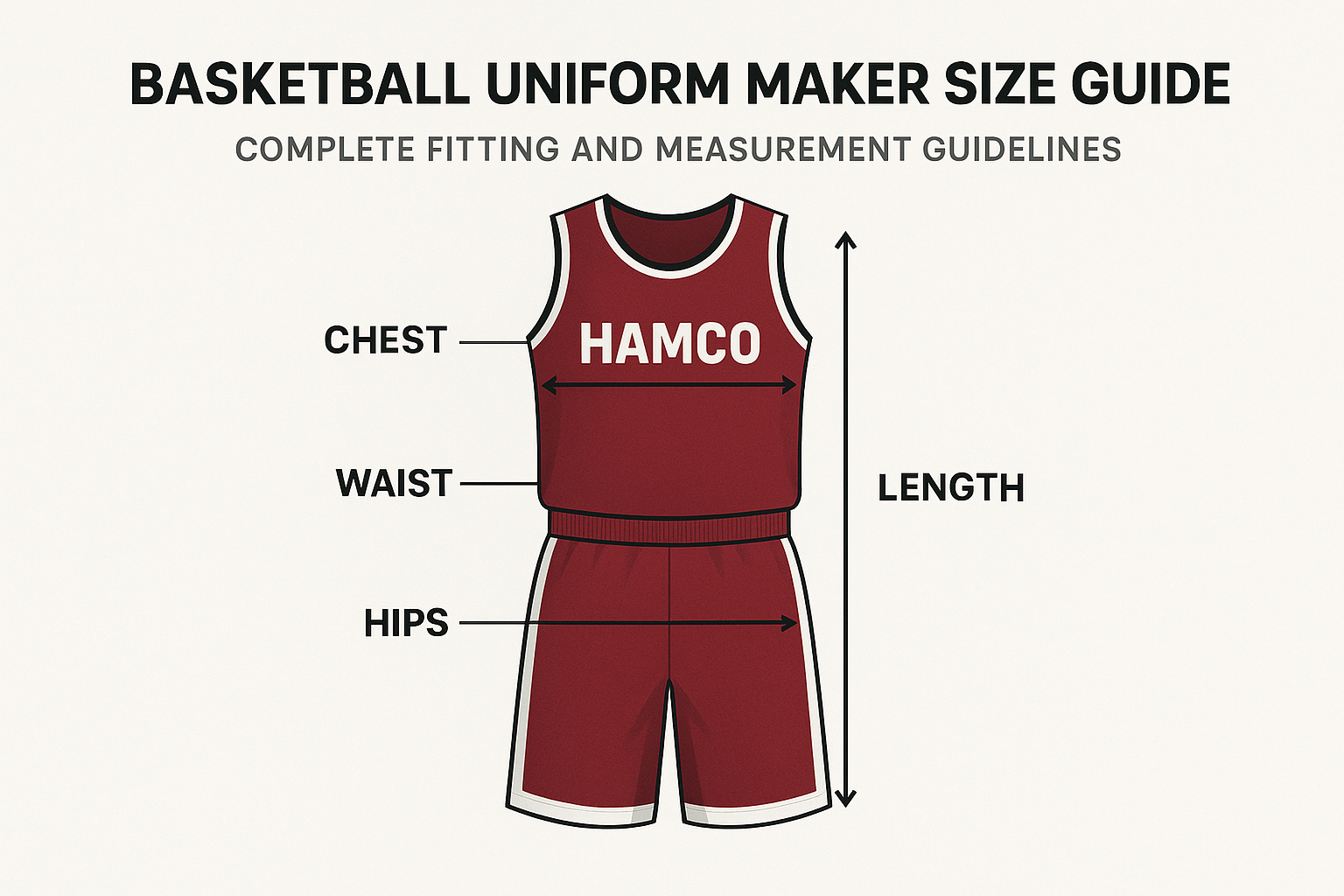
Custom basketball jerseys should be sized appropriately for youth bodies using youth-specific size charts. Adult sizing will not fit young players proportionally. Hamco Sports makes basketball uniforms in youth and adult sizes, in men’s, women’s, girls’ and boys’ cuts. There is no minimum order, you get a free mockup within 12 hours with unlimited changes, and names and numbers are sublimated in at no extra cost. Basketball pieces can be mixed on one order to reach a price tier.
Frequently Asked Questions
Frequently Asked Questions
Q: What size basketball should a 10-year-old use?
A: The NBA and USA Basketball youth guidelines put a 10-year-old on a size 6 ball (28.5-inch circumference). Some retail size charts still list a size 5 ball (27.5 inches) for ages nine to eleven, so use the ball your league plays with.
Q: Can youth basketball leagues use full-court press defense?
A: The NBA and USA Basketball youth guidelines allow only player-to-player defense through age eleven. They bar pressing for ages seven and eight. Players aged nine through eleven may guard full court only in the fourth period and any extra period. From twelve on, pressing is allowed, except by a team that leads by 25 points or more.
Q: What jersey number rules apply in youth basketball?
A: Youth leagues set their own number rules. NFHS high school rules allow only numbers made of the digits 0 to 5: 0 to 5, 00, 10 to 15, 20 to 25, 30 to 35, 40 to 45 and 50 to 55, and one team can’t list both 0 and 00 (NFHS basketball uniform guide, front number, item 3, checked November 7, 2026). Check your league’s rules before ordering jerseys.
Q: How many players are on a youth basketball team?
A: Your league sets roster size. The NBA and USA Basketball youth guidelines call for equal playing time at ages seven and eight, and equal time in the first three periods at ages nine through eleven. They also suggest 3 on 3 half-court games to get young players more involved.
Q: What is included in a complete custom basketball uniform set?
A: A complete custom basketball uniform set includes a sublimated jersey with player name and number, matching shorts, and optionally a warm-up jacket. Reversible basketball uniforms include both a dark and light side in a single garment.
Q: What size basketball for an 8 year old?
A: A size 5 ball, 27.5 inches around, on an eight-foot basket. That is the NBA and USA Basketball youth guideline for ages seven and eight.
Q: What size basketball for a 12 year old?
A: Under the NBA and USA Basketball youth guidelines, a 12-year-old boy uses a size 7 ball (29.5 inches) and a 12-year-old girl uses a size 6 ball (28.5 inches). Both shoot at a ten-foot basket from age twelve.
Use the appropriate court size, basket height, and ball for your players’ age group, enforce rules with a developmental mindset rather than a strictly technical one, and equip your program with custom basketball uniforms that give every player a reason to be proud to show up.

2 thoughts on “Youth Basketball Rules by Age Group: Ball Size, Hoop Height and Game Length”
Comments are closed.