Quick Answer
Baseball jersey design works in this order: cut, rules, look, color, then art. Pick the cut first, because a full button placket splits the chest while a V neck or round neck leaves it open, at a published $10 difference per jersey. Check NFHS Rule 1-4-3 next, which requires a plain back number at least 8 inches high in a solid color contrasting with the shirt, a border no wider than a quarter inch, and no duplicate numbers on a team. Then pick one of the four classic looks that keep working: vertical pinstripes, a script chest wordmark, white or gray at home with color on the road, and knicker pants with stirrups. Build the full classic kit for about $94.97 per player at the lowest published tier, or the modern version for $69.98, with smaller orders paying more per piece. Sublimation adds no charge for extra colors, so complexity is free and restraint is the real discipline.
Baseball is one of the most restrictive design canvases in team sports, and that is part of why good baseball jersey design looks so good. A button front, pants in one color, a cap, and a rulebook that sets the number height. Inside those limits, the sport has produced some of the most recognizable uniforms in America. This guide covers the decisions in the order they matter. First the cut and what it does to your art. Then the rules that decide what a referee accepts, and the four classic looks that still work. Then what each one costs at published prices, and how color and type behave from the stands. Every price below is the lowest published tier rather than an entry price. Every construction fact comes from our custom baseball uniforms pages, read in September 2026, and every rule comes from the NFHS rulebook, linked where it appears.
One thing up front. Hamco builds baseball uniforms, so the prices here are ours and published. The design opinions are labeled as opinions. Sublimation dyes the graphic into the polyester rather than pressing it on top, so color count, gradients, and pinstripe density cost nothing extra. Our guide to what sublimation printing is explains. That changes the design question from what can we afford to print into what belongs on the jersey.
Start With the Cut, Because It Is the Canvas
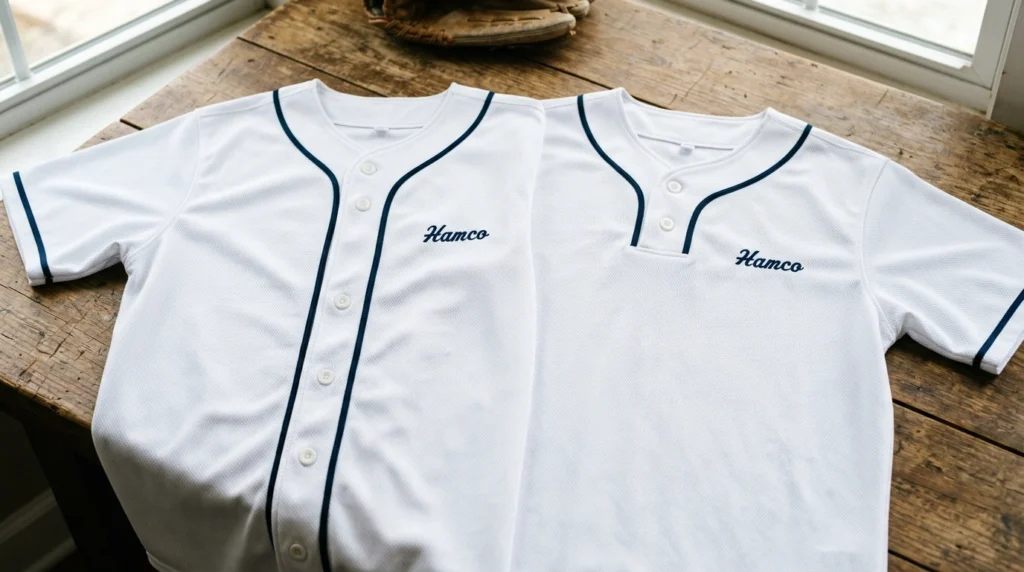
Every baseball uniform design starts with a decision most teams make last. The cut decides where the art can go, and the price moves with it. Here is the lowest published tier price and the design effect of each cut, with the product page for each linked.
| Cut | 101 plus tier | What it does to your design | Best for | Source |
| Full button | $39.99 | The classic placket. Buttons split the chest, so a script wordmark has to sit across the opening or arch above it | Programs that want the traditional look | Product page |
| Two button | $34.99 | Henley placket at the collar only. The chest stays open, so a large wordmark or crest reads cleanly | Modern programs that still want a placket | Product page |
| V neck | $29.99 | Full open chest, the widest canvas of any cut. Piping at the neck is the classic accent | Budget builds and modern athletic looks | Product page |
| Round neck | $29.99 | Same canvas as the V neck with a crew collar. Reads traditional without the buttons | Youth programs and practice sets | Product page |
| Sleeveless | $29.99 | No sleeve stripes, so the design lives in the body and the undershirt carries the second color | Hot climate programs and the vest look | Product page |
| Batting practice | $29.99 | Simpler art on the same body, usually one color plus a small mark | BP tops and second jerseys | Product page |
Verified September 2026. Prices are the lowest published tier. The full button product page states that $39.99 is the price on orders of 101 plus, so the 1 to 24 tier is higher on every cut. The design effect and Best for columns are our editorial view.
What the Rulebook Rejects Before You Design
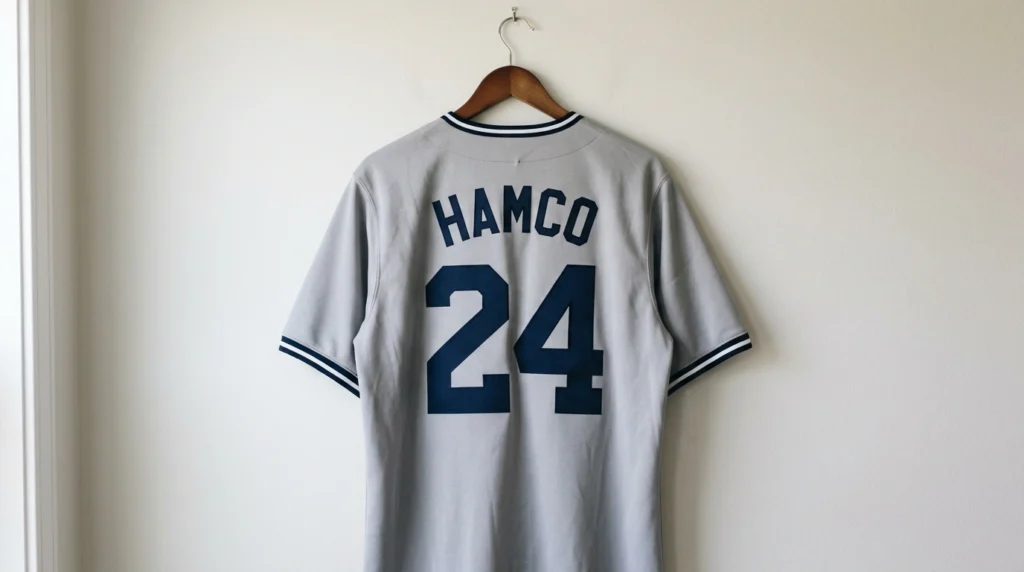
High school programs design inside NFHS Rule 1, and the specifics are tighter than most coaches expect. Per the NFHS baseball uniform rules, the back number must be plain Arabic style, at least 8 inches high, and a solid color contrasting with the shirt. A border is allowed but cannot exceed one quarter inch. No two players on a team may wear the same number. Three more constraints catch designers out. A 2025 NFHS interpretation rules on numbers formed by the jersey fabric itself. If the number is outlined by sewn material or a contrasting border, the jersey is not legal. The number has to be a solid contrasting color. Uniform pants must extend below the knee, so shorts and knee length pants are out. Knicker style pants are legal because they end below the knee. And only one manufacturer logo is allowed per item, capped at two and a quarter square inches. NFHS also lists a clarification to Rule 1-4-4 covering what a school uniform may carry. Rules trackers report school names, nicknames, mascots, and player names being permitted on tops and pants from 2027. Confirm the current year with your state association through the NFHS baseball rules page before you finalize lettering.
The Four Classic Looks That Keep Working
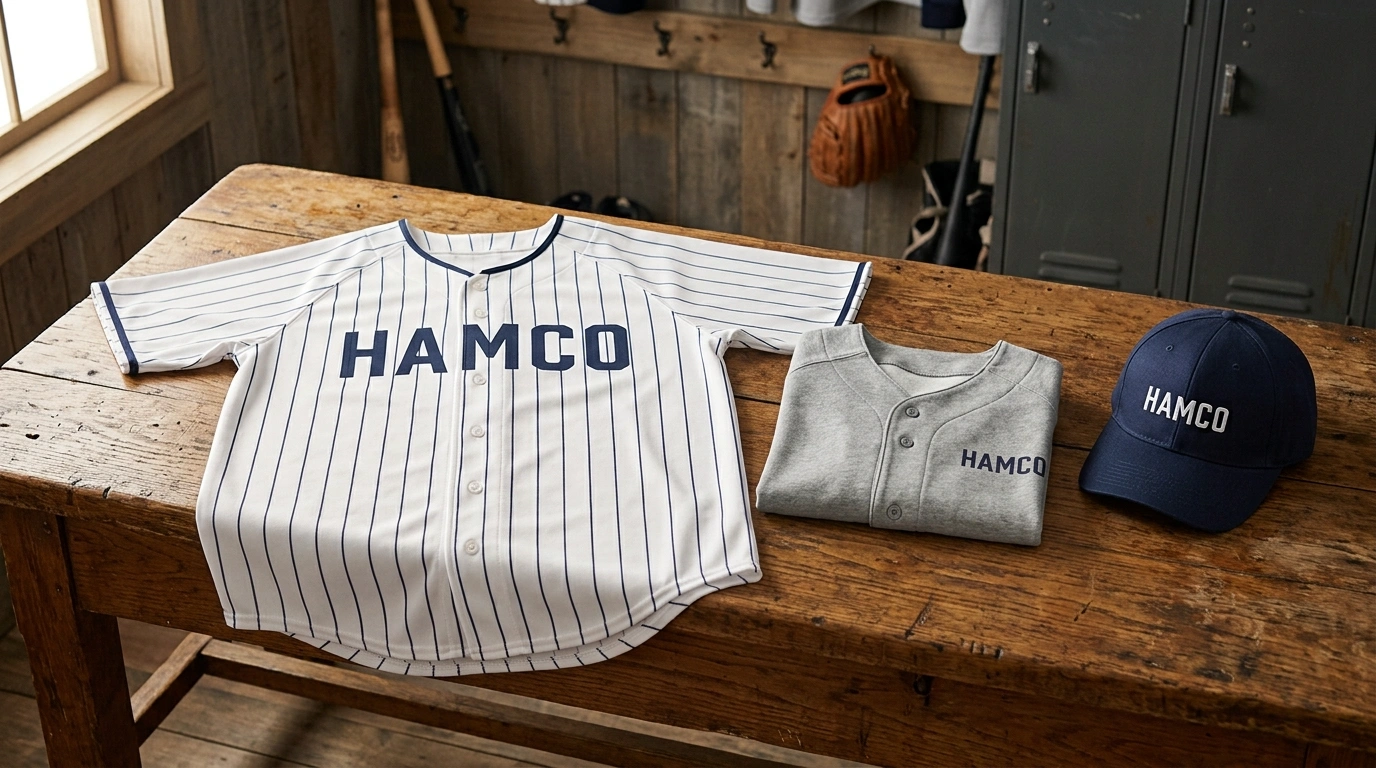
Trends move. These four have not. First, vertical pinstripes on a white home jersey, a pattern the sport has used for over a century. Sublimation holds them through a full summer of wash cycles rather than fading like older printed stripes. Second, the script wordmark across the chest, one of the strongest conventions in American sport design. It needs a two button or V neck cut to read cleanly, because a full button placket cuts it in half. Third, the home and away system. White or gray at home, a colored jersey on the road, both ordered together so they share one dye batch. Fourth, knickers with stirrup socks. Our guide to baseball stirrups covers how the pant break and sock height work together. Throwback variants extend all four. Vintage flannel look polyester and raglan sleeve color blocking are both options. So are horizontal contrast bands in the Negro League tradition and 1940s style chain stitch lettering, all on the published customization list.
What the Classic Look Costs, Piece by Piece
Classic is a set of choices with a price attached, so here is the build up at the lowest published tier, per player.
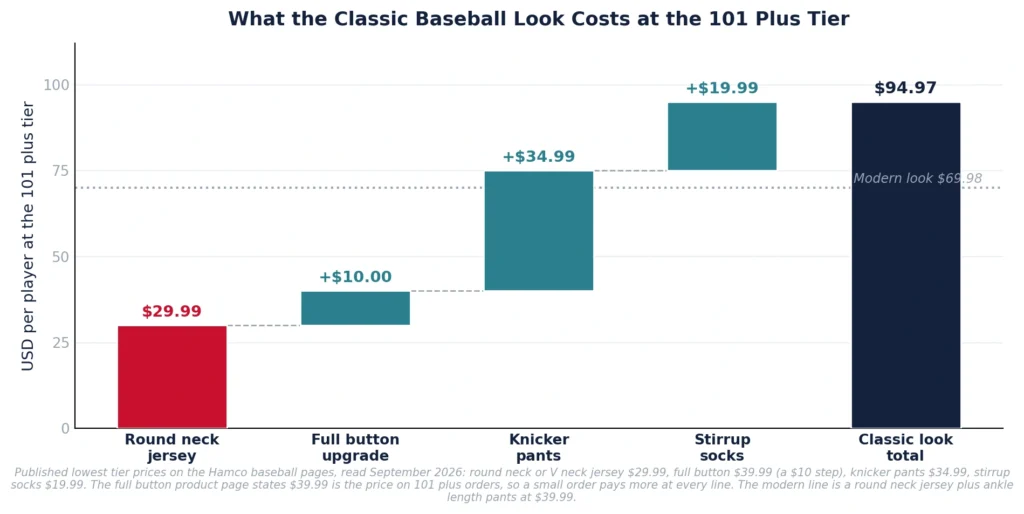
Read it plainly. The full button upgrade is a $10 step over a round neck or V neck jersey. Knicker pants add $34.99 and stirrup socks add $19.99, which lands the full classic kit at $94.97 per player. The modern version, a round neck jersey with ankle length pants, sits at $69.98. So the traditional look costs about $25 more per player, and $10 of that is the placket alone. Read the tier before you budget from those numbers. The full button page states $39.99 is the price at 101 plus jerseys. A 15 player team pays more per piece than this chart shows. The gap between classic and modern stays about the same. A full button jersey and pants uniform set starts at $79.99 and runs both pieces in one dye batch. Our custom baseball uniforms cost breakdown covers the volume tiers that lower every figure above.
Colors and Type That Read From the Stands
Baseball is watched from the stands and photographed from behind a backstop, so legibility beats detail. Four working rules. One, contrast beats cleverness. The rulebook already demands a solid contrasting number. A gray number on a white jersey fails the stands even when it passes the rule. Two, pick two colors and a metal, not four colors. Our best jersey color combinations guide covers which pairs hold up under stadium light and on camera. Three, let the type do one job. A script handles the chest and a block face handles the back number. Mixing three faces on one jersey is a fast way for cool baseball uniforms to turn busy, and our guide to best jersey fonts gets into. Four, design the cap into the palette from the start. The cap carries a large share of a baseball program’s visual identity and is usually bought separately.
Youth Baseball Uniform Ideas That Survive the Season
Youth design is constraint design, and the constraints are different from varsity. Names are often optional at this level, and leaving them off makes hand me downs easy and reorders cheaper. Numbers should be oversized for the age group, because a parent in a folding chair reads them from further away than a scorekeeper does. Round neck and two button cuts at $29.99 to $34.99 cover most youth programs, and a set with pants keeps the whole roster matching. Order a size up on a spring roster and keep the art simple enough to read on a YS jersey. Keep the design file with your maker so a July replacement matches the March batch. League wide programs can share one logo template across every team and differentiate by team name and color. That keeps a district unified without designing twelve kits.
How to Customize Your Own Baseball Uniform
The process is short at a direct maker. Send colors, a logo, and a roster, and a free mockup comes back within 12 hours, with unlimited revisions before approval. A full button baseball jersey from $39.99 is the most traditional starting point. A baseball jersey designer checks the number spec against your sanction while the proof is still open. Approve only when the roster sheet and the mockup agree, because what you sign is what prints. Production runs about three weeks from approval, with rush available in 7 to 10 days for tournament deadlines. Reorder add ons ship in 7 to 10 days at the same flat pricing.
Ready to design a baseball uniform your program keeps for five seasons? Send colors, logo, and roster and see the mockup before you pay. Published tier pricing reaches $29.99 per jersey and $79.99 for a jersey and pants set at volume. No minimum, sizes from youth XS to adult 4XL at no upcharge, and free US shipping.
Frequently Asked Questions
Q: What makes a good baseball jersey design?
A: Restraint, and a canvas that fits the art. Pick the cut first, because a full button placket splits the chest and a V neck does not. Then one wordmark treatment, one accent color, and numbers that pass the rulebook. NFHS requires a plain back number at least 8 inches high in a solid contrasting color, so legibility is a rule, not a preference.
Q: What are the classic baseball uniform designs?
A: Four keep working. Vertical pinstripes on a white home jersey. A script wordmark across the chest. White or gray at home with a colored jersey on the road. And knicker pants with stirrup socks. Any of the four can be built on modern sublimated polyester, with published tier pricing reaching $29.99 per jersey at volume.
Q: What numbers and letters are legal on a high school baseball jersey?
A: Under NFHS Rule 1-4-3, the back number must be plain Arabic style and at least 8 inches high. It must be a solid color contrasting with the shirt, with a border no wider than one quarter inch. No two players may share a number. A 2025 NFHS interpretation also rules that a number formed by the jersey itself with a sewn border is not legal.
Q: How do I design a baseball uniform for a youth team?
A: Keep it simple and size it for growth. One crest, two colors, big legible numbers, and names left off, since youth leagues often skip personalization. Round neck and two button cuts are the common youth baseball uniform ideas, and they sit at the bottom of the published price range. A preserved design file means the July replacement jersey matches the March batch.
Q: Can I customize my own baseball uniform online?
A: Yes. Send colors, a logo, and a roster to a direct maker. A free mockup comes back within 12 hours, with unlimited revisions before approval. Sublimation puts no limit on pinstripe direction, gradient, or color count, and there is no per color charge. The design costs nothing extra at any complexity.