
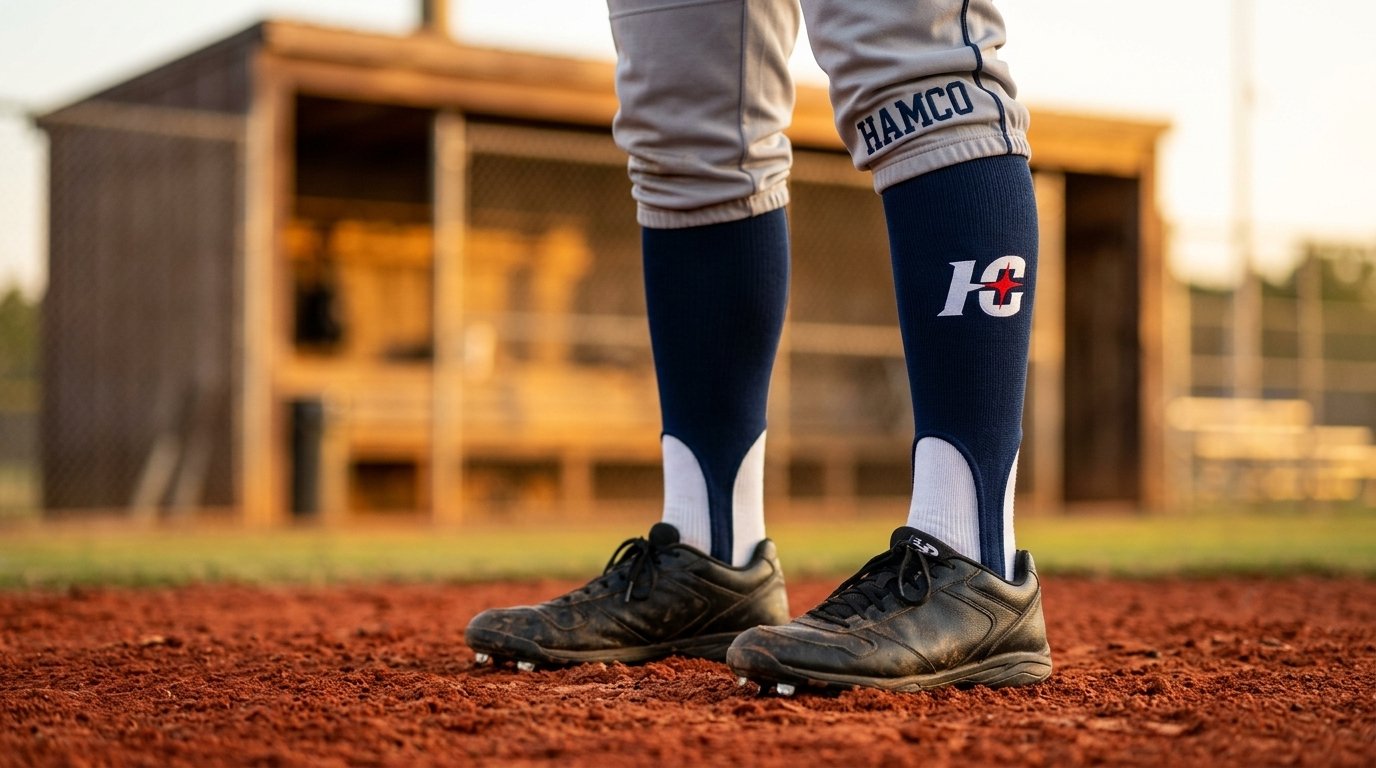
| Quick Answer Baseball stirrups are footless colored socks with a loop under the arch of the foot, worn over white sanitary socks. They were created in the early 1900s after infected spike wounds made players afraid of colored sock dye touching open cuts. The white sanitary sock sat against the skin while the colored stirrup displayed team identity on top. Stirrups defined the look of baseball for nearly a century before ankle length pants took over in the mid 1990s, and today they are making a strong comeback at youth, high school, college, and even MLB level. |
What Are Baseball Stirrups?
Walk into any old clubhouse photo from the 1950s through the 1980s and you will see the same thing on every pair of legs: a band of team color arcing up the calf with a strip of white showing at the ankle. That is the stirrup, and no other sport ever produced anything quite like it.
A baseball stirrup is a knee length sock with no toe and no heel. Instead of a foot, it has a narrow loop that slips under the arch, which is exactly why it borrowed its name from the stirrup irons used in horse riding. The stirrup is always worn as the top layer of a two sock system:
- Sanitary sock: A white sock worn directly against the skin, changed frequently for hygiene, which is where the old clubhouse term comes from
- Stirrup sock: The colored, footless team sock worn over the sanitary, carrying team colors, stripes, or logos
The gap in the stirrup exposes the white sanitary at the ankle, creating the layered two tone look that became one of the most recognizable visual signatures in all of sports.
The History: From Red Stockings to Ribbon Stirrups
The story starts before stirrups even existed. In the late 1860s, the Cincinnati Red Stockings introduced knickers and high red socks to the baseball uniform, showing off the lower leg in a way that was genuinely shocking to spectators at the time. Colored high socks quickly became standard across the sport, and several franchises were literally named after them: the Red Stockings, the Boston Red Sox, and the Chicago White Sox all take their identities from hosiery.
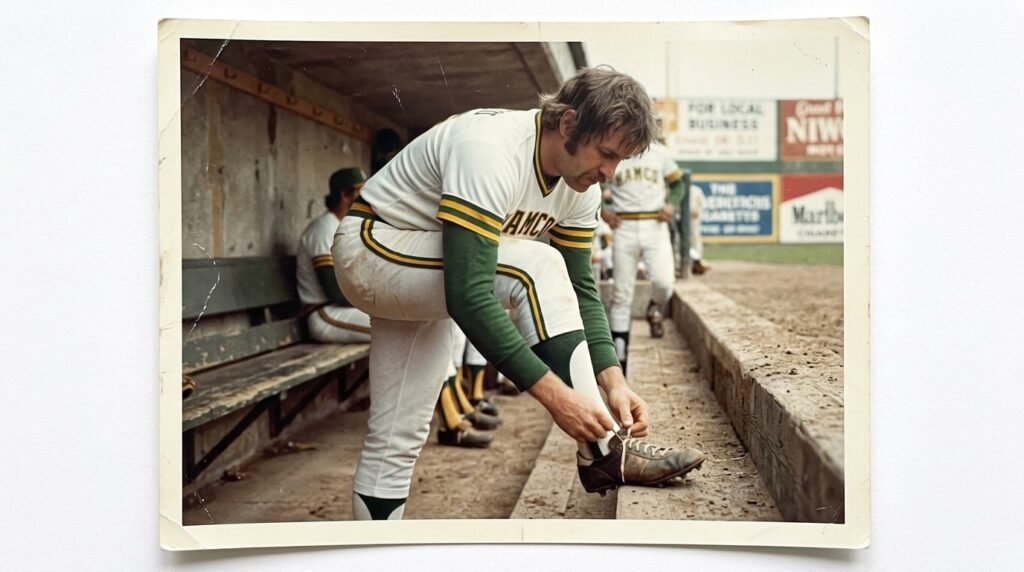
The stirrup itself was born from a medical scare. In 1905, star infielder Nap Lajoie was spiked on the field and the wound became badly infected. The blame fell on the dye in his colored socks, because fabric dyes in that era were not considered color fast and players believed dye entering an open cut could poison the blood. Lajoie nearly lost his leg. His solution was to wear clean white socks against the skin, but pulling a colored sock over a full white sock was bulky and awkward inside a tight baseball shoe. The fix was elegant: remove the foot from the colored sock entirely and leave only a loop under the arch. The stirrup sock was born, and the cheaper white sanitary underneath could be swapped out as often as needed.
A Century of Rising Loops
What began as a hygiene fix slowly turned into a style statement. Decade by decade, players stretched their stirrup loops higher and higher up the ankle, exposing more and more white:
| Era | Stirrup Style | What It Looked Like |
| 1900s to 1920s | Low cut stirrups | Loop sat at the ankle, stirrup mimicked a solid colored sock |
| 1930s to 1950s | Moderate openings | A clean crescent of white showing at the ankle, the classic vintage look |
| 1960s to 1970s | High stretched loops | Large white windows, with managers like Leo Durocher using a measuring stick to cap loops at about 4 inches |
| 1980s | Ribbon stirrups | Loops pulled so high that only thin vertical color lines showed beside the white sanitary |
| Mid 1990s onward | Pants to the ankle | Stirrups largely disappeared from MLB as long baggy pants took over |
| 2010s to today | The comeback era | High cuffed pants return, with real stirrups worn by players like Chris Archer and Francisco Lindor |
Teams also used stirrups as a branding canvas. The Minnesota Twins wore navy stirrups with a TC mark on the side for the Twin Cities, and the Houston Astros wore navy or orange stirrups with a contrasting star. In the 1980s, manufacturers even created a two in one sock that wove a fake stirrup stripe onto a plain white sock, imitating the layered look without the layers.
Why Did Players Stop Wearing Stirrups?
Starting in the mid 1990s, big league players began wearing their pant legs all the way down to the ankle, and the rest of baseball followed. A few forces drove the change:
- Style trends: Loose, long pants became the dominant fashion across the league and stirrups simply vanished from view
- Relaxed regulation: Uniform codes were enforced less strictly, so the old clubhouse rules that kept sock height uniform across a roster faded away
- Simpler alternatives: Two in one socks and solid knee high socks offered the high sock look without managing two layers
Interestingly, the official rules of baseball never mention stirrups at all. Rule 1.11 does require every player on a team to wear uniforms identical in color, trim, and style, which is why traditionalists argue that a roster mixing stirrups, solid socks, and low pants is technically out of uniform. For over a century, teams enforced exactly that kind of consistency.
The Stirrup Comeback
Baseball is a sport that loves its own history, and the stirrup never really died. MLB players such as Josh Outman, Chris Archer, and Francisco Lindor brought genuine stirrups over sanitaries back to the biggest stage. More importantly for most of our readers, the high sock and stirrup look has surged at the youth and high school level, where entire teams are choosing knickers and stirrups to stand out from a sea of baggy pants.
Modern stirrups also solved the old problems. Dye safety is no longer a concern, moisture wicking polyester has replaced heavy wool, and full dye sublimation means a stirrup can now carry gradients, logos, player numbers, and unlimited colors that old knit machines could never produce.
Stirrups vs Other Baseball Sock Options
| Option | How It Works | Best For |
| Traditional stirrup + sanitary | Two layers, colored footless loop over a white sock | Purist programs and throwback uniform sets |
| Two in one stirrup sock | One sock with the stirrup pattern built in, no separate sanitary needed | Teams that want the classic look with zero layering hassle |
| Solid knee high sock | One colored over the calf sock worn with knickers | Clean modern high sock look without the white window |
| Low pants, any sock | Pants cover everything to the ankle | Players who prefer the contemporary MLB style |
At Hamco, the most popular choice for teams today is the two in one style. Our custom baseball stirrup socks build the classic stirrup pattern into a single over the calf performance sock, fully sublimated in your team colors with logos and player numbers printed straight into the fabric. You get the 1970s look with none of the 1970s laundry.
How to Wear Traditional Stirrups the Right Way
- Put on the white sanitary sock first and pull it smooth to just below the knee
- Slip the stirrup loop under the arch of your foot, seam centered, before putting on your cleat
- Pull the stirrup up the calf and set the loop height so the white window shows evenly on both legs
- Blouse your knickers just below the knee so the pant covers the top edge of the stirrup
- Match loop height across the whole roster, because uniform means uniform, just ask Leo Durocher and his measuring stick
Choosing Stirrups for Your Team
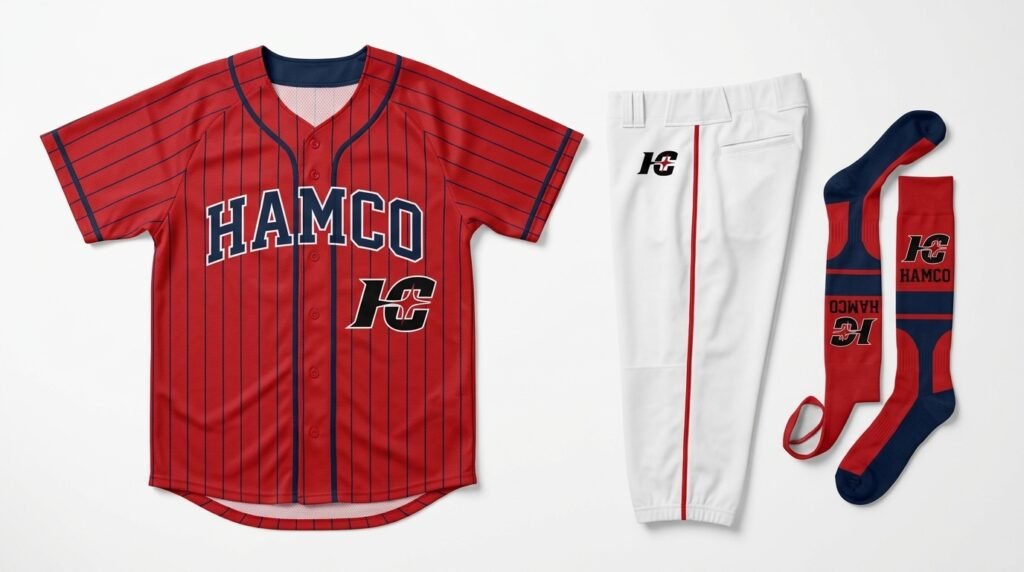
If you are outfitting a team, think about the sock as part of the full uniform system rather than an accessory. A few things worth checking before you order:
- Color matching: Sublimated stirrups allow unlimited colors and exact brand matching with your jerseys and pants, with no knit line limitations
- Fabric: Look for moisture wicking polyester with arch support, because a sock that slides mid game is a sock nobody wears twice
- Sizing: Youth and adult calf sizes are different, so order sized runs rather than one size fits all if your roster spans ages
- Batch consistency: Ordering socks in the same production batch as your uniforms locks the shade across every piece
Stirrups look best when the entire kit is designed together. Our custom baseball uniforms line covers jerseys, knickers, and socks as one coordinated package, and if you are planning a full team order from scratch, our complete buyer’s guide to custom baseball uniforms walks through fabrics, numbering rules, and design decisions step by step.
Frequently Asked Questions
1. Why are they called stirrups?
The footless loop that passes under the arch of the foot looks just like the stirrup iron a rider’s boot rests in, so the equestrian name carried over to the sock.
2. Do MLB players still wear stirrups?
Most wear long pants, but a visible minority wear high socks, and players like Chris Archer and Francisco Lindor have worn true stirrups over sanitaries. The high sock trend has been growing again since the 2010s.
3. What is the difference between a stirrup sock and a sanitary sock?
The sanitary is the plain white full sock worn against the skin. The stirrup is the colored footless sock worn on top of it. Modern two in one socks combine both into a single sock with the stirrup pattern woven or printed on.
4. Are stirrups legal in high school and youth baseball?
Yes. The rules of baseball do not restrict stirrups. The main requirement, in pro rules and in most sanctioning bodies, is that teammates dress consistently, so the safest approach is for the whole team to wear the same sock style at the same height.
5. Can stirrups be customized with team logos and colors?
Absolutely. With full dye sublimation, stirrup socks can carry unlimited colors, gradients, team logos, and even player numbers with no fading, cracking, or peeling, something the knit stirrups of the 20th century could never do.



1 thought on “Baseball Stirrups Explained: The History, Purpose, and Modern Comeback of Baseball’s Most Iconic Sock”