
Quick Answer
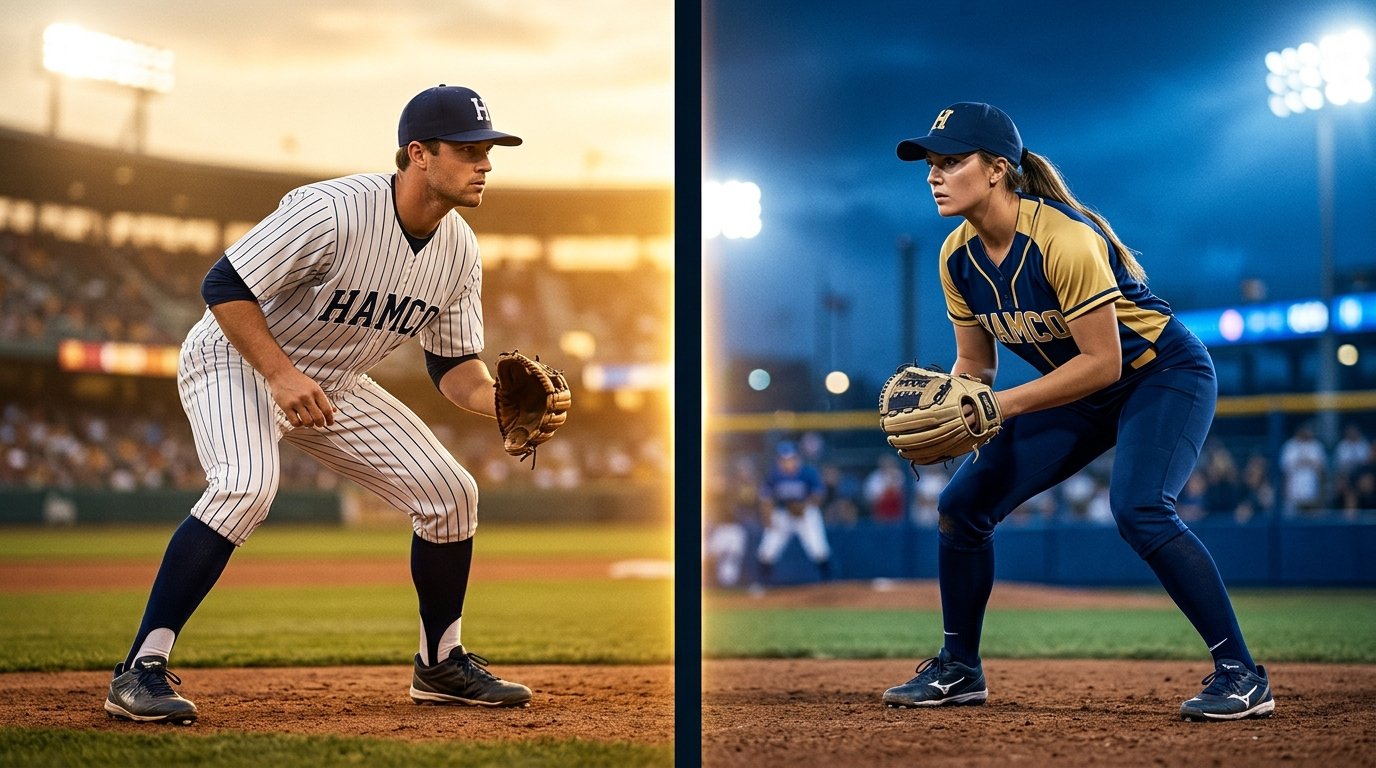
Baseball and softball pants are not the same. Baseball pants are cut looser, run full length or knicker, and almost always have belt loops and two back pockets. Fastpitch softball pants are cut on a women’s pattern with a larger hip. They come in full length, knicker, or short styles, and many youth styles use an elastic waist. The rules differ too. USA Softball numbers must be at least 3 inches and NFHS softball numbers at least 6 inches. Both NFHS baseball and softball have allowed jewelry since 2023.
Walk into any sporting goods store and you will find baseball and softball pants hanging side by side, looking almost the same. They are not. The fit is cut differently, the length options differ, and the waistband and pockets differ. Most parents shopping for a first travel ball season learn the baseball vs softball pants difference the hard way. A player says the pants ride up, bunch at the knees, or will not stay tucked. If your question is really fastpitch versus slowpitch, our fastpitch vs slowpitch softball gear guide covers that split.
This guide breaks down baseball vs softball pants first, because that is where the biggest fit problems happen. Then it covers jerseys, caps and visors, socks, belts, the 2026 uniform rules for each governing body, and what each piece costs. Every rule below links to the rule book it comes from, and every Hamco price comes from a product page you can open. For a full budget by team size, see our custom baseball uniforms cost guide.
Are Baseball and Softball Pants the Same?
No. Despite looking nearly identical on the rack, baseball and softball pants differ in cut, length options, waistband, and pockets. Men’s slowpitch softball pants are the closest match to baseball pants. Women’s and girls’ fastpitch pants are the most different. They are drafted on a women’s pattern with a shorter rise in front and more room at the hip. Wearing the wrong type will not get a player ejected, but it will affect comfort, movement, and how long the pants last.
Baseball vs Softball Pants and Uniforms: Side by Side Comparison
The softball vs baseball pants comparison below covers fit, fabric, and design at a glance. Jerseys, headwear, and accessories follow it.
| Feature | Baseball uniform | Softball uniform |
|---|---|---|
| Pants fit | Looser through hips and thighs | Fastpitch: women’s pattern, trimmer; slowpitch: close to baseball |
| Pants length | Full length over the cleats most common; knickers traditional | Full length, knicker, or shorts |
| Waistband | Elastic waist with belt loops; belt is part of the look | Belt loops or elastic; many youth styles use elastic only |
| Back pockets | Usually two | Varies by brand; some have none |
| Padding | Double knee and sliding seat | Double knee; some brands add hip pads, most rely on sliding shorts |
| Jersey cut | Looser through the torso and sleeves | Trimmer, cut for a female athlete in fastpitch |
| Jersey closure | Full button most traditional; 2 button pullover common | Pullover most common; full button at higher levels |
| Headwear | Cap, almost universal | Cap or visor; both allowed in fastpitch |
| Socks | Stirrups, crew, or knee high | Knee high most common, often two tone |
| Color habits | White, gray, navy, pinstripes | Bolder colors and sublimated patterns |
| Sizing chart | Men’s or unisex | Women’s and girls’ for fastpitch; men’s for slowpitch |
The Difference Between Baseball and Softball Pants (In Detail)
1. Fit and Cut
Baseball pants are cut on a looser block. The thighs have more room and the seat has more drape, even on competitive pants. That is tradition. Baseball’s look has always favored a slightly baggy line, and pant patterns follow it.
Fastpitch softball pants run trimmer through the hips, thighs, and knees. For girls and women, the pattern is drafted on a women’s fit block. That means a shorter rise in front, a higher rise in back, and a hip measurement that is larger than the chest. You can see that in the women’s size chart on our custom softball pants page. In women’s XS the hip is 33 to 35 inches against a 30 to 32 inch chest. The men’s XS chart lists 32 to 34 for both. Men’s slowpitch pants sit in between, closer to baseball pants.
2. Length
Baseball pants are most often worn full length, over the top of the cleats. The knicker style, ending below the knee with socks pulled up, is the classic look from old photos and throwback uniforms. It is the minority choice at most levels today. Our baseball stirrups guide explains the sock side of that look.
Softball pants come in three lengths. Full length pants are common at the competitive fastpitch level. Knickers worn over knee high socks are a softball staple in high school and college. Softball shorts, cut at mid thigh, are the third option that you almost never see in baseball. Many fastpitch programs wear pants for games and shorts for practice, or let players choose by position.
3. Padding and Reinforcement
Both sports use double knee construction on game pants. Baseball pants also reinforce the seat for sliding. Some fastpitch brands sew slide pads into the hip and outer thigh. That is not universal, and it is not something Hamco does on its softball pants. Our softball pants use a 240 GSM woven polyester shell with double knee reinforcement and belt loops. That is the same build and the same price as our baseball pants. If your players want hip protection, order sliding shorts under the pants.
4. Waistband, Belt Loops, and Pockets
Baseball pants almost always have an elastic waist with belt loops and two back pockets. The belt is part of the look. Hamco’s custom baseball pants follow that build, with a snap and zipper fly.
Softball pants are split. Adult and high school fastpitch pants often have belt loops too. Many youth styles skip them for an elastic waist with a drawstring, which is quicker for kids to put on. Pockets vary by brand. Some softball pants have one back pocket, some have none. Check the product page before you order, because a coach who expects pockets for batting gloves will be annoyed on game day.
5. Color
Baseball pants come in white, gray, and a few dark solids, plus pinstripes. Anything bolder looks off for the sport. Softball pants use the whole palette. Black, navy, and gray are still the most common, but royal blue, red, purple, and pink show up at the youth and travel level. Sublimated pants with side panels and team graphics are increasingly common in fastpitch and rare in baseball.
Baseball vs Softball Jerseys
Jerseys are the second biggest difference and the one most people underestimate.
Baseball jerseys lean traditional. The cut is looser through the torso and sleeves. Full button jerseys are the most formal option and remain standard in MLB and at the higher travel ball levels. Two button pullovers are common at youth and rec levels. Colors stay conservative: white at home, gray on the road, with team color in piping, sleeve bands, and lettering. Our baseball jersey design guide has the classic layouts.
Softball jerseys, especially fastpitch, use a trimmer athletic cut on a women’s pattern. Pullovers are far more common than button fronts, since they layer over compression gear and have no placket to dig in on a slide. Sleeve length varies more in softball than in baseball: cap sleeves, short sleeves, and sleeveless jerseys are all standard at the women’s level. Hamco’s softball V neck jerseys are cut on a female athlete pattern, not a unisex pattern sized down.
Design is where softball teams get bold. Two tone color blocking, side panels, sublimated patterns, and big chest wordmarks are part of the modern fastpitch look. For ideas, see our guide to designing your own softball uniforms.
Headwear: Baseball Caps vs Softball Visors
Baseball is a cap sport. Fitted, snapback, or adjustable, almost every player wears a structured cap in team colors.
Softball is a cap and visor sport, and the rules say so. The 2026 USA Softball rule book (Rule 3, Section 6) makes ball caps mandatory and alike in male fastpitch. In female fastpitch and all slowpitch, caps, visors, and headbands are optional and may be mixed on the same team. Allowed colors are black, white, gray, beige, pink, or team colors. Plastic visors are not allowed. NFHS softball also lets caps and visors be mixed in white, black, beige, or school colors, per the USA Softball, NCAA, and NFHS comparison sheet. So a team can order custom visors for some players and caps for others without breaking a rule.
Socks, Belts, and Undergear
Socks: baseball uses stirrups over sanitary socks for the classic look, crew socks under full length pants, or knee high solids. Softball most often uses knee high socks, often two tone, because knickers and shorts show more sock.
Belts: baseball almost always uses a belt in a team color. Softball belt use depends on the pants. Belt loops mean a belt; an elastic waist means no belt.
Undershirts and sliding shorts: both sports use them, but fastpitch relies on them more. The rules treat exposed undergarments as part of the uniform. USA Softball allows a solid color undershirt and solid color sliding pants. If more than one player wears them, they must be alike in color and style. NFHS softball requires exposed undergarments to be a solid single color: black, white, gray, or a school color. NCAA softball requires visible undergarments to contrast with the ball color. All three are quoted in the 2026 comparison sheet.
League Uniform Rules to Know in 2026
Uniform rules differ by governing body, and some of the rules repeated online are years out of date. Here is what the current rule books say.
| Rule | USA Softball 2026 | NFHS softball 2025/26 | NFHS baseball 2025/26 |
|---|---|---|---|
| Numbers | Arabic whole number 0 to 99, at least 3 inches high, on all uniform shirts; 0 and 00 count as different numbers | Back number at least 6 inches high, solid contrasting color; 0 and 00 count as the same number | Numbers required; see your state’s current NFHS baseball uniform sheet for size |
| Jewelry | Allowed unless the umpire judges it dangerous; religious and medical alert items must be taped | Allowed since 2023; umpires may still remove distracting or risky items | Allowed since 2023 (Rule 1 5 12); umpires may still remove distracting or risky items |
| Headwear | Caps mandatory and alike in male fastpitch; optional and mixable in female fastpitch and slowpitch | Caps and visors may be mixed; white, black, beige, or school colors | Caps are the norm; check the state sheet |
| Undershirts | Solid color; alike if more than one player wears one | Solid single color: black, white, gray, or school color | Check the state sheet |
| Metal cleats | Allowed in listed Junior Olympic fastpitch classes | Metal cleats and toe plates permitted | Permitted |
Three corrections to common claims, including claims an earlier version of this page made. First, USA Softball does not require 6 inch numbers. Its minimum is 3 inches, and the number goes on all uniform shirts, not only the back. The 6 inch back number is an NFHS softball rule. Second, the NFHS does not prohibit jewelry. The NFHS softball rules committee approved jewelry starting with the 2023 season, and the baseball committee did the same for 2023. The MHSAA 2025/26 NFHS uniform summary confirms both. Third, NCAA softball’s undershirt rule is about contrast with the ball, not a ban on white or gray.
Little League requires all players on a team to wear numbered uniforms identical in color, trim, and style. Each league must also provide batting helmets that meet NOCSAE standards. Both are in Little League Rules 1.11 and 1.16. Our Little League rules guide covers the rest of the rule book. Travel ball and rec leagues vary. Many follow USA Softball or USSSA rules by default, so confirm the current rule book before you finalize number sizes and sleeve colors.
What Do Baseball and Softball Uniforms Cost in 2026?
Here is where the two sports split in a way most comparison articles never show. The pants cost the same. The savings in softball come from pullover jerseys and shorts. These are Hamco’s published prices per piece on October 1, 2026, with names, numbers, team logo, a 12 hour mockup, and shipping included.
| Hamco item | 1 to 24 | 25 to 50 | 51 to 100 | 101 or more |
|---|---|---|---|---|
| Baseball pants (full length, belt loops, two pockets) | $49.99 | $47.99 | $44.99 | $39.99 |
| Softball standard pants (240 GSM, belt loops, double knee) | $49.99 | $47.99 | $44.99 | $39.99 |
| Baseball knickers | $44.99 | $42.99 | $41.99 | $34.99 |
| Softball knickers | $44.99 | $42.99 | $41.99 | $34.99 |
| Baseball full button jersey (165 GSM) | $44.99 | $42.99 | $41.99 | $39.99 |
| Softball full button jersey (180 GSM) | $44.99 | $42.99 | $41.99 | $34.99 |
| Baseball 2 button jersey | $44.99 | $42.99 | $41.99 | $34.99 |
| Softball V neck jersey (180 GSM) | $41.99 | $39.99 | $37.99 | $29.99 |
| Baseball sliding shorts (85/15 poly spandex, cup pocket) | $48.99 | $46.99 | $42.99 | $39.99 |
| Softball shorts (9 to 11 inch inseam) | $34.99 | $32.99 | $29.99 | $26.99 |
| Softball visors | $29.99 | $24.99 | $21.99 | $19.99 |
A 12 player fastpitch team in V neck jerseys, standard pants, and visors pays about $121.97 per player before tax at the 1 to 24 tier. The same 12 player baseball team in 2 button jerseys and full length pants pays $94.98 per player, plus a cap from another supplier. Add a second jersey for home and away and the gap grows. The softball V neck is $3 cheaper per piece, and softball shorts are $14 cheaper than sliding shorts. If you want a full set in one order, the softball racerback uniform set starts at $89.99 per player for jersey and pants together.
Every Hamco baseball and softball piece is ready 2–3 weeks after design approval, then arrives in 3–5 days, with no minimum order. Need it sooner? Ask for a free rush. We say yes when production allows. Prices drop at 25, 51, and 101 pieces, and the drop is the same for both sports. A combined baseball and softball program order moves up a tier faster.
Custom Baseball and Softball Uniforms: What to Look For
- Sport specific patterns. A jersey cut on a men’s baseball pattern will not fit a fastpitch player. Ask whether the women’s sizes are a separate pattern or a men’s pattern sized down. Hamco’s softball jerseys and pants carry a separate women’s chart with the hip larger than the chest.
- Fabric weight. Game pants should be a woven shell with double knees, about 240 GSM. Jerseys run 165 to 180 GSM moisture wicking knit. Shorts are a lighter knit. If a supplier will not state the weight, ask for a swatch.
- Sublimation. Dye sublimated polyester holds color through a season because the dye is in the fiber, not on top. Ask for a Pantone match on team colors and check it on a printed mockup, not a phone screen.
- One supplier for the kit. Navy from two vendors is two navies. Order jerseys, pants, socks, and visors from one place so the color matches.
- Turnaround and reorders. At Hamco, your order is ready 2–3 weeks after you approve your design, then it arrives 3–5 days later. Ask any supplier to keep your design file so a mid season replacement matches.
Hamco designs both lines in the USA and makes them overseas in our own factory, with free mockups within 12 hours, unlimited revisions, free US shipping, and no minimum. Start on our custom baseball uniforms or custom softball uniforms page. If you are comparing vendors, our softball uniform companies comparison lists published prices side by side. The travel baseball uniforms guide covers what a travel program needs in a full kit.
What we do not do: we do not sell baseball caps, belts, or batting helmets. We do not sew hip slide pads into softball pants. For hip protection, wear sliding shorts.
Frequently Asked Questions
Are baseball and softball pants the same?
No. Baseball pants are cut looser, almost always have belt loops and two back pockets, and run full length or knicker. Fastpitch softball pants use a women’s pattern with a larger hip. They come in full length, knicker, or shorts, and many youth styles use an elastic waist. Men’s slowpitch pants are close to baseball pants.
Can softball players wear baseball pants, and the other way around?
Yes, no rule book bans it. Men’s slowpitch players can wear baseball pants with no real issue. Fastpitch players usually get a poor fit at the hip and waist and a longer inseam than they need. Baseball players in women’s fastpitch pants get a tight hip and no sliding seat.
Is there a difference between baseball and softball pants for kids?
Yes, mostly in fastpitch. Girls’ fastpitch pants use a women’s or girls’ chart with a curvier hip and often an elastic waist for easy dressing. Youth baseball pants use a straighter cut with belt loops and reinforced knees. A poor fit at this age shows up as pants that ride up or will not stay tucked.
Why do softball players wear visors instead of caps?
Visors give sun protection without a closed crown, fit over a ponytail, and swap on and off with a batting helmet quickly. USA Softball lets female fastpitch and slowpitch players choose caps, visors, or headbands and mix them on one team. Male fastpitch must wear matching caps.
Are baseball and softball uniforms regulated differently?
Yes. USA Softball requires 3 inch numbers on all uniform shirts. NFHS softball requires a 6 inch back number. Both NFHS baseball and softball have allowed jewelry since 2023. NCAA softball requires visible undergarments to contrast with the ball. Little League requires matching numbered uniforms and NOCSAE helmets. Always check the current rule book for your league.

3 thoughts on “Baseball vs Softball Pants and Uniforms: The Real Differences (2026 Guide)”