| Quick Answer Teaching youth pitching mechanics comes down to four simple checkpoints: a balanced leg lift, a straight stride toward the plate, the throwing arm up on time, and a full follow through out front. But mechanics come second. Arm care comes first. A 10 year old should throw only a fastball and a changeup, stay under 75 pitches in a day, and never pitch through pain. Overuse, not bad form or curveballs, is what wrecks young arms. |
Every parent teaching a kid to pitch worries about the same two things, usually in the wrong order. They obsess over velocity and mechanics, and barely think about the arm those mechanics are wearing down. Flip that. The honest truth of teaching youth pitching mechanics is that keeping the arm healthy matters more than any drill, because a perfect delivery on an injured arm is worthless. This guide covers the mechanics you can teach in one session, but it starts and ends with arm care. If your player is brand new to throwing, build the base first with our beginner drills, then come back to the mound.
A word on who this is for. You do not need to be a former pitcher to teach solid youth pitching technique to a 10 year old, you need a few clear checkpoints and the discipline to protect the arm. Keep it simple, keep it short, and stop the moment anything hurts. All you need is a ball, a target, and a flat surface, though a proper glove and cleats help, which our pitching gear guide covers. Here is how to build clean kid pitching form without putting an arm at risk.
The Four Checkpoints You Can Teach in One Session
Good pitching looks complicated, but for a young player it breaks into four checkpoints you can teach in a single session. Do not overload a kid with more than these. Simple and repeatable beats perfect and confusing every time.
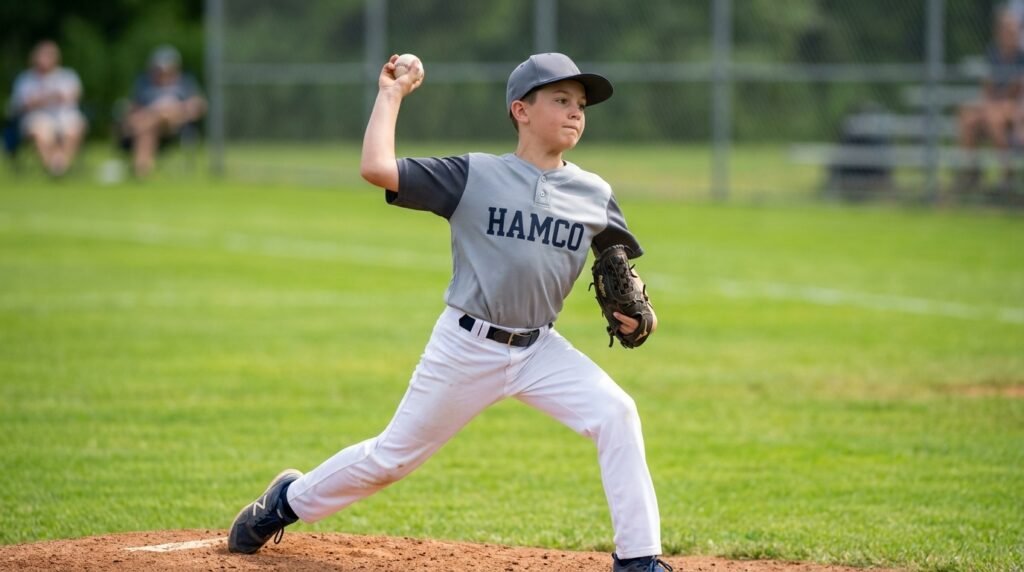
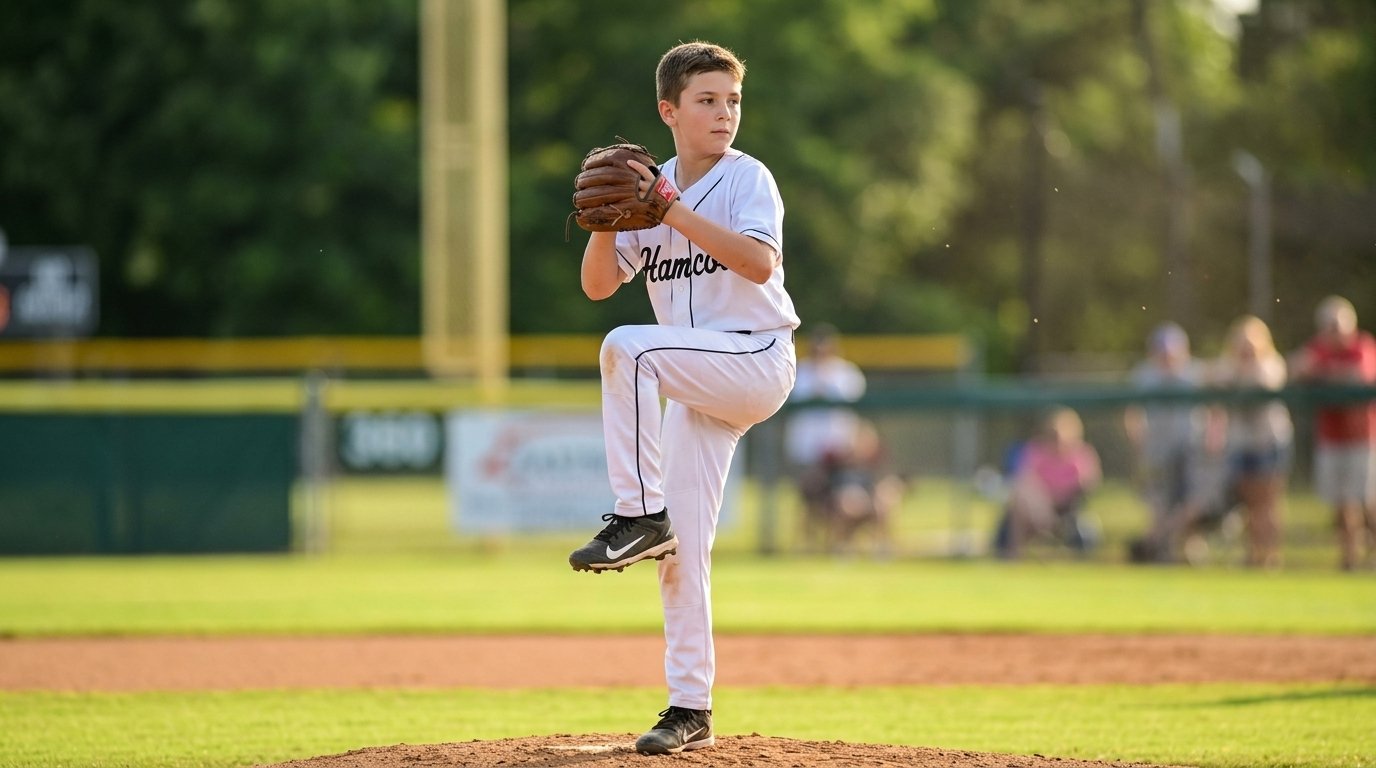
First, the balance point. The pitcher lifts the front knee to about waist height and holds a beat, balanced over the back leg, before anything moves forward. Rushing this is the root of most youth flaws. Second, the stride and direction. The front foot strides straight toward the target, not off to the side, and lands on a firm front leg that the body can rotate over. Third, the arm up on time. When the front foot lands, the throwing arm should already be up near shoulder height with the ball facing away, not still down by the hip. Fourth, the follow through. After release, the arm decelerates across the body and the back leg comes around, finishing balanced and out front. That deceleration is not decoration, it is how the arm sheds force safely instead of yanking to a stop.
The Pitch Types Kids Should Not Throw Yet
This is the section that starts arguments, so here is the straight version. A young pitcher should throw two pitches: a four seam fastball and a changeup. That is it. The fastball builds arm strength and command, and the changeup is completely safe for young arms because it is thrown with the same motion as the fastball, just with a different grip that takes speed off. A good changeup makes a 10 year old far more effective than any breaking ball would, and it costs the arm nothing.
Curveballs and sliders are the pitches to hold back. The guidance from Pitch Smart, the MLB and USA Baseball safety program, is to avoid breaking balls until at least age 13 or 14, and only after the fastball and changeup are consistent. The reason is that a young pitcher’s growth plates and elbow ligament are still developing, and the twisting force of a breaking ball on tissue that is not ready is a documented risk. It is worth being honest about the research here: studies suggest overuse and fatigue cause far more injuries than the curveball itself, but since a beginner cannot throw a curveball without straining to do it, the practical rule stands. No breaking balls until the mid teens.
Pitch Count Limits by Age
If you take one thing from this article, take this. Pitch counts are the single most effective tool for preventing arm injuries, and they are not optional. The Pitch Smart guidelines set a daily maximum by age and, just as important, the number of rest days a pitcher needs afterward. For a 10 year old, the daily ceiling is 75 pitches, and if they throw 66 or more, they need four full days of no pitching before they take the mound again. These are ceilings, not targets, and most outings should finish well below them. Many leagues, including Little League pitch count rules, now enforce these by rule and track every pitch. The chart and table lay out the limits.
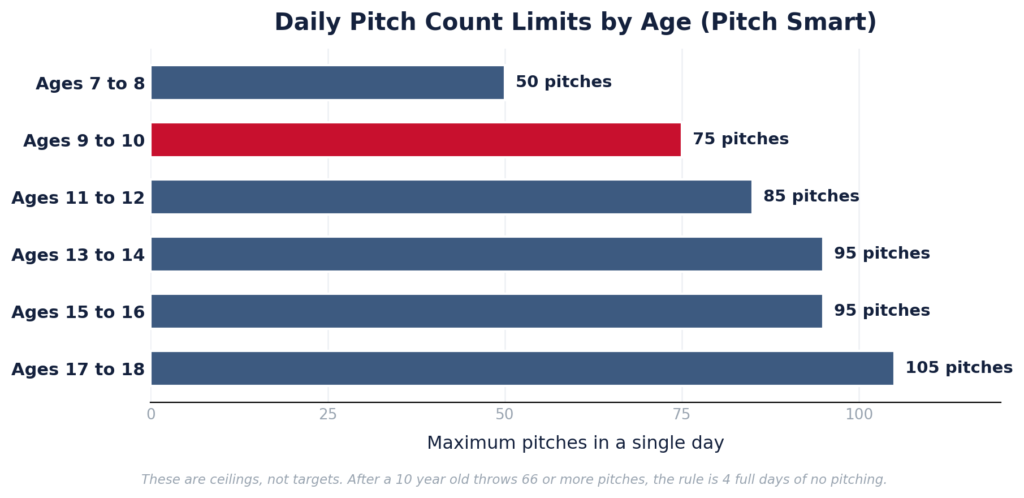
| Age | Daily Max | Rest at 51 to 65 | Rest at 66 plus | Breaking Balls? |
| 7 to 8 | 50 | 3 days | 4 days | No |
| 9 to 10 | 75 | 3 days | 4 days | No |
| 11 to 12 | 85 | 3 days | 4 days | No |
| 13 to 14 | 95 | 3 days | 4 days | Only after mastering fastball and changeup |
| 15 to 16 | 95 | 3 days at 61 to 80 | 4 days at 81 plus | Yes |
| 17 to 18 | 105 | 3 days at 61 to 80 | 4 days at 81 plus | Yes |
Three rules that go with the numbers: a pitcher should not also catch on a day they pitch, should not pitch on multiple teams in overlapping seasons, and should take at least four months off from throwing every year, with two to three of them in a row. Roughly 60 to 70 percent of a young arm’s stress comes from throwing outside games, so bullpens and long backyard sessions count too.
The Warning Signs of Arm Trouble Parents Miss
Kids will not tell you their arm hurts, because they want to keep pitching. So you have to read the signs they do not say out loud. The clearest early warning is a drop in velocity or command late in an outing, since a tired arm loses both. Watch for a pitcher shaking or rubbing the arm between pitches, taking longer to recover between innings, or quietly dropping their arm slot. On the stat sheet, a what WHIP measures number that climbs across several starts often signals fatigue before anything else does, since command is the first thing to go, and the same is true of a rising what ERA measures over time.
| The One Rule That Overrides Everything Any pain in the elbow or shoulder means stop pitching immediately, that day and until it is checked. Arm pain in a young pitcher is never normal and never something to throw through. If pain persists, see a doctor, not a coach. No game, no inning, and no tournament is worth a growth plate or a ligament in a 10 year old. |
How to Fix the Three Most Common Youth Flaws
Almost every young pitcher shares the same three flaws, and all three are fixable with a checkpoint, not a lecture.
The first is rushing, drifting toward the plate before reaching the balance point, which leaves the arm dragging behind the body. The fix is the balance drill: have the pitcher lift the knee and hold it for a two count before striding. The second is a late arm, where the throwing arm is still down when the front foot lands, forcing the arm to catch up and stressing the shoulder. The fix is to freeze the delivery at foot strike and check that the ball is already up. The third is throwing all arm, with a stiff or collapsing front leg and no lower body, which is both weak and unsafe. The fix is teaching the stride to land on a firm front leg the hips can rotate over, so the legs and core carry the load instead of the arm. Pitching is one of the hardest jobs on the field, as our how hard pitching is breakdown lays out, so patience with these fixes is part of the job.
When to Call in a Private Pitching Coach
You can teach the four checkpoints and manage a pitch count yourself. A private coach becomes worth the money in a few specific cases, and it helps to be honest about which. If a pitcher has real ambitions past the local level, a qualified instructor can refine mechanics beyond what a parent can see. If you have tried the checkpoint fixes and a flaw will not budge, a fresh expert eye, ideally with video, can catch what you cannot. And if there is any history of arm pain, a coach who works alongside a physical therapist is worth every dollar.
Two honest cautions when you hire one. Avoid any instructor who sells radar gun velocity to a pre teen as the goal, since chasing velocity is how young arms break. And a good youth pitching coach should talk about arm care and pitch counts without being asked. If they never mention the arm, find another one. The right coach protects the player first and develops them second, in that order.
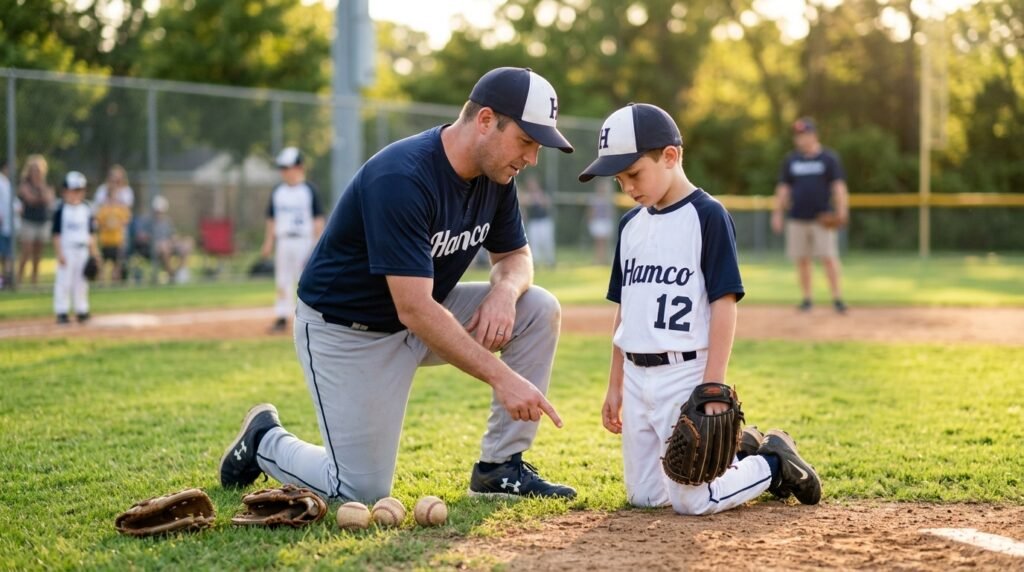
A pitcher wears out a uniform faster than anyone on the field, and always in the same place, the throwing shoulder, from thousands of reps. That is why we reinforce it. Our pitcher jerseys are cut full button with reinforced shoulder seams and durable sublimated fabric that holds up to a full season on the mound. Outfit the whole staff and the rest of the roster in matching baseball uniforms, with custom numbering, a free mockup, and about a three week turnaround.
Frequently Asked Questions
Q: How do you teach youth pitching mechanics?
A: Use four checkpoints: a balanced leg lift, a straight stride toward the plate, the throwing arm up when the front foot lands, and a full follow through out front. Keep it simple and protect the arm above all.
Q: What is good youth pitching technique for a beginner?
A: Command over velocity, and a fastball and changeup only. A young pitcher who throws strikes with two pitches and clean mechanics beats one chasing speed every time.
Q: How do you teach kid pitching form without hurting the arm?
A: Arm care first. Stay under the pitch count for the age, take the required rest days, hold off on breaking balls, and stop the instant anything hurts. Overuse is the main cause of injury.
Q: What age can a kid throw a curveball?
A: Not before 13 or 14, and only after the fastball and changeup are consistent. Young growth plates and ligaments are not ready for the twisting force of a breaking ball.
Q: How many pitches should a 10 year old throw? A: No more than 75 in a day under Pitch Smart guidelines, and most outings should be well below that. After 66 or more pitches, a 10 year old needs four full rest days.