| Quick Answer Wrestling weight classes change at every level. High school wrestling uses 14 weight classes under NFHS rules, from 106 to 285 pounds for boys. College wrestling uses 10 NCAA weight classes, from 125 to 285 pounds. Youth weights are flexible and set by age bracket, and international freestyle uses metric classes. Strict certification and weight cutting rules govern how low a wrestler can safely go. |
Wrestling is the only major sport where your size category is something you manage, weigh in for, and sometimes agonize over. The weight classes are the backbone of the whole sport, and they are not the same from one level to the next. A 14 year old, a high school senior, and a college wrestler all step onto the same mat but into different numbers. This guide lays out the wrestling weight classes at every level, youth through college and international, plus the rules on allowances, certification, and cutting that most charts leave out. Since the singlet is sized straight to the wrestler, our singlet guide pairs naturally with the weight breakdown below.
Here is the honest starting point. There is no single set of wrestling weight classes. The number and the exact pounds depend on your age, your governing body, and your gender, and they get revised every few years. The most recent big change came in 2023, when the national high school federation reworked its numbers. Weigh ins, singlet requirements, and weight rules all live in the same rulebook, which our uniform rules guide covers separately. So what are the weight classes in wrestling? Here is the full picture in one place, then the detail on each level.
| Level | Weight Classes | How Many |
| High school boys (NFHS) | 106, 113, 120, 126, 132, 138, 144, 150, 157, 165, 175, 190, 215, 285 lb | 14 |
| High school girls (NFHS) | 100, 105, 110, 115, 120, 125, 130, 135, 140, 145, 155, 170, 190, 235 lb | 14 |
| College men (NCAA D1, D2, D3) | 125, 133, 141, 149, 157, 165, 174, 184, 197, 285 lb | 10 |
| College women (NCWWC) | 101, 109, 116, 123, 130, 136, 143, 155, 170, 191 lb | 10 |
| Olympic freestyle men (UWW) | 57, 65, 74, 86, 97, 125 kg | 6 |
| Olympic freestyle women (UWW) | 50, 53, 57, 62, 68, 76 kg | 6 |
Women’s college numbers still vary slightly by sanctioning body, and World Championships in non Olympic years add more classes than the six shown.
Youth Wrestling Weight Classes
Youth wrestling is the one level with no fixed national chart. Under USA Wrestling, kids compete in age divisions, 8U, 10U, 12U, and 14U, and the weight classes sit inside each division. They are spaced close together, often just 3 to 6 pounds apart at the youngest ages, because a 6 pound gap means a lot more when a kid weighs 50 pounds than when they weigh 250. Many local tournaments do not use fixed classes at all. They use a bracketing system, where the director weighs everyone in and groups the closest 8 or 16 kids together on the day. The honest takeaway for parents: at the youngest ages, do not chase a specific number. Let the child wrestle near their natural weight and grow into the structure later. No young kid should be cutting weight.
High School (NFHS) Weight Classes
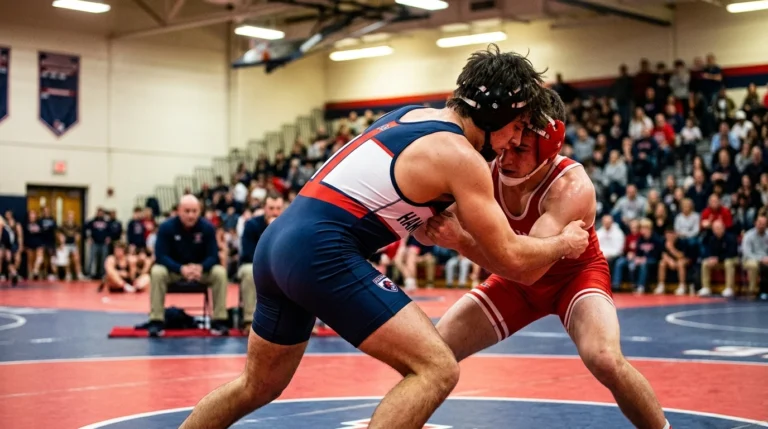
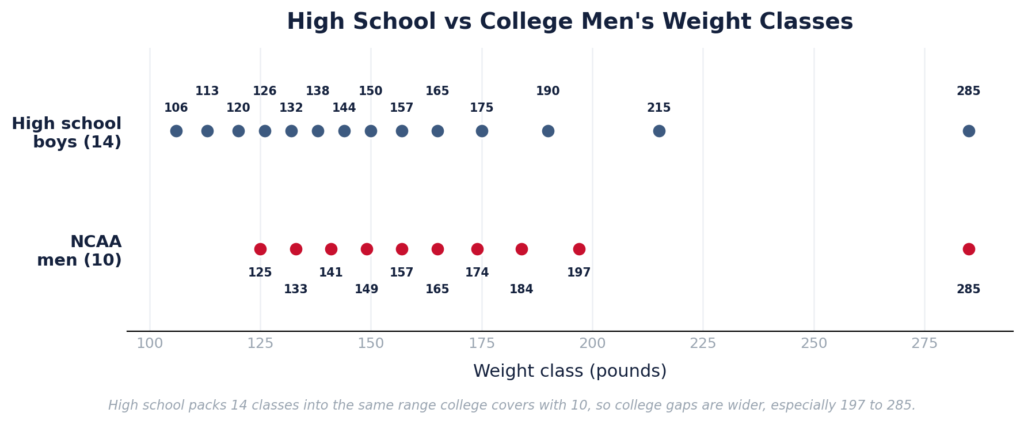
High school is where weight classes get formal. The National Federation of State High School Associations, the NFHS, sets the standard, and as of the 2023 to 2024 season it offers states a choice of three sets, 12, 13, or 14 classes. Most states use the 14 class set, so how many weight classes in high school wrestling? Fourteen, in most of the country. For boys, the 14 classes run 106, 113, 120, 126, 132, 138, 144, 150, 157, 165, 175, 190, 215, and 285 pounds, with 285 as an unlimited heavyweight cap. Notice the gaps widen as the weights climb, since a few pounds matter far more at 113 than at 215. Girls high school wrestling, one of the fastest growing sports in the country, got its own standardized 14 class set in 2023: 100, 105, 110, 115, 120, 125, 130, 135, 140, 145, 155, 170, 190, and 235 pounds. A singlet has to fit every one of those bodies, from the narrow 106 pounder to the heavyweight, which is why our buying guide sizes by weight class rather than a generic small, medium, and large.
College Weight Classes: NCAA Division I, II, and III
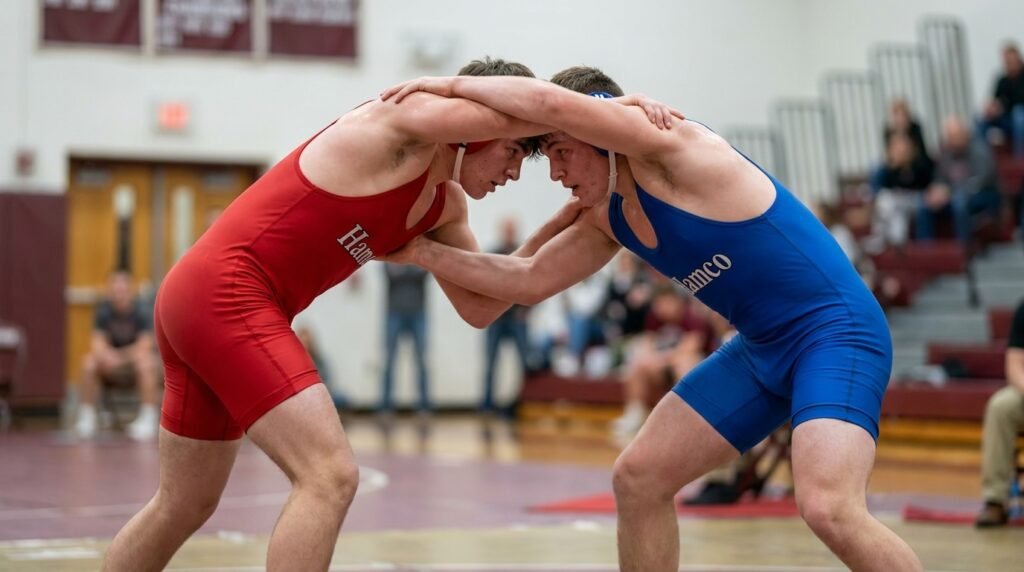
College tightens the field. So how many weight classes in college wrestling? Ten. The NCAA uses 10 men’s weight classes, and all three divisions, Division I, II, and III, wrestle the same numbers: 125, 133, 141, 149, 157, 165, 174, 184, 197, and 285 pounds. Because there are only 10 classes spread across the same range high school covers with 14, the college classes sit farther apart and the jumps are bigger. That gap matters at recruiting time. A high school 157 pounder might land at 149 or 157 in college depending on how they fill out, and the space between 197 and 285 is a canyon that many light heavyweights have to navigate. Women’s college wrestling, now an official NCAA championship sport after years as an emerging program, commonly uses 10 classes as well, roughly 101, 109, 116, 123, 130, 136, 143, 155, 170, and 191 pounds, though the exact ncaa wrestling weight classes for women still vary by sanctioning body as the sport settles. That growth has brought a wave of women’s specific gear too, right down to women’s singlet cuts and design. The chart shows how the high school and college men’s classes line up, and where they do not.
Freestyle and International Weights
Step onto the international mat and the whole system switches to metric. United World Wrestling, the global governing body, runs freestyle and Greco Roman, and its weight classes are in kilograms. For the Olympic Games there are six classes per style. Men’s freestyle runs 57, 65, 74, 86, 97, and 125 kilograms, while women’s freestyle runs 50, 53, 57, 62, 68, and 76 kilograms. World Championships in non Olympic years add more classes, up to 10, to give more athletes a shot. If you only ever wrestled in pounds, the switch is jarring: 57 kilograms is about 126 pounds, and 125 kilograms is about 275. American wrestlers chasing an Olympic path have to learn to think in both systems at once.
The Weight Allowance Over a Season
Weight classes are not quite as fixed as the charts suggest, because wrestlers are still growing. To account for that, both high school and college build in a weight allowance that grows as the season goes on. Under NFHS rules, a 2 pound growth allowance is added to every class after the new year, so a 132 pounder is really wrestling 134 for the back half of the season. There is also typically an extra pound for the second day of a multi day tournament, since making weight two mornings in a row is harder than once. College uses a similar consecutive day allowance. It is a small thing that matters enormously to a wrestler sitting right on the line, and it is one of the honest little mercies built into the rulebook.
Weight Certification Rules
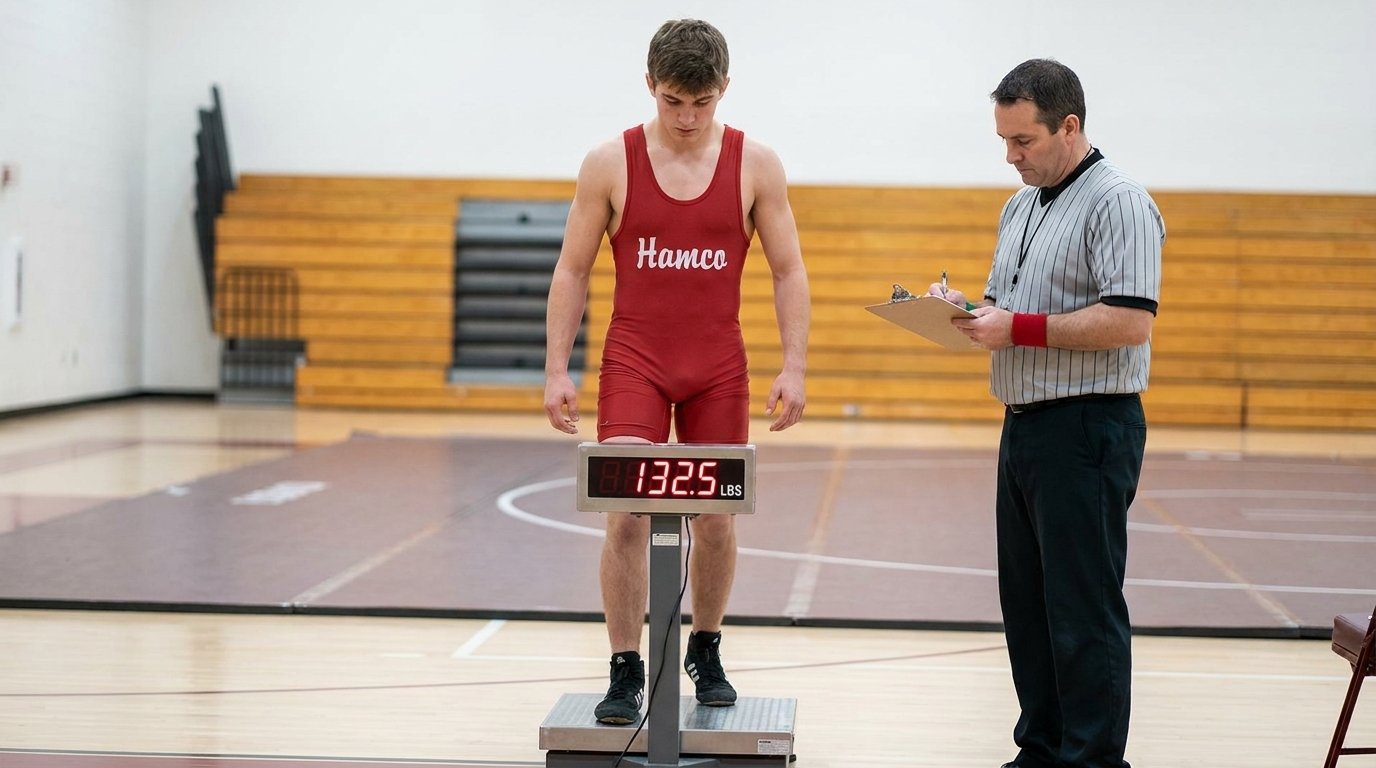
Before a wrestler can compete at a given class, most levels require weight certification, and this is where the modern sport protects its athletes. At the start of the season a wrestler takes a hydration test, a urine specific gravity check, to prove they are not already dehydrated. Then a body composition assessment measures body fat. From those two numbers, a formula sets the lowest weight class the athlete is allowed to certify for, based on a minimum body fat, 7 percent for high school boys and 12 percent for girls, and 5 percent for college men. A wrestler simply cannot certify below that floor. On top of that, the descent plan caps how fast they can get there, at no more than 1.5 percent of body weight per week. The whole system, run through the coaches association calculator, exists to make the dangerous version of this sport against the rules.
Weight Cutting: What Is Legal and What Is Safe
No honest article on wrestling weight classes can skip this. Weight cutting, dropping pounds fast to compete in a lower class, is the sport’s oldest and darkest habit. For decades it was brutal and unregulated, until the fall of 1997, when three college wrestlers died in separate incidents within about six weeks, pushing themselves through extreme dehydration to make weight. The sport responded. Rubber and plastic sweat suits, saunas used for cutting, diuretics, laxatives, and self induced vomiting are all now banned, and the certification and hydration rules above came directly out of those deaths. So what is legal and safe is straightforward: eat and hydrate properly, manage weight gradually inside your certified plan, and treat the number on the scale as a limit, not a target to starve toward. What is neither legal nor safe is any method that works by dehydration or starvation. If a wrestler cannot make a class while eating and drinking like a healthy athlete, the class is too low, full stop. Wrestlers and parents should lean on the school’s certification program and a doctor, not locker room folklore. The gear takes a beating during a hard season too, so proper singlet care keeps it lasting, but the wrestler’s health always comes first. This is a sensitive area, and any wrestler feeling pressure to control weight in unhealthy ways should talk to a trusted adult or medical professional.

Outfitting a full roster across 14 weight classes is its own budgeting exercise, and our pricing guide breaks down what a season of singlets actually costs. Different weight classes need different singlet sizes, from the 106 pound freshman to the 285 pound heavyweight, and one order has to cover the whole range. Our custom wrestling singlets are cut and sized across every class in the same dye batch, so number 1 matches number 14. Kit the whole team in wrestling apparel built for a full season, and for larger programs our wholesale options keep the per singlet cost down as the roster grows.
Frequently Asked Questions
Q: How many weight classes are in wrestling?
A: It depends on the level. High school uses 14 under NFHS rules, college uses 10 under the NCAA, and the Olympics use 6 per style. Youth weights are set by age bracket.
Q: What are the high school wrestling weight classes?
A: For boys, the standard 14 NFHS classes run from 106 to 285 pounds. Girls use a separate 14 class set from 100 to 235 pounds.
Q: How many weight classes are in college wrestling?
A: Ten. The NCAA uses 125, 133, 141, 149, 157, 165, 174, 184, 197, and 285 pounds across Divisions I, II, and III.
Q: What is weight certification in wrestling?
A: A start of season hydration test and body fat measurement that sets the lowest weight a wrestler can safely compete at, with a limit of 1.5 percent body weight loss per week.
Q: Is cutting weight in wrestling safe? A: Only when done gradually within a certified plan by eating and hydrating normally. Dehydration methods like sweat suits and saunas are banned and dangerous. Always work with your program and a doctor.