
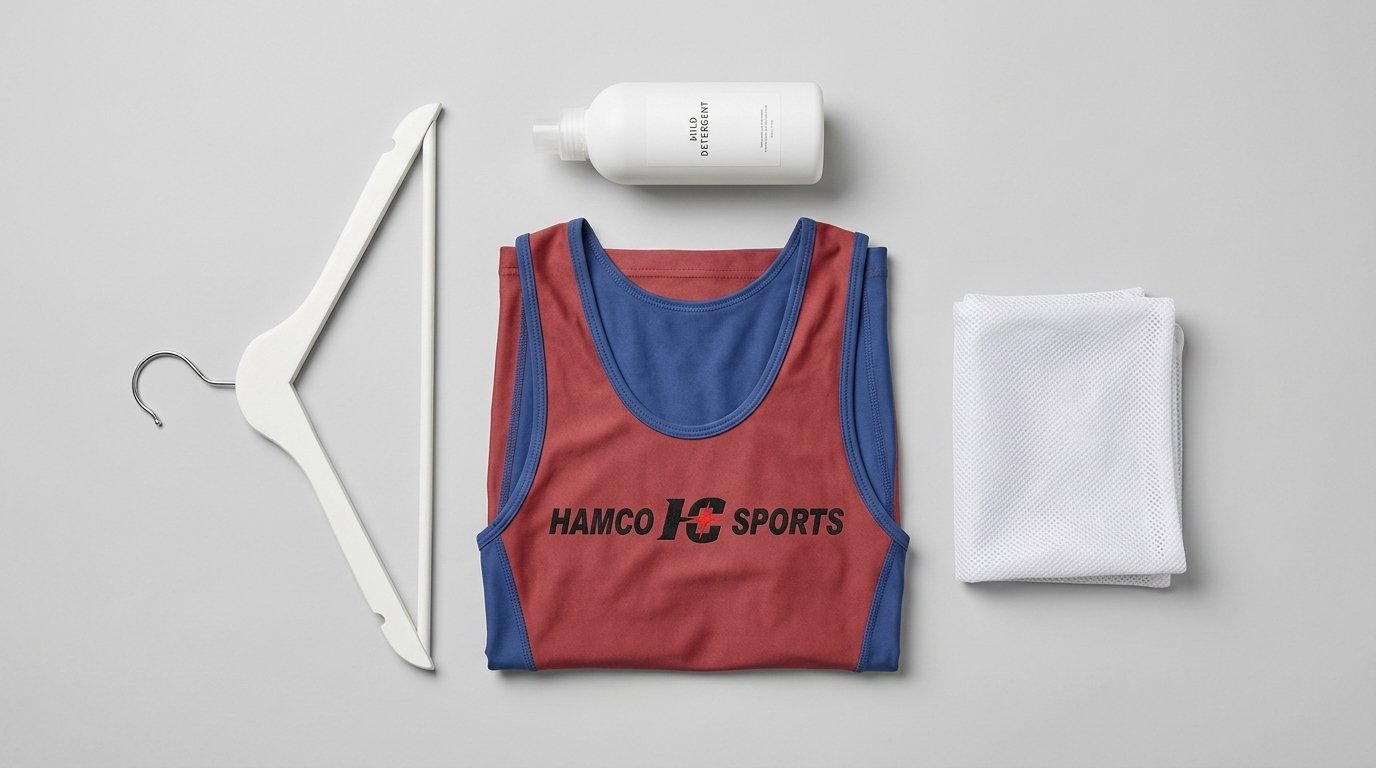
If you’ve ever pulled a singlet out of a gym bag three days after a tournament and wondered if it’s salvageable, you already know why this guide exists. Wrestling singlets get abused. Sweat, blood, mat burn, and hours of friction breaking down the fabric. And washing them wrong does more damage than the match itself.
This guide covers everything you actually need to know about washing, drying, storing, and rescuing wrestling singlets. Not generic laundry advice. Specific instructions for the spandex and lycra blends that singlets are made from, with the real-world problems wrestlers and parents run into at practice, tournaments, and the start of a new season.
How to Wash a Wrestling Singlet
To wash a wrestling singlet: turn it inside out, place it in a mesh laundry bag, wash alone in cold water on the gentle cycle with mild detergent, and air dry flat out of direct sunlight. Never use hot water, bleach, fabric softener, or the dryer. Wash after every use to prevent bacteria buildup and permanent odor.
That’s the short version. The rest of this guide explains why each step matters, what to do when things go wrong, and how to solve the problems competitors’ articles never address.
Why Wrestling Singlets Need Special Washing
Wrestling singlets are made from a stretch blend of spandex (also called elastane), polyester, nylon, or lycra. These are the same fabrics used in compression wear, competitive swimwear, and gymnastics leotards. They stretch in four directions, return to shape, and wick moisture. But they’re fragile in two specific ways most people don’t realize.
Heat destroys them. Spandex fibers lose elasticity when exposed to temperatures above roughly 40°C (105°F). Hot water washes, hot dryers, and direct sunlight all degrade the stretch. A singlet that’s been through three hot washes will start to sag at the shoulders and bunch at the waist. Not because it’s old, but because the fibers have been heat-damaged.
Friction matters too. Velcro, zippers, and rough fabrics in the same load abrade the smooth surface of a singlet. Over time this creates pilling, fuzzing, and weak spots where the fabric eventually splits during a scramble.
Then there’s the hygiene problem. Singlets trap sweat, skin oils, and bacteria against the body for hours. The CDC has documented that improperly cleaned wrestling gear contributes to the spread of skin infections including staph, ringworm, and impetigo among wrestlers. Washing correctly isn’t just about making the singlet last. It’s about not sending a wrestler into a match with a bacterial infection.
Before You Wash: The 30-Second Post-Practice Protocol
The biggest mistake in wrestling singlet care happens in the five minutes after practice, not at the washing machine. Throwing a sweat-soaked singlet into a closed gym bag is how odors become permanent. Once bacteria colonize the fabric deeply enough, no amount of washing fully removes them.
Here’s the routine that prevents 90% of singlet problems:
- Remove the singlet within 10 minutes of finishing practice or a match
- Shake it out and lay it flat if you can’t wash it immediately
- Never seal it back into a closed gear bag damp
- If you can’t wash it the same day, hang it to dry fully before storing
- Keep a separate mesh laundry bag in your gear bag for used singlets
Wrestlers who do this have singlets that last two to three full seasons. Wrestlers who don’t have singlets that reek by week four and need replacement by mid-season.
How to Wash a Wrestling Singlet in the Machine (Step by Step)
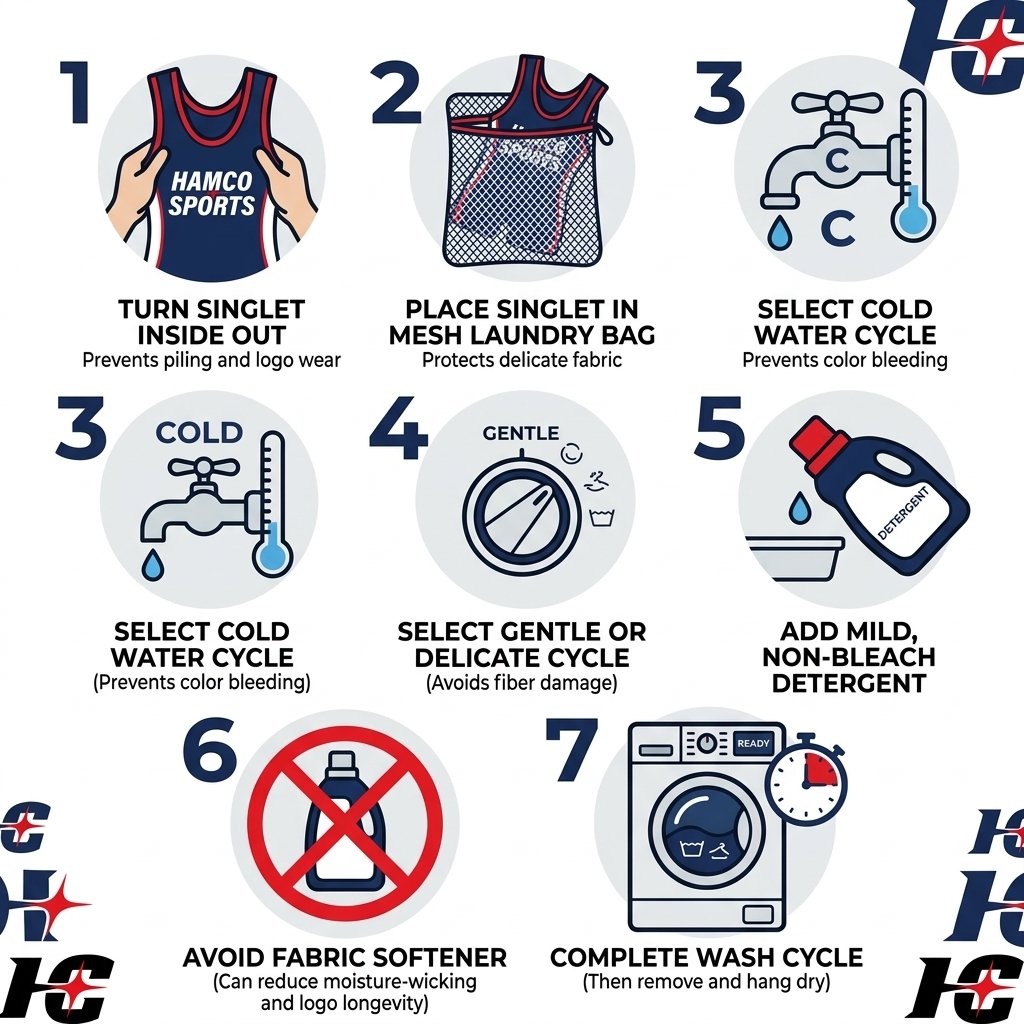
Machine washing is safe for practice singlets and standard sublimated competition gear. Follow this sequence exactly.
Step 1: Pre-rinse if heavily soiled. If the singlet has visible blood, mud, or heavy sweat rings, rinse it in cold water first. Don’t scrub. Just let cold water flush the surface for 30 seconds.
Step 2: Turn it inside out. This protects the sublimated graphics, printed logos, and any embroidery from abrasion during the wash cycle. Skip this step and your team name will fade twice as fast.
Step 3: Put it in a mesh laundry bag. A basic zippered mesh bag costs three dollars and doubles the lifespan of your singlet. It prevents the shoulder straps from stretching and stops the singlet from catching on other clothes.
Step 4: Wash alone or with other singlets only. Don’t mix with towels, jeans, or anything with velcro, zippers, or hooks. Lint transfer is the number one reason custom singlets look cheap after a month.
Step 5: Cold water, gentle cycle, mild detergent. Cold water means water under 30°C (86°F). Use about half the detergent you’d use for a normal load. Sport-specific detergents like ACTIVE, WIN, or Defunkify are designed for moisture-wicking fabric and break down body oils better than standard detergent. Tide or Persil work too, just use less.
Step 6: Skip the fabric softener. Fabric softener coats the fibers with a waxy residue that blocks moisture-wicking. A softened singlet actually holds sweat against the skin instead of pulling it away. This is also true for dryer sheets, so skip those at the drying stage.
Step 7: Remove immediately when the cycle ends. Sitting wet in the washer for hours creates mildew that takes a full rewash to remove. Set a timer.
How to Hand Wash a Wrestling Singlet (The Safer Method)
For competition singlets, reversible UWW-compliant gear, or anything expensive you want to last multiple seasons, hand washing is the safer way to clean a wrestling singlet. It takes about 10 minutes.
Fill a clean sink or basin with cold water. Add a teaspoon of mild detergent and swirl it in until it dissolves. Submerge the singlet completely and let it soak for 10 to 15 minutes. Then gently massage the fabric, paying attention to the armpit area, the chest, and anywhere that had direct sweat contact. Don’t wring or twist. Drain the basin, refill with clean cold water, and rinse until no soap remains. Press the singlet between two clean towels to remove excess water, then move to drying.
Hand washing a singlet once a month extends its life by roughly 50% compared to exclusively machine washing, according to the general wear patterns HAMCO sees across team orders.
First-Time Washing: What to Do With a New Singlet
This step trips up new wrestling parents constantly. A brand-new sublimated singlet can release small amounts of dye during its first wash. If you wash a new red-and-white singlet with a new blue-and-white singlet, you’ll end up with two pink-tinted singlets.
For the first wash only, do this:
- Wash the new singlet completely alone
- Use only cold water
- Use a color-catching sheet like Shout Color Catcher in the wash
- Skip detergent or use half the normal amount
- Air dry as usual
After the first wash, you can wash multiple singlets together safely, as long as they’re similar colors. Mixing a red singlet with a white singlet is still risky for several washes.
Singlet care is only one piece of wrestling uniform knowledge. For the full picture including rules, sizing, and design cuts, see the complete wrestling singlet guide.
How to Dry a Wrestling Singlet (And How Long It Takes)
Never put a singlet in the dryer. Not on low heat, not on the air-only setting, not for a quick fluff. Dryer drums have metal parts that can catch straps, and even minimal heat starts the elastic breakdown process. One dryer cycle probably won’t ruin a singlet. Ten cycles absolutely will.
Air drying is the only correct method. Here’s how to do it properly:
Hang drying: Fold the singlet over a plastic or wooden hanger at the waist, not by the straps. Hanging by the straps stretches them over time. A shower rod, laundry line, or over-the-door hanger all work. Keep it out of direct sunlight. UV rays fade sublimated colors within a few seasons of repeated exposure.
Flat drying: Lay the singlet on a clean dry towel on a flat surface. Press gently to remove water, then lay a second dry towel on top. Change towels once if needed. This is the gentlest method and best for competition singlets.
How long does it take? Plan on 4 to 8 hours in a ventilated room at normal household humidity. In a humid basement or after a heavy-duty wash cycle, it can take 12 to 24 hours. If you need to speed up drying, point a fan at the singlet. Do not use a hairdryer or space heater.
This is why rotating between two or three singlets matters for serious wrestlers. One singlet can’t dry fully between practices if you’re on the mat four days a week.
How to Remove Wrestling Singlet Odor (The Funk Removal Protocol)
Every wrestler eventually faces this. The singlet comes out of the wash smelling okay, but the moment your wrestler puts it on and starts sweating, the funk returns. That’s embedded bacteria, and regular detergent alone won’t kill it.
Here’s the protocol that actually works:
Step 1: Soak in vinegar solution. Fill a basin with cold water and add one cup of white vinegar per gallon of water. Submerge the singlet and soak for 30 minutes. White vinegar is acidic enough to kill the bacteria living in the fibers without damaging the fabric.
Step 2: Rinse thoroughly with cold water. You want all the vinegar out before the main wash.
Step 3: Add baking soda to the wash cycle. A quarter cup of baking soda sprinkled directly into the washing machine drum, plus your normal dose of mild detergent. Run a cold gentle cycle.
Step 4: Air dry in sunlight for 30 minutes only. This is the one time brief sun exposure helps. UV light kills remaining surface bacteria. Don’t leave it in the sun all day, though, or you’ll fade the graphics.
For extreme cases, enzyme-based sports detergents like Defunkify or HEX Performance are specifically engineered to break down the bacterial compounds that cause permanent sports-gear odor. They cost more than regular detergent but work when nothing else does.
If you’ve tried all this and the smell still comes back within one wearing, the singlet has reached the end of its life. Bacteria can permanently colonize degraded fabric fibers, and no amount of cleaning fully removes them at that point.
Stain Removal Guide: Blood, Sweat, Grass, and Mat Burns
Wrestling creates stains that normal laundry advice doesn’t address. Here’s what works for each:
| Stain Type | Treatment | What NOT to Do |
| Fresh blood | Rinse immediately with cold water. Dab hydrogen peroxide on the spot, wait 5 minutes, rinse, then wash normally. | Never use hot water. It sets blood permanently. |
| Dried blood | Soak in cold water for 30 minutes first. Then treat with hydrogen peroxide or an enzyme stain remover before washing. | Don’t scrub hard. It pushes the stain deeper. |
| Sweat stains | Pre-treat with a paste of baking soda and water. Let sit for 15 minutes. Wash as normal. | Don’t rely on regular detergent alone. |
| Deodorant buildup | White vinegar soaks for 30 minutes. Wash normally. | Don’t use bleach, even on white singlets. |
| Grass stains | Apply enzyme stain remover directly. Let sit for 10 minutes. Wash cold. | Don’t use hot water. It sets the chlorophyll. |
| Mat burn marks | Most mat burn residue is actually sweat plus mat chemicals. Treat it like a sweat stain. | Don’t use abrasive scrubbing tools. |
| Mystery yellow spots | Usually oxidized sweat. Baking soda paste plus cold soak, then wash. | Don’t wait. These are set permanently over weeks. |
The universal rule: treat stains immediately, before the fabric dries. A stain treated in the first hour comes out 90% of the time. A stain that’s been dried and sitting for a week comes out maybe 30% of the time.
Washing Instructions by Design Type
Not all wrestling singlets are built the same. The printing or decoration method on your singlet changes what you can safely do to it.
Sublimated singlets. This is the modern standard. Dye is infused directly into the fabric fibers, so the color becomes part of the material. Sublimated singlets are the most forgiving to wash because there’s no surface layer to peel or crack. Follow the standard washing steps in this guide and your custom design will hold up for seasons.
Screen-printed singlets. The logo or name sits on top of the fabric as a layer of ink. This layer doesn’t stretch the way the fabric does, which is why screen-printed designs crack within a season on stretch fabric. To extend their life, always wash inside out, never expose to any heat, and expect fading regardless. Screen-printing is being phased out in wrestling for this reason.
Embroidered singlets. The embroidered threads are sewn into the fabric, which creates stress points during wash and wear. Heavily embroidered singlets should be hand-washed. Turn inside out for machine washing. The thread can snag on mesh bag zippers, so use a bag with a full-length zipper cover.
Heat-transfer designs. These are applied with heat and adhesive. They’re the most fragile decoration type. Never use hot water. Never use the dryer. Even low heat compromises the adhesive. If you have a heat-transfer singlet, hand wash it every time.
Before buying or ordering a custom wrestling singlet, ask about the decoration method. Sublimation is almost always worth the small extra cost because of how much longer it lasts through washing.
How to Store a Wrestling Singlet Between Matches at Tournaments
This is the problem no other article solves. You wrestle at 10am, win, and have to be back on the mat at 2pm. The singlet is drenched. You can’t wash it. What now?
Here’s what works:
Bring a zippered mesh bag specifically for used gear, separate from your clean gear. After your match, strip off the singlet, gently press excess moisture out with a microfiber towel, and hang it over a chair back or folded towel in your team area (not in a closed bag). Open the bag between uses to let it breathe.
If the tournament venue has access to a bathroom with hand dryers, a 2-minute pass under a hand dryer at medium distance (hands held about 12 inches away) removes enough moisture to make the singlet wearable again without full drying. Don’t hold it directly against the heat element. Just use the airflow.
For two-day tournaments, always bring two singlets. Always. One singlet wrestled for a full day becomes a biohazard by day two no matter how well you care for it.
Some wrestlers pack a small spray bottle with water plus a teaspoon of white vinegar. A light spray on the inside of the singlet between matches neutralizes odor-causing bacteria. It’s not a substitute for washing, but it buys you a few hours.
The Emergency Pre-Tournament Clean (When You Have 2 Hours)
The singlet reeks. The tournament starts at noon. The washing machine cycle takes 45 minutes and air drying takes 6 hours. What do you do?
The emergency protocol:
- Hand wash in a sink with cold water, a teaspoon of mild detergent, and a quarter cup of white vinegar. Soak for 20 minutes, agitating occasionally. (25 minutes)
- Rinse thoroughly with cold water. (3 minutes)
- Roll the singlet tightly inside a clean dry bath towel and press hard, repeating with 2 or 3 towels. This wicks out 70% of the moisture. (5 minutes)
- Lay flat under a ceiling fan on high, or in front of a standing fan. Flip every 15 minutes. (45 to 60 minutes)
- Light iron on the lowest synthetic setting if absolutely needed, through a dry towel. Never direct heat. Iron a small section at a time, no more than 5 seconds per area. (10 minutes)
Total time: around 90 minutes. The singlet will still feel slightly cool to the touch. That’s fine. Body heat will finish drying in the first 10 minutes of wearing it.
This is not recommended as routine care. It’s a last resort that works when you’ve run out of time.
Multiple Singlet Rotation Strategy
Serious wrestlers need more than one singlet. Here’s the framework based on practice and competition frequency:
- Practice 2 to 3 times per week: 2 singlets. One clean, one in the wash rotation.
- Practice 4 to 5 times per week: 3 singlets. One clean, one drying, one in reserve for tournaments.
- Daily practice plus weekend tournaments: 4 or more. Keep a dedicated tournament singlet separate from practice gear.
- Team programs: Always keep a backup in the team’s equipment bag. Split seams happen at the worst possible moments.
Label singlets by number on the inside waistband with a fabric marker. Knowing which singlet was worn helps track wear patterns and plan replacements.
When to Replace a Wrestling Singlet (5 Visible Signs)
A singlet is past its useful life when any of the following are true:
- The elastic around the leg openings or straps no longer snaps back. Pinch and release a section. If it doesn’t return to flush against the fabric within a second, the elastic is done.
- Visible fabric thinning. Hold the singlet up to bright light. If you can see through the fabric in the seat area, armpits, or chest, it’s no longer providing coverage and will soon tear.
- Graphics that peel, crack, or flake. For screen-printed or heat-transfer designs, this is cosmetic at first and compliance-affecting later if the team name becomes unreadable for officials.
- Permanent odor that survives a vinegar soak. If the funk comes back the moment it’s worn, bacteria have colonized too deeply to remove.
- Visible staining that won’t come out. Yellowing, discoloration along seams, or set-in stains that age the singlet visibly. This matters for competition; refs and photographers notice.
A well-maintained sublimated singlet should last 2 to 3 full seasons of regular use. A poorly-maintained one might last 6 months. When it’s time to replace, the wrestling singlet cost guide breaks down what to expect at each price tier.
Frequently Asked Questions
How often should you wash a wrestling singlet?
After every single use. No exceptions. Singlets are one of the few athletic garments where wearing them a second time without washing genuinely risks skin infections. If this isn’t practical, own more singlets.
Can you put a wrestling singlet in the dryer?
No. Not on any setting. The heat damages the elastic fibers, shortens the lifespan, and can warp the fit. Always air dry flat or on a hanger.
Can you wash a wrestling singlet with other clothes?
Only with other singlets of similar color. Never with items that have velcro, zippers, hooks, or rough textures. Lint transfer from towels and fleece is also a common problem.
Is it okay to use bleach on a white wrestling singlet?
No. Chlorine bleach breaks down spandex fibers and dulls sublimated colors permanently. For whites that need brightening, use oxygen-based bleach alternatives like OxiClean at half the recommended amount.
How do you get the smell out of a wrestling singlet?
Soak in cold water with one cup of white vinegar per gallon for 30 minutes. Rinse. Wash in cold water with a quarter cup of baking soda and mild detergent. Air dry with 30 minutes of sunlight exposure at the start.
Can you iron a wrestling singlet?
Generally no. If absolutely necessary, use the lowest synthetic setting, always iron through a dry towel (never direct), and never iron over printed designs. Even then, the heat risks damaging the stretch.
Do wrestling singlets shrink in the wash?
A properly washed singlet (cold water, gentle cycle, air dry) will not shrink. Shrinkage happens when singlets are washed in hot water or put in the dryer. Heat causes the spandex fibers to contract and the fabric to lose stretch permanently. If a singlet has already shrunk, the damage is usually not reversible.
Can you machine wash a wrestling singlet?
Yes. Most wrestling singlets are machine washable as long as you use cold water, a gentle cycle, and a mesh laundry bag. Check the care tag if you have a custom or reversible singlet, since some manufacturers specify hand wash only for those.
What detergent should you use on a wrestling singlet?
Any mild detergent works. Sport-specific detergents (ACTIVE, WIN, Defunkify, HEX Performance) work best for breaking down body oils and bacteria. Avoid anything with fabric softener mixed in, and avoid scented detergents that leave residue.
How do you wash a sublimated wrestling singlet without ruining the design?
Turn inside out, cold water only, gentle cycle, mesh laundry bag, air dry out of direct sunlight. Sublimation is the most durable decoration method, so standard washing care is enough.
How do you remove blood from a wrestling singlet?
Rinse with cold water immediately. Apply hydrogen peroxide directly to the stain, wait 5 minutes, rinse. Wash cold on a gentle cycle. Never use hot water on blood, it sets the stain permanently.
How do you soften a stiff wrestling singlet?
Stiffness usually means detergent buildup or fabric softener residue. Soak in a cold water and vinegar solution (1 cup vinegar per gallon) for 30 minutes, rinse thoroughly, wash with plain water and no detergent to strip residue.
The Bottom Line
Washing a wrestling singlet correctly takes an extra 2 minutes per wash compared to doing it wrong. Those 2 minutes extend the singlet’s life by a full season, prevent skin infections, and keep team colors sharp through weekly competition.
The single biggest mistake isn’t the detergent or the cycle setting. It’s leaving a wet singlet in a closed gym bag. Prevent that one habit and you prevent 90% of singlet problems.
If your current singlet is past saving, or if you’re outfitting a team for the next season, HAMCO Sports produces fully sublimated custom wrestling singlets built to handle this level of wash rotation. No minimum order, free design mockups, and NFHS and NCAA compliance built in.


5 thoughts on “How to Wash a Wrestling Singlet: The Care Guide That Actually Works”