
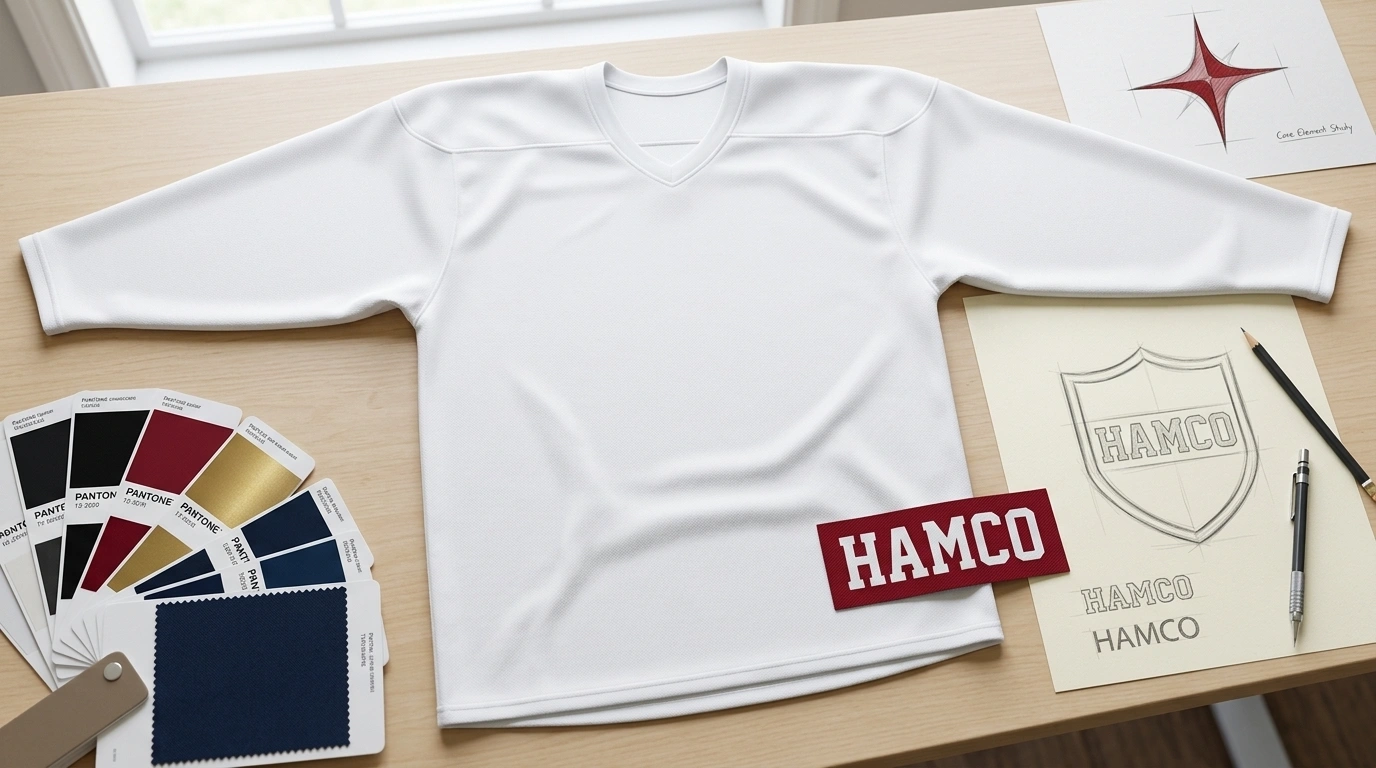
| Quick Answer To design your own hockey jersey, work in this order: rules, colors, crest, details, then the free mockup. Confirm the fight strap rule for your league first. The NHL requires tied down jerseys, and many leagues require one at older age levels, so check your league’s rule. Pick one light and one dark color set that reads under rink lights, red and white and black and gold are the most legible. Make the front crest your main graphic, put the last name on the upper back with the number below, and place captain letters on the left chest per league rule. Then send colors, logo, and roster to our designers and review a free mockup within 12 hours, with unlimited changes before production. Published prices start at $49.99 per player for a game jersey and $89.99 for a reversible with two full color schemes, at 1 to 24 pieces. |
A hockey jersey is a uniform where the crest, not the number, is the star. That changes how you design it. This guide walks through hockey jersey design in the order the decisions happen. The rules that bind the design, the colors that survive arena lights, and the crest and lettering layout. Then how our designers turn all of it into a free mockup you can approve. Every price and spec here is published, checked in October 2026. For the color theory behind the palette choice, our best jersey color combinations guide is the companion piece.
One thing up front. Hamco builds hockey jerseys, so the process and prices here are ours and are published on our custom ice hockey uniforms page. The layout conventions come from Wikipedia’s hockey jersey article, and the fight strap picture comes from NHL fighting rules and USA Hockey’s youth rules, linked where they appear. Where something is our design opinion, we say so.
Start With the Rules, Not the Art
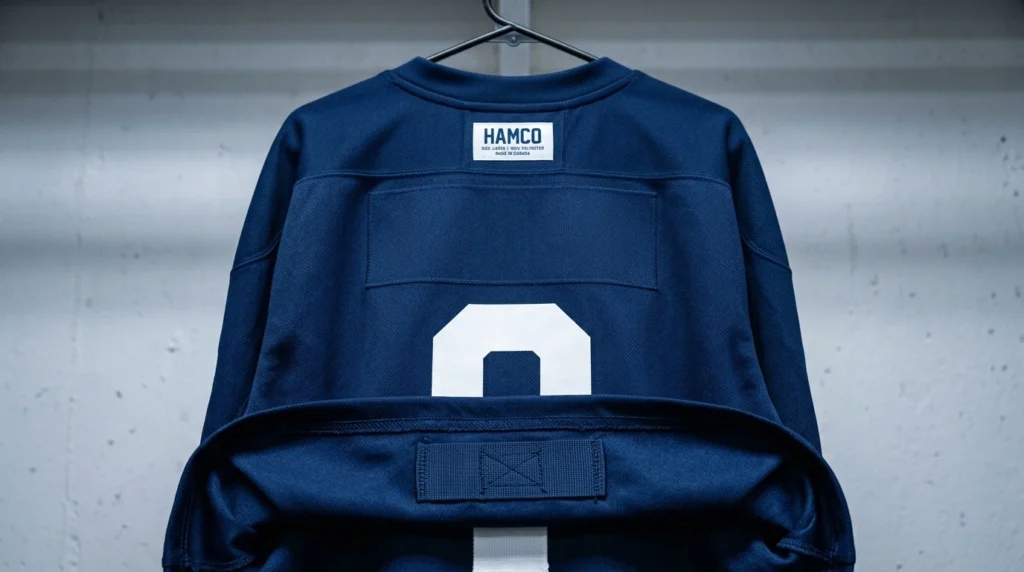
Most hockey jersey design mistakes happen before the first color is picked. Three rules shape the canvas. First, the fight strap. It is a fabric loop inside the back hem that ties the jersey to the pants. That way it cannot be pulled over a player’s head. The NHL penalizes a player whose untied jersey comes off in a fight, so straps are standard on pro jerseys. Many leagues require one at older age levels. Your league’s own rulebook is the reference, and the USA Hockey rulebook is where most youth programs start. Ask before you approve the mockup. Second, the layout convention. Per the hockey jersey tradition, the team crest goes on the front. The player’s last name goes on the upper back, with the number below it, from 0 to 99. Captains wear an uppercase C and two alternates wear an A, sublimated or twill on the left chest and placed per league rule. Third, the fit. A hockey jersey layers over shoulder and elbow pads, so a slim street fit is a wrong fit, and goalies need their own pattern. Design inside those three and the referee never becomes your art critic.
The Hockey Jersey Design Checklist
Every element our designers will ask you about, what you decide, and where the rule or spec comes from. The What to decide column mixes published rules with our design guidance, and the Source column tells you which is which.
| Element | What to decide | Source |
|---|---|---|
| Front crest | Your main graphic; the crest is the major feature of a hockey jersey rather than the numbers; sublimated, or sewn tackle twill (your quote shows the price) | Wikipedia, hockey jersey; Hamco hockey page |
| Name and number layout | Last name on the upper back, number below it, 0 to 99 | Wikipedia, hockey jersey |
| Number height | Back and sleeve number size per your league rule | Hamco hockey page |
| Captain letters | Uppercase C for the captain and A for two alternates, on the left chest, sublimated or twill, placed per league rule | Hamco hockey page |
| Fight strap | Standard on NHL jerseys; many leagues require one at older age levels, so ask your league; Hamco adds a fight strap on request | Hamco hockey page; Wikipedia, hockey jersey |
| Fit over pads | Athletic cut layered over shoulder and elbow pads, in men’s, women’s, youth and goalie cuts | Hamco hockey page |
| Fabric | Game jerseys 240 GSM air mesh; reversibles two ~160 GSM layers, one sublimated design on each | Hamco hockey page |
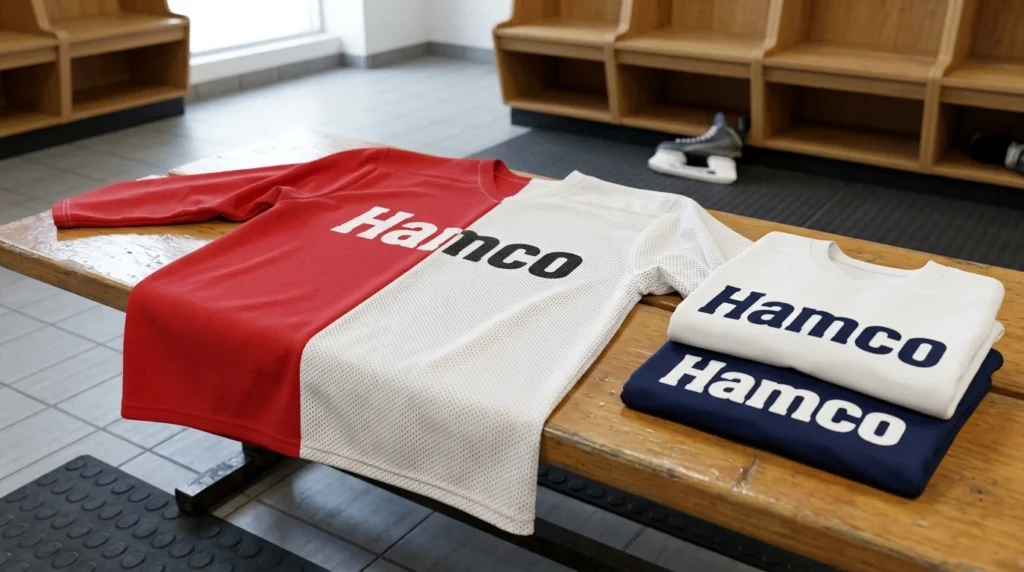
| Color sets | One light and one dark look; order jerseys, socks and shells together and your whole order is made in the same dye batch | Hamco hockey page |
| Legible colors | Red and white and black and gold read best under rink lights; test number legibility in low light | Hamco color combinations guide |
Checked October 2026. Every Source cell is a link to the page it cites: Wikipedia’s hockey jersey article for layout conventions and the fight strap’s purpose, the live Hamco hockey page for specs and options, and our published color combinations guide for the color row.
Colors That Read Under Arena Lights
Rink lighting is cold, bright, and unforgiving, and broadcast cameras flatten color. Four practical rules. One, build a light set and a dark set from the same art file, so home and away swap only the base color. Two, pick a palette that reads. Our color combinations guide rates red and white and black and gold the most readable under rink lights and on cameras. Dark teal and silver is a strong modern option. Give our designers a PMS code or a swatch to match. Every palette should be tested for number legibility in low light. Three, contrast the numbers. A silver number on a white jersey looks premium on a screen and disappears from the penalty box. Four, order everything in one order. Your whole order is made in the same dye batch, so jerseys, socks and shells match. A second batch ordered in January is how a program ends up with two royal blues. A note on borrowed palettes. Pairing your colors and stripes exactly like a professional team invites trademark trouble and makes your program look like a replica. Take the color logic, not the design.
Hockey Jersey Ideas by Program
Youth and house league
Simplicity wins. One crest, two colors, big numbers a parent can read from the bleachers. A common youth choice is a single reversible practice jersey with two complete color schemes, which covers scrimmage sides and saves buying two sets. Player names are often optional at this level, and skipping them makes hand me downs easy.
High school and travel
This is where the crest earns its place. A shoulder yoke in the secondary color, contrasting sleeve stripes, and a wordmark or mascot crest give a program its identity. Design the home and away as one art file and order both with matching socks in one batch. Confirm the fight strap for your sanction. If the program lacks a logo, a free sports logo maker with hockey icons and badge shapes is a fast starting point before the jersey design begins.
Adult and beer league
Looser rules, louder ideas. Sponsor placement on the shoulders, retro stripes, throwback lace neck styling, and nickname nameplates are all common. Reversibles work well as a league issued jersey because the league skips home and away logistics. The design risk is clutter, so pick one loud element and let the crest carry the rest.
Custom hockey jersey maker choices that change the look
Two tone jerseys run the shoulder yoke and sleeves in one color and the body in another. They start at $49.99 per player at 1 to 24, the same as a solid game jersey. Practice jerseys use the same cut with simpler art. Shells are open mesh pullovers worn over pads for line sorting in practice, not for game wear. A game day hockey jersey in 240 GSM air mesh is the standard canvas. The reversible is two ~160 GSM layers sewn together, one sublimated design on each.
Reversible or Two Jerseys? The Cost Comparison
The most common design question in hockey is whether one reversible beats two jerseys. At 1 to 24 pieces the reversible is about $10 cheaper per player than a home and away pair, and at 101 plus they cost the same, so the decision is mostly about weight and use.
| Option | 1 to 24 | 101 plus |
|---|---|---|
| Reversible jersey (two looks, one jersey) | $89.99 | $79.99 |
| Home + away game jerseys | $99.98 | $79.98 |
| Home + away + practice jerseys | $149.97 | $119.97 |
| Home uniform + away uniform | $141.98 | $105.98 |
Volume tiers at 25 and 51 pieces sit in between. Sublimated names and numbers are included; tackle twill lettering is $5 per name and $5 per number.
Read it plainly. At 1 to 24 pieces a reversible is $89.99 and a home plus away pair is $99.98 per player, so the reversible saves about $10. At 101 plus they meet: $79.99 against $79.98. The reversible is one two-layer garment that flips, ideal for practice and youth. Two game jerseys are the 240 GSM game build with a full crest on each. They suit programs that play real home and away schedules. Adding a practice jersey to the pair lands at $149.97, and a home uniform plus an away uniform, each a jersey with matching socks, lands at $141.98, at 1 to 24 pieces. Volume tiers lower every figure as the roster grows.
How Our Free Hockey Jersey Design Service Works
Our designers work in four steps, and the honest version of each matters more than the marketing. Step one, submit. Send colors, logo, roster, and league. Our designers return a free mockup within 12 hours. A phone photo of an old jersey is enough to start. Step two, revise. Unlimited revisions cost nothing before approval, so test the yoke, the stripe, the throwback idea. Step three, approve. What you sign off is what prints. Check the roster numbers, the captain letters, and the fight strap requirement on the proof. If we get something wrong against the approved proof, we remake it free when you tell us within 30 days of delivery. Step four, production. Your whole order is made in the same dye batch and is ready 2–3 weeks after you approve the design, plus 3–5 days of shipping, free anywhere in the USA. For a tournament deadline, ask for a free rush: we do it when production allows, but it is never guaranteed.
Design your own hockey jersey this week and see it before you pay for it. Send colors, logo, and roster and a free mockup comes back within 12 hours, with a fight strap on the proof if your league needs one. Published prices start at $49.99 per player for a game jersey, with no minimum order and free US shipping. New programs usually start one step earlier, and our ice hockey team names list is where that step begins. For the design principles that carry across every sport, the team uniform design guide is the wider read.
Frequently Asked Questions
Q: How do I design my own hockey jersey?
A: Start with the rules, not the art. Confirm whether your league requires a fight strap, then lock a light and a dark color set. Choose the crest as your main graphic. Place the name on the upper back with the number below, and add captain letters on the left chest per league rule. Send colors, logo, and roster to our designers and review the free mockup before anything is produced.
Q: Is there a free hockey jersey designer?
A: Yes. Hamco Sports designers build the design for you at no charge. Send colors, a logo or even a phone photo of an old jersey, and your roster. A free mockup comes back within 12 hours with unlimited revisions before approval. A free sports logo maker with hockey icons also exists for teams that need a crest first.
Q: How much does a custom hockey jersey cost to design and make?
A: The design and mockup are free. Published prices start at $49.99 per player for a sublimated game jersey and $89.99 for a reversible jersey with two full color schemes, at 1 to 24 pieces, with sublimated names and numbers included; tackle twill lettering is $5 per name and $5 per number. Home and away uniforms, a game jersey plus matching socks, start at $70.99. Volume tiers lower each price, and there is no minimum order.
Q: Should my team design a reversible hockey jersey?
A: For practice and youth programs, yes. One reversible carries two complete color schemes in two ~160 GSM layers, one on each side. Players flip it for scrimmage sides or home and away without a second set. At 1 to 24 pieces one reversible ($89.99) costs about $10 less than two separate game jerseys ($99.98), and at 101 plus they cost the same, so the choice is mostly about weight and feel.
Q: What colors work best on a hockey jersey?
A: Red and white and black and gold are the most readable under rink lights and on cameras. Dark teal and silver is a strong modern option. Whatever the palette, test number legibility in low light and keep the front crest as the main graphic. Order jerseys, socks, and shells in one order: your whole order is made in the same dye batch, so colors match.

3 thoughts on “Design Your Own Hockey Jersey: Ideas, Colors & Free Mockup”