
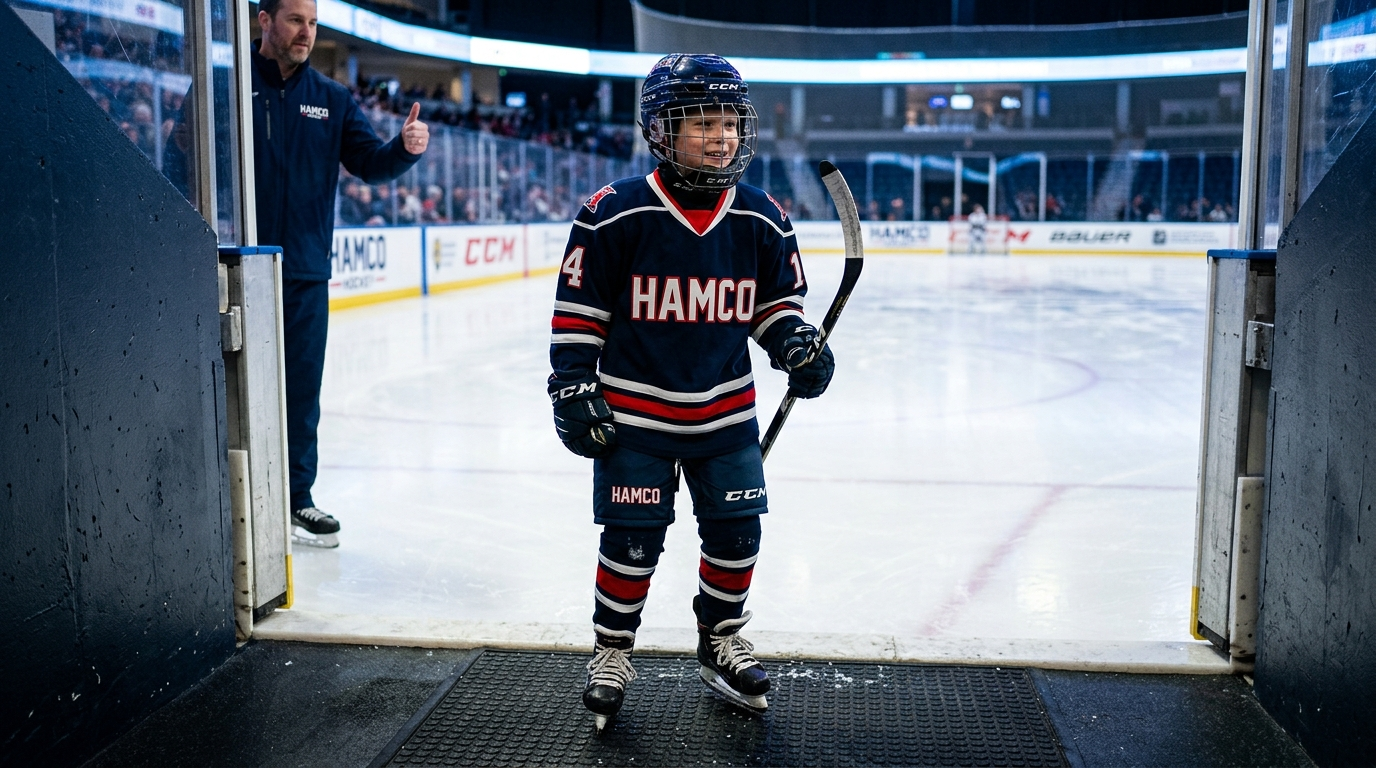
Starting your child in youth hockey means navigating one of the most equipment-intensive youth sports in existence. From mandatory protective gear to game-day uniforms, the gear list is long, the sizing rules are unfamiliar, and the costs add up quickly. This complete youth hockey equipment checklist walks you through every required item, what to look for when buying, how to size each piece correctly, and a realistic budget breakdown so you know exactly what you’re committing to before your child steps on the ice.
Hockey is also one of the fastest-growing youth sports in the United States. USA Hockey reports steady registration increases, particularly in non-traditional markets outside the northern tier states. Getting the equipment right from the start makes the difference between a player who falls in love with the game and one who struggles, gets hurt, or quits before they ever enjoy it.
Quick-Reference Youth Hockey Equipment Checklist
Before we dive into details, here is the full required gear list at a glance:
| Numbers | Equipment | Required? | Avg. Cost (USD) |
|---|---|---|---|
| 1 | Ice Skates | ✅ Yes | $150 to $400 |
| 2 | Helmet with Cage | ✅ Yes (HECC) | $60 to $180 |
| 3 | Shoulder Pads | ✅ Yes | $50 to $150 |
| 4 | Elbow Pads | ✅ Yes | $30 to $90 |
| 5 | Hockey Gloves | ✅ Yes | $50 to $200 |
| 6 | Shin Guards | ✅ Yes | $40 to $120 |
| 7 | Hockey Pants / Girdle | ✅ Yes | $50 to $150 |
| 8 | Jockstrap / Pelvic Protector | ✅ Yes | $20 to $40 |
| 9 | Mouthguard | ✅ Yes | $5 to $30 |
| 10 | Neck Guard | ✅ Yes | $20 to $40 |
| 11 | Hockey Socks | ✅ Yes | $15 to $40 |
| 12 | Hockey Stick | ✅ Yes | $40 to $200 |
| 13 | Game Jersey (Custom) | ✅ Yes | $50 to $120 |
| 14 | Equipment Bag | ✅ Yes | $40 to $120 |
| 15 | Water Bottle | ✅ Yes | $10 to $25 |
| Total Range | $680 to $1,905 |
Pro tip: Most associations sell or rent gently-used gear for beginners at 40 to 60 percent off retail. Ask before buying everything new.
📥 Download the Free Printable Youth Hockey Equipment Checklist (PDF) to keep on your phone while gear shopping.
1. Ice Skates: The Most Important Purchase on the Checklist
Ice skates are the single most personal and most important item on the youth hockey equipment checklist. Poorly fitted skates make skating slower, harder, and more painful, which causes blisters, foot pain, and bad mechanics that follow players for years.
Sizing rule: Hockey skates run approximately 1 to 1.5 sizes smaller than street shoe size. A child who wears a size 4 shoe usually fits a size 2 or 2.5 skate.
What to check during fitting:
- Heel locks firmly into the heel pocket with minimal lift on ankle flex
- Toes barely brush the front when standing, but don’t curl
- No pressure points on the side of the foot or ankle
- Skate stiffness matches age and ability (softer for under 8, stiffer for competitive)
Always have skates fitted in person at a hockey pro shop. Ordering online based on shoe size alone is the number one mistake new hockey parents make.
Budget guidance: $150 to $400 for entry-level to mid-range youth skates. Skip the cheapest options because they wear out fast and offer poor ankle support.
2. Helmet with Cage or Full Shield
HECC (Hockey Equipment Certification Council) certification is mandatory for all helmets used in USA Hockey sanctioned programs. Full wire cage protection is required through age 15 in most leagues.
Fitting checklist:
- Padding makes firm contact around the entire head
- Helmet should not rock side-to-side when shaken
- Chin strap holds the helmet flat with no upward tilt
- Cage screws are tight and the chin cup sits naturally
Maintenance: Helmets should be recertified every two years. Replace immediately if involved in a severe impact, or if shells show cracks or padding is deteriorated.
Budget: $60 to $180 depending on certification level and brand.
3. Shoulder Pads
Shoulder pads protect the shoulder caps, upper chest, and back from contact with boards, pucks, and other players. They should fit snugly without restricting arm movement.
Fit check:
- Shoulder cap centers exactly on the shoulder bone
- Back panel covers the shoulder blade area
- Chest panel sits flat without bunching
- Arms move freely overhead with no pinching
Budget: $50 to $150 for youth sizes.
4. Elbow Pads (Separate Section)
Elbow pads are sized independently of shoulder pads and need their own fitting. The hard plastic elbow cap should center exactly on the elbow point, with foam padding extending up the lower bicep and down the forearm.
Fit check:
- Cap stays centered when arms move through full range of motion
- Pad does not slip down the forearm during play
- Top edge does not gap between elbow and shoulder pad
Budget: $30 to $90.
5. Hockey Gloves
Hockey gloves protect the hands and wrists from puck impacts, slashes, and ice contact. Youth gloves are sized by overall length from cuff to fingertip, typically 8″ to 13″ for youth players.
Fit check:
- Fingers curl naturally around a stick without bunching in the palm
- Cuff covers the wrist with no exposed skin above it
- Fingers are not jammed against the front of the glove
- Player can grip and rotate the stick freely
Note: New gloves are stiff and need a break-in period. Use them in stickhandling drills before the first game to soften the palm.
Budget: $50 to $200.
6. Shin Guards
Hockey shin guards protect the knee, shin, and calf from pucks, sticks, and falls. Sizing uses the measurement from the center of the kneecap to the top of the skate tongue. That measurement in inches equals the shin guard size.
Fit check:
- Knee cap centers in the knee cup
- Bottom of pad reaches the top of the skate boot tongue
- Calf strap holds the pad firmly without cutting off circulation
- Pad does not rotate around the leg during skating
Budget: $40 to $120.
7. Hockey Pants or Girdle
Hockey pants protect the hips, thighs, tailbone, and kidneys. They come in two styles: traditional shell pants (looser, easier to use) and girdle systems (tighter, worn under a shell).
Fit check:
- Waistband sits at natural waistline with the belt fully tightened
- Pants extend to the top of the shin guards with a slight overlap
- Side and front padding flexes freely when skating
- Pants do not ride up during striding
Budget: $50 to $150.
8. Jockstrap or Pelvic Protector
Mandatory for male players and strongly recommended for female players. Modern hockey jockstraps integrate the cup, garter belt for socks, and pelvic guard into one piece.
Budget: $20 to $40.
9. Mouthguard
A mouthguard is required in most USA Hockey sanctioned programs from Mite level upward. Boil-and-bite mouthguards are inexpensive and work well for youth players. Custom dental mouthguards offer better fit and protection but cost considerably more.
Budget: $5 to $30 for boil-and-bite, or $50 to $200 for custom dental.
10. Neck Guard (BNQ-Certified)
Required at all USA Hockey youth levels following recent rule updates. Look for BNQ-certified cut-resistant neck guards that protect against skate blade contact.
Budget: $20 to $40.
11. Hockey Socks
Hockey socks pull over the shin guards and attach to the jockstrap garter or velcro tabs. They are part of the team uniform on game day and match team colors.
Budget: $15 to $40 per pair. Buy at least two pairs.
12. Hockey Stick
Stick length and flex are critical to comfortable play. Youth sticks should reach the chin when the player stands in skates. Flex rating should generally be half the player’s body weight, so an 80 lb player needs roughly a 40 flex stick.
Fit check:
- Stick reaches between chin and nose when standing in skates
- Flex matches body weight (lighter players need lower flex)
- Player can flex the shaft slightly when leaning into a shot
Budget: $40 to $80 for entry-level wood or composite. Higher-grade composite runs $100 to $200.
13. Custom Game Jersey
Custom ice hockey uniforms complete the youth player’s game-day appearance. A regulation hockey uniform set includes a game jersey, hockey pants (or pant shell), team socks, and a helmet in team colors.
Sublimated polyester hockey jerseys offer unlimited design freedom for team colors, logos, player numbers, and names, in durable construction that holds color permanently and looks sharp under arena lighting.
For complete team orders with bulk pricing, free design mockups, and on-time production, order custom ice hockey uniforms from Hamco Sports.
Budget: $50 to $120 per jersey for custom team orders.
Sizing note: Jersey fit matters as much as protective gear fit. For brand-by-brand comparisons, see our ice hockey jersey size chart guide.
14. Equipment Bag
A proper hockey equipment bag has compartments for each piece of gear and ventilation to air out wet equipment between practices. Wheeled bags are easier for younger players to manage independently.
Budget: $40 to $120.
15. Water Bottle
Easy to overlook, but essential. Hockey is exhausting and players need a personal water bottle marked with their name for every practice and game.
Budget: $10 to $25.
Beyond the Mandatory Gear: Training Tools That Develop Players Faster
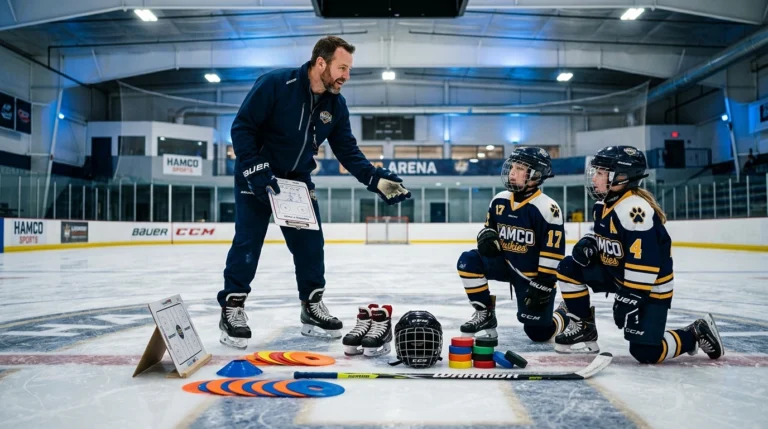
Once your player has all the required equipment, the next investment is training gear that accelerates skill development between practices. Stickhandling tiles, training pucks, shooting targets, and balance tools build the skating mechanics, hand speed, and shooting accuracy that separate developing players from stagnating ones.
For a complete coach-recommended list, see our guide to essential youth ice hockey training gear.
Total Budget Breakdown for New Youth Hockey Players
| Tier | Total Cost | Best For |
|---|---|---|
| Entry / Used | $400 to $700 | Beginners trying the sport |
| Mid-Range / New | $800 to $1,200 | Committed first-year players |
| Premium | $1,500 to $2,000+ | Competitive youth programs |
Money-saving tips:
- Buy used skates and pads from association swap programs
- Buy new helmet, mouthguard, neck guard, and cup (never used)
- Stick to mid-range gear for the first season because kids grow fast
- Order team uniforms in bulk for per-jersey discounts
Frequently Asked Questions
How much does a complete youth hockey equipment set cost?
A new entry-level complete youth hockey equipment set runs $800 to $1,600. Used equipment programs through hockey associations can reduce this by 40 to 60 percent, especially for beginners. Goalie gear adds another $500 to $1,500 on top.
What is the most expensive piece of youth hockey equipment?
Skates are typically the most expensive single item, at $150 to $400 for quality entry-level pairs. This investment is non-negotiable because bad skates create bad mechanics that are hard to undo later.
Can I use inline hockey equipment for ice hockey?
Some pieces overlap, but skates are completely different and not interchangeable. Helmets certified for ice hockey can be used for inline hockey, but not the reverse in USA Hockey sanctioned events.
How often do youth hockey skates need to be sharpened?
Every 10 to 20 hours of ice time. Beginning skaters may need more frequent sharpening as they develop edge usage. Pro shops typically charge $5 to $10 per sharpening.
Are custom hockey jerseys required for youth teams?
Custom jerseys are standard at every level of organized youth hockey. Team identity through matching uniforms is expected from beginner programs through competitive leagues.
What gear should I buy new vs. used?
Always buy new: helmet, mouthguard, neck guard, jockstrap or cup. Safe to buy used: skates (with proper fit check), pads, gloves, sticks, bags. Either works: pants and socks.
Final Word
Youth hockey equipment is a meaningful investment, but the right gear unlocks one of the most rewarding youth sports a child can play. Use this checklist to ensure no safety item is missed, fit each piece carefully before buying, and complete your player’s game-day setup with quality custom hockey uniforms that reflect the program they’re proud to be part of.
📥 Download the Free Printable Youth Hockey Equipment Checklist (PDF)
For complete custom team uniform orders, contact Hamco Sports for free mockups and bulk pricing.

1 thought on “Youth Hockey Equipment Checklist 2026: Every Item Parents Need (With Costs)”