Every youth hockey coach faces the same question from parents: what training gear does my child actually need, and what’s worth the money? The answer matters more than most parents realize, because the right training equipment builds the skating mechanics, stickhandling instincts, and shot accuracy that separate developing players from stagnating ones.
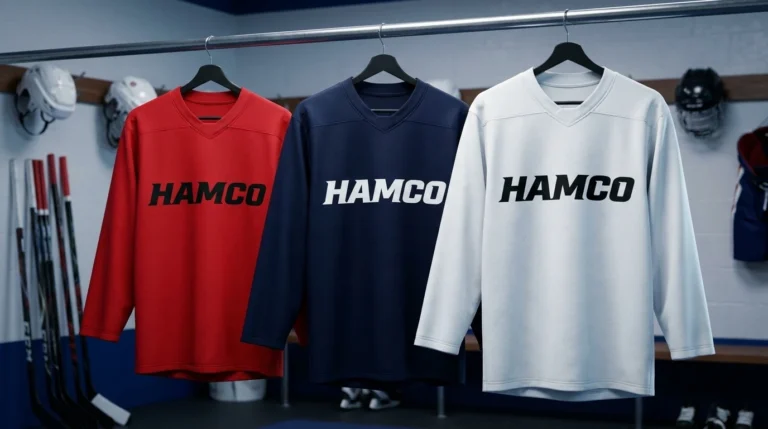
Before getting into the gear list, make sure your program is set up with quality custom ice hockey uniforms that give your team a unified identity and prepare players to take every practice session seriously.
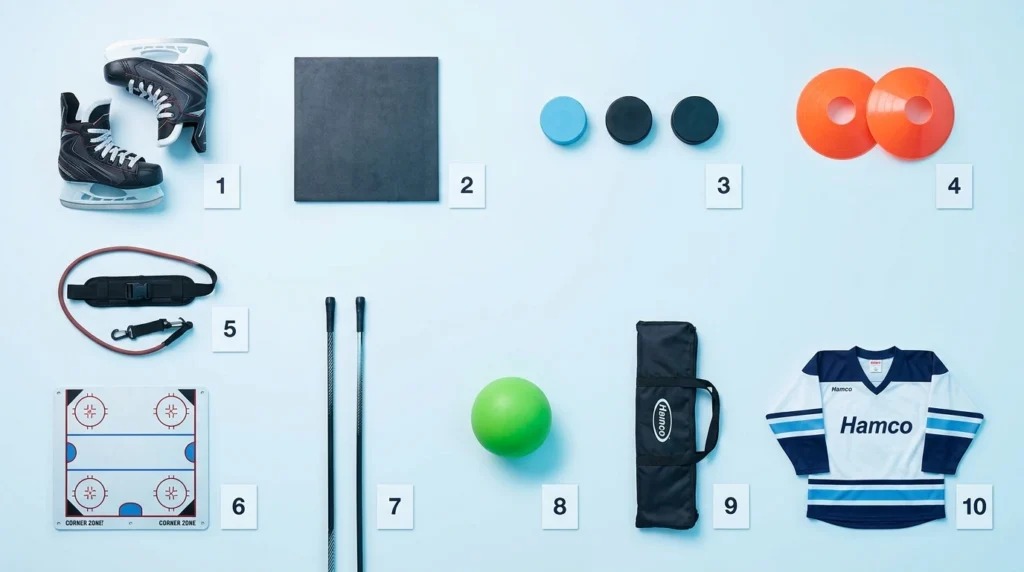
Below are the 10 training essentials experienced youth coaches recommend to every family entering the sport.
1. Properly Fitted Ice Skates with Adequate Stiffness
No piece of youth ice hockey training gear influences development more directly than the skates. Every stop, stride, crossover, and backward edge is executed through the skate blade and boot, so a player in poorly fitted skates is learning bad movement habits every time they step on the ice.
Skate stiffness matters as much as fit for training purposes. Beginning skaters under eight years old benefit from a more flexible boot that allows the natural ankle movement needed during the learning phase. Competitive youth players moving into faster programs need stiffer boots for edge control and explosive power transfer during stride and stop drills.
Coach Note: For complete skate fitting guidance and full sizing details, see our Youth Hockey Equipment Checklist 2026, which covers fit checks, budget ranges, and what to look for at a pro shop.
2. Stick Handling Tiles and Shooting Pads for Off Ice Training
One of the most impactful and underutilized items in a youth hockey gear list is the off ice stickhandling tile or shooting pad. These smooth synthetic surfaces allow players to practice puck handling, passing, and shooting technique at home or in any flat surface environment, on carpet, hardwood, or concrete, using a roller puck or a green biscuit training puck designed specifically for off ice use.
Off ice stickhandling training tiles snap together in modular configurations and provide a slick surface that closely mimics the feel of ice under a hockey stick blade. Players who spend even fifteen minutes per day on a stickhandling pad develop dramatically faster hand speed and puck control than players who only touch a stick during on ice practice sessions. For youth coaches building a development focused program, recommending a stickhandling pad to every family is one of the highest return on investment suggestions you can make.
What to look for: Interlocking tiles with a smooth consistent surface, a minimum two by three foot coverage area for basic training drills, and compatibility with both wood and composite stick blades.
3. Training Pucks in Multiple Weights
Standard pucks used in games weigh six ounces. Training pucks come in a range of weights, from lighter four ounce pucks that improve hand speed and quickness to heavier ten ounce pucks that build forearm and wrist strength for harder, more accurate shots. Adding both lighter and heavier training pucks to a youth player’s hockey practice equipment rotation produces measurable improvements in shooting power and stickhandling speed within a single season.
Green biscuit pucks are specifically designed for off ice use and slide smoothly across dry surfaces without damaging stick blades. They are one of the most practical and affordable additions to any youth hockey training setup and should be on every coach’s recommended gear list for families practicing at home between ice sessions.
Coach Note: Suggest players spend two minutes with a heavy puck, two minutes with a light puck, and two minutes with a standard puck during each off ice session. This contrast training method accelerates hand speed development more effectively than using a single puck weight exclusively.
4. Skating Aid and Balance Training Tools
For players in the early stages of skating development, balance training tools designed specifically for hockey skating mechanics make a significant difference. Balance boards with a hockey specific curved base simulate the lateral weight transfer mechanics of crossovers and edge transitions. These tools can be used at home or in off ice training spaces to reinforce the movement patterns that young skaters struggle most to develop on ice.
Skating aids also include slide boards, which are smooth low friction surfaces with end stops that allow players to practice the lateral push and glide motion of hockey skating in a dry land environment. Slide boards are particularly valuable for players who do not have access to abundant ice time, which describes the majority of youth players outside of dedicated hockey markets.
What to look for: A slide board measuring at least four feet wide by six feet long with adjustable end stops and a smooth surface coating that is compatible with the slide booties that come with the board.
5. Passing and Shooting Targets
Shooting accuracy is one of the most important and most neglected skills in youth hockey development. Most young players practice shooting power without any deliberate target feedback, which trains them to shoot hard in the general direction of the net without developing the precision that becomes critical as goaltending quality increases at higher competitive levels.
Shooting targets attach to the inside of a net frame and create clearly defined scoring zones that give players specific spots to aim for rather than shooting at the net opening in general. These targets transform every shooting repetition from a power drill into an accuracy and decision making drill. Even simple nylon or canvas shooting targets with corner openings and center blocker zones produce measurable improvements in shot placement within a few weeks of consistent use.
Coach Note: Challenge players to call their target before each shot during off ice or on ice target shooting sessions. This cognitive step of identifying a zone before shooting develops the game transferable skill of picking a spot before releasing in live game situations.
6. Agility Cones and Pylons for Skating Drills
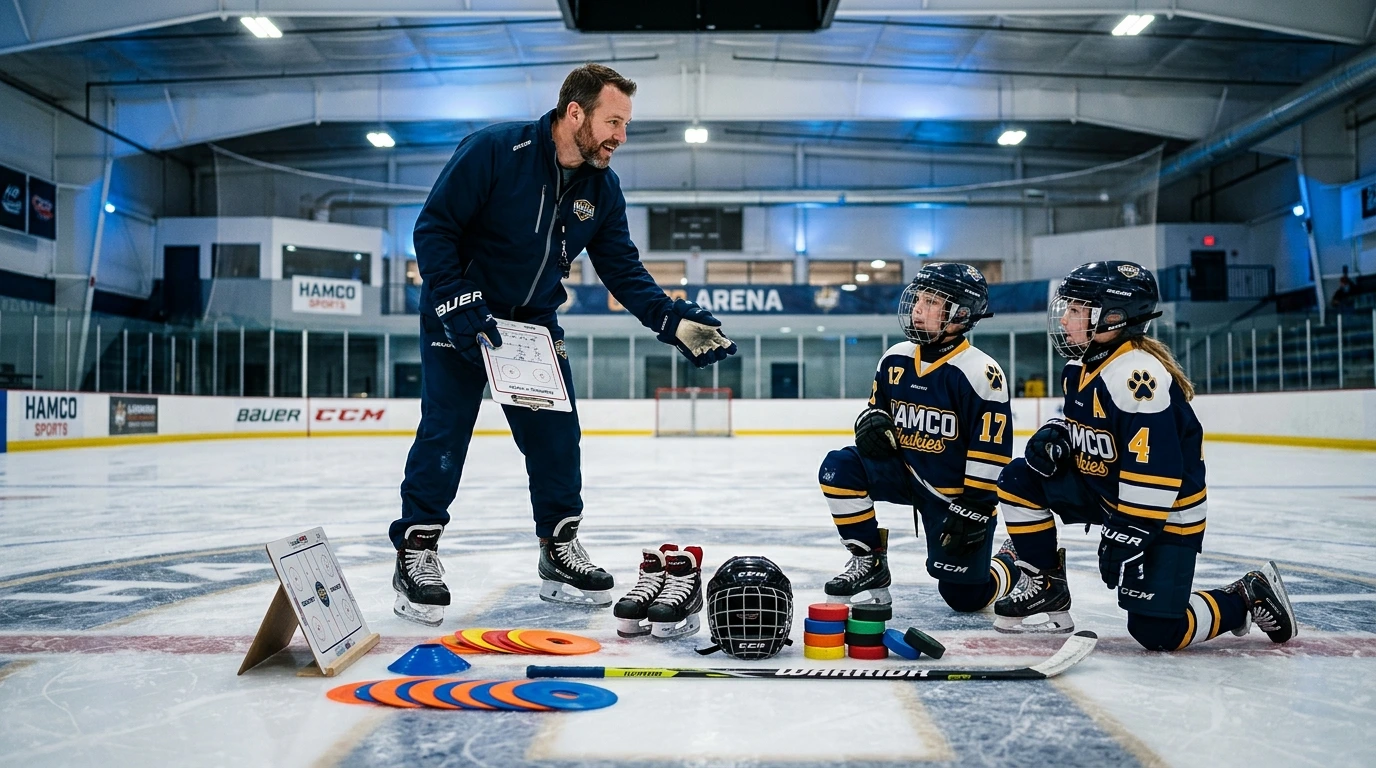
Agility cones are one of the most affordable and versatile items in any hockey practice equipment collection. For youth coaches running on ice skating development drills, pylons define the lanes, turning points, and obstacle paths that force players to practice edge control, crossovers, tight turns, and acceleration bursts in structured repetition.
Small five inch disc cones are preferred over tall traffic cones for hockey training because they sit flat on the ice and do not create a trip hazard for skating players. A set of twenty to thirty small disc cones gives a coach enough equipment to run complete agility circuits, breakout lane drills, and defensive positioning exercises simultaneously for a full team practice.
What to look for: Brightly colored flat disc cones in at least two contrasting colors so coaches can designate different drill stations or directional routes with color coding during complex skating circuit drills.
7. Resistance Bands Designed for Skating Training
Resistance training for hockey skating is one of the most effective dry land development tools available to youth players at any age. Skating specific resistance bands attach around the waist or thighs and create opposing tension during the push phase of each skating stride, forcing the glutes and hip flexors to work harder on every repetition than they would in unresisted skating.
Resistance bands designed specifically for hockey training are different from general fitness resistance bands. Hockey specific designs include a hip attachment harness and an anchor point that a partner or stationary fixture holds, allowing the player to practice full skating strides with consistent resistance throughout the movement pattern. Even short resistance training sessions of ten to fifteen minutes per practice session produce noticeable gains in explosive first step speed and stride length over the course of a season.
Coach Note: Pair resistance band work with unresisted skating sprints immediately after. This contrast method, sometimes called overspeed and resistance training, produces faster neuromuscular adaptation than resistance training alone.
8. Puck Handling Obstacles and Weave Rods
Stickhandling through obstacles is one of the most direct ways to develop the puck protection instincts and hand eye coordination that translate directly to game performance. Stickhandling weave rods are tall flexible sticks that stand on the ice or on a shooting pad surface and force players to navigate around them while maintaining puck control, mimicking the defensive pressure of an opposing player’s stick.
Sets of five to eight weave rods allow coaches to construct puck handling circuits that challenge players at progressively higher speeds as they develop. These rods are inexpensive, lightweight, and easy to transport in a team equipment bag. They are one of the most consistently underused tools in youth hockey programs and one that coaches who use them regularly see fast and visible results from in their players’ on ice puck handling confidence.
What to look for: Flexible weighted base rods that will not slide or tip on ice during fast puck handling passes, with a height of at least twenty four inches so they are visible to the player at skating speed.
9. Goalie Specific Training Tools for Developing Netminders
Youth coaches with a goalie on their roster need a specific category of the youth hockey gear list dedicated entirely to netminder development. Goalies require reaction balls for reflex training, blocker and glove targets for positional training drills, and butterfly slide trainers that allow goalies to practice their post-to-post movement and butterfly technique on dry land flooring between ice sessions.
A reaction ball is an irregularly shaped rubber ball that bounces unpredictably off hard surfaces. Goalies who train regularly with reaction balls develop faster hand eye coordination and better reflexive tracking that transfers directly to stopping deflections, screens, and scramble pucks during games. A single reaction ball costs less than ten dollars and provides hundreds of effective training repetitions.
Coach Note: Do not neglect your goalies during off ice training planning. Many youth programs run excellent skater development sessions but send their goalies to stand around with nothing to do during dry land time. A dedicated five to ten minute goalie specific circuit keeps your netminder developing at the same rate as your skaters.
10. A Personal Stick Bag or Equipment Carrier
This item may seem purely logistical, but a properly organized equipment setup directly affects how seriously young players approach their training. Youth players who have their own dedicated stick bag and equipment carrier arrive to practices organized and ready. Players who dig gear out of a shared pile or stuff everything into a backpack develop disorganized habits that reflect in their approach to training details.
A hockey stick bag that holds two to three sticks plus small accessories like training pucks and a mouthguard is an inexpensive addition to any player’s gear setup. Full equipment bags with dedicated compartments for skates, helmets, pads, and gloves keep gear separated, aired out between sessions, and easy to inventory before and after each practice or game.
Building Your Complete Youth Hockey Training Gear Recommendation List
As a youth hockey coach, your gear recommendation list is one of the most valuable things you give to families entering your program. Parents trust coaches to direct them toward equipment that is worth the investment and away from products that are not. Here is a simplified priority order for families working within a realistic budget.
Priority 1: Properly fitted skates, a certified helmet with cage, and a well sized stick. These three items are non-negotiable for safe and productive practice participation.
When recommending jerseys to families, share a reliable ice hockey jersey size chart so parents can confidently order the right fit on the first try and avoid costly mid-season returns.
Priority 2: A stickhandling tile with training pucks and a shooting target. These items extend development time beyond ice sessions and accelerate skill progression more than any other off ice investment.
Priority 3: Agility cones, resistance bands for skating, and stickhandling weave rods. These tools are program level investments that coaches can supply for team use rather than requiring individual families to purchase them.
Priority 4: A personal equipment bag and stick carrier. Once the foundational gear is in place, proper organization tools round out a complete and professional training setup.
Frequently Asked Questions
1. What is the most important piece of youth ice hockey training gear for beginners?
Properly fitted ice skates are the single most important investment for any beginner. Skating is the foundation of every other hockey skill, and poorly fitted skates create bad mechanics that are difficult to correct later in development.
2. Can youth players use the same gear for practice and games?
Yes for most protective gear. Training specific items like weighted pucks, resistance bands, stickhandling tiles, and shooting targets are practice and development tools only and are not used in game situations.
3. At what age should youth hockey players start off ice training?
Light off ice training with stickhandling pads, balance tools, and agility cones is appropriate as early as age six or seven. Resistance band training and more structured dry land programs are better introduced around age ten to twelve when players have adequate body awareness.
4. How much should a family expect to spend on youth hockey training gear?
A complete training gear setup including a stickhandling tile, training pucks, shooting target, agility cones, and a resistance band runs approximately one hundred fifty to three hundred dollars on top of the standard game equipment investment. Many of these items last multiple seasons.
5. Should coaches provide training gear or require families to purchase their own?
The best approach is a combination. Coaches should supply shared team training tools like cones, weave rods, and resistance bands during practices. Families should invest in personal items like stickhandling tiles and training pucks that players can use at home between ice sessions.
Conclusion
Helping families understand what youth ice hockey training gear is worth investing in is one of the most practical and lasting contributions a youth hockey coach makes to a player’s development. When your players arrive to practice with the right hockey practice equipment, spend time at home on stickhandling tiles and shooting targets, and train with proper tools during dry land sessions, they develop faster, stay more engaged with the sport, and show up to games better prepared. Use this youth hockey gear list as your standard recommendation framework, prioritize the items that deliver the highest development return, and build a program culture that treats every training session as an opportunity to develop a more complete player.