
Quick Answer
Basketball uniform design is a system: jersey and shorts designed together, a home set and an away set designed together, and a color plan that passes the rule book before it goes to the factory. For high school play the NFHS requires a single solid color torso, white at home and a dark color away. Numbers must be at least 4 inches tall on the front and 6 inches on the back with a 3/4 inch stroke, use no more than three colors, and use only the digits 0 to 5 (so 23 is legal, 36 is not). The NCAA allows 0 to 99 and a tonal pattern within 15 percent of the base color. Design freedom lives above the neckline, in the side inserts, and on the shorts. A sublimated jersey and shorts set costs $59.99 to $69.99 per player from Hamco, a reversible set $89.99 to $99.99, with a free mockup in 12 hours and 3 week production.
A good basketball uniform reads from the top row, photographs well under gym lights, and still passes the referee’s check at the scorer’s table. Most design guides skip that last part. This one starts with it. The most common reason a finished design gets rejected is not taste, it is a rule: a gradient across the torso, a number 7 on a high school jersey, or a side panel an inch too wide. If you only want the jersey itself (fonts, fades, layouts), our basketball jersey design guide covers that piece. This guide covers the whole uniform as a system: jersey, shorts, home and away, and the rules each level plays under.
Two honest notes before the process. One, uniform design does not win games; clear numbers and a set that does not fall apart in March are what coaches and officials notice. Two, the trendiest 2026 looks, full body fades and all over patterns, are legal in AAU and most youth leagues. They are not legal on the torso of an NFHS high school game jersey. We say where each idea is allowed instead of pretending the rules do not exist. For color pairs that pass the contrast test, the best jersey color combinations guide lists the ones officials flag.
Why basketball uniform design is different from other sports
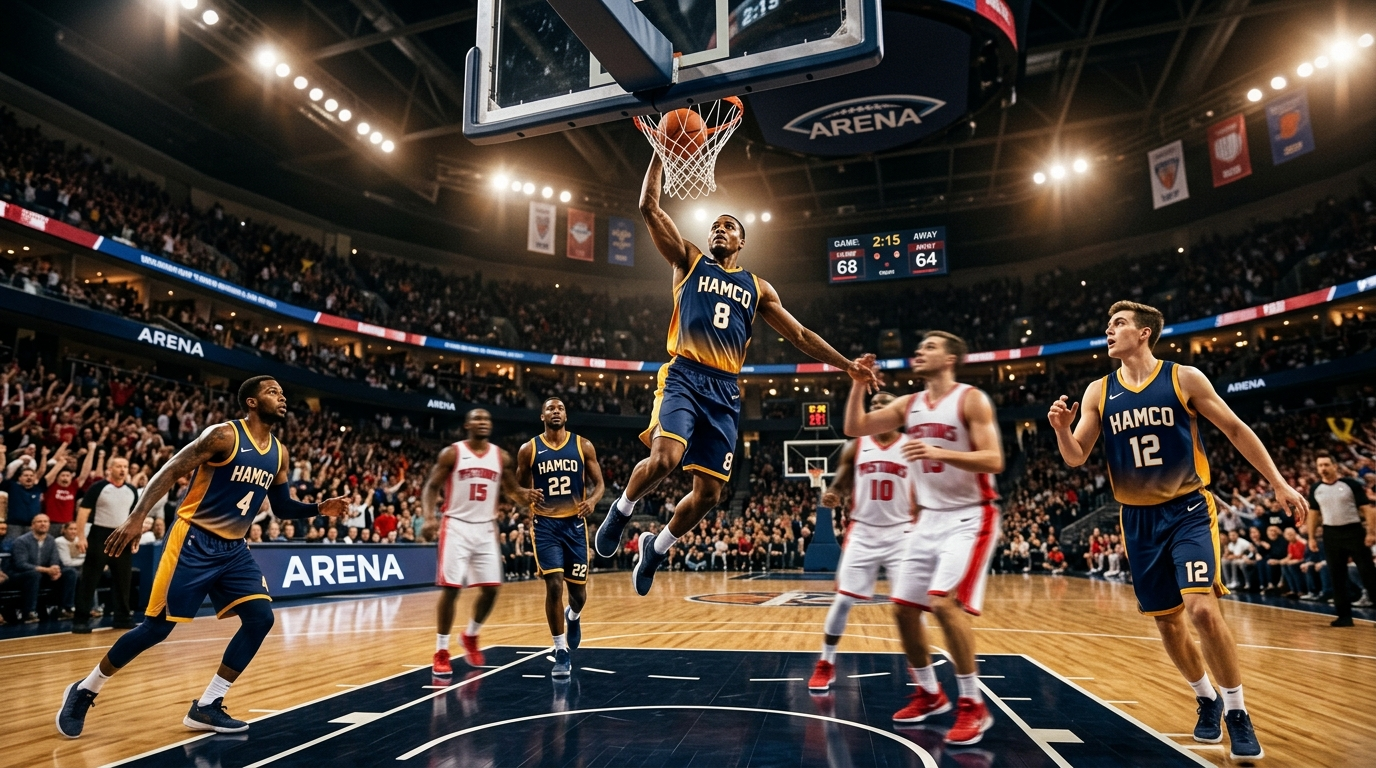
Basketball is the most exposed team sport. No helmet, no pads, no cap. Ten players in jersey and shorts, every one of them visible from every seat at the same time, and the broadcast camera close enough to read a seam. That leads to three constraints that drive the rest of this guide.
- The jersey and shorts are one outfit. A strong jersey over generic shorts looks borrowed. Design the set together.
- Every graphic has to work in motion, at distance, and under arena lighting. Test the mockup small and blurred, not just full size on a screen.
- Contrast is not optional. Officials read numbers from across the court and the rule books define how big and how clear they must be.
What can you design on a basketball uniform? The rule zones
Before colors or fonts, learn the zones. The NFHS basketball uniform sheet (high school) and NCAA Rule 1, Section 22 (college) each split the jersey into areas with different freedom. Youth, rec and AAU leagues usually write their own rules or borrow NFHS, so check the league page before you commit.
| Zone | NFHS high school | NCAA college (2026/27 book) |
|---|---|---|
| Torso (front and back body) | One single solid color, no designs in the fabric. White at home, a dark color clearly contrasting white away. Gray only as an away color and at least 70 percent closer to black. | Called the neutral zone, at least 12 inches wide. One single color; a tonal design is allowed if the shift is within 15 percent of the base color. Home light, away dark, changeable by mutual consent. |
| Above the neckline (collar line up to the shoulder seam, front and back) | No color or design restrictions, except identifying names. Any color, any pattern. | The shoulder panel, up to 5 inches from the shoulder seam, sits outside the neutral zone; no color or design restrictions outside the neutral zones. |
| Side inserts | Any color or design, centered below the armpit, maximum 4 inches wide including trim, same width on every jersey. | Outside the neutral zone, so no color or design restrictions. |
| Armhole trim | Trim or accent color no wider than 1 inch around the arm opening. | A colored neckline no wider than 1 inch; armhole not separately restricted. |
| Numbers | Front at least 4 inches, back at least 6 inches, stroke at least 3/4 inch, plain Arabic numerals, same style and color front and back, no more than three colors. Legal digits 0 to 5 only: 0, 00, 1 to 5, 10 to 15, 20 to 25, 30 to 35, 40 to 45, 50 to 55. A roster may not use both 0 and 00. | Front at least 4 inches, back at least 6 inches, at least 1 inch wide, one single solid color in distinct contrast, border up to 1/2 inch. Numbers 0 to 99; a roster may use 0 or 00, not both. No duplicates. |
| Names and wordmarks | School name, nickname, logo name or abbreviation on the front; the same plus the player’s name on the back; horizontal or arched; at least 1 inch from any number. | Up to two identifying names or abbreviations front and back, at least 1 inch from the number; horizontal, arched, angled or circular. |
| Logos | One manufacturer logo up to 2 1/4 square inches; school or conference logo at the neckline apex, in the back panel area or in a side insert; American flag up to 2 by 3 inches. No sponsor logo is listed. | One manufacturer logo; institutional and conference logos in set spots; Division I only may carry a commercial logo up to 4 square inches on the front shoulder panel or on the back at least 2 inches above the number. |
| Shorts | No length rule in the uniform sheet. Team shorts must match. | Names, mascots and logos allowed as long as a perceptible majority of the shorts is the neutral zone color; color, style and design alike for all teammates. |
Read that table once and most of the design decisions make themselves. On a high school jersey the body is a solid block, so personality comes from the shoulder area, the side inserts and the shorts. On a college jersey a quiet tonal pattern can live in the body. In AAU, gradients and patterns are usually fine, but the team will still want a clean number because the same players get recruited off tournament film.
The basketball uniform design process in 7 steps
- Define the program identity first. A rec league wants warmth and easy to find numbers. A varsity program wants continuity with its past. A travel program wants to look current on a tournament floor. Every later choice should point back to this.
- Lock the color system: one dominant color, one secondary, one trim. Three is the practical maximum, and the NFHS caps the number itself at three colors, so a fourth color has nowhere legal to go on a high school jersey.
- Choose the silhouette. Sleeveless is the default at every level. Short sleeve adds graphic space but is mostly a shooting shirt or practice look. Reversible gives two looks in one piece and is the budget answer for rec and youth; our reversible basketball uniforms guide covers when it fits.
- Design the graphic system inside the zones. Decide what the shoulder area, the side inserts and the shorts carry. On an NFHS jersey the torso stays solid; put the pattern in the inserts and above the neckline.
- Plan typography, numbers first. Pick the number font, check the digits and sizes against the rule table, then pick a name font that does not fight it. The best jersey fonts guide shows which number fonts stay readable at 6 inches.
- Extend the system to the shorts. Waistband, side panel and hem should echo the jersey. The shorts carry the pattern a high school jersey body cannot.
- Mock up home and away together. NFHS: white at home, dark away. NCAA: light at home, dark away. Design both at once so they read as one program, not two teams.
Jersey styles and what each one costs
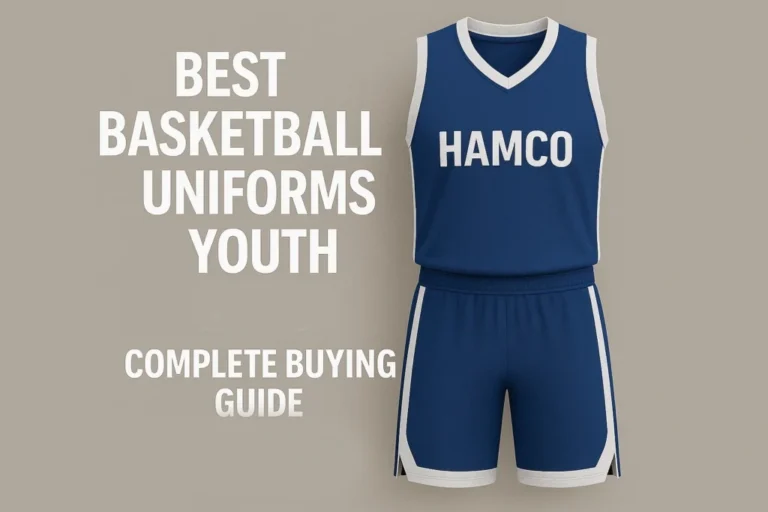
Here are the uniform builds Hamco publishes prices for, so you can match the design to a budget before the mockup. Every set is fully sublimated 160 to 180 GSM polyester interlock, and reversibles are a single layer 180 GSM with sublimation on both faces. Sizes run youth XS to adult 4XL with custom sizing available. The price includes names, numbers, free US shipping and no setup fee.
| Build | Design notes | 1 to 24 | 25 to 50 | 51 to 100 | 101 plus |
|---|---|---|---|---|---|
| V neck uniform set (jersey + shorts) | Modern neckline; the V opens the above the neckline zone a little wider for collar color | $69.99 | $64.99 | $62.99 | $59.99 |
| Round neck uniform set (jersey + shorts) | Classic crew neckline; the traditional varsity look | $69.99 | $64.99 | $62.99 | $59.99 |
| Reversible uniform set (jersey + shorts, two looks) | Light face and dark face must share one graphic skeleton; names and numbers read on both faces | $99.99 | $94.99 | $92.99 | $89.99 |
| Reversible jersey only (V neck or round neck) | Practice and rec league staple; pair with any shorts | $49.99 | $44.99 | $42.99 | $39.99 |
| Performance shorts only | Replacement or mix and match piece | $39.99 | $34.99 | $32.99 | $29.99 |
The chart shows the budget decision most programs face. Two standard sets for home and away cost $139.98 per player at the 1 to 24 tier. One reversible set is $99.99 and covers both, a $39.99 saving per player. The trade is design freedom: a reversible shares one shape and one number layout across both faces, and the rec leagues that use it rarely enforce the NFHS color rules. For a varsity program that must wear white at home, two dedicated sets are still the cleaner answer. The custom basketball uniforms cost guide runs the full roster math.
Color: what works, what reads, and what the rule book allows
Most uniform color systems fail for one of two reasons: the contrast is too weak to read at distance, or the palette is too busy to feel like one program. The rule books remove some choices for you. NFHS home jerseys are white and away jerseys are a dark color clearly contrasting with white. Gray is only an away color if it sits at least 70 percent toward black. The NCAA uses light at home and dark away, changeable by agreement. Inside those limits, these palettes hold up.
| Palette | Why it works | Rule note |
|---|---|---|
| Navy, white, gold | Highest contrast of the classic sets; ages well at every level | Navy away, white home, gold in the number border and inserts |
| Black, red, white | Aggressive and universally readable; strong for travel programs | Black away, white home; keep red to one number border or insert |
| Forest green, cream, gold | Heritage feel without looking stiff | Cream is not white; NFHS home jerseys must be white, so cream works for AAU, not NFHS home |
| Royal blue, orange, white | High energy, reads under bright lights | Orange number on royal passes the contrast test; royal away, white home, orange in the border and inserts |
| Slate gray, electric blue, black | Current, clean, tech look | NFHS: gray must be at least 70 percent toward black for an away jersey; slate usually fails. Use black torso, slate inserts |
| Burgundy, dusty pink, cream | Unexpected and photographs well | Dusty pink number on burgundy fails the contrast test; use cream numbers, pink only in inserts |
| Charcoal, safety orange, white | Industrial, high contrast | Charcoal must pass the 70 percent rule for NFHS; check a swatch under gym light |
| Deep teal, coral, off white | Fresh, works on a gradient in AAU | Gradient torso is AAU only; off white is not white for an NFHS home jersey |
Three combinations to avoid at any level: three saturated colors at equal weight (visual noise), two colors with similar brightness (a navy number on a black torso disappears on broadcast), and a trend palette that has nothing to do with the program. Graphics can change next season. A wrong color system shows up every game for four years.
Typography: numbers and names that read from the back row
Jersey typography is where amateur basketball uniform design falls apart: thin numerals, ornate names, or two fonts fighting each other. Three rules fix most of it, and two of them are in the rule book.
- Numbers come first. Pick the number font, lock it, then choose a name font that complements it. Numbers are the one piece of information the official, the scorer and the opponent all need.
- Numbers need size and weight. NFHS: at least 4 inches on the front, 6 inches on the back, a stroke at least 3/4 inch wide, plain Arabic numerals, no more than three colors. NCAA: the same 4 and 6 inch minimums, a stroke at least 1 inch wide, one solid color with an optional border up to 1/2 inch. Many teams go 6 inches front and 8 inches back so the number reads on film; nothing in either book stops you going larger.
- Check the digits. NFHS allows only 0 to 5 in each position. The whole legal list is 00, 0 to 5, 10 to 15, 20 to 25, 30 to 35, 40 to 45 and 50 to 55. A player who wants 7, 23 or 33 is fine with 23 and 33 but not 7. The NCAA allows 0 to 99. AAU and youth leagues set their own rule; many copy the NFHS list, so ask before a player picks 7.
- Names stay simple. Uppercase, condensed, straight or arched across the shoulder blades, at least 1 inch from the number under both rule books. Save the expressive type for the chest wordmark.
Pairings that keep working: collegiate block numerals with a condensed sans name; geometric numerals with an all caps sans; a vintage serif numeral with a matching serif name for heritage programs. For a wordmark that fits the chest zone, the sports logo maker walkthrough covers what the factory needs in the file.
Basketball uniform design trends for 2026, and where each one is legal
| 2026 trend | What it is | Where you can use it |
|---|---|---|
| Gradient fades | Torso transitions from one team color to another | AAU, rec, adult leagues. Not on an NFHS torso (single solid color). NCAA only as a tonal shift within 15 percent |
| Asymmetric side panels | A curved or angled block on one side only | NFHS side inserts must be the same width on every jersey and no wider than 4 inches, so the asymmetry has to live above the neckline or on the shorts. Free in AAU and NCAA outside the neutral zone |
| Heritage block typography | Collegiate block numerals, serif wordmarks | Legal everywhere; the safest trend to adopt for a school program |
| Muted earth palettes with one bright accent | Cream, clay, forest, rust, slate bodies | Fine for AAU and adult. NFHS home must be white and away must be dark, so cream and slate bodies fail at the high school level |
| All over sublimated patterns | Geometric, topographic or camo textures across the body | AAU and rec. On an NFHS jersey the pattern can only sit in the side inserts and the shoulder area; on an NCAA jersey only as a tonal pattern |
| Minimal blank canvas | One wordmark, plain numerals, one stripe | Legal everywhere and often the strongest look on broadcast |
If a trend you like is not legal at your level, move it to the shorts, the shooting shirt or the warm up. Those pieces carry no torso rule, and the shorts are the half of the uniform most programs forget to design at all. For layout ideas by jersey cut, the basketball jersey template ideas post has examples.
Shorts: the other half of the uniform
Shorts are where a high school program gets its pattern back. The NFHS uniform sheet puts no design rule on the shorts beyond the team matching, and the NCAA only asks that a perceptible majority of the shorts be the neutral zone color. The strongest shorts designs do three things. They echo the jersey color system at the waistband and side panel. They use the side seam as a design line (a stripe, a fade, a contrast panel). And they match the jersey hem treatment at the leg opening. Keep the back of the shorts cleaner than the front. Neither rule book sets a shorts length; mid thigh is the common cut, and a league may add its own rule, so ask before you order a retro length.
Design by level
| Level | Design priorities | Rules that apply |
|---|---|---|
| Youth rec leagues | Durability, big clear numbers, bright contrast, reversible if the league does not supply home and away. The best basketball uniforms for youth guide covers fit by age. | League rules; many copy NFHS numbers. Our youth basketball rules by age group guide lists what changes by age. |
| Travel and AAU | More latitude: fades, patterns, bold wordmarks. Still keep a solid, high contrast number because recruiters watch film. | Event rules vary by organizer and are usually looser on uniform design than NFHS. Check the event page before you order. |
| High school varsity | Continuity with the school’s history; solid torso; personality in inserts, shoulder area and shorts. | NFHS uniform sheet in full: white home, dark away, digits 0 to 5, three colors in the number, 4 inch inserts. |
| College | Tonal patterns in the body, two identifying names, conference and commercial logo placement. | NCAA Rule 1, Sections 22 to 25. Division I only for commercial logos. |
| Adult leagues | Self expression; custom wordmarks and unusual palettes. | Usually none beyond matching jerseys and readable numbers. |
Common basketball uniform design mistakes
- A gradient or pattern across the torso of a high school jersey. It is a rule, not a taste, and it is the first thing an official checks.
- A number the league does not allow. 6, 7, 8 or 9 anywhere in the number on an NFHS jersey.
- Four colors. The design feels busy and the NFHS number rule only allows three anyway.
- Thin numerals or low contrast with the body. Numbers exist to be read.
- Shorts ordered separately, from a different vendor or a different run, so the dye lot does not match.
- Designing home only and assuming away will sort itself out. It will not.
- A side insert wider than 4 inches, or different widths on different sizes, on a high school jersey.
Ordering the finished design
Once the design is locked, production is simple if the timing is right. Hamco’s standard production is 3 weeks from the time you approve the final mockup, and the mockup comes back free within 12 hours. Rush production is 10 to 12 business days, per the refund and production policy. Custom orders cannot be returned, so send the size chart to parents before the order and have a sample size run tried on; the basketball uniform size guide shows how to measure. Lock the roster (name, number, size) before you submit, because adding players later is a second run at the 1 to 24 price. Sublimated polyester keeps its color through a season when washed cold, as the how to wash a jersey guide explains. The what is sublimation printing guide covers why the graphics do not crack or peel. If the team is still picking a name for the chest, the basketball team names list has 200 options.
Frequently Asked Questions
What are the number rules for a basketball uniform?
NFHS high school: at least 4 inches tall on the front and 6 inches on the back, a stroke at least 3/4 inch wide, and no more than three colors. Only the digits 0 to 5 are legal (00, 0 to 5, 10 to 15, 20 to 25, 30 to 35, 40 to 45, 50 to 55). NCAA: the same 4 and 6 inch minimums, a 1 inch stroke, one solid color, and numbers 0 to 99.
How many colors should a basketball uniform use?
Three: a dominant color, a secondary and a trim. The NFHS also limits the number itself to three colors, and the torso of a high school jersey must be one solid color.
Can a high school basketball jersey have a gradient or pattern?
Not on the torso. The NFHS uniform sheet requires a single solid color with no designs in the fabric. Patterns are allowed above the neckline, in side inserts up to 4 inches wide, and on the shorts. The NCAA allows a tonal pattern within 15 percent of the base color.
Can I put sponsor logos on a basketball uniform?
Not on an NFHS high school jersey; the sheet lists only one manufacturer logo, school and conference logos, and the flag. NCAA Division I allows one commercial logo up to 4 square inches on the front shoulder panel or the back above the number. Youth and adult leagues set their own policy.
How much does a custom basketball uniform cost per player?
From Hamco a sublimated jersey and shorts set is $69.99 at 1 to 24 pieces and $59.99 at 101 plus. A reversible set is $99.99 to $89.99. Names, numbers and US shipping are included, and production is 3 weeks from mockup approval.
Final thoughts
A well designed basketball uniform is a system that passes the rule check and still looks like one program from the top row. That means solid, high contrast numbers, a color plan that is legal at home and away, jersey and shorts built together, and the personality placed where the rule book lets it live. Get the zones right first and the trends become choices instead of risks.
Ready to turn the design into a set? Browse custom basketball uniforms, send the colors, logo and roster count, and a free mockup of home and away comes back within 12 hours. No minimum, free US shipping, 3 week production from approval.

3 thoughts on “Basketball Uniform Design: The Complete 2026 Guide”