| Quick Answer Rugby union has 15 positions on the pitch, each with a number from 1 to 15 and a specific job. Numbers 1 to 8 are the forwards, the bigger players who contest the scrum and lineout. Numbers 9 to 15 are the backs, the faster players who move the ball and score the tries. Every body type has a home somewhere in the 15. |
Rugby can look like organized chaos, 30 players piling into each other with no obvious plan. It is not. Every one of the 15 players on a rugby union side has a numbered position and a defined job, and once you learn the numbers, the chaos turns into a pattern you can read. In rugby, the number on a player’s back tells you exactly what they do, which is one reason the shirt matters so much, as our rugby vs football jersey guide explains. This is every position, 1 through 15, and what each one is there to do.
So are there positions in rugby? Very much so, and they are more specialized than in almost any team sport. The 15 positions split into two groups: the eight forwards, numbered 1 to 8, who do the heavy contact work and contest the set pieces, and the seven backs, numbered 9 to 15, who are generally faster and score most of the tries. Whether you are a new player working out where you fit, a parent learning the sport from scratch, or naming a new club with our team names guide, this breakdown of the rugby positions explained by number is where to start. So what are the positions in rugby? Here are all 15 in one place, running in numbered order from the front of the scrum to the last line of defense, then the detail on each unit.
| No. | Position | Unit | Main Job |
| 1 | Loosehead prop | Front row | Anchor the scrum, support the lineout |
| 2 | Hooker | Front row | Hook the ball in the scrum, throw the lineout |
| 3 | Tighthead prop | Front row | Anchor the scrum, hold the most pressure |
| 4 | Lock | Second row | Scrum power and lineout jumping |
| 5 | Lock | Second row | Scrum power and lineout jumping |
| 6 | Blindside flanker | Back row | Tackle, hit rucks, physical work |
| 7 | Openside flanker | Back row | Win turnovers, first to the breakdown |
| 8 | Number 8 | Back row | Carry from the scrum base, link play |
| 9 | Scrum half | Halfbacks | Link forwards and backs, clear the ball |
| 10 | Fly half | Halfbacks | Playmaker and kicker, controls the game |
| 11 | Left wing | Back three | Pace and finishing, score tries |
| 12 | Inside center | Centers | Crash ball, distribute, defend |
| 13 | Outside center | Centers | Pace and power, create space |
| 14 | Right wing | Back three | Pace and finishing, score tries |
| 15 | Fullback | Back three | Last defender, field high kicks, counterattack |
The Front Row: Props and Hooker
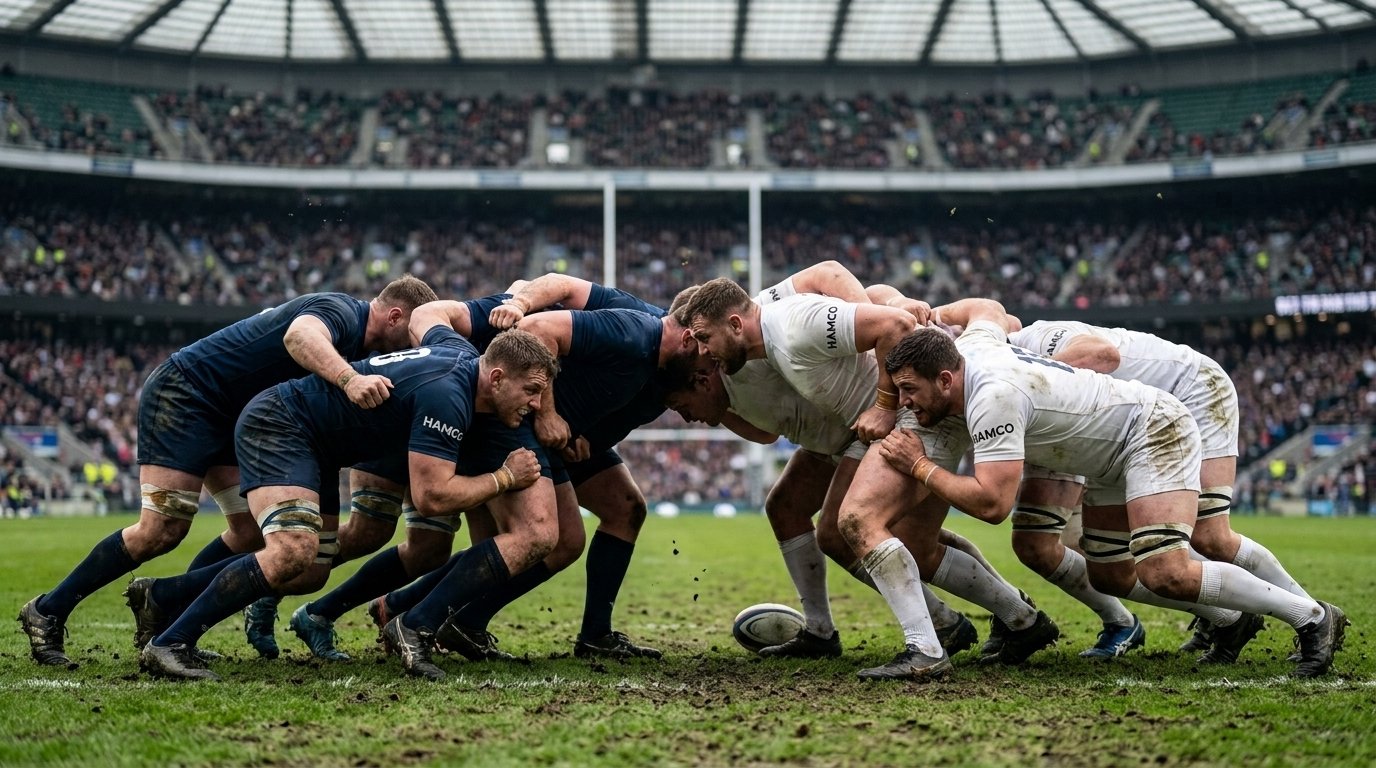
The front row is where rugby is at its most brutal. These three players, the loosehead prop at 1, the hooker at 2, and the tighthead prop at 3, pack down at the very front of the scrum and take the full force of the opposition front row. The two props are usually the heaviest players on the field, built like fire hydrants, and their job is raw power: hold the scrum steady, drive forward, and support the jumpers in the lineout. The hooker sits between them and has the most technical job of the three. In the scrum the hooker hooks the ball backward with a foot, and at the lineout the hooker throws the ball in, which demands real accuracy under pressure. Together with the second row, these are the rugby scrum positions that decide who controls the set piece. Front rowers are strong, low, and stubborn, and not usually tall. One honest detail most fans miss: loosehead and tighthead props are not interchangeable. They bind on opposite sides of the scrum and train for different angles of pressure, so a specialist tighthead is one of the hardest players in the world to replace.
The Second Row: Locks
Behind the front row are the two locks, numbers 4 and 5, also called the second row. These are the tallest players on the team, often well over six and a half feet, and they are the engine of the scrum, adding the bulk of the forward push. Their signature moment is the lineout, where teammates lift them into the air to catch the ball thrown in by the hooker. A good lock wins his own lineout ball and disrupts the other team’s. Away from the set piece they are workhorses, hitting rucks and mauls and carrying the ball into contact. Think tall, long, and relentless. The second row is also where many teams hide their lineout caller, the player who reads the throw and calls which jumper goes up, so a smart lock is as valuable as a tall one.
The Back Row: Flankers and Number 8
The back row, or loose forwards, are the most athletic of the pack. The two flankers wear 6 and 7. The blindside flanker at 6 is bigger and more physical, a heavy tackler who defends the short side of the field and hits every ruck. The openside flanker at 7 is the fastest and most mobile forward on the team, first to every breakdown, hunting turnovers and generally making a nuisance of himself. The number 8 binds onto the back of the scrum and is allowed to pick the ball up from its base and charge forward. The 8 is the bridge between the forwards and the backs, a powerful ball carrier who needs the size of a forward and some of the speed of a back. The back row is also where many captains play, since they are involved in nearly every phase and can read the whole field from the middle of the action.
The Halfbacks: Scrum Half and Fly Half
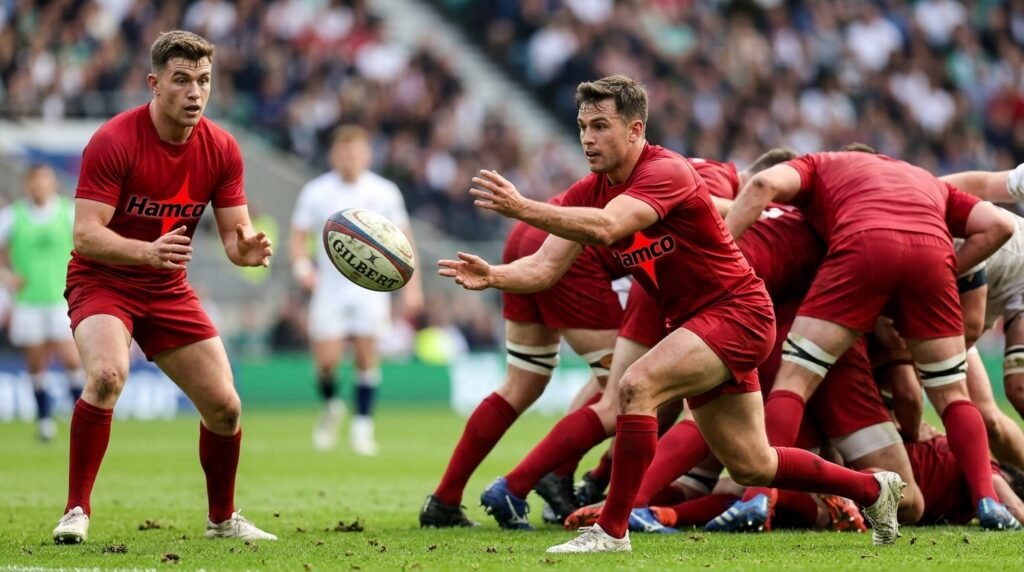
If the forwards win the ball, the halfbacks decide what to do with it. The scrum half, number 9, is the link between the two groups. Usually the smallest and quickest player on the field, the 9 dives into rucks and scrums to dig the ball out and fires a fast, accurate pass to get it moving, and is also the on field organizer who never stops talking. The fly half, number 10, is the brain of the team. Standing just behind the scrum half, the 10 receives the ball first and decides in a split second whether to kick, pass, or run, and usually handles the goal kicking too. The best number 10s control an entire match with their choices, which is why coaches spend so much of their season preparation building a team around that position. A fly half needs vision, a good boot, and ice in the veins. Together the 9 and the 10 are called the halfback axis, and they are the spine of the team, since almost every attacking move runs through their hands first.
The Centers: Inside and Outside
The two centers, numbers 12 and 13, form the midfield. Here is a numbering quirk that trips up newcomers: the centers are 12 and 13, but the wings who play just outside them are 11 and 14. The inside center at 12 is often bigger, a crash ball runner who takes the ball hard into contact and can act as a second playmaker beside the fly half. The outside center at 13 is usually faster and a sharp reader of the game, tasked with breaking the defensive line and putting the wingers into space. Both centers have to be punishing tacklers, since the midfield is where most attacks are stopped. They blend power and pace in roughly equal measure. Good center pairings are built on trust, since the two defend the widest and most dangerous channel on the field as a unit.
The Back Three: Wings and Fullback
The back three are the last line of defense and the sharpest attacking weapons: two wings, numbered 11 and 14, and the fullback at 15. The wings are the fastest players on the team, the finishers who score most of the tries. Give a good winger a yard of space and they are gone. The fullback, number 15, plays deepest of all, behind the whole defense. Their job is to field the high kicks that rain down from the opposition, catching under pressure with a tackler bearing down, and to launch counterattacks from deep. A fullback needs a reliable boot, real bravery under the high ball, and the positional sense to always be in the right place. These are the players who cover the most grass in a match, which is why their rugby shorts and kit are cut for pure speed.
Where Body Types Fit
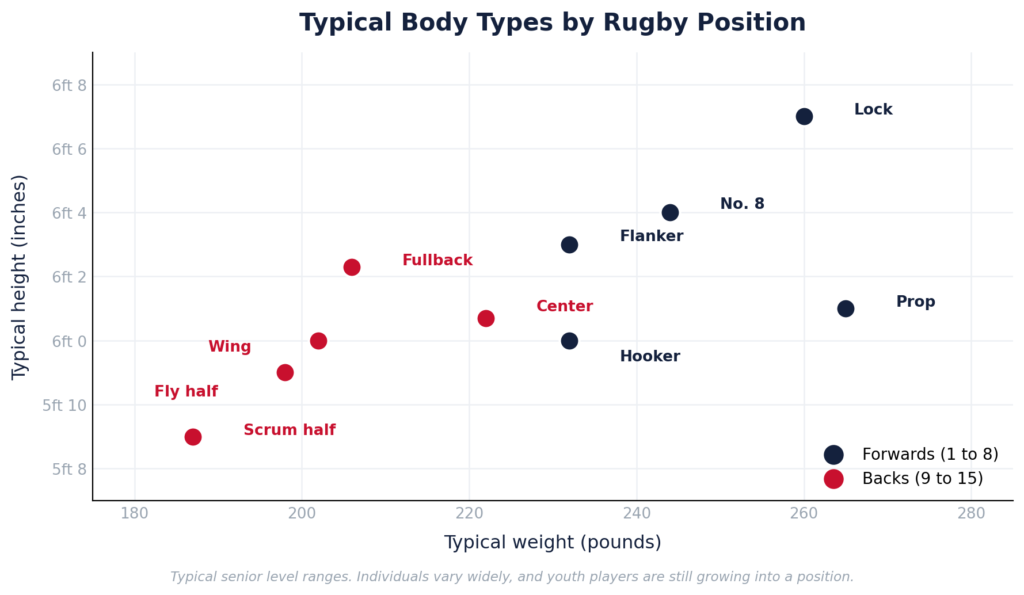
Here is the honest and best part about rugby: there is a position for every body type. It is one of the only sports where a 260 pound teenager and a 150 pound teenager can play on the same team and both be essential. The biggest, strongest players go in the front five, the props, hooker, and locks, where size wins scrums. The athletic big bodies play the back row. The small and quick belong at scrum half. The skillful decision makers play fly half and center. And the fastest, most elusive athletes go to the wings and fullback. The chart shows the rough size ranges by position, though every one of these has exceptions, and youth players especially should try several spots before settling. Do not let a 10 year old decide they are only a prop. Bodies change fast in the teens, and plenty of professional players moved from the backs to the forwards, or the other way, as they filled out. The best youth coaches rotate kids through several positions so they learn the whole game before specializing.
Fifteen positions means 15 different bodies to kit out, from the squat 250 pound prop to the lean, sprinting winger, and one order has to fit them all. That is exactly what we do. Our custom rugby uniforms are cut and sized across the whole range in one dye batch, so the entire XV matches, and coaches and subs can grab matching sideline polos for the touchline. Kit your whole program in rugby apparel built for scrums, tackles, and 80 minutes of contact, and get every number from 1 to 15 sorted in a single run.
Frequently Asked Questions
Q: How many positions are there in rugby?
A: Rugby union has 15 positions, numbered 1 to 15. Numbers 1 to 8 are forwards and 9 to 15 are backs. Rugby league fields 13 players and sevens fields 7.
Q: What are the rugby positions by number?
A: 1 loosehead prop, 2 hooker, 3 tighthead prop, 4 and 5 locks, 6 and 7 flankers, 8 number eight, 9 scrum half, 10 fly half, 11 and 14 wings, 12 and 13 centers, 15 fullback.
Q: What are the forwards and backs in rugby?
A: Forwards are numbers 1 to 8, the bigger players who contest scrums and lineouts. Backs are 9 to 15, the faster players who move the ball and score.
Q: What is the hardest position in rugby?
A: There is no single answer. Fly half carries the most decision pressure, prop the most physical load, and fullback the most defensive isolation. Each is hard in its own way.
Q: Which rugby position is best for a beginner? A: Many new players start in the back row or center, where a mix of tackling and running suits developing athletes. Try a few spots before specializing.