| Quick Answer A soccer match is 90 minutes, split into two 45 minute halves with a 15 minute halftime. The clock never stops, so the referee adds stoppage time at the end of each half, which pushes most matches to about 95 to 100 minutes. Knockout games can add 30 minutes of extra time and a penalty shootout on top of that. |
If you are new to soccer, the clock is the first thing that makes no sense. It counts up instead of down, it never stops, and the game somehow ends a few minutes after it is supposed to. Soccer hides a lot of its logic this way, the same way the offside rule baffles every newcomer until someone explains it properly. The clock is simpler than it looks. Here is exactly how long a soccer match runs, including all the stoppage time nobody warns you about.
The short version is 90 minutes. The honest version is longer. A match is built from a fixed 90 minutes of play, a halftime break, and then a stack of add ons that can stretch a knockout game past two and a half hours. Parents juggling pickup times learn this fast, somewhere between sorting out the jersey rules their league enforces and realizing the final whistle is more of a suggestion than a schedule. Let us break the clock down piece by piece.
The 90 Minute Clock
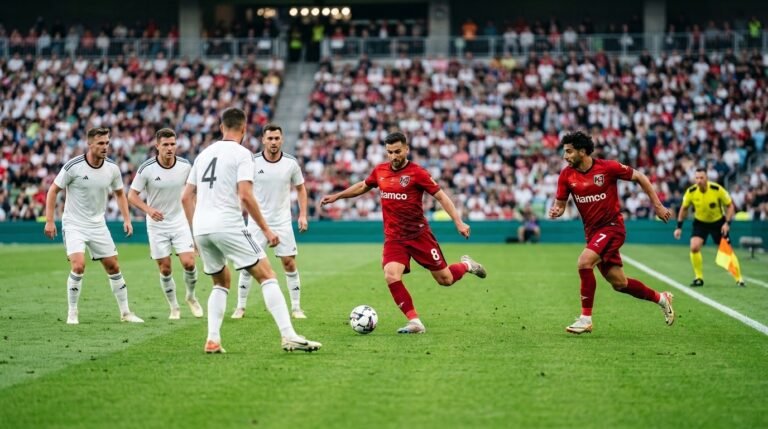
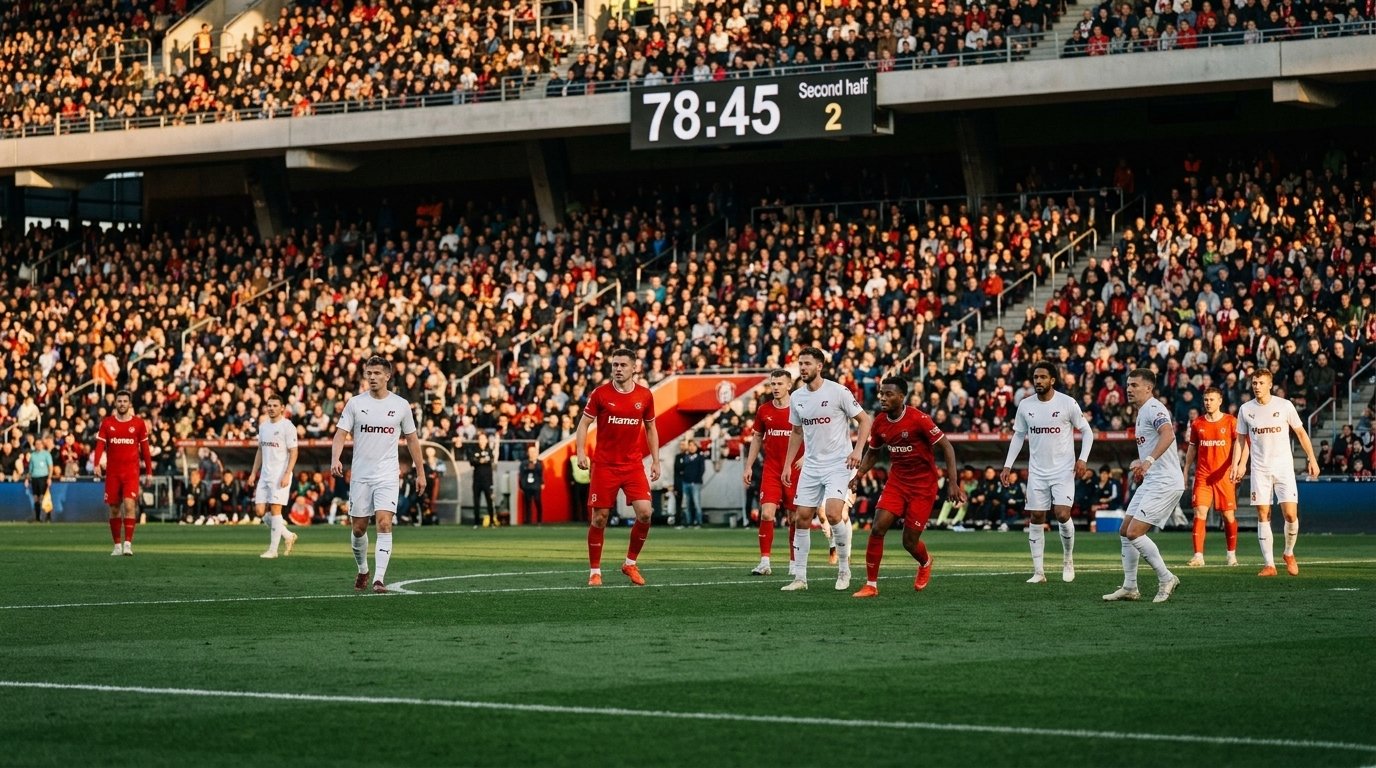
Every standard soccer match is 90 minutes long, divided into two halves of 45 minutes each. The key thing to understand is that the clock runs continuously. Unlike basketball or American football, it does not stop when the ball goes out, when a goal is scored, or when a player is treated for an injury. It just keeps ticking. The referee, not the scoreboard, is the official timekeeper, and the number on the screen is a courtesy for fans. That is why a match almost never ends exactly at 90:00. It is also a real endurance test, with outfield players often covering 7 miles in a match, which is part of why footwear matters and why players care so much about the difference between soccer and football cleats.
Stoppage Time and How It Is Calculated
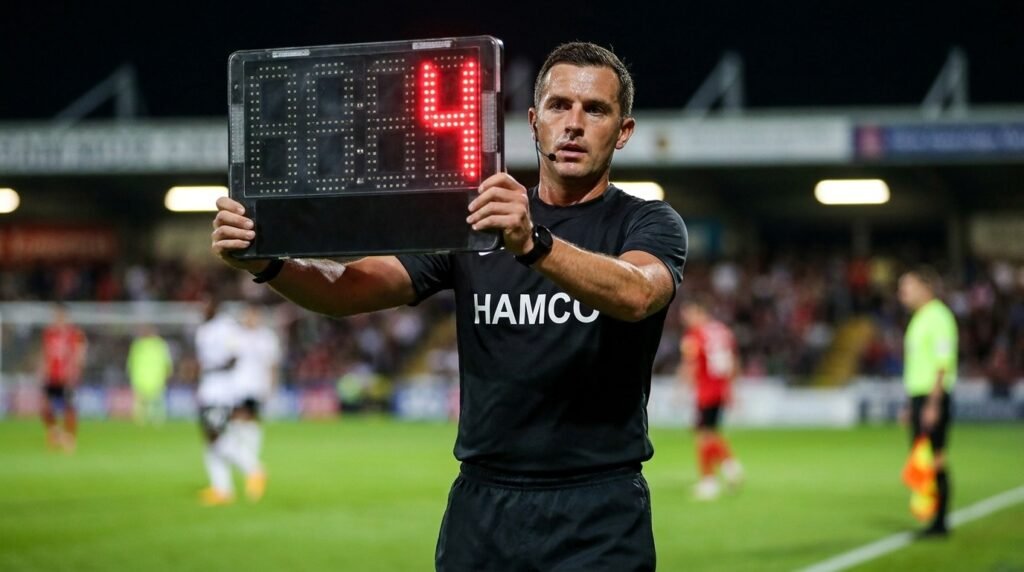
Because the clock never stops, soccer makes up for lost time at the end of each half. This is stoppage time, also called added time or injury time. The referee tracks every delay during the half, then adds those minutes back on. The list of what counts is long: substitutions at roughly 30 seconds each, injuries, goal celebrations, time wasting, VAR checks, and cards. The fourth official holds up a board showing the minimum to be added, and the referee can add even more. There is no maximum. Since the 2022 World Cup, referees have been told to be stricter about it, so added time has grown. It is now common to see 6 to 10 minutes tacked onto a half, which is why a 90 minute match often runs closer to 100 minutes of play.
Halftime Is 15 Minutes
Between the two halves is a halftime break of 15 minutes. That is the standard at the professional and international level, set by the Laws of the Game, and it is the players’ only real rest. Youth and amateur leagues often trim it to 5 or 10 minutes to keep younger players moving and to fit tighter field schedules. Either way, halftime is fixed dead time, so when you are planning your evening, add it on top of the playing minutes.
Extra Time in Knockout Matches Is 30 Minutes
In league play a tie is a perfectly good result, so the match simply ends after 90 minutes plus stoppage. Knockout matches are different, because someone has to advance. If the score is level after regulation and stoppage time, the game goes to extra time: two more halves of 15 minutes each, 30 minutes in total, with only a short one minute switch between them rather than a full halftime. Extra time is not sudden death. Both halves are played in full, and stoppage time gets added to these periods too. By now a knockout match has run well past two hours.
Penalty Shootouts
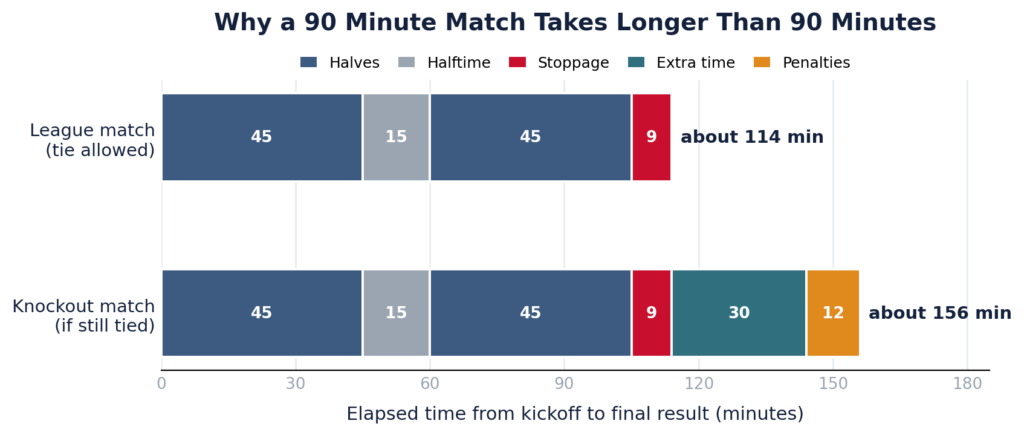
If the teams are still level after extra time, the match is decided by a penalty shootout. Each team takes five penalty kicks, alternating, and the team with the most goals wins. If they are still tied after five kicks each, it moves to sudden death, where the teams trade single kicks until one scores and the other misses. A shootout usually takes 10 to 20 minutes, and it is the most nerve wracking way to lose a game in all of sports. Add it all up, regulation, stoppage, extra time, and penalties, and the longest knockout matches push past 150 minutes from first whistle to last. The chart shows where all that time goes.
Youth Match Variations
Youth soccer scales the clock down by age, because 90 minutes of running is far too much for young legs. Most United States Youth Soccer guidelines shorten the halves as players get older, and many leagues set their own rules on top of that. At these ages a sensible soccer equipment checklist matters more than the exact minutes, but here is roughly how the time grows.
| Level or Age | Format | Total Playing Time |
| U6 | Four 6 minute quarters | About 24 min |
| U8 | Four 12 minute quarters | About 48 min |
| U10 | Two 25 minute halves | 50 min |
| U12 | Two 30 minute halves | 60 min |
| U14 | Two 35 minute halves | 70 min |
| High school | Two 40 minute halves | 80 min |
| College and pro | Two 45 minute halves | 90 min plus stoppage |
High school soccer in the United States is usually two 40 minute halves for 80 minutes total, while college and the pros play the full 90. Always check your specific league, since match length is one of the most commonly adjusted rules in youth play.
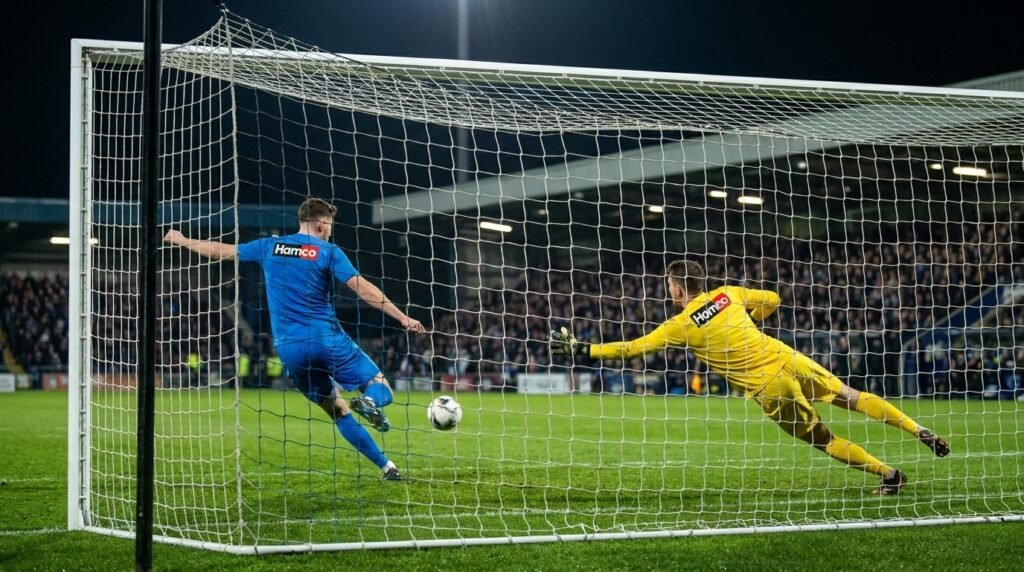
However long the match runs, your players are the ones doing the running, and 90 minutes in the heat is brutal in the wrong kit. Breathable, lightweight jerseys make all of it easier, and getting the kit colors right means your team looks sharp from the first whistle to the last. Our custom soccer uniforms are built for full matches in real weather, so kit the whole roster in soccer apparel that lasts the season, stoppage time and all.
Frequently Asked Questions
Q: How long is a soccer match?
A: Ninety minutes of play, split into two 45 minute halves with a 15 minute halftime. With stoppage time, most matches run about 95 to 100 minutes.
Q: What is stoppage time in soccer?
A: Extra minutes the referee adds at the end of each half to make up for time lost to substitutions, injuries, celebrations, and VAR. There is no maximum.
Q: How long is extra time in soccer?
A: Thirty minutes, played as two 15 minute halves, but only in knockout matches that are tied after 90 minutes plus stoppage.
Q: How long is a youth soccer game? A: It depends on age. Halves range from about 25 minutes for under 10s up to 40 minutes in high school, compared to 45 for adults.