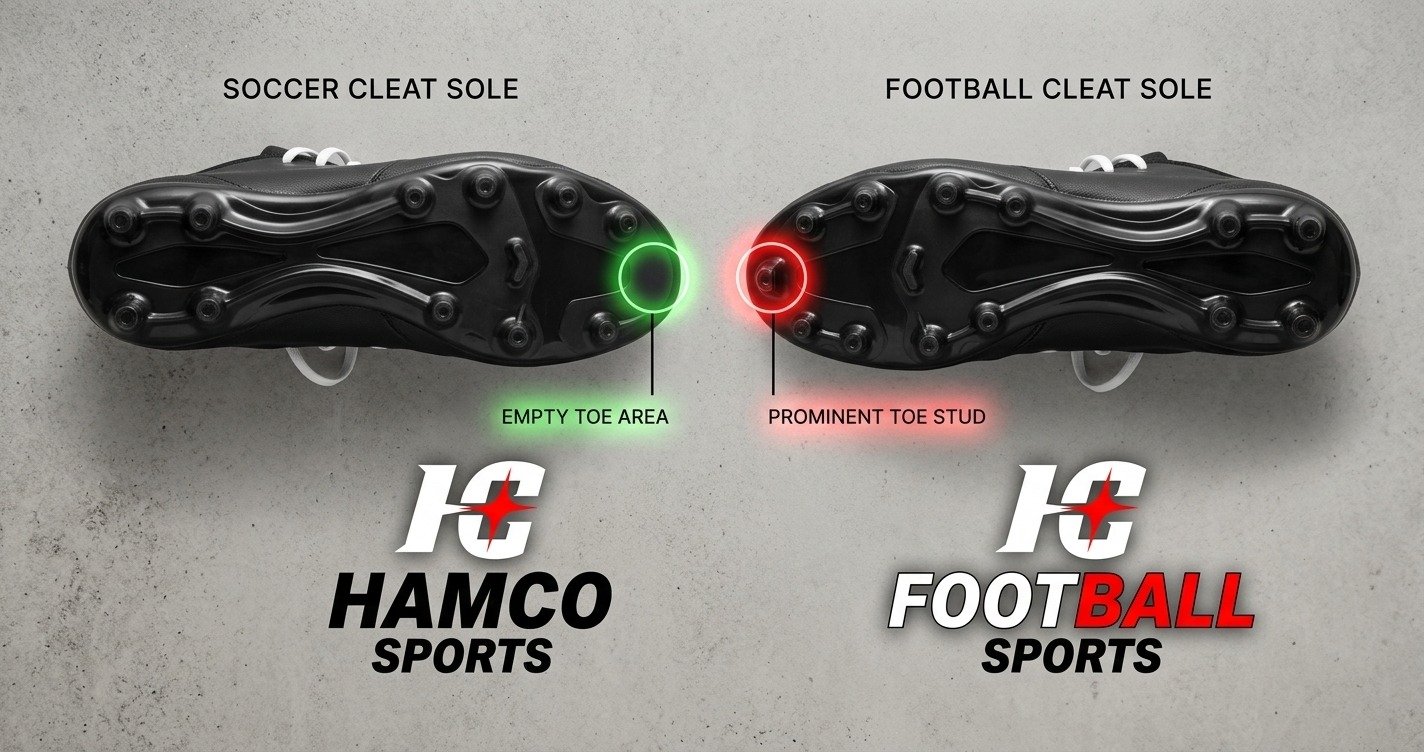
One toe stud. That’s often the only visible thing separating soccer and football cleats, and it’s enough to get your player pulled from a match. Buying the wrong pair wastes money, slows your team down, and sometimes breaks league rules before anyone kicks a ball.
The difference between soccer and football cleats comes down to three things. Football cleats have a front toe stud for explosive push-off, a heavier upper built for contact, and often a higher ankle collar. Soccer cleats skip the toe stud for safety, use a lighter upper for ball feel, and spread studs evenly for cutting and pivoting.
Difference between soccer and football cleats shown in sole comparison
Soccer vs Football Cleats at a Glance
| Feature | Soccer Cleats | American Football Cleats |
| Toe stud | None (banned in most leagues) | Yes, most models |
| Stud layout | Spread evenly for multi-directional cuts | Clustered for forward drive and anchoring |
| Upper material | Thin leather, knit, or synthetic for ball feel | Thicker, more protective synthetic |
| Collar height | Low-cut most common | Low, mid, and high-top all common |
| Average weight | 7 to 10 ounces per shoe | 11 to 15 ounces per shoe |
| Best for | Running, cutting, ball control | Sprinting, blocking, contact |
| Legal for soccer | Yes | No, in almost all leagues |
| Legal for football | Only kickers and punters usually | Yes |
What’s Actually Different?
Soccer and football look alike on a cleat rack, but the game they’re built for is completely different. Soccer is 90 minutes of constant running, turning, and striking a ball with precision. American football is short, violent bursts of power, contact, and anchoring your feet against another player pushing back.
That single contrast drives every design choice. Stud shape, upper thickness, collar height, and weight all come back to the same question: what is your foot doing on the field?
Soccer Cleats: What Sets Them Apart
Soccer cleats are the lightest and most flexible shoe in the cleat family. Every gram matters when a player covers six or seven miles in a single match.
Studs and outsole
Soccer cleats have shorter, evenly spread studs, usually a mix of conical and bladed shapes. You won’t find a stud on the toe, and that’s by design. IFAB’s Law 4, which governs soccer equipment worldwide, requires that a player must not wear anything dangerous to themselves or other players. Referees check soles before kickoff and will remove any player whose studs could injure an opponent.
Soft ground soccer cleats use fewer, longer metal studs for wet pitches. Firm ground cleats have more molded plastic studs for dry grass. Turf shoes skip studs entirely and use small rubber nubs for artificial surfaces. Match the cleat to the pitch, not just the sport.
Upper and collar
The upper is thin and grippy so you can feel the ball through the shoe. Knit, soft leather, and synthetic textiles dominate the market. Most soccer cleats sit low at the ankle so you get full range of motion when you pivot or reach for a cross. Some modern models use a sock-like mid collar, but those are for fit and lockdown, not protection.
Weight
Elite soccer cleats can weigh under 7 ounces per shoe. That’s lighter than most running shoes. You feel the difference in the 80th minute when your legs are heavy and the other team is still fresh.
Want to go deeper on the soccer side? Check out our soccer guides and gear tips for more on kit, training, and team setup.
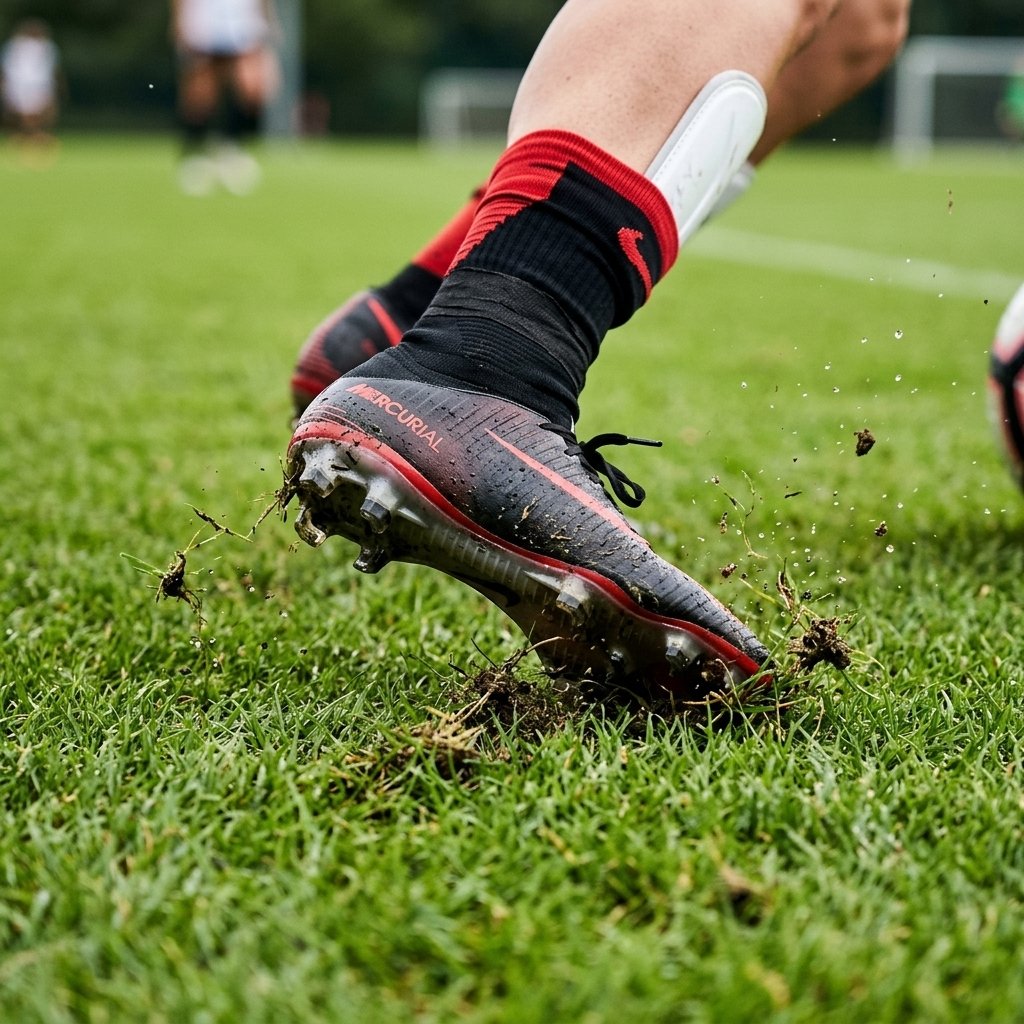
American Football Cleats: What Makes Them Different
Football cleats are heavier, tougher, and designed to protect your feet when another 250-pound body is pushing against them.
The toe stud
This is the giveaway. A stud at the very front of the sole gives linemen, running backs, and receivers a firm anchor for their first step. It bites into the grass when you’re pushing a sled or launching off the line. Soccer doesn’t use it because it catches when you swing through a ball and because it can injure other players in a tackle.
Build and ankle support
Football cleats come in low, mid, and high-tops. Linemen usually wear high-tops for ankle stability in the trenches. Skill position players often prefer mid-tops for a balance of support and speed. Kickers almost always wear low-tops, and many kickers actually prefer soccer cleats because of the cleaner ball contact.
Position-specific variations
This is something most articles gloss over. A linebacker’s cleats and a wide receiver’s cleats are not the same shoe. Linebackers want stability and traction. Receivers want explosive speed. Offensive linemen want rock-solid support through the ankle. When you’re ordering team gear, not every player on your roster needs the exact same model, even if they all wear the same uniform.
The NFL’s official playing rules and the NFHS football equipment guidelines both regulate cleat length and shape. At the high school level, nicked, burred, or loose studs can get a player removed from the game. That’s a real problem for parents who buy cleats on clearance and don’t check them before the season.
Baseball Cleats, Lacrosse Cleats, and Why They’re Not Interchangeable
Parents buying their first cleats often assume cleats are cleats. They aren’t. Baseball cleats have a toe stud similar to football cleats and sometimes use metal spikes that are banned in almost every other sport. They’re built for forward running and lateral shuffling in short bursts, not continuous movement. Lacrosse cleats sit closer to football cleats in design, with a toe stud and reinforced upper, but usually weigh less and offer more lateral flex.
Here’s the clean rule: never use baseball cleats for soccer. The metal spikes and toe stud are both safety hazards and will get your kid ejected before the first whistle. Lacrosse cleats can sometimes work for football, depending on your league’s rules. Football cleats can sometimes work for lacrosse for the same reason. Soccer cleats, because they have no toe stud, are the most “universal” option and are commonly allowed in flag football, soccer, and even some recreational lacrosse leagues. Always check your league’s equipment rules first.
Can I Wear Football Cleats for Soccer?
Short answer: no, and most referees will make you change shoes before kickoff.
The toe stud on football cleats violates almost every youth and amateur soccer rule set because it’s considered a dangerous piece of equipment during tackles and challenges. Even setting the rules aside, the extra weight and stiffness hurt your game. You’ll feel slower, your first touch will feel clumsy, and you’ll burn more energy covering the same ground.
The only real exception is kickers and punters in American football who wear soccer-style cleats on purpose. A soccer cleat’s flexible toe and thin upper give a cleaner strike through the ball. But going the other direction, football to soccer, just doesn’t work.
If you only own football cleats and you get invited to a soccer pickup game, wear turf shoes or flat trainers instead. Safer for you, safer for everyone else, and you won’t get sent off.
Men Difference Between Soccer and Football Cleats
For men, the biggest fit differences come down to toe box width and forefoot flexibility. Men’s soccer cleats generally run narrower and snugger than men’s football cleats. You want that tight fit so the ball doesn’t roll inside the shoe when you strike it. Football cleats give you more room because your foot is doing less precision work and more raw force work.
One tip for adult recreational players: if you’re switching sports on the weekend, don’t size your football cleats the way you size your soccer cleats. You’ll end up with cramped toes by halftime. Order football cleats a half size up from your soccer size if you’re between sizes.
Women Difference Between Soccer and Football Cleats
Women’s cleats are not just men’s cleats in smaller sizes, at least not the good ones. Female players generally have narrower heels, higher arches, and a different Q-angle at the knee, which changes how forces travel through the foot.
For soccer, women’s specific lasts (the shape the shoe is built around) reduce heel slip and give better lockdown during lateral cuts. For flag football and tackle football, women’s cleats often have a slightly more cushioned insole and adjusted forefoot width. Women who play both sports should avoid the trap of buying one pair and using it for both.
An honest tip that competitors skip: a lot of women’s football cleats on the market are still just pink versions of men’s models. If you’re shopping for a serious female player, check whether the brand actually uses a women’s last or just a smaller men’s last with different colors. That matters more than the logo on the side.
[INTERNAL LINK: suggest linking to a Hamco women’s custom soccer jersey page or women’s team uniform collection]

Difference Between Soccer and Football Cleats Youth
Youth cleats follow the same design rules as adult cleats, but there are three extra things parents should know.
First, youth soccer cleats almost never have a toe stud, but cheap multisport youth cleats sometimes do. Check before you hand them to your kid, because most youth soccer leagues will bench a player wearing a toe-studded shoe.
Second, fit matters more for kids than for adults because kids grow. The temptation to buy cleats a size too big so they “last longer” leads to heel slip, blisters, and rolled ankles. Buy to fit now and accept you’ll replace them mid-season if your kid hits a growth spurt.
Third, youth football leagues often ban metal studs entirely. Molded plastic studs are the norm for kids under 14. If you’re looking at hand-me-down cleats from an older sibling, check the league rules first.
A real-world tip for parents of cross-sport kids: buy one pair of soccer cleats and one pair of football cleats rather than trying to find a “do both” shoe. The do-both shoe doesn’t exist, and your kid will get hurt or benched eventually. Two decent pairs cost less than one expensive hybrid, and the hybrid usually fails at both jobs.
Mistakes We See All the Time
Three mistakes show up over and over in youth and amateur leagues.
The first is parents buying baseball cleats because they were cheaper, thinking kids can use them for soccer. Baseball cleats have a toe stud just like football cleats and sometimes have metal spikes. They are not safe or legal for soccer.
The second is players wearing worn-out cleats because they’ve “broken them in.” Studs wear down, especially on the outer and inner edges where you push off when cutting. Worn studs slip, and slipping is how ankles get rolled and ACLs get torn. Run your finger across the studs once a month. If they feel rounded or uneven, it’s time to replace them.
The third is ignoring the surface. Firm ground cleats on wet, muddy pitches are a slip-and-fall waiting to happen. Long soft ground studs on hard, dry fields cause painful pressure points and faster fatigue. Match the cleat to the surface, not just the sport.
When to Replace Your Cleats (and How to Spot Fakes)
Most recreational players get one full season out of a pair of cleats. Competitive players often go through two pairs a year. Watch for cracks in the outsole where the studs meet the plate, worn-down studs, holes in the upper near the toe, and a stretched heel collar that no longer locks your foot in place.
One more thing worth saying out loud: counterfeit cleats are everywhere online, especially on marketplaces with discounted “authentic” boots. Fakes have softer plastics, weaker stitching, and studs that snap off mid-game. Real giveaways include uneven stitching, off-center logos, crooked stud placement, and a heel counter that feels flimsy when you squeeze it. Buy from authorized retailers, and if a deal looks too good to be true on a premium cleat, it probably is.
Pairing Cleats With the Right Uniform
Once you’ve sorted out the right cleats for your sport, the rest of the kit should work with them, not against them. Soccer socks need to be long enough to hold your shin guards securely over the cleat collar. Football socks need reinforced cushioning where cleat edges dig in. Uniform fit affects how you move, and baggy, wrong-cut gear can undo all the agility you just bought with good cleats.
If you coach a team or manage a youth league, getting the whole kit right matters as much as the cleats themselves. At Hamco Sports, we work with coaches, schools, and clubs to design custom soccer and football uniforms that fit the way your players actually move, along with matching socks and training apparel that hold up to a full season.
If you’re building out a full team setup, our custom soccer uniforms and football uniforms are designed to handle a real season, not just one photo day.
Final Word
Picking between soccer and football cleats isn’t about price or brand loyalty. It’s about the shape of your sport, your surface, and your league’s rules. Get the cleat right, then build the rest of your kit around it.
Ready to outfit your team from socks to jerseys? Head over to hamcospo.com and let’s put your crest on gear that actually holds up to the game.
FAQ
Can I wear football cleats for soccer if I’m just practicing?
Even in practice, most coaches will ask you to swap them out for soccer cleats or flats. The toe stud creates a real injury risk during scrimmages, and you don’t want to be the player who accidentally spikes a teammate.
What’s the Women difference between soccer and football cleats when buying for a college player?
For a serious college-level female player, buy sport-specific cleats built on a women’s last, not a smaller men’s model. The heel lockdown and forefoot fit will be noticeably better, which translates to fewer blisters and cleaner cuts.
Is the Difference between soccer and football cleats youth sizing the same as adult sizing?
The design differences are identical, but youth leagues often add extra rules like banning metal studs and requiring pre-game boot checks. Always confirm with your league before the first practice.
What’s the Men’s difference between soccer and football cleats for someone who plays pickup only?
If you play both sports casually, get molded soccer cleats for soccer and turf shoes for pickup football. It’s cheaper than a full second pair of American football cleats and safer than forcing one type of cleat to do two jobs.
Are American Football Cleats good for lacrosse or baseball?
They can work for lacrosse since both sports allow toe studs, but check your league rules. They don’t work for baseball because baseball cleats have specific spike patterns that differ from football. Sport-specific is always the safer bet.