
| Quick Answer The best lacrosse drills for beginners are the boring, high rep ones: wall ball, ground balls, passing, dodging, and shooting, in that order of priority. Wall ball alone builds stick skills faster than any video, because it is pure repetition on both hands. Below are 12 drills with rep counts and a 60 minute practice template that puts them together. |
Lacrosse rewards stick skills more than almost any youth sport, and stick skills come from one thing: reps. The good news for beginners is that the drills that build them are simple, cheap, and mostly doable in a driveway. You do not need a full team or a fancy setup, just a stick, a ball, and a wall. These drills work for every player, whatever their eventual positions, because catching, throwing, and scooping are the foundation under all of it. Here are 12 lacrosse drills for beginners, grouped by skill, with honest rep counts.
A quick note before the drills. The barrier to starting is low. A beginner needs a properly strung stick, a few balls, and a wall or a partner, and that is genuinely most of it, as our gear checklist lays out. Everything below is built for youth lacrosse drills for beginners and scales up as skills grow. Do not skip the wall ball. It is the least glamorous drill on the list and by far the most important.
Wall Ball Variations (4 Drills)
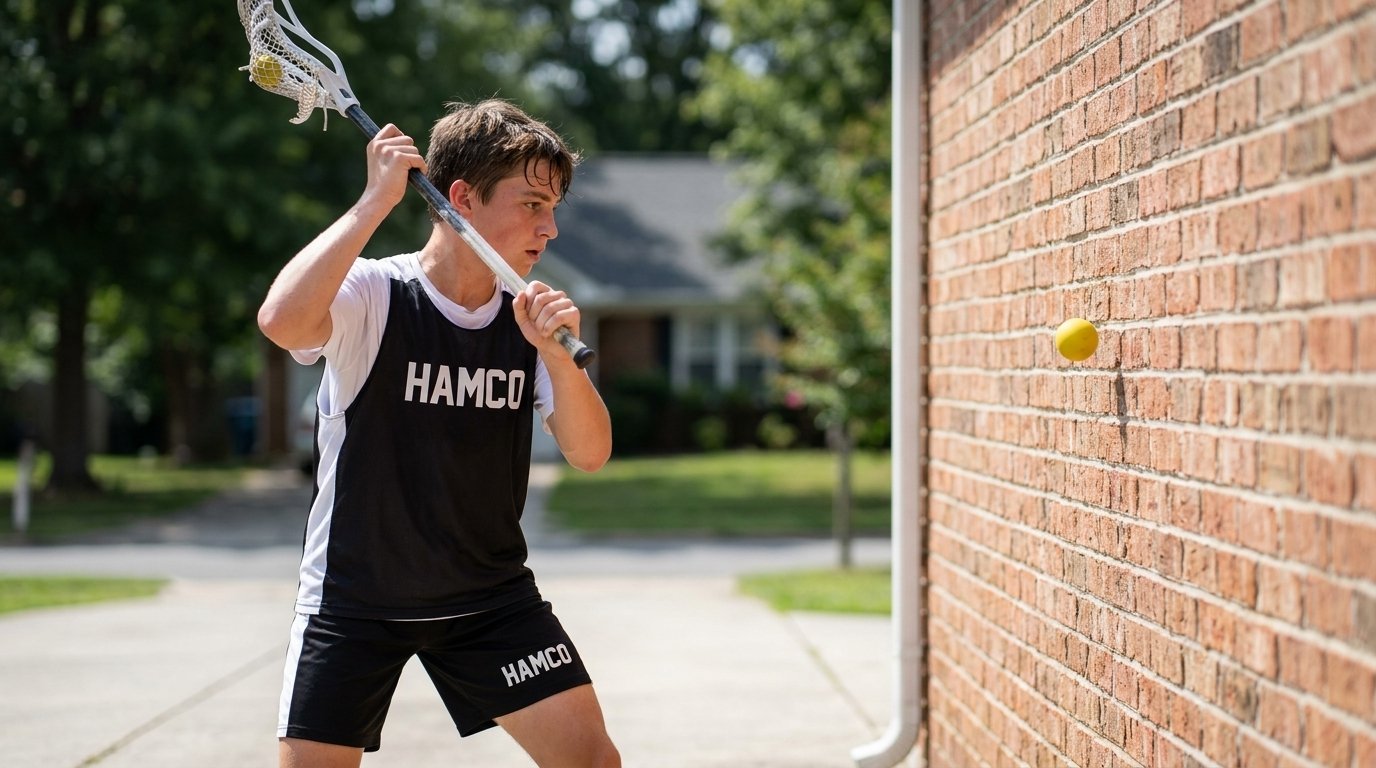
Wall ball is the single fastest way to build stick skills, full stop. Stand about 10 feet from a solid wall and throw and catch, over and over. It is the drill every good player has done thousands of times, and it needs no partner. Do all four of these every session.
1. Right Hand Wall Ball. Throw and catch with your dominant hand only, letting the top hand do the work. Keep your feet set and the stick up by your ear. Aim for 50 clean throws and catches without a drop, then push the tempo. This one drill is the backbone of the whole sport.
2. Left Hand Wall Ball. The same thing with your off hand, which beginners always neglect and good players never do. It will feel useless at first. Do 50 anyway. A player who can go both ways is twice as hard to defend, and this is where that starts.
3. Quick Stick. Catch and release in one motion with no cradle, both hands. It builds soft hands and a fast release, the difference between a dropped ball and a goal. Start slow and close to the wall, 25 reps each hand, and speed up as it gets clean.
4. Cross Hand Wall Ball. Catch with one hand and throw with the other, switching every rep, to train true ambidexterity. It is awkward and humbling, which is exactly why it works. 25 reps. These four wall ball drills are the closest thing lacrosse has to a cheat code.
Ground Ball Drills (3 Drills)
Ground balls win games. A loose ball on the turf is up for grabs, and the team that scoops more of them usually wins, which is why coaches obsess over these. The rule is simple: get low, use two hands, and scoop through the ball, not at it.
5. Stationary Scoop. Roll a ball a few feet away, then scoop it cleanly with a low body and two hands, coming up into a protected cradle. Bend the knees, do not just reach with the stick. 20 scoops on each side. Getting the body low is the whole battle.
6. Ground Ball Races. Set two lines facing a spot, roll a ball out, and the first player from each line sprints to scoop it clean and clear. It adds competition and energy, and it is one of the more fun lacrosse drills for beginners, since kids compete without realizing they are drilling fundamentals.
7. Contested Ground Ball. Two players compete for one loose ball, boxing each other out and protecting the scoop. This is the honest version, because in a real game almost no ground ball is uncontested. Start at half speed for the youngest players and build up the pressure with age.
Dodging Drills (2 Drills)
Dodging is how a ball carrier beats a defender, and it always rides on top of solid cradling. If you want dedicated lacrosse cradling drills for beginners, wall ball and these dodges are it, since protecting the ball through contact is the point. Teach the footwork first, then add a defender.
8. Cone Dodge Series. Carry the ball at a cone and run through a dodge past it, a split dodge, a roll dodge, then a face dodge, cradling to protect the stick the whole way. No defender yet, just clean footwork and ball protection. 5 reps of each dodge type on both hands.
9. 1v1 Dodge to a Cone. Now add a live defender. The attacker dodges and drives to a cone or a goal while the defender applies real pressure. It teaches change of direction and cradling under a check, which is where beginners either protect the ball or lose it. Keep the reps short and frequent.
Passing and Catching Pairs (2 Drills)
Passing and catching are what turn a group of players into a team. Both drills need only a partner and a bit of space, and the coaching point is the same throughout: give a target with the stick up by the ear, and cushion the catch like you are catching an egg.
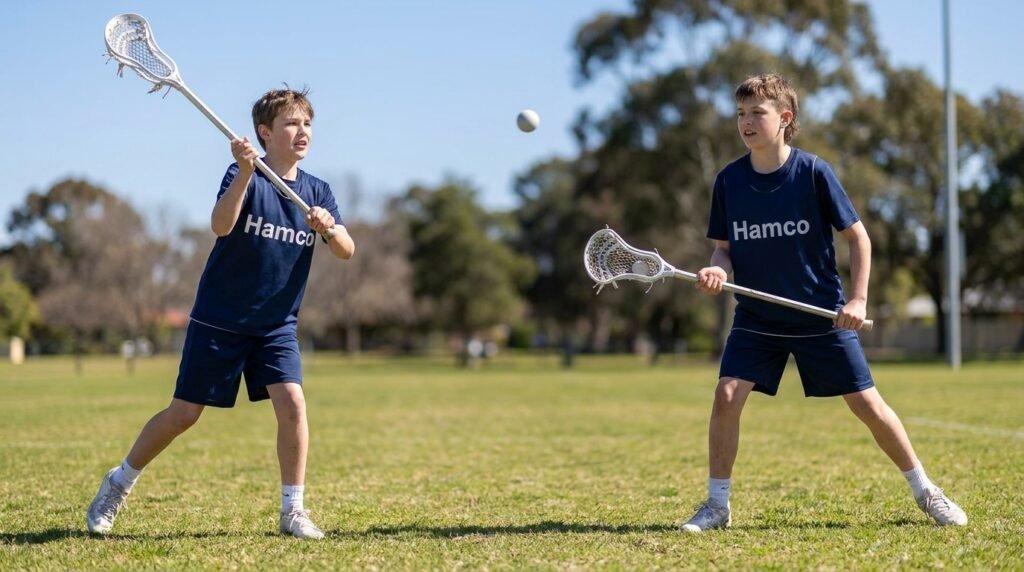
10. Partner Passing. Two players stand about 15 to 20 feet apart and pass back and forth with both hands, focusing on a clean release and a soft catch. Stretch the distance as accuracy improves. 5 minutes, and count how many you can string together without a drop to make it a game.
11. Passing on the Move. The same pair jogs side by side and passes while running, leading each other into space rather than throwing at the body. This is the game realistic version, since nobody stands still in a match. It is harder than it looks and worth every minute.

Shooting Drills (1 Drill)
Shooting is the reward at the end of practice, and the one place beginners rush. The coaching point that matters most: accuracy before power. A hard shot at the goalie’s chest is a save, and a placed shot in the corner is a goal.
12. Star Shooting. Set 5 cones in an arc around the goal and shoot from each one, aiming for the corners rather than swinging for the fences. Start stationary, then progress to shooting on the run across the front of the goal. These are the lacrosse shooting drills for beginners that build real accuracy, 2 to 3 rounds through the star. Set up targets in the corners if you can.
Girls Lacrosse and Younger Players
A quick honest note. All 12 of these work as girls lacrosse drills for beginners too, since the core skills, wall ball, ground balls, passing, dodging, and shooting, are identical across the boys and girls games. The difference is contact: the girls game does not allow body checking, so the dodging drills lean even more on stick protection and clean footwork than on shrugging off hits. For the youngest players of any gender, keep every rep short, keep it fun, and let them touch the ball as much as possible. Standing in a long line is how you lose a beginner.
The 60 Minute Practice Template
Drills are only useful if they add up to a practice. Here is a simple 60 minute session that runs the 12 drills in the order that builds skills fastest: touches first, then possession, then beating a defender, then finishing. End with a small game so they get to use what they just learned, since a rough rule of thumb is to save real scrimmage time for the end. Numbered pinnies make splitting teams quick, and a team that is easy to sort wastes less time standing around.
| Block | Time | What to Run |
| Warmup and dynamic stretch | 5 min | Light jog, arm circles, a few cradles |
| Wall ball and stick skills | 10 min | Drills 1 to 4, both hands |
| Ground balls | 10 min | Drills 5 to 7, add a race |
| Passing and catching | 10 min | Drills 10 and 11, partners |
| Dodging | 10 min | Drills 8 and 9, cones then live |
| Shooting | 5 min | Drill 12, aim for corners |
| Small sided game | 8 min | 3v3 to put it together |
| Cool down and one teach | 2 min | Stretch and one thing to fix |
| Total | 60 min | Trim to 45 minutes for young kids by shortening each block |
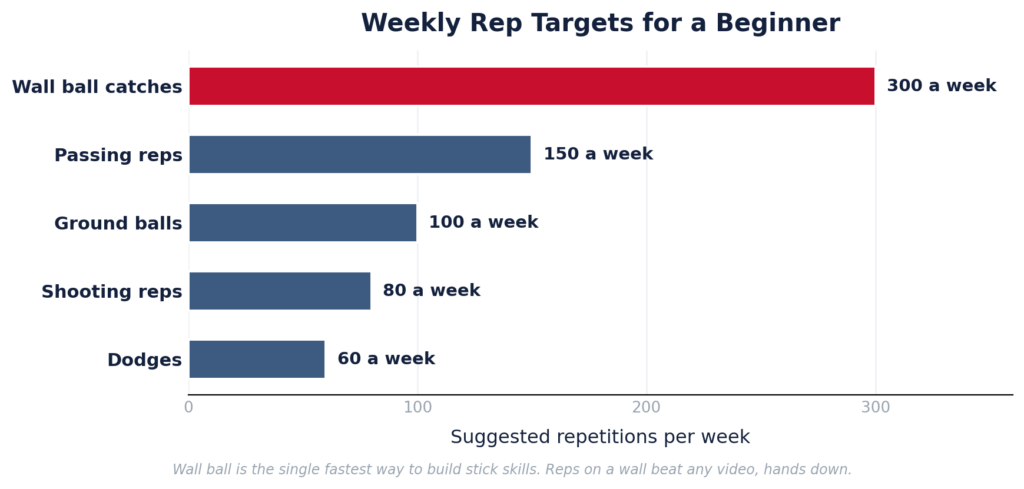
If you want concrete weekly targets outside of practice, this is where the real gains hide. The chart shows sensible rep goals for a beginner, and wall ball leads for a reason. Indoor and travel players hauling gear all season also get value from a solid team bag, and the same fundamentals carry over even if your program plays the indoor game, which our box vs field guide breaks down.
Beginner practice is messy, sweaty, and hard on kit, so drill day gear needs to be tough and easy to sort. Reversible pinnies split a squad into two teams in seconds, which means more reps and less standing around. From a fresh team names idea to the finished set, our lacrosse pinnies come in reversible cuts with bold numbers on both sides, and you can outfit the whole program in lacrosse apparel in your program colors. Get a quote and kit every player for practice and game day in one run.
Frequently Asked Questions
Q: What are the best lacrosse drills for beginners?
A: Wall ball, ground balls, passing, dodging, and shooting, in that order. Wall ball builds stick skills fastest because it is pure repetition on both hands.
Q: How can a beginner practice lacrosse alone?
A: Wall ball is the answer. A stick, a ball, and a solid wall let you build catching, throwing, and both hands with no partner needed.
Q: What are good lacrosse cradling drills for beginners?
A: Cradle while walking, then jogging, then through the cone dodge series. Protecting the ball through movement and contact is the whole point.
Q: Are the drills different for girls lacrosse?
A: The core skills are the same. Since the girls game has no body checking, the dodging drills lean more on stick protection and footwork than on absorbing contact.
Q: How long should a beginner lacrosse practice be? A: About 60 minutes, or 45 for young kids. Keep each drill short, rotate often, and end with a small game so they use what they learned.




2 thoughts on “12 Lacrosse Drills That Build Stick Skills Fast”