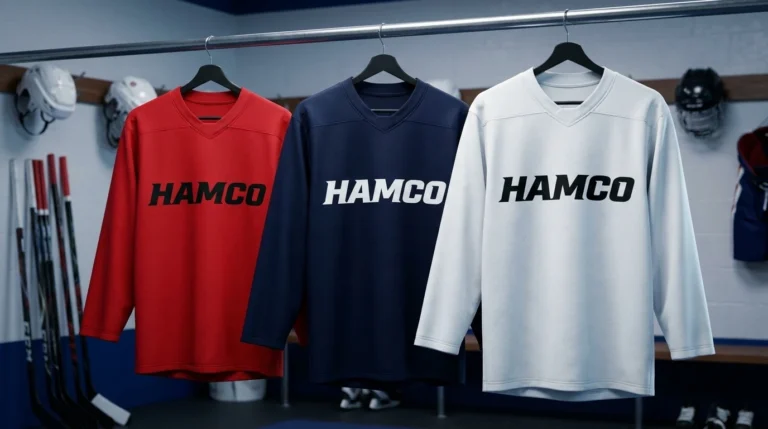
Two ice hockey teams of six, a goalie and five skaters, try to shoot a puck into the other team’s net. Three rules stop play most often: offside, icing and penalties. Youth hockey adds one more: no body checking before 14U. Suiting up a team? Hamco Sports hockey team jerseys start at $49.99 a player for 1 to 24 jerseys, with sublimated names and numbers included. They are ready 2 to 3 weeks after design approval.
How Does Hockey Work on the Ice?
A hockey game is played by two teams of six on the ice at once: one goalie and five skaters. The rink is split into three zones by two blue lines. The center red line divides the rink in half, and the goal lines at each end mark where a goal counts.
Each team defends its own zone, battles for the puck in the neutral zone between the blue lines, and attacks in the other team’s zone. Play starts and restarts with a faceoff: the referee drops the puck between two players. Teams change players on the fly, without stopping play, so a fresh line jumps over the boards. Positions and roster sizes are covered in our guide to how many players are on a hockey team.
The five basic rules a new parent needs:
- A goal counts when the whole puck crosses the goal line between the posts.
- Attackers can’t enter the offensive zone ahead of the puck (offside).
- A team can’t shoot the puck from its own half to beyond the other goal line untouched (icing).
- Illegal contact or stick use sends a player to the penalty box.
- A team can’t have more than six players on the ice at once.
How long a game lasts depends on the level and the league. Read how long a hockey period is for periods, game length and overtime.
Sources: NFHS Ice Hockey Uniform Rules 2019 to 2020, Rule 2-1-1; Wikipedia, Ice hockey (read Oct 31, 2026).
How Does Offside Work in Hockey?
Offside, often called “offsides”, happens when an attacking player crosses the opponent’s blue line before the puck does. The player’s skates decide it, not the stick: at least one skate must be on or behind the blue line when the puck fully crosses it.
When a linesman calls offside, play stops and the faceoff moves outside the zone. Hockey uses two versions of the rule:
| Version | What happens | Who uses it |
|---|---|---|
| Immediate offside | Play stops as soon as the attacker is offside | USA Hockey youth levels below Youth 15-Only and Girls 16U |
| Delayed (tag-up) offside | Play continues if the attackers all skate back out of the zone (“tag up”) before touching the puck | USA Hockey Youth 15-Only and older, Girls 16U and older, since August 2025 |
Sources: USA Hockey Official Rules of Ice Hockey 2025 to 2029, Junior Hockey Edition, Rule 630 (read Oct 31, 2026); USA Hockey’s playing rules article on the 2025 to 2029 rulebook updates (Sep 16, 2025).
A simple check for parents in the stands: watch the attacker’s back skate, not the puck carrier’s stick, when the puck crosses the blue line.
What Is Icing in Hockey?
Icing happens when a team shoots the puck from its own side of the center red line past the other team’s goal line. Nobody touches it on the way. Play stops, and the faceoff comes back to the end of the team that iced it.
Icing stops a team from simply firing the puck down the ice to kill time. In pro hockey, the team that iced the puck also can’t change players before the faceoff, so tired legs stay on the ice. High-school rules and USA Hockey’s youth rules still allow that change. USA Hockey’s junior hockey rules don’t, so ask which rulebook your league plays under.
A team that is a player short on a penalty may ice the puck without a whistle at some levels. Under USA Hockey’s 2025 to 2029 rules, that shorthanded exception applies to Youth 15-Only and older and Girls 16U and older. Younger teams are called for icing even when shorthanded.
Sources: USA Hockey Official Rules of Ice Hockey 2025 to 2029, Junior Hockey Edition, Rule 624 (read Oct 31, 2026); Wikipedia’s Ice hockey page (read Oct 31, 2026); USA Hockey 2025 to 2029 rulebook updates (Sep 16, 2025); USA Hockey/NFHS rules comparison 2026 to 2027.
Common Hockey Penalties and the Power Play
A hockey penalty sends the player who broke a rule to the penalty box, and the team plays a skater short. A minor penalty lasts 2 minutes and a major lasts 5, though USA Hockey lets games with shorter periods shorten them. The team with the extra skater is on a power play; the shorthanded team is on the penalty kill.
Four calls a new parent hears in almost every game:
- Tripping: using the stick, a knee or a foot to make an opponent lose balance or fall.
- Hooking: using the blade of the stick to pull or hold back an opponent.
- Slashing: swinging the stick at an opponent’s body or stick.
- Holding: grabbing an opponent or the opponent’s stick with a hand.
If the power-play team scores during a minor, the penalized player usually returns early. A major is served in full, whatever the score.
Sources: USA Hockey Official Rules of Ice Hockey 2025 to 2029, Junior Hockey Edition, Rules 402, 622, 623, 634 and 639 (read Oct 31, 2026); Wikipedia’s Ice hockey article (read Oct 31, 2026).
What’s Different in Youth and Adult Rec Hockey?
Youth and adult rec hockey follow the same basic rules as the pro game. There are three big differences: when body checking starts, which offside version is used, and when icing is allowed shorthanded. The table shows the US rules most teams play under.
| Rule | Youth (USA Hockey) | Adult rec | Pro (NHL, contrast only) |
|---|---|---|---|
| Body checking | Not allowed at 12U and under (body contact still allowed); allowed from 14U in boys’ youth hockey | Set by each league; ask yours | Allowed |
| Offside | Immediate below Youth 15-Only and Girls 16U; delayed (tag-up) from those levels up | Set by each league | Delayed (tag-up) |
| Icing while shorthanded | Called below Youth 15-Only and Girls 16U; allowed from those levels up | Set by each league | Allowed |
Sources: USA Hockey’s article on the 2025 to 2029 rulebook updates (Sep 16, 2025; rules effective August 1, 2025, for four seasons); body checking from 14U since the 2011 to 2012 season: Wikipedia, “Checking (ice hockey)” (read Oct 31, 2026); body contact below 14U: USA Hockey ADM article on admkids.com (read Oct 31, 2026).
For a new adult player, the best first step is to ask the league office whether it is a no-check league before the first skate. For practice outside games, our skating and puck-handling drills help adults find their feet.
Suiting Up the Team
Suiting up a team starts with the uniform rules. High-school rules (NFHS Rule 2-1-2) ask the home team to wear light jerseys and the visitors dark. Jerseys, socks and pants must be identical for every player, so a high-school team needs two jerseys per player. For the rest of each player’s kit, see our youth hockey equipment checklist.
Four facts settle most team questions before you order:
- Goalie-cut jerseys cost the same as skater jerseys, and the goalie’s jersey matches the team design.
- Fight straps are your call: we make jerseys with or without a sewn-in strap, and no youth or high-school rule we found requires one.
- Sublimated names and numbers are in the jersey price. Tackle twill is $5 per name and $5 per number.
- Every size costs the same. Shipping is free in the USA, and we pay the tariffs, duties and import fees on US and Canada orders.
Order your custom ice hockey jerseys with your roster, goalies marked, and your first game date. You get a free mockup within 12 hours and as many changes as you need. Nothing is made until you approve it, and there is no minimum order.
Frequently Asked Questions
What are the 5 basic rules of hockey?
The five basic rules of hockey start with scoring: a goal counts when the whole puck crosses the goal line. Attackers can’t enter the offensive zone before the puck (offside). A team can’t shoot the puck from its own half past the other goal line untouched (icing). Illegal contact or stick use earns a penalty. Each team has no more than six players on the ice.
Is hockey 3 periods or 4?
Most hockey games are played in three periods, though period length changes with the level and the league. For period lengths by level, intermissions and overtime, see the Hamco Sports guide to hockey period length.
What is a hat trick in hockey?
A hat trick is when one player scores three goals in a single game. Fans at some rinks celebrate it by throwing hats onto the ice. The goals can come at any point in the game, and they don’t have to be scored in a row.
What is the difference between offside and icing?
Offside is about the players: an attacker can’t cross the other team’s blue line before the puck. Icing is about the puck: a team can’t shoot it from its own half past the other team’s goal line with nobody touching it. After offside, the faceoff moves outside the attacking zone. After icing, it comes back to the end of the team that iced the puck.
When does body checking start in youth hockey?
Body checking starts at 14U in boys’ youth hockey under USA Hockey rules. Players at 12U and under can’t body check, though body contact is still allowed. Adult rec leagues set their own rule, so ask yours before the first skate.
Ready to Suit Up Your Team?
On-time delivery is the first worry coaches bring to us, so start with the date: put your roster and your first game date on your quote. Your jerseys are ready 2 to 3 weeks after design approval, then take 3 to 5 days to reach you.
One person on our team answers you from the first email until the box is at your door.
Get My Free Quote for your team’s hockey jerseys.
How we made this guide: written by the Hamco Sports team. We used the USA Hockey Official Rules of Ice Hockey 2025 to 2029, its Junior Hockey Edition, USA Hockey’s 2025 to 2029 rulebook updates and the NFHS Ice Hockey Uniform Rules (2019 to 2020 edition). We also used our price list (as of October 2026) and our own jersey specifications. Facts checked October 31, 2026.
Together… It’s Guaranteed.