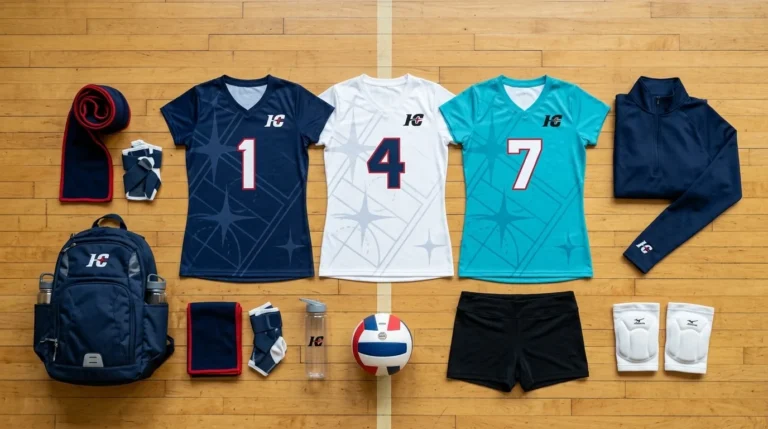
A libero in volleyball is a back-row defender who wears a jersey that clearly contrasts with the team’s. Under USA Volleyball’s rules, the libero can’t block or attack a ball that is entirely above the net, and may serve in one rotation per set. From the 2026 to 2027 season, high school teams may name two liberos.
You’re setting your lineup, and one player wants the libero spot. The Hamco Sports team put the answers from the three US rule books side by side below. Before you say yes, you need to know what a libero may do on court and how the libero comes in and out. You also need to know whether your team order needs one libero jersey or two.
How we made this guide: written by the Hamco Sports team from the NFHS 2026 to 2027 volleyball uniform rules, the NFHS libero rule announcement of February 5, 2026, and the USA Volleyball 2025 to 2027 abridged indoor rules. We also used the PAVO NCAA/USA Volleyball/NFHS rule comparison (July 2025). Ordering facts come from our own order terms. Facts checked October 30, 2026.
What Does a Libero Do in Volleyball?
A libero is a back-row specialist who may replace any player in a back-row position, under USA Volleyball’s indoor rules (checked October 2026). The libero’s job is defense: passing the serve and digging the other team’s attacks, without ever playing at the net. A libero comes in by a replacement, not a substitution.
Here is how that looks in a match. Your middle blocker rotates from the front row to the back row, and the libero takes that spot. When the libero’s turn would bring the libero to the front row, the middle blocker comes back on and the libero leaves the court. The swap repeats every time that rotation comes around.
The libero also wears a different jersey, so officials can follow every replacement. In high school, the libero’s top must clearly contrast with the main color of the team’s tops, trim excluded (NFHS 2026 to 2027). Our guide to volleyball uniform rules covers the full jersey rule.
What Can’t a Libero Do?
A libero may not block or attempt to block. A libero also may not complete an attack hit on a ball that is entirely above the top of the net at contact. That holds anywhere on the court, including the free zone. Both limits come from USA Volleyball’s 2025 to 2027 indoor rules (checked October 2026).
The height of the ball decides it. A libero standing at the attack line can dig, pass and even send a ball over the net. Part of the ball just has to be below the top of the net when the libero hits it. An attack hit on a ball that is entirely above the net is a fault, wherever the libero stands.
Setting has one limit too. Say the libero sets with an overhand finger pass from inside the front zone, between the net and the attack line. A teammate may not attack that ball while it is entirely above the net. Make the same overhand set from behind the attack line, and the hitter can attack it freely. So when your setter has to dig the first ball, a libero who steps back behind the attack line to set keeps every hitter’s options open.
Can a Libero Serve?
Yes. A libero may serve in high school, college and USA Volleyball play, in one rotation position per set (PAVO rule comparison, July 2025; USA Volleyball indoor rules 2025 to 2027, checked October 2026). Under USA Volleyball’s rules, the libero serves after replacing the player in position 1, the serving position.
If a page tells you a libero can never serve, it doesn’t describe these three US rule books. Pick the one rotation where your libero’s serve helps most. In every other rotation of that set, the libero passes without serving.
| Libero rule (checked October 2026) | High school (NFHS, 2026 to 2027) | College (NCAA) | Club (USA Volleyball, 2025 to 2027) |
|---|---|---|---|
| Serving | May serve in one position in a set | May serve in one position in a set; with two liberos, either may serve in one position | May serve in one position in a set; with two liberos, either may serve in one position |
| Liberos per set | Zero, one or two (new for 2026 to 2027); one on court at a time | Zero, one or two | Zero, one or two; one on court at a time |
| Between two libero replacements | A completed rally, unless the libero’s next action is to serve | A completed rally, unless the libero’s next action is to serve; also not needed after an injury, an illness or a rotation forced by a penalty | A completed rally, unless the libero’s next action is to serve; also not needed after an injury, an illness or a rotation forced by a penalty |
| Substitutions per set (for comparison) | 18 | 15 | 15 |
Sources: NFHS announcement, February 5, 2026 (liberos per set); PAVO NCAA/USA Volleyball/NFHS rule comparison, July 2025 (serving, replacements, substitutions); USA Volleyball abridged indoor rules 2025 to 2027.
How Do Libero Replacements Work?
Libero replacements don’t count as substitutions, and they are unlimited. All three rule books add one condition: a completed rally must come between two libero replacements, unless the libero’s next action is to serve (PAVO comparison, July 2025). College and USA Volleyball rules also drop the rally after an injury, an illness or a rotation forced by a penalty.
Go back to the rotation from the first section. Your libero leaves the court when your middle blocker rotates to the front row. The libero can’t come straight back on for another back-row player in the same dead ball. A rally has to be played first, unless the libero’s next action is to serve.
However often the libero goes in and out, a high school team keeps all 18 substitutions per set for its other players.
Can a Team Have Two Liberos?
Yes. A team may name zero, one or two liberos for each set, and only one libero may be on the court at a time. Starting with the 2026 to 2027 season, this is true in high school too. The NFHS announced on February 5, 2026 that “prior to each set, a team may designate zero, one or two liberos on the lineup sheet.” College (NCAA) and USA Volleyball rules already allowed two.
Two liberos give you options. You can name your best passer for one set and a second libero for the next, or name both on the lineup sheet before a set. Either way, a high school team with two liberos named now has two players who wear the libero top, not one.
So decide how many liberos you’ll name before you send your roster. There is no minimum order, so one or two libero jerseys go on the same order as the team’s jerseys.
Hamco Sports volleyball jerseys start at $42.99 a player for 1 to 24 jerseys in the sleeveless or racerback cut. Your order is ready 2 to 3 weeks after you approve your design, then takes 3 to 5 days to reach US teams. See our libero jerseys on the volleyball uniforms page.
Libero vs Defensive Specialist: What’s the Difference?
“Defensive specialist” is not a role in any of the three rule books. A defensive specialist (DS) is a regular player who comes in by a normal substitution and wears the team jersey. A libero comes in by a libero replacement, which doesn’t use up the team’s substitutions, and wears the contrasting jersey.
| Libero | Defensive specialist (DS) | |
|---|---|---|
| How the player comes in | Libero replacement (not a substitution) | Normal substitution |
| Uses up the team’s substitutions | No | Yes: 18 per set in high school, 15 in college and USA Volleyball |
| Jersey | Contrasting libero jersey | Team jersey |
| Block or attack above the net | Never | Same rules as any other player |
Sources: PAVO rule comparison, July 2025 (substitution limits); USA Volleyball indoor rules 2025 to 2027 (libero limits). Checked October 2026.
The difference shows up in your substitution count. Say a high school coach brings a DS in for a back-row starter, then brings the starter back. That uses up substitutions from the team’s 18 for that set. The libero can do the same back-row work all match without touching that count. Our guide to volleyball positions covers every role on the court.
Frequently Asked Questions
Can a libero block?
No. USA Volleyball’s indoor rules say the libero may not block or attempt to block (2025 to 2027 rules, checked October 2026). The libero is restricted to back-row play, so the libero is never one of the front-row players who reach above the net to stop an attack. A defensive specialist is a regular player and may block when rotated to the front row.
Can a libero serve?
Yes, in one rotation position per set. That is the rule in high school, college and USA Volleyball play alike. Under USA Volleyball’s rules, the libero serves after taking the place of the player in position 1. When a college or club team names two liberos, either one may serve, but only in one position.
Can a team have two liberos?
Yes. High school teams may name zero, one or two liberos before each set, starting with the 2026 to 2027 season, after the NFHS changed the rule on February 5, 2026. College and USA Volleyball already allowed two. Only one libero may be on the court at a time, and both wear the contrasting libero top. At Hamco Sports, a player added mid-season, a new libero included, is priced at the same tier as your team’s original order.
Can a libero set the ball?
Yes, with one limit under USA Volleyball’s rules. If the libero sets with an overhand finger pass from inside the front zone, a teammate may not attack that ball while it is entirely above the net. A libero set from behind the attack line can be attacked freely, so a libero who sets from back there gives the hitters every option.
Can a libero play in the front row?
No. USA Volleyball’s rules restrict the libero to back-row play, and the libero may replace any back-row player. The libero may not complete an attack hit on a ball entirely above the top of the net, from anywhere on the court. When the libero’s rotation would reach the front row, the player the libero replaced comes back on.
Plan Your Liberos Before You Order
Tell us how many liberos you’ll name, and we draw the libero top on the same free mockup as the team’s jerseys, so you can check the contrast side by side before anything is made. For Canadian clubs, shipping is billed with the order, and Hamco Sports covers the tariffs, duties, import fees and GST/HST, so nothing is due at delivery.