| Quick Answer Men’s field lacrosse has 10 players in four position groups: 3 attackmen who score, 3 midfielders who run the whole field, 3 defensemen with long poles, and 1 goalie. Inside those groups are specialists like the FOGO who takes face offs, the LSM who defends with a long pole in the midfield, and the SSDM. Women’s lacrosse uses 12 players and different rules. |
Lacrosse looks fast and messy from the stands, but every player on the field has a defined role. Men’s field lacrosse puts 10 players on each team, split into four position groups, attack, midfield, defense, and goalie, with a handful of specialists layered on top. Learn those four groups and the rest of the game clicks into place. Before a player picks a spot, it helps to know that gear changes by position too, which our youth lacrosse gear checklist breaks down for boys and girls. Here is who does what on a lacrosse field, position by position.
So what are the positions in lacrosse? At the simplest level there are four: attackmen score, midfielders do everything, defensemen stop the other team, and the goalie guards the net. But the sport rewards specialists, so inside those four groups you will hear names like FOGO, LSM, and SSDM, which we will get to. Whether you are a new player choosing a position or a parent naming a brand new club with our team names guide, this is the full lacrosse position guide. The reference table lays them all out first.
| Position | On Field | Stick | Main Job |
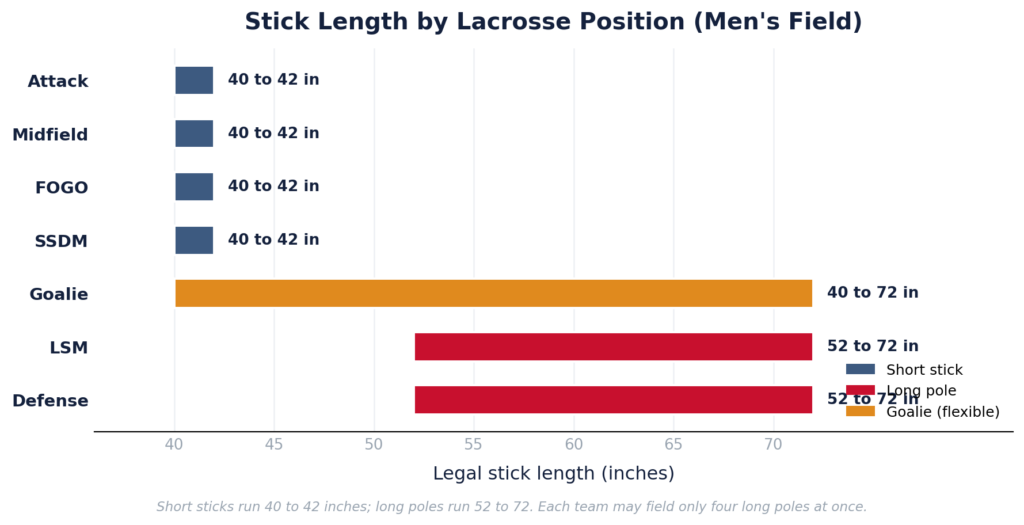
| Attack | 3 | Short (40 to 42 in) | Score and feed on the offensive end |
| Midfield | 3 | Short | Two way, run the whole field |
| Defense | 3 | Long pole (52 to 72 in) | Guard attackmen, check, and clear |
| Goalie | 1 | Goalie, wide head | Make saves and run the defense |
| LSM | part of 3 | Long pole | Long stick middie, defend in transition |
| FOGO | part of 3 | Short | Win the face off, then sub off |
| SSDM | part of 3 | Short | Short stick defensive middie |
Before the roles, the quick math on how many players on a lacrosse team: each side fields 10 in the men’s game and 12 in the women’s game. An offside rule keeps the shape honest. In men’s play, three players must stay on the offensive half and four, the three defensemen and the goalie, must stay on the defensive half at all times, or the team is penalized. That balance is exactly why the positions are grouped the way they are, and why attackmen and defensemen rarely trade ends.
Attack: The Offensive Specialists
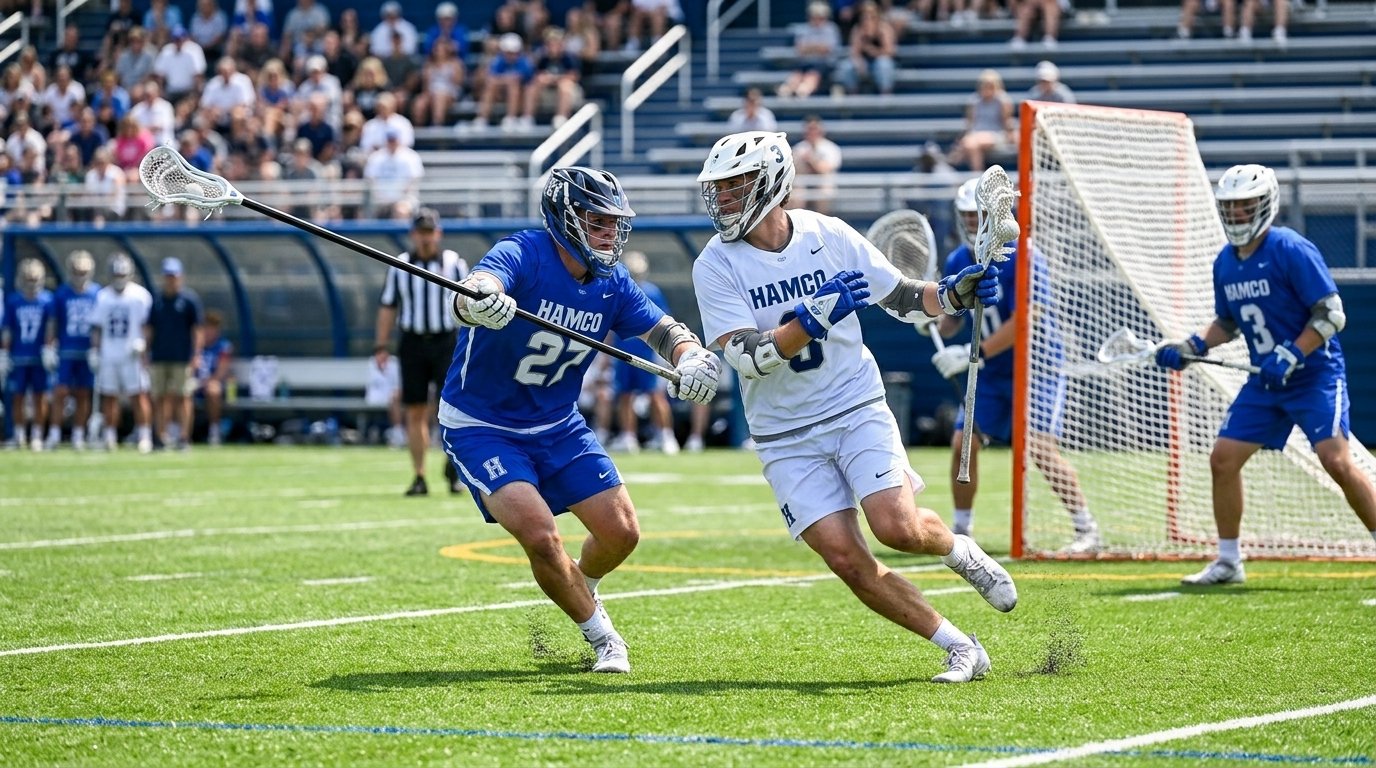
The three attackmen are the team’s scorers. They live on the offensive half of the field and, by rule, cannot cross into their own defensive end without a teammate swapping places, so they specialize in one thing: putting the ball in the net. Attackmen are usually the most skilled stick handlers on the team, dangerous at dodging past defenders, feeding cutters, and finishing quick shots. One of the three usually plays from behind the goal, an area called X, acting as the quarterback of the offense, while the other two work the wings as finishers. They carry short sticks, 40 to 42 inches, for quick hands. A great attackman is a scorer and a passer in one.
Midfield: Two Way Runners
The three midfielders, or middies, are the engine of the team. Unlike attackmen and defensemen, middies play the entire field, both offense and defense, which makes them the fittest athletes on the roster. They bring the ball up in transition, take most of the face offs, chase down ground balls, and are the first ones back on defense when possession flips. Because the running load is brutal, teams rotate middies in waves, or lines, substituting on the fly like hockey. Middies use short sticks and need a bit of everything: speed, endurance, stick skill, and toughness. If you like being involved in every phase of the game, this is your spot.
Defense: Long Pole, Body, and Slide
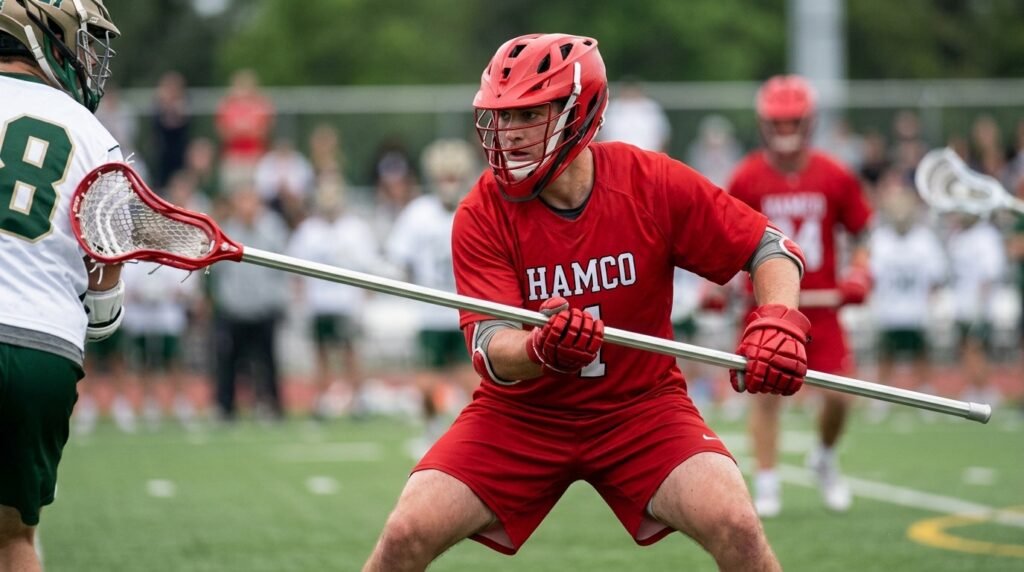
The three close defensemen have the clearest job on the field: stop the other team from scoring. They stay on the defensive half and carry the long pole, a stick 52 to 72 inches long that gives them the reach to poke and disrupt an attackman from a distance. Good defense is more about footwork and positioning than big hits, though a well timed body check is part of the toolkit. The defining skill is the slide, the coordinated help defense where one defender leaves his man to stop a driving attacker and everyone else rotates to cover. Defensemen are big, physical, and vocal, and they work hand in hand with the goalie to organize it all. The long pole and heavy contact mean their gear takes a beating, which is why a solid gear checklist matters as much for defenders as anyone.
The Goalie
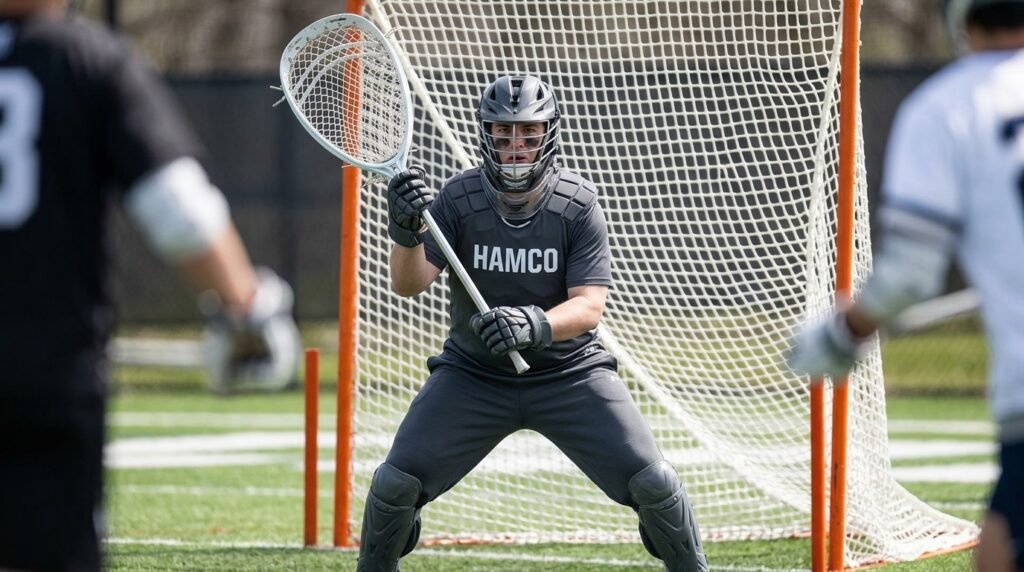
The goalie is the last line of defense and, honestly, the bravest player on the field. Facing shots that travel up to 100 miles per hour, the goalie makes saves with a stick that has an oversized head, then immediately starts the clear by outletting the ball to a midfielder. Just as important, the goalie is the quarterback of the defense, reading the play and calling out the slides before they happen. It takes reflexes, communication, and a willingness to get hit, which is why goalies wear extra protection, a chest protector and throat guard, and by rule a different colored jersey. Goalies in the indoor box game wear even more, closer to a hockey setup, as our guide to box lacrosse vs field lacrosse explains. Many coaches will tell you the goalie is the hardest position in the sport.
Specialists: LSM, FOGO, and SSDM
Modern lacrosse is a game of specialists, and three roles sit inside the midfield. The LSM, or long stick midfielder, is the fourth long pole a team is allowed on the field, since the rules cap each team at four long poles at once. The LSM subs in on defense to guard the opposing team’s most dangerous midfielder, wins ground balls, and often pushes the ball into transition, and they are frequently the best athlete on the team. The FOGO, short for face off get off, is exactly that: a face off specialist who wins possession at the center X, then sprints off the field for an offensive player. Because winning face offs is like keeping possession in basketball, a great FOGO can quietly decide games. The SSDM, or short stick defensive midfielder, is a defensive middie who covers opposing midfielders with a short stick and lives on ground balls and hustle. These specialists carry so much dedicated gear that a proper team bag is a genuine help on game day.
How These Change in the Girls’ Game
Girls’ and women’s lacrosse shares the same four position ideas, attack, midfield, defense, and goalie, but the game around them is genuinely different. First, the numbers: women’s lacrosse puts 12 players on the field, not 10, with a more spread out formation and traditional position names like first home, point, and cover point. Second, and most important, there is no body checking and only limited stick to stick contact, so the game is built on speed, positioning, and stick skill rather than collisions. That also means no long poles, since every field player uses a same length stick, so there is no LSM. Instead of a face off, play restarts with a draw, where two players stand with sticks pressed back to back and flick the ball up at the whistle, which makes the draw specialist the women’s answer to the FOGO. The roles rhyme, but the rulebook does not. The women’s game also plays around an eight meter arc in front of the goal, where fouls hand the attacker a free position shot, so defensive positioning matters even more than in the men’s game.
However your roster breaks down across attack, midfield, defense, and the cage, every player needs a number and a matching look, and practice needs pinnies you can flip for scrimmages. That is our whole job. Our custom lacrosse pinnies are cut for every position and printed with the numbers coaches want on both sides, and you can kit the entire program in matching lacrosse apparel built for a full season of ground balls and checks. Get a quote and outfit all 10 positions, plus the specialists, in one run.
Frequently Asked Questions
Q: How many players are on a lacrosse team?
A: Men’s field lacrosse has 10 players on the field: 3 attack, 3 midfield, 3 defense, and 1 goalie. Women’s field lacrosse has 12.
Q: What are the four main lacrosse positions?
A: Attack, midfield, defense, and goalie. Specialists like the FOGO, LSM, and SSDM sit inside the midfield group.
Q: What does a FOGO do in lacrosse?
A: A FOGO, or face off get off, is a face off specialist who wins possession at the center X, then subs off the field for an offensive player.
Q: What is an LSM in lacrosse?
A: A long stick midfielder, the fourth long pole a team is allowed on the field. The LSM defends in the midfield and transition and hunts ground balls.
Q: What is the hardest position in lacrosse?
A: Most players say goalie, because of the pressure of stopping 100 mile per hour shots, directing the defense, and starting the clear, all at once.