| Quick Answer Soccer substitution rules depend on the level. Top professional leagues like the Premier League, MLS, and NWSL allow 5 substitutions, made in 3 windows, and a player who comes off cannot return. College, high school, and youth soccer allow unlimited substitutions, and in most of them players can come back on. So the honest answer to how many subs in soccer is 3, 5, or unlimited, depending on where you are watching. |
Soccer has a quiet talent for making simple things confusing, and substitutions are a perfect example. The number a team is allowed depends on the league, the age group, and even whether the game goes to extra time. Parents who have already wrestled with the jersey rules their league enforces hit the same wall with subs: the rule their kid plays under looks nothing like what they see on television. This guide lays out the soccer substitution rules at every level, from the pros down to under 8s.
Here is the honest starting point. There is no single answer to how many subs in soccer. Like the offside rule, substitutions come with a web of exceptions that change by competition. The professional game settled on 5 substitutions only a few years ago, while most youth and school soccer runs on unlimited changes. Knowing which set of rules applies to your match saves a lot of sideline confusion.
The History: 3 to 5 Substitutions
For most of soccer’s modern history, the magic number was 3. From the mid 1990s until 2020, professional teams got three substitutions per match, and that is still what many casual fans expect. The change came during the COVID pandemic in May 2020, when fixtures were crammed together and players were breaking down, so the lawmakers at IFAB temporarily allowed 5 substitutions to protect them. It worked, it stuck, and in 2022 the 5 substitution rule became permanent in Law 3. The Premier League was the last big holdout, finally adopting it for the 2022 to 2023 season. The chart below shows how the number climbed over the decades.
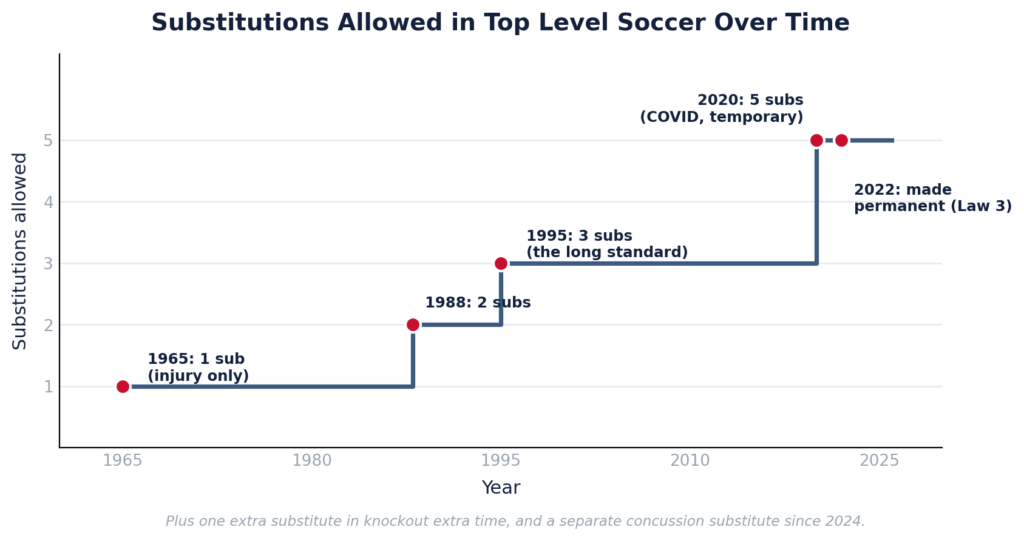
One honest note: the jump from 3 to 5 was not really about scoring more goals. It was about squad depth and player welfare, and richer clubs with deeper benches arguably gained the most, which is exactly why smaller clubs fought it for so long.
Professional Leagues Today: FIFA, MLS, NWSL, Premier League
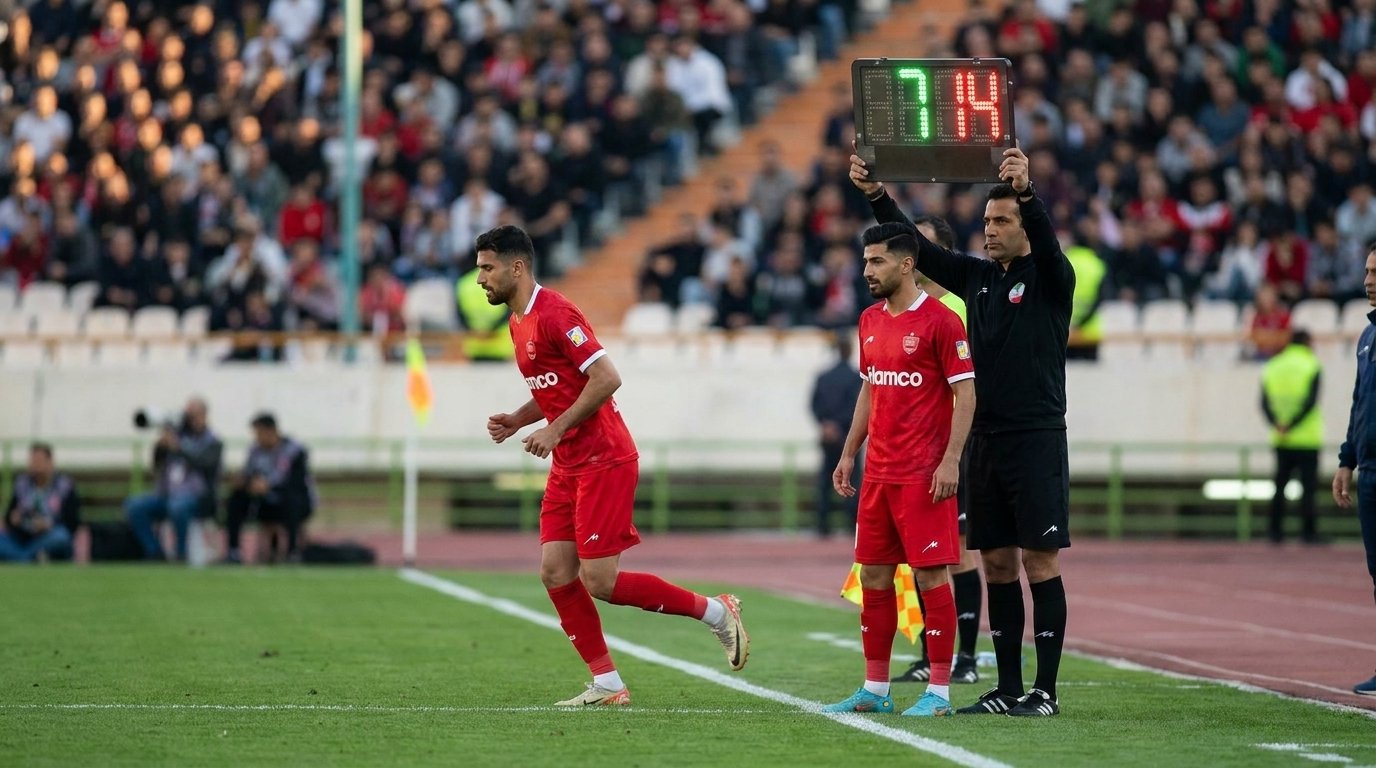
At the top level, the rule is now consistent worldwide. FIFA competitions, the Premier League, MLS, NWSL, and every major European league allow 5 substitutions. The catch that trips up even seasoned fans is the window rule: those 5 subs have to be made in a maximum of 3 stoppages during play, with halftime as a free fourth chance. A coach who burns all three windows early can be stuck watching an injured player limp around with no way to replace him. And at this level a substitution is permanent. Once a player comes off, he is done for the day, which is why a player jogging off slowly draws such anger. The 2026 World Cup adds a new 10 second exit rule to fight that exact time wasting: the player coming off has 10 seconds to leave the field, or the team plays a man short for 60 seconds before the substitute can enter.

The Extra Sub in Extra Time
Knockout matches add one more wrinkle. If a tie goes to extra time, each team gets a sixth substitution and an extra window to use it, and any subs or windows left over from the 90 minutes carry into extra time as well. This is the one case where the maximum climbs past 5. If you are fuzzy on when extra time even happens, our guide to how long a soccer match runs breaks down the 90 minutes, stoppage time, and the 30 minutes of extra time that trigger that bonus substitution.
Rolling Substitutions in Youth and Recreational Leagues
Step away from the pro game and the rules flip completely. Most youth and recreational leagues use rolling subs, also called unlimited substitutions, where players come on and off freely at stoppages and can come back on later. The whole point at these ages is participation and development, not tactics, so coaches rotate the entire roster through. Keeping that many young players game ready is a job in itself, which is where a simple soccer equipment checklist earns its keep. The details still vary by league. Many leagues for under 13s and up borrow from the pro game, allowing unlimited changes but only at set moments and with no return in the same half. Always check your specific league sheet, because youth soccer is where the rules differ the most.

High School and NCAA Rules
American school soccer runs on its own rulebook, and the option to return is the big difference. Under high school rules from the NFHS, substitutions are unlimited and players can freely return to the game, coming off and back on as many times as the coach likes, with changes made at stoppages like goal kicks and after goals. College is more of a hybrid. The NCAA allows unlimited substitutions but has tightened the return rules. As of the 2024 season, Division I men’s soccer banned coming back on in either half, moving closer to the pro model, while most other NCAA levels still let a player return once in the second half. College also stops the clock on substitutions late in close games to stop teams from running down time.
The Concussion Substitute
One substitution stands apart from all the counting: the concussion sub. If a player suffers a suspected concussion, the team can bring on a permanent replacement that does not count against their 5 subs or their 3 windows. IFAB made this protocol permanent in 2024. The removed player cannot come back even if they later feel fine, which is the entire point, since the rule exists to take the pressure off players and staff to rush a head injury. To keep it fair, the opposing team is also given a substitution when a concussion sub is used. It is the rare soccer rule where player safety, not strategy, drives the decision. These substitution rules by league are summarized in the table below.
| Level or League | Subs Allowed | Players Return? | Notes |
| FIFA and World Cup 2026 | 5, plus 1 in extra time | No | 3 windows plus halftime |
| Premier League | 5 | No | Adopted 2022 to 2023 |
| MLS | 5 | No | Plus a concussion sub |
| NWSL | 5 | No | 3 windows |
| NCAA Division I men | Unlimited | No | 6 moments, no return |
| Other NCAA levels | Unlimited | Once in 2nd half | Limited return |
| High school (NFHS) | Unlimited | Yes | Free return |
| Youth and rec | Unlimited (rolling) | Yes | Maximize playing time |
Rules shift often, especially in youth and college play, so always confirm your league’s current sheet before a match.
All of this matters more the deeper your bench goes, and at the youth and school level deeper benches are the norm. A roster that rotates 16 or 18 players through every match needs every one of them in matching kit, and getting that many sizes right is its own task, which is why our soccer sizing chart exists. When you are ready to outfit the full squad, our custom soccer uniforms handle big rosters and reorders without the headache, so kit every sub and starter in soccer apparel built to last a full season of rotation.
Frequently Asked Questions
Q: How many substitutions are allowed in soccer?
A: Top professional leagues allow 5 substitutions made in 3 windows, plus 1 more in extra time. Youth, high school, and college soccer allow unlimited substitutions.
Q: Can a substituted player come back on in soccer?
A: Not in professional soccer, where a sub is permanent. In youth, high school, and most college soccer, players can return to the game.
Q: When did soccer change from 3 to 5 substitutions?
A: The 5 sub rule started as a temporary COVID measure in May 2020 and became permanent in 2022. The Premier League adopted it for the 2022 to 2023 season.
Q: How many subs are allowed in extra time?
A: One extra substitution, a sixth, plus any subs and windows a team did not use during the 90 minutes.
Q: Does a concussion substitute count against the limit? A: No. A concussion sub is an extra permanent substitution that does not count against the 5 subs or the 3 windows, and the opponent gets one too.