
You sat through all nine innings. You saw your kid go 1-for-3 with a walk and a run scored. Then you open the app the next morning, the box score loads, and it’s a wall of capital letters — AB, R, H, RBI, BB, SO, AVG — followed by a second wall that looks like a different language entirely: IP, ER, K, WHIP. Somewhere in that grid is the story of the game you just watched, but you can’t find it.
This is the guide that fixes that. By the end, you’ll be able to open any baseball box score — your kid’s travel-ball game, last night’s MLB result, a college playoff — and read it the way a scout does: in about thirty seconds, knowing which numbers matter and which are noise. We’ll go abbreviation by abbreviation, but more importantly, we’ll explain what each one actually measures — because knowing that “AVG” means batting average is useless if you don’t know what batting average is hiding from you.
Let’s start with the shape of the thing.
What a Box Score Actually Contains
A box score isn’t one table. It’s three, stacked on top of each other, and most confusion comes from not realizing they’re separate.
The line score is the strip at the very top — the one that looks like a row of innings. It shows runs scored by each team per inning, then totals for Runs, Hits, and Errors (the R-H-E you see on the right). This is the 10,000-foot view. A line score that reads “0 0 0 2 0 0 1 0 0 — 3” tells you the scoring came in bursts: a two-run fourth, a single run in the seventh. It tells you nothing about who did the damage. For that, you drop down.
The batting block is the middle table — one row per hitter, in batting order, with columns of offensive stats. This is where you find your kid’s line.
The pitching block is the bottom table — one row per pitcher who appeared, with a completely different set of columns built around preventing runs rather than scoring them.
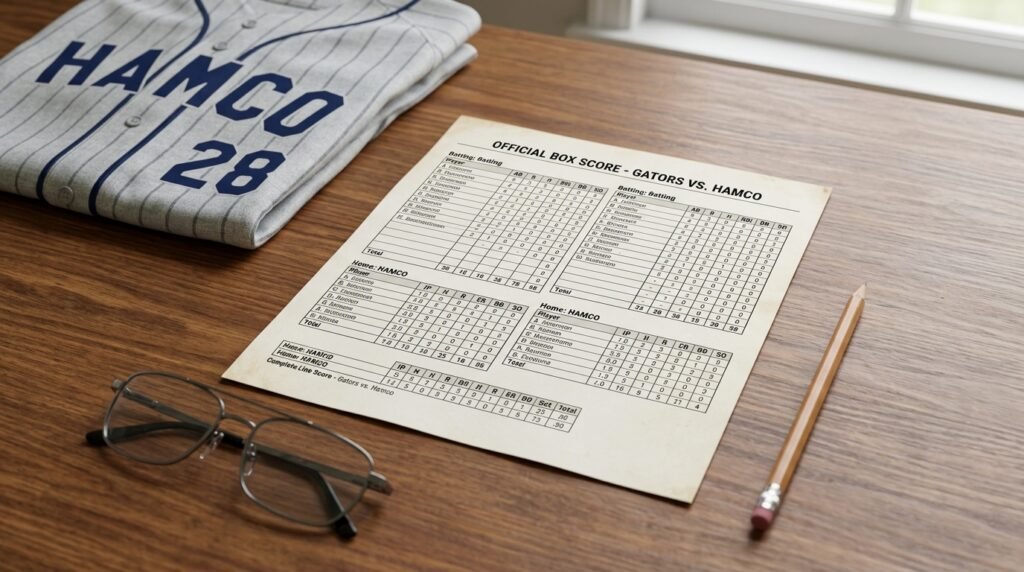
The single most common mistake new readers make is trying to read a hitting stat (like AVG) in the pitching block, or expecting an ERA next to a batter’s name. The two blocks share almost no columns because they’re measuring opposite jobs. Keep them mentally separated and the whole thing gets easier.
A quick habit: read the line score first for the what (final score, when runs happened), then the batting block for the offensive who, then the pitching block for the defensive who. Three tables, three questions. Now let’s decode each block.
The Batting Block: AB, R, H, RBI, BB, SO, AVG
Here’s a typical batter’s line:
Ramirez, 2B — 4 AB, 1 R, 2 H, 1 RBI, 0 BB, 1 SO, .312 AVG
Read left to right, here’s what each column means.
AB (At-Bats). The number of times the hitter completed a plate appearance that “counts” toward batting average — meaning they either got a hit or made an out via their bat. Crucially, AB does not include walks, hit-by-pitches, sacrifice bunts, or sacrifice flies. This is the first place box scores quietly mislead you: a player who walks three times and singles once shows up as 1 AB, 1 H — a tidy 1.000 day at the plate — even though they came up four times. The AB column undercounts how often a patient hitter actually contributed.
R (Runs). Times this player crossed home plate and scored. A run is credited to the runner, not the batter who drove them in. So your kid scoring a run means they were on base and came around — it says nothing about how they got on.
H (Hits). Singles, doubles, triples, and home runs combined. The box score usually breaks out extra-base hits in a footnote below the table (“2B: Ramirez (12)” means Ramirez hit a double, his 12th of the season). The H column itself lumps a 400-foot homer and a swinging-bunt single together as “1” — another reason the raw number needs context.
RBI (Runs Batted In). Runs that scored as a direct result of this batter’s action — a hit, a sacrifice, a walk with the bases loaded, or a fielder’s choice that plates a runner. RBI is the most overrated number in this block, because it depends enormously on whether teammates were on base when the hitter came up. A cleanup hitter gets RBI chances a leadoff hitter never sees. We have a whole breakdown of what RBI counts, what it misses, and why analysts have moved past it — worth reading before you judge a hitter by this column alone.
BB (Bases on Balls / Walks). Times the hitter was awarded first base on four balls. Sometimes you’ll see this as “BB” and sometimes spelled out. A high walk total is a sign of plate discipline — the hitter is forcing pitchers to throw strikes and not chasing junk. Because walks don’t count as at-bats, they’re invisible to batting average, which is exactly why batting average alone is a poor measure of a hitter’s value.
SO (Strikeouts). Sometimes shown as “K.” Times the hitter struck out. One strikeout in a four-at-bat game is unremarkable; the column matters more in aggregate over a season than in any single line.
AVG (Batting Average). Hits divided by at-bats, carried to three decimals. A .312 average means 31.2% of official at-bats became hits. For a century this was the hitting stat, but you now know its blind spots: it ignores walks entirely, treats all hits as equal, and rewards hitters who play in lineups that give them more at-bats. It’s a fine starting point and a terrible finishing point.
That last issue — batting average not telling you how valuable a hitter’s contributions are — is what modern stats were invented to fix. Hold that thought; we’ll get to OPS shortly.
You may also see 2B, 3B, HR as their own columns in fuller box scores (doubles, triples, home runs), plus SB (stolen bases) and CS (caught stealing). These are self-explanatory once you’ve got the core seven down.
The Pitching Block: IP, H, R, ER, BB, K, HR, ERA
Now drop to the bottom table. A pitcher’s line looks like this:
Tanaka (W, 5-2) — 6.0 IP, 5 H, 2 R, 2 ER, 1 BB, 7 K, 1 HR, 3.18 ERA
The “(W, 5-2)” means Tanaka earned the win and his season record is now 5 wins, 2 losses. You’ll also see (L) for the losing pitcher, (S) for a save, (H) for a hold, and (BS) for a blown save. Now the columns.
IP (Innings Pitched). How long the pitcher was in the game, measured in innings. The decimal here is not a normal decimal — it counts outs in thirds. “6.0” means six complete innings. “6.1” means six innings plus one out. “6.2” means six innings plus two outs. This trips up nearly everyone the first time. There is no “6.3” — three outs rolls over to 7.0.
H (Hits). Hits the pitcher allowed. Lower is better, obviously.
R (Runs). Total runs that scored while this pitcher was responsible, earned or not.
ER (Earned Runs). Runs that scored without the help of a fielding error or passed ball — runs that are the pitcher’s own fault. The gap between R and ER is the defense’s fault, not the pitcher’s. If you see “4 R, 2 ER,” two of the runs scored because someone booted a ball, and the pitcher doesn’t get charged for them. This distinction is the entire basis of ERA, below.
BB (Walks allowed). Batters the pitcher walked. Like a hitter’s walks but from the opposite perspective — here, more is bad.
K (Strikeouts). Batters the pitcher struck out. In the pitching block, strikeouts are a good thing, which is why they get the punchier “K” label that fans chant about.
HR (Home Runs allowed). Long balls surrendered. A single number that often explains a bad ERA in one glance.
ERA (Earned Run Average). The headline pitching stat: earned runs allowed per nine innings, calculated as (ER ÷ IP) × 9. A 3.18 ERA means that, on average, this pitcher gives up 3.18 earned runs every nine innings of work. Lower is better. But ERA has the same kind of hidden dependencies that batting average has — it’s heavily influenced by the defense behind the pitcher, the ballpark, and plain luck on balls in play. A great defense can make a mediocre pitcher’s ERA look elite. We unpack exactly how ERA works and where it lies in its own walkthrough.
The same warning that applies to AVG applies here: ERA is the right place to start evaluating a pitcher and the wrong place to stop. Which brings us to the stats that fill the gaps.
Advanced Stats That Show Up in Modern Box Scores
Ten years ago, a box score stopped at AVG and ERA. Today, even casual apps surface a second tier of numbers because the baseball world has broadly accepted that the old stats hide too much. You don’t need a math degree for these — you need to know what question each one answers.
OBP (On-Base Percentage). The fraction of plate appearances where the hitter reached base by any means — hit, walk, or hit-by-pitch. This is the stat that fixes batting average’s biggest flaw: it counts walks. A hitter batting .250 with a .400 OBP is getting on base 40% of the time, which is enormously valuable even though the average looks pedestrian. If you learn one “new” stat, learn this one — getting on base is the single thing most correlated with scoring runs.
SLG (Slugging Percentage). Total bases divided by at-bats — a single is one base, a homer four. SLG measures power: how far the hitter advances when they connect. A .500 slugging percentage means half a base per at-bat, on average.
OPS (On-Base Plus Slugging). Exactly what the name says: OBP + SLG, combined into one number. This is the stat to anchor on. By fusing “how often do they get on” with “how much damage when they hit,” OPS captures the two things that win games far better than batting average ever could. Rough scale: ~.700 is average, .800 good, .900 All-Star, 1.000+ MVP-level. Our full breakdown of what OPS really tells you about a hitter is the most useful five minutes you can spend on hitting stats.
WHIP (Walks plus Hits per Inning Pitched). The pitching counterpart to OPS in usefulness: (walks + hits) ÷ innings pitched. It answers one brutal question — how many baserunners does this pitcher allow per inning? Near 1.00 is excellent, 1.30 is average, above 1.50 is trouble. WHIP often spots a pitcher about to decline before ERA catches up, because baserunners eventually become runs. Here’s the full guide to reading WHIP and what counts as good at each level.
BABIP (Batting Average on Balls In Play). The most “inside baseball” of the common advanced stats. BABIP measures how often balls hit into the field of play (excluding home runs and strikeouts) fall for hits; league average sits around .300. Its real use is as a luck detector: a hitter with a .380 BABIP is probably getting fortunate and due to cool off, while a pitcher with a .250 BABIP against him is likely being bailed out by defense or luck. You won’t quote BABIP at the ballpark, but it explains a lot of “how is that guy hitting .340?” mysteries.
If these five — OBP, SLG, OPS, WHIP, BABIP — feel like a lot, don’t worry. You can read a box score competently with just OPS for hitters and WHIP for pitchers layered on top of the basics. Everything else is refinement.
Reading a Box Score in 30 Seconds: My Shorthand Routine
Once you know the columns, you don’t read a box score left to right like a paragraph. You jump to the numbers that carry the most information. Here’s the exact sequence I run, and you can do it in well under a minute.
- Line score, R-H-E. Final score and the run-scoring pattern. Did the winner grind out runs across many innings, or did one crooked-number inning decide it? The shape tells you close game or blowout.
- Find the highest OPS in the batting block (or, if OPS isn’t shown, scan for the most H and BB combined). That’s the hitter who actually controlled the game — not necessarily the one with the most RBI.
- Check the starting pitcher’s IP and WHIP. IP tells you whether the starter went deep or got knocked out early; WHIP tells you whether they were genuinely sharp or living dangerously. A starter who went 7.0 IP with a 0.85 WHIP dominated, regardless of the final score.
- Scan the footnotes below the tables for extra-base hits (2B, 3B, HR) and errors (E) — where you find the home run that swung the game or the error that opened the door.
- Then, and only then, look at the headline stats — most RBI, the win, the save. By now you know the real story, so these just confirm or complicate it.

The whole point is that the most-promoted numbers (RBI, batting average, pitcher wins) are the last things you check, because they’re the most context-dependent. Get in the habit of leading with OPS and WHIP and you’ll “see” games in the box score that other people miss entirely.
What a Box Score Does NOT Tell You (and Where to Look Instead)
For all its detail, a box score is a summary, and summaries discard information. Knowing what’s missing keeps you honest.
It doesn’t show how outs were made. A “0-for-4” line could be four weak pop-ups or four 410-foot flyouts that died at the warning track — and the second hitter is far more likely to break out tomorrow. For that you need quality-of-contact data (exit velocity, launch angle), which lives in Statcast pages, not the box score.
It doesn’t show sequence or leverage. A two-run single in a 12-1 blowout looks identical to one that wins Game 7 in the ninth; the box score weights them the same. Win Probability Added (WPA) exists to capture when the damage happened.
It doesn’t show defense well. Errors only count balls a fielder touched and botched — not the balls a slow fielder never reached — so a great defensive game can be nearly invisible. And innings pitched won’t tell you whether a youth arm threw 95 stressful pitches or 70 easy ones, which matters enormously for arm health.
The fix for all of this is the same: the box score is your index, and the advanced pages (Statcast, FanGraphs, Baseball Reference, or your league’s stat platform) are the chapters. If something in the box score surprises you, that’s the cue to dig one level deeper.
If you found the leap from “AVG and ERA” to “OPS and WHIP” eye-opening, the natural next step is our parent-friendly tour of the handful of modern stats that have quietly replaced the old ones — written for people who want to follow a broadcast, not write a thesis.
You Can Read Any Box Score Now
That’s the whole machine. Three stacked tables, two blocks measuring opposite jobs, a core set of abbreviations, and a second tier of smarter numbers that fix the blind spots in the first. The grid that looked like alphabet soup this morning is now a readable account of who got on base, who allowed baserunners, and who actually decided the game — which is frequently not the player the headline stats crown.
Read a dozen box scores with this guide open beside you and the lookups stop being lookups. You’ll glance at a line, register “1.040 OPS, that’s the game,” and move on. That’s the goal: not memorizing definitions, but seeing the story.
A few practical follow-ups for where to go from here. If you’re keeping score for a youth team, our youth baseball gear checklist covers the scorebook, clipboard, and basics worth having in the bag. If you’re feeding a player into the summer circuit, here’s our rundown of the travel baseball tournaments worth the trip. And if you’re at the point of organizing the whole thing yourself, we’ve written a step-by-step on how to start a youth baseball league from the ground up.
When the season’s on and you’re outfitting a squad, we build custom baseball uniforms and full baseball team apparel sublimated to last a full season of wash cycles.
If you score your own kid’s games, our custom score-keeper polos are made for the long innings.