| Quick Answer The best softball drills for beginners teach the fastpitch motion in the order a play uses it: throwing and the windmill first, then fielding at fastpitch tempo, then hitting including the slap, then baserunning off the back foot. The 12 drills below are built for fastpitch specifically, not borrowed from baseball, because the underhand game moves faster and closer. Run them in small groups and you can fit all four skills into a single 90 minute practice. |
Fastpitch is not baseball with a bigger ball. The field is smaller, the pitch comes underhand from 43 feet, and the hitter gets barely a quarter of a second to react, so the skills have to be trained for that speed from day one. Good softball drills for beginners build the fastpitch motion properly instead of borrowing baseball habits that do not transfer. These 12 youth softball drills cover the four skills every one of the nine softball positions relies on, from the windmill to the slap. Train them right and a beginner looks like a softball player, not a baseball player holding the wrong ball.
One note before the drills. This guide is built for fastpitch, the version played in high school, college, and travel ball, where pitching and speed rule the game. If your league plays the recreational version, some of these change, and our guide to fastpitch vs slowpitch spells out the differences. Everything below assumes fastpitch, and none of it needs fancy equipment, just a bucket of balls, a tee, a few cones, and a partner.
Throwing Drills (Windmill Foundation Work)
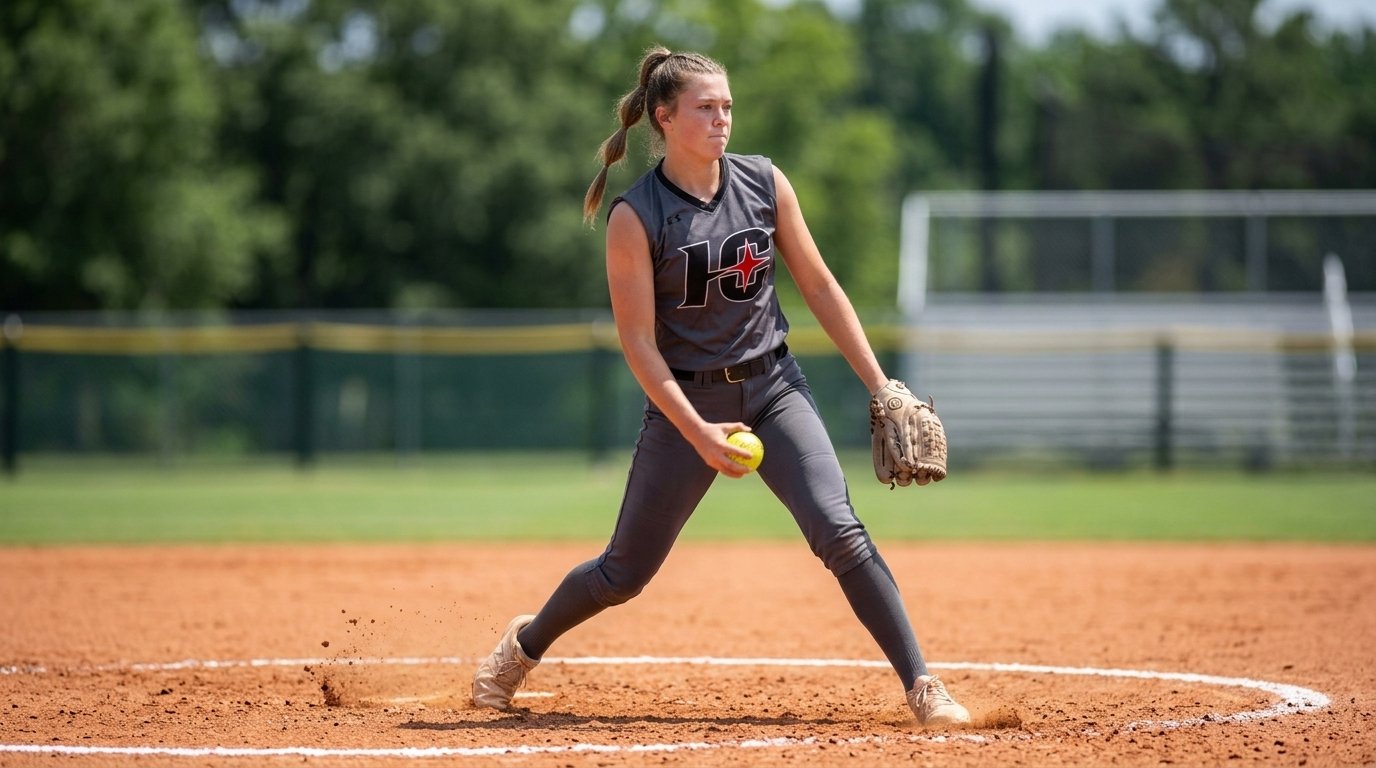
Fastpitch has two throwing motions, and beginners need both. Every fielder throws overhand, and pitchers add the windmill, the full underhand circle that defines the sport. Start every player on the overhand throw, then introduce the windmill to anyone who wants to pitch. These are the softball pitching drills for beginners that build the motion without straining a young arm. Gear matters here, since a glove that fits and cleats that grip make a real difference, which our softball gear guide covers.
1. Overhand Four Seam Throw. Every fielder starts here. Partners throw at a comfortable distance holding a four seam grip, two fingers across the wide seams, so the ball carries straight instead of tailing. Focus on a clean overhand motion with the elbow up and a full follow through. This is the throw every position uses, so master it before anything fancy. 5 minutes.
2. Windmill Arm Circles. For anyone learning to pitch, start the windmill with no ball. The pitcher stands on the rubber and practices a slow, full arm circle, brushing the hip on the way down, keeping the arm loose and the circle tight to the body. Add the ball only once the path is smooth. Slow and correct beats fast and wild every single time at this stage. This is the heart of fastpitch pitching.
3. Windmill Wrist Snaps. From a short distance, the young pitcher works only the release, snapping the wrist at the bottom of the circle to put spin on the ball while staying behind it, not rolling it over. This builds the spin and control a fastpitch pitcher lives on. Keep these sessions short, since a young arm learning the windmill tires faster than it feels.
Fielding Drills (Fastpitch Tempo)
Because the field is smaller and the ball comes off the bat fast, fastpitch fielders have less time than baseball fielders do. Every fielding drill has to be run at game tempo, meaning field it and release it quickly, not field it and admire it. Run these in small groups so nobody stands and waits.
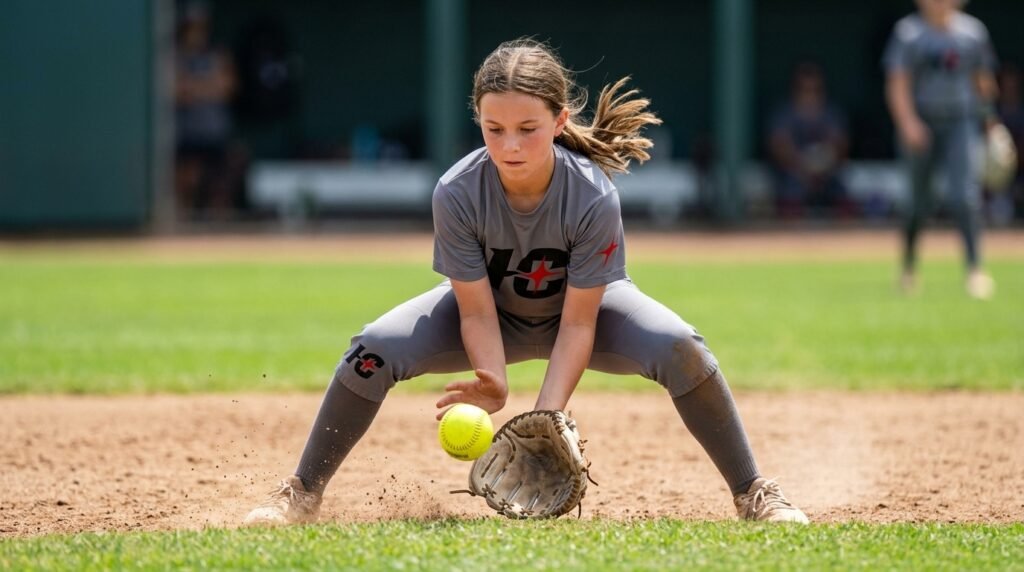
4. Funnel Short Hops. From a short distance, a partner throws short hops that the fielder catches out front, funneling the ball to the center of the body with soft, giving hands. Learning to catch the short hop instead of backing up is what separates a confident infielder from a scared one, and at fastpitch speed it happens constantly. Soft hands, ball out front.
5. Quick Feet Ground Balls. Roll or hit ground balls and demand the fielder field and release in one beat, working the feet through the ball toward the target rather than catching flat footed. Fastpitch does not give you time to gather, so the footwork has to be quick from the start. Make it a timed relay to add the game speed pressure that keeps players sharp.
6. Drop Step and Call. Toss fly balls and teach the fielder to drop step and turn, running to the spot rather than backpedaling, then calling the ball loudly to claim it. Communication is half of this drill, because two fielders colliding under a pop up is a fastpitch staple that good calling prevents. Start with soft, high tosses and build up.
Hitting Drills (Slap Hitting Included)
Hitting is where fastpitch gets its own identity, because alongside the normal swing, the sport has the slap, a left side running approach that does not exist in baseball. These softball hitting drills for beginners go from the foundation to the fastpitch specialties. Run them as stations so every player swings constantly instead of waiting in line.
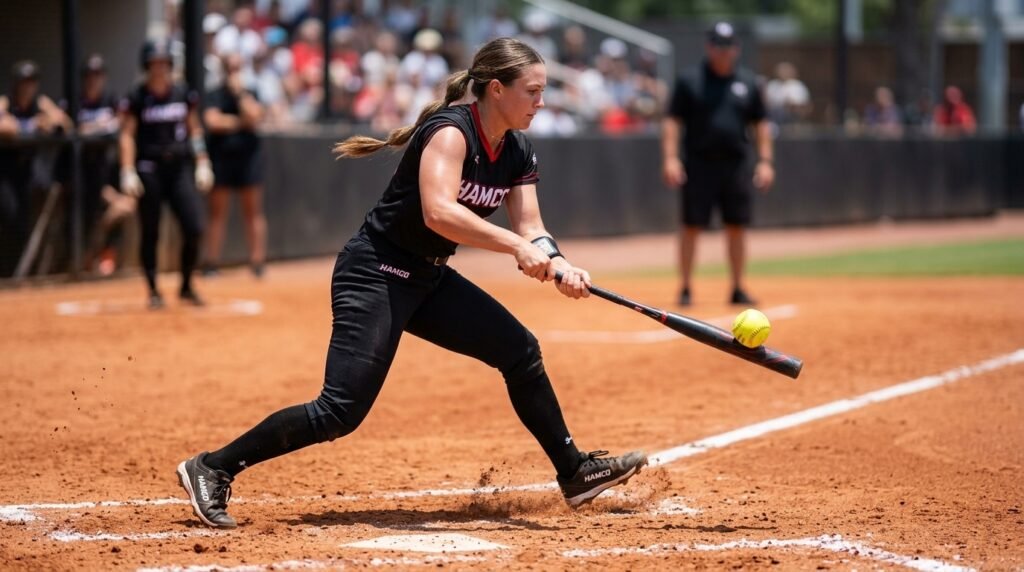
7. Tee Work. The foundation for every hitter, slapper or not. Set the ball on a tee over the plate and drive it into a net, working a short, level swing and solid contact. Move the tee around the zone, inside, outside, up, and down, so the swing works everywhere. Even college hitters take tee reps daily, so no beginner is above it.
8. Front Toss Timing. From behind a screen a short distance in front, toss underhand into the zone so the hitter times a ball coming from the pitcher’s direction. It bridges the tee and live hitting, and it builds the timing a fastpitch hitter needs against a quick release. Never toss straight at a hitter from the front without a screen, since it is unsafe.
9. Slap Footwork. This is the fastpitch specialty. A left handed hitter starts in the box and practices the running slap footwork, a crossover step that carries momentum toward first base as the hands guide the ball to the ground on the left side. Start with the footwork alone, no ball, then add a tee, then live. A good slapper uses speed as a weapon, beating out balls a normal hitter never would. This is one of the highest value fastpitch drills a fast player can learn.
10. Sacrifice Bunt. Low scoring fastpitch games turn on the short game, so every player must bunt. Teach square to bunt early, catching the ball with the bat by giving with the hands, and deadening it down a line. Bunting looks simple and is not, and a team that bunts well moves runners the pitching starved offense cannot drive in otherwise.
Baserunning Drills (Off the Back Foot)
Fastpitch base running has one rule that changes everything: there is no leadoff. A runner cannot leave the base until the pitcher releases the ball, so every jump starts off the back foot at the moment of release. Timing that release is a trainable edge most teams ignore.
11. Rocker Start. On the base, the runner rocks back onto the back foot and times the pitcher’s release, pushing off hard the instant the ball leaves the hand, not a beat before, which is an out, and not a beat after, which is a wasted jump. Have a coach or pitcher deliver while runners practice leaving on release. This one drill wins bases all season, and it is pure fastpitch.
12. Home to First. Line hitters at home and have them sprint through first base, running full speed through the bag rather than slowing into it, then breaking for a possible overthrow. Fastpitch is a game of tight plays at first, so a runner who runs through the bag beats out infield hits a slower runner loses. Time them to make it competitive.
How to Combine Them Into a 90 Minute Practice
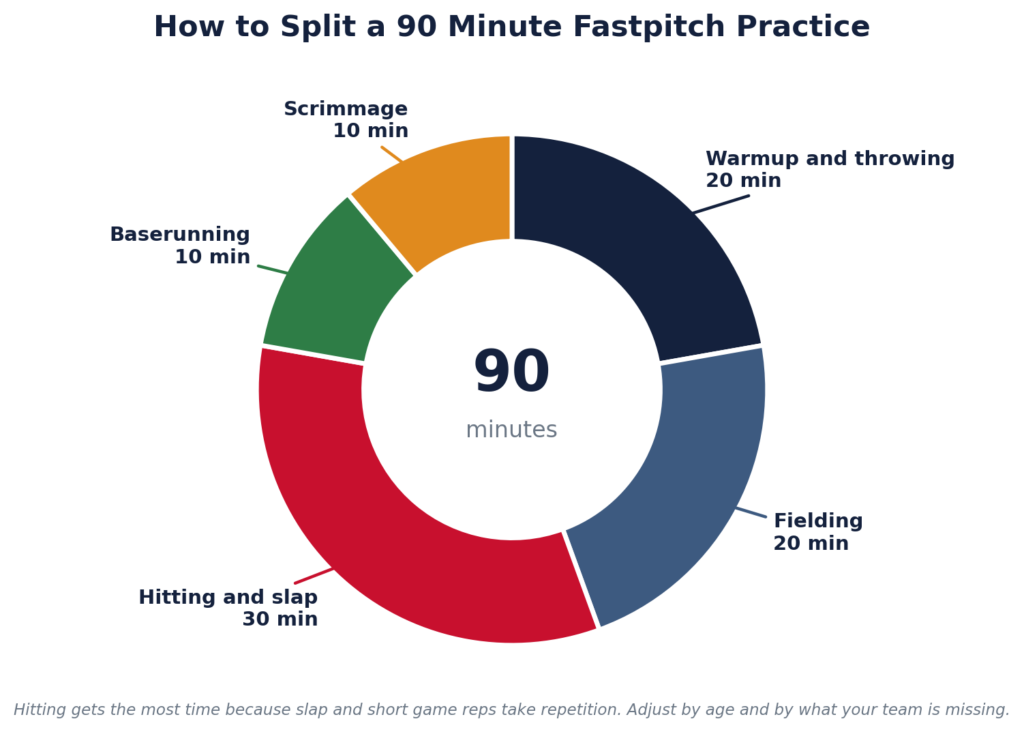
Twelve drills fit into 90 minutes if you run stations and keep groups small. The donut shows how to split the time, weighted toward hitting because the slap and the short game take the most repetition to learn. The drill index below is your at a glance reference for the whole session. A team that trains together should look together too, and our uniform ideas guide helps with that.
| # | Drill | Skill Area | What It Teaches |
| 1 | Overhand Four Seam Throw | Throwing | A true, straight throw for every fielder |
| 2 | Windmill Arm Circles | Throwing | The pitching motion, built slowly |
| 3 | Windmill Wrist Snaps | Throwing | Spin and release for young pitchers |
| 4 | Funnel Short Hops | Fielding | Soft hands at fastpitch speed |
| 5 | Quick Feet Ground Balls | Fielding | Field and release in one beat |
| 6 | Drop Step and Call | Fielding | Tracking fly balls and communication |
| 7 | Tee Work | Hitting | The swing foundation for everyone |
| 8 | Front Toss Timing | Hitting | Timing a pitched ball |
| 9 | Slap Footwork | Hitting | The lefty running slap, fastpitch only |
| 10 | Sacrifice Bunt | Hitting | The short game that wins low scoring games |
| 11 | Rocker Start | Baserunning | Leaving on the release, off the back foot |
| 12 | Home to First | Baserunning | Running through the bag at full speed |
Two rules make it work. Keep groups to four or five so players get reps instead of standing in line, which means recruiting a parent or two to run a station. And end on something competitive, a scrimmage or a baserunning relay, so players leave wanting the next practice. Do this twice a week and a beginner team plays real fastpitch by midseason.
Twelve drills of sliding, diving, and slapping is hard on kit, and softball is harder on pants than almost any sport because of the constant sliding. That is why we build ours for it. Fastpitch uniforms differ from baseball for real reasons, as our guide to why softball uniforms differ explains. Our custom softball uniforms are cut for female athletes in sublimated fabric with reinforced knees and hips that survive a season of sliding, with two color reversibles for scrimmage day. Outfit the whole roster in matching softball apparel, with custom numbering, a free mockup, and about a three week turnaround.
Frequently Asked Questions
Q: What are the best softball drills for beginners?
A: Start with the overhand throw and fielding at game tempo, then tee and front toss hitting, then add the fastpitch specialties, slap footwork and the rocker start on the bases. Master the basics before the specialties.
Q: What are good fastpitch drills for a beginner?
A: Windmill arm circles for pitchers, quick feet ground balls for fielders, slap footwork for fast left side hitters, and the rocker start for baserunners. Each one trains a skill unique to the fastpitch game.
Q: What are good softball hitting drills for beginners?
A: Tee work first, then front toss for timing. Add slap footwork for left handed hitters with speed, and sacrifice bunting for everyone, since the short game decides low scoring fastpitch games.
Q: What are good softball pitching drills for beginners?
A: Windmill arm circles to groove the full underhand motion, then wrist snaps to build spin and release. Keep sessions short, since a young arm learning the windmill tires quickly, and never let a beginner pitch through pain.
Q: How long should a youth softball practice be? A: About 90 minutes for most youth levels. Split it across throwing, fielding, hitting, and baserunning, run stations so players get reps, and end with a scrimmage.