
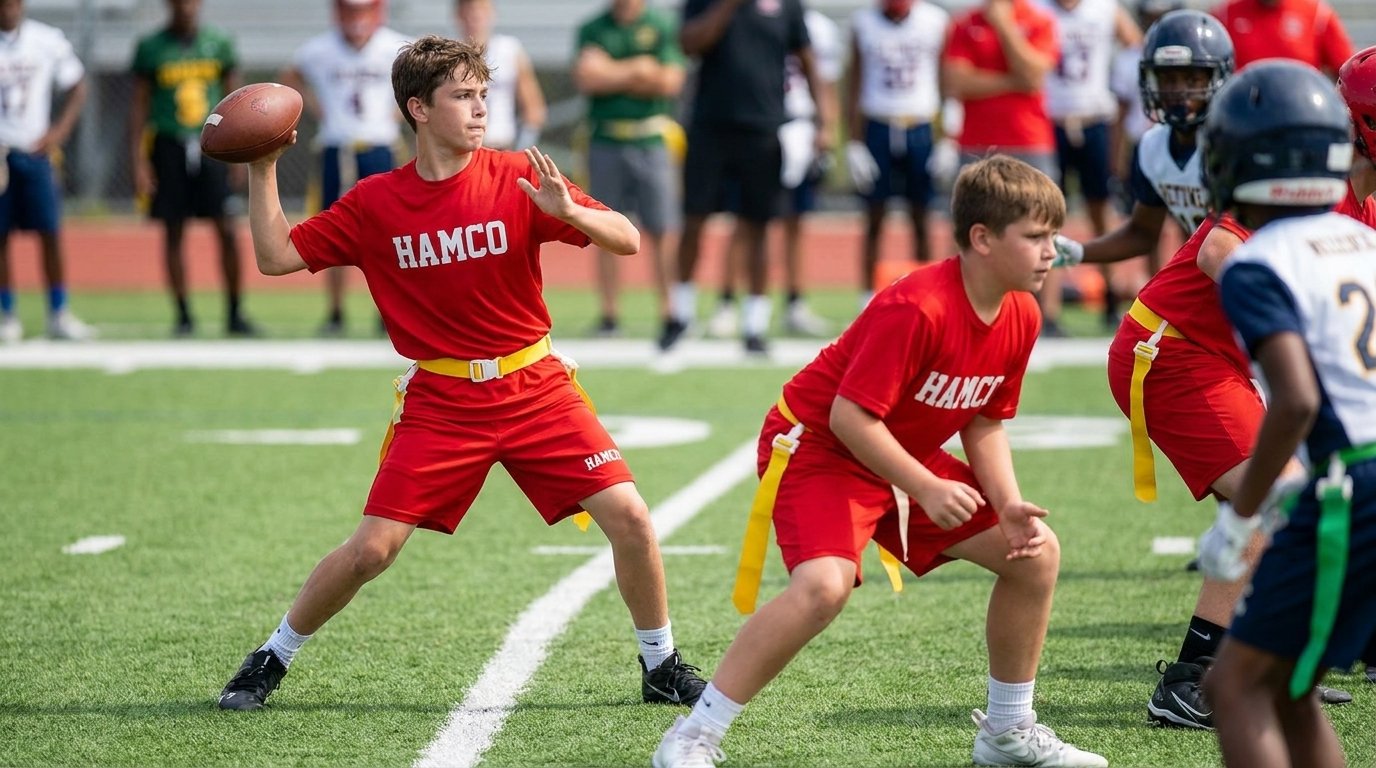
| Quick Answer Flag football positions are simpler than tackle. In 5v5 you have a quarterback, a center, and three receiver defenders who play both ways. In 7v7 you carry a quarterback, a center, and five receiver defenders. On defense one player is the designated rusher and the deepest is the safety. There are no linemen, because there is no blocking or tackling. |
Flag football looks like backyard chaos until you learn who is supposed to be where. It is not chaos. Every player has a position and a job, and because there is no blocking or tackling, the positions are cleaner and easier to learn than in tackle football. The whole thing runs on a shared set of flag football rules, and once you know the five or seven roles on the field, the game opens up. Here is every flag football position and exactly what each one does, in both 5v5 and 7v7.
Here is the honest short version. So what are the positions in flag football? On offense you have a quarterback, a center, and receivers. On defense the same players become a rusher, defensive backs, and a safety, because in most flag formats everyone plays both ways. There are no offensive or defensive linemen, since nobody blocks. Whether you are a new coach starting a flag football team or a parent trying to follow along, this is the full position guide, format by format. The table lays out the roster first.
| Position | 5v5 | 7v7 | On Offense | On Defense |
| Quarterback | 1 | 1 | Takes the snap and throws | Often plays safety or covers |
| Center | 1 | 1 | Snaps, then runs a route | Covers a receiver or rushes |
| Receiver defender | 3 | 5 | Runs routes and catches | Covers receivers; one rushes |
5v5 Positions: QB, Center, and Three Receiver Defenders
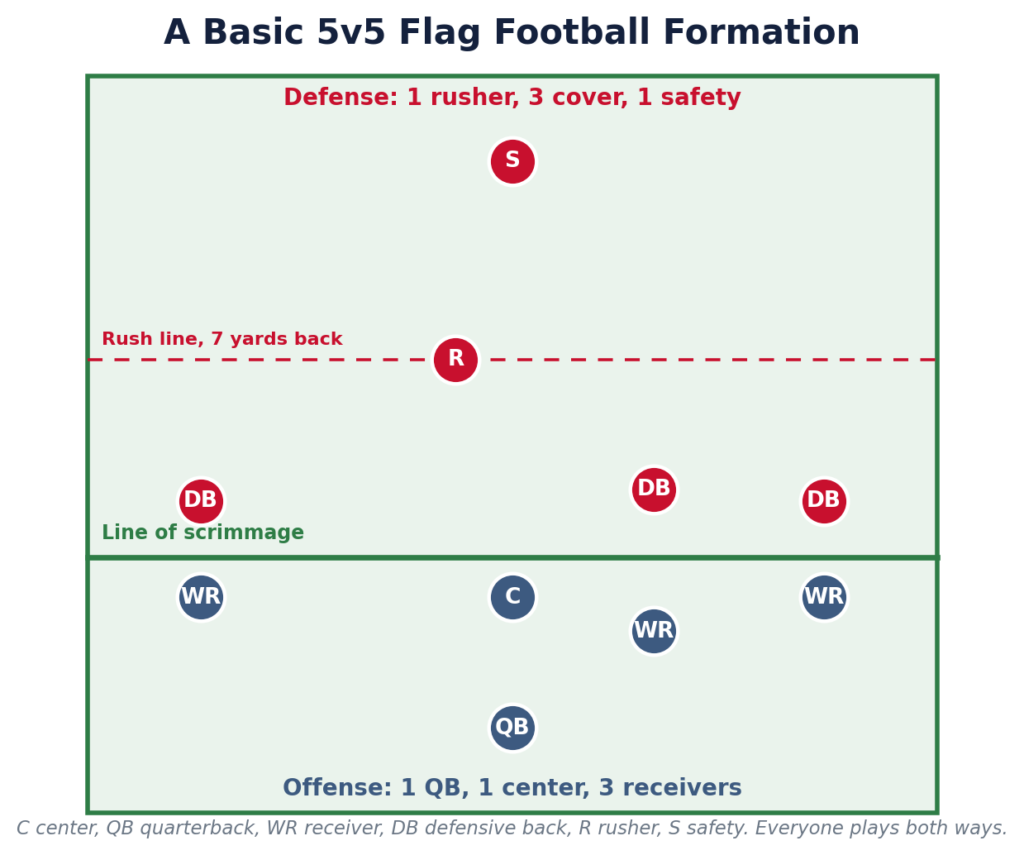
The 5v5 format is the most common version in the country, and the one the 2028 Olympics will use. Five players, and every one of them is eligible to catch a pass. On offense the five break down like this. The quarterback takes the snap and throws, and is usually the only player allowed to advance the ball by passing. The center snaps the ball to the quarterback and then, unlike in tackle football, immediately releases downfield as a receiver, so the center is a real route runner, not a blocker. The other three are receivers who run routes and try to get open. On defense those same five players flip roles: one becomes the rusher, the rest cover receivers man to man or drop into zones, and one usually plays deep as the safety. Because rosters are small, a good 5v5 player has to do a bit of everything, which is part of the fun. Most 5v5 defenses either match up man to man, with the safety free to help over the top, or drop into a simple zone where each defender guards an area of the field. Teaching young players to keep their assignment instead of all chasing the ball is the hardest part of coaching the defensive side. When you are naming that small, versatile squad, our team names guide has a few hundred ideas.
7v7 Positions: QB, Center, and Five Receiver Defenders
The 7v7 format is the step up, used by older youth, high school, and competitive adult leagues on a bigger 80 by 40 yard field. The core is the same, a quarterback and a center, but now there are five receivers instead of three. Those extra bodies change the game. Offenses can run real formations with motion, stacks, and bunch sets, and defenses can play true zone coverage, disguise their looks, and mix up who rushes. The center still snaps and then releases as an eligible receiver. The two extra receiver defenders give a 7v7 defense enough players to cover the whole field and still bring pressure, which is why the 7v7 game looks the most like traditional football. If someone asks about flag football positions 7v7 specifically, the honest answer is that the names are the same as 5v5, there are just two more receiver defenders on each side. What those two extra players unlock is disguise. With seven defenders, a coach can show one coverage before the snap and rotate into another after it, something a 5v5 defense rarely has the bodies to do.
The Rusher and the Count Rule
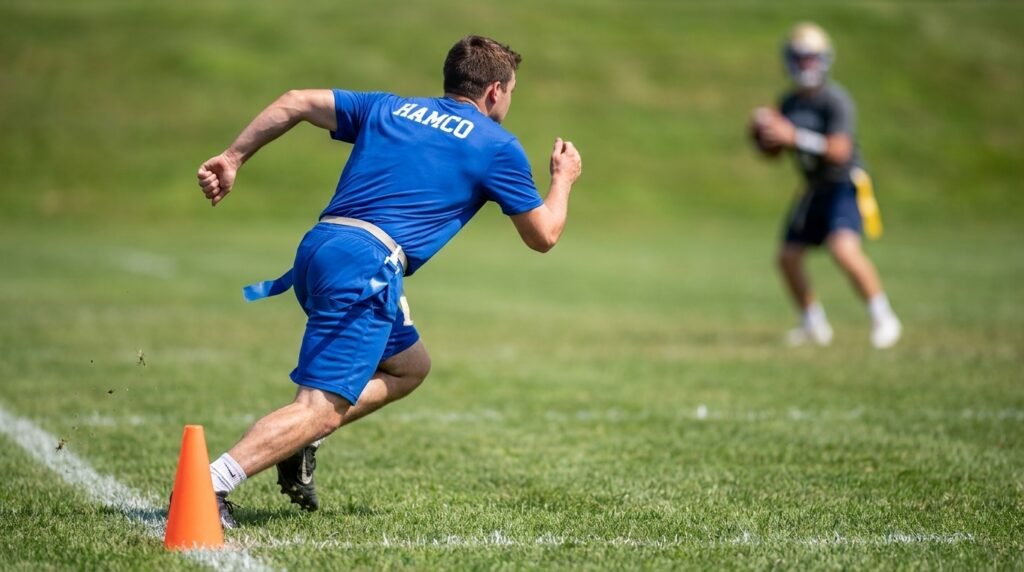
The rusher is the one truly specialized position in flag football, and it comes with a rule that surprises newcomers. The defense may send exactly one player to chase the quarterback, but that rusher cannot start on the line. They have to line up at least 7 yards behind the line of scrimmage, marked by a cone or a spot the referee calls out. Only when the ball is snapped can the rusher take off, sprinting those 7 yards to pressure the quarterback before the 7 second pass clock runs out. Some youth leagues replace the 7 yard line with a verbal count, where a referee counts out loud and no one may rush the quarterback until the count finishes. Either way it is called the count rule, and it exists so the quarterback is not swallowed instantly on every snap. The 7 yard head start is the whole point, since it gives the quarterback a fair window to read the field and throw before the pressure arrives. It is the flag football cousin of the blitz in tackle football, just tamer and limited to one player.
The Blitz Limit
That one rusher rule is worth its own section, because it is the single most misunderstood part of flag defense. In most 5v5 and 7v7 formats, only one player may rush the quarterback at a time. You cannot send two, three, or the whole defense at the passer, no matter how tempting. The limit only lifts once the offense hands the ball off or the ball carrier crosses the line of scrimmage on a run, at which point any defender may pursue and pull the flag. This blitz limit is what keeps flag football a passing game and stops defenses from simply overwhelming a young quarterback. A coach who understands it teaches the rest of the defense to hold their coverage and trust the single rusher rather than crashing the line and giving up an easy completion. It is a discipline test as much as a rule, and the teams that respect it usually beat the ones that forget it in the heat of a drive.
Flag Football Safety: The Deep Defender
On defense, the most important position after the rusher is the safety, the deepest player on the field. While the rusher attacks and the cornerbacks cover receivers up close, the safety hangs back, reads the quarterback’s eyes, and guards against the long touchdown. Coaches sometimes call this the spotter role, because the safety is the one player watching the whole field develop rather than locked onto a single receiver. A good safety turns a blown coverage into a five yard gain instead of a score. It is a thinking position, better suited to a smart, disciplined player than the fastest one. Flag football also asks very little in the way of equipment for any of these positions, no pads or helmets, just a belt, flags, a mouthguard, and cleats, which our gear checklist lays out next to the tackle list so you can see the difference.
Which Positions Work for Which Body Types
Here is the best thing about flag football, and the honest reason it has exploded in popularity: it has a spot for every body type, because size barely matters. With no blocking and no tackling, the game rewards speed, quickness, good hands, and a football brain over pure size and strength. The quarterback needs an accurate arm and quick decisions, not height. Receivers need speed and change of direction, so the smaller, shiftier players often shine. The rusher needs a fast first step and a motor. The safety needs instincts and discipline. A child who would get pushed around in tackle football can be a star in flag, which is a big part of why so many families start here. Searches for flag football positions girls turn up this same list, because the girls and coed game uses an identical set of roles, quarterback, center, receivers, rusher, and safety, with no changes. The positions in flag football girls play are the same ones the boys play. Since everyone is visible and eligible, a clean set of flag football uniforms with bold numbers helps quarterbacks find open receivers fast.
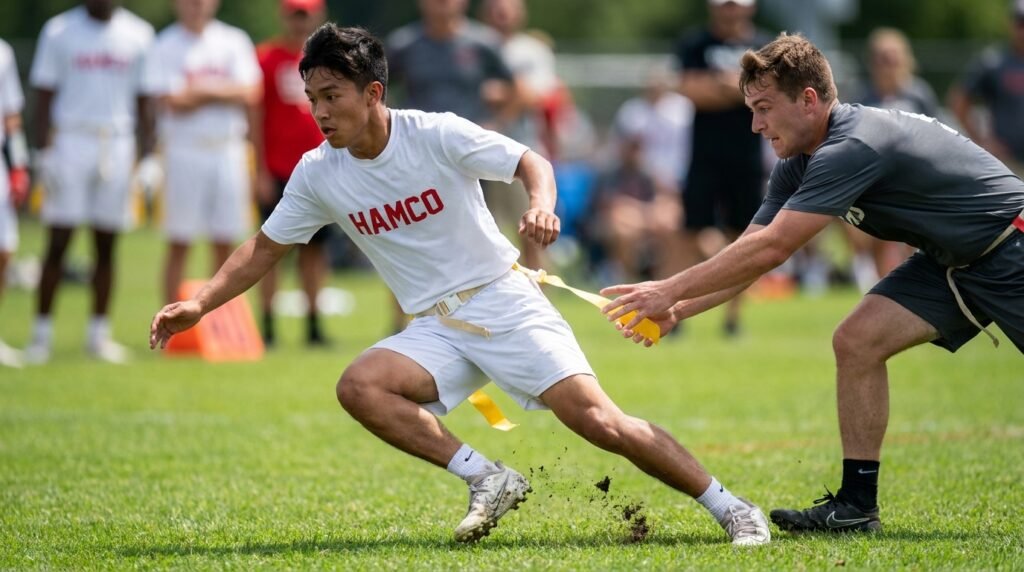
Whatever positions your roster settles into, every player needs a number they are proud of and a jersey built to move. That is our whole job. Our flag football jerseys are cut slim and flag belt friendly, with the bold front and back numbers leagues require and quarterbacks can spot in a crowd, and we turn a full team set around in about two weeks. Kit your quarterback, center, receivers, and defense in matching flag football apparel and get a free mockup back within a day. Quote a team set on our flag football page.
Frequently Asked Questions
Q: What are the positions in flag football?
A: A quarterback, a center, and receivers on offense. On defense the same players become a rusher, cornerbacks, and a safety. There are no linemen, since there is no blocking.
Q: What positions are there in flag football for girls?
A: Exactly the same as the boys game. Girls and coed flag football use a quarterback, center, receivers, one rusher, and a safety, with no position changes.
Q: What are the positions in flag football 7v7?
A: The same roles as 5v5, just with five receiver defenders instead of three. A 7v7 team fields a quarterback, a center, and five receivers who also cover on defense.
Q: How do you play flag football positions on both sides?
A: In most leagues everyone plays offense and defense. A receiver on offense becomes a defensive back or the rusher on defense, so players learn two roles.
Q: What positions are in flag football on defense? A: One designated rusher who starts 7 yards back, cornerbacks who cover receivers, and a safety who plays deep and reads the quarterback.

1 thought on “Flag Football Positions by Positions: What Each Spot Does”