
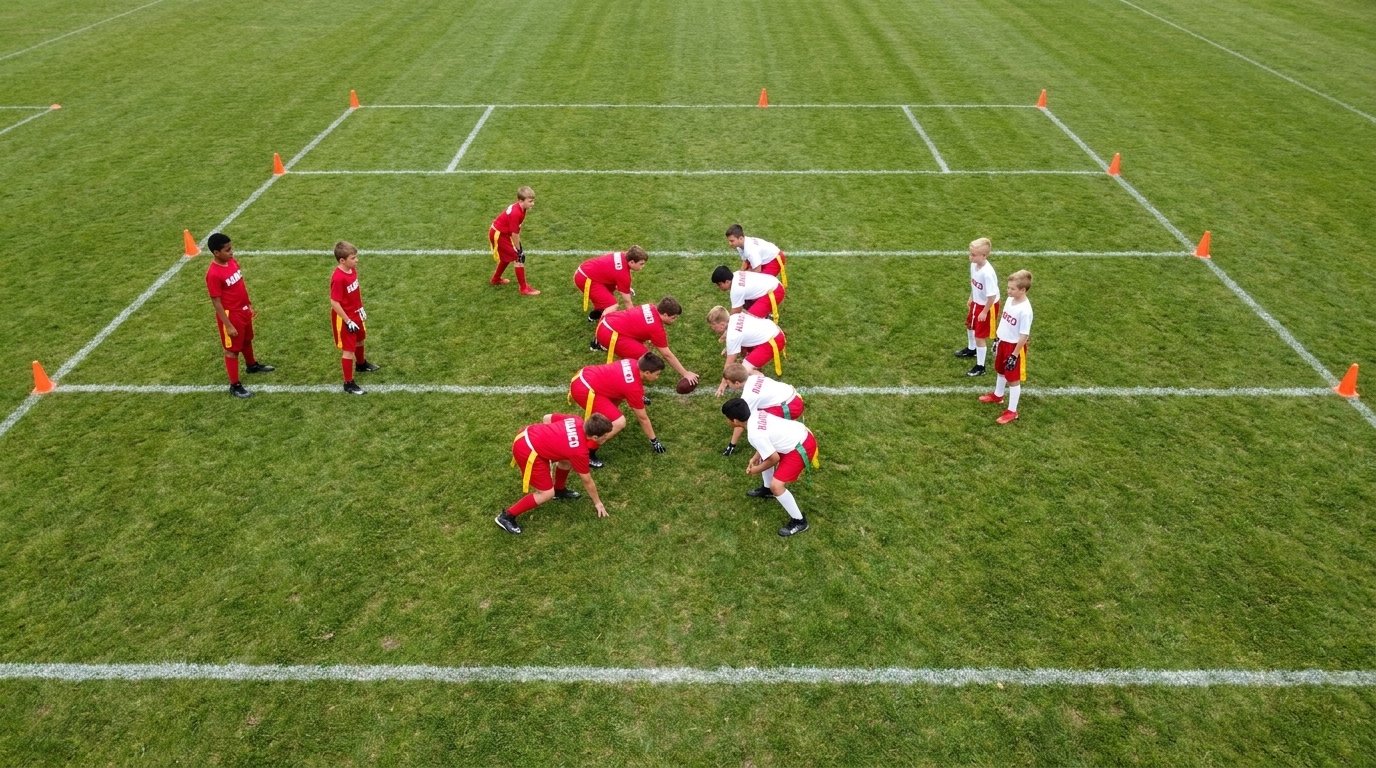
| Quick Answer An NFL Flag 5v5 field is 30 yards wide and 70 yards long, which includes two 10 yard end zones, leaving 50 yards between the goal lines. A 7v7 field is bigger at 40 by 80 yards. Both formats use 5 yard no run zones before each end zone and on either side of midfield, where the offense must throw the ball. |
Ask what are the dimensions of a flag football field and the honest answer is that it depends on the format, but every version is smaller than a tackle field on purpose. That smaller footprint is not a budget cut. It is the design choice that makes the sport work, and it drives everything from the flag football rules to the pace of the game. Here is the full layout for every format, with the markings that confuse newcomers explained.
The short version first. The standard NFL Flag 5v5 field is 30 by 70 yards. A 7v7 field is 40 by 80. Youth fields scale down from there by age. Every one of those layouts exists to give five or seven players enough room to actually use their flag football positions without the field swallowing them. The table lays out each format, then the diagram shows where the lines go.
| Format | Length | Width | Goal to Goal | End Zones | No Run Zones |
| NFL Flag 5v5 | 70 yd | 30 yd | 50 yd | 10 yd | Yes |
| 7v7 flag | 80 yd | 40 yd | 60 yd | 10 yd | Yes |
| Youth (ages 5 to 8) | 50 to 60 yd | 20 to 25 yd | 30 to 45 yd | 7 to 10 yd | Yes |
| High school (NFHS) | 100 or 120 yd | 40 or 53⅓ yd | 80 or 100 yd | 10 yd | Check state rules |
| Tackle, for scale | 120 yd | 53 yd | 100 yd | 10 yd | No |
In feet, the 5v5 field in this table is 90 by 210 feet and the 7v7 field is 120 by 240 feet, end zones included. The high school field adds its end zones on top, as the next section shows.
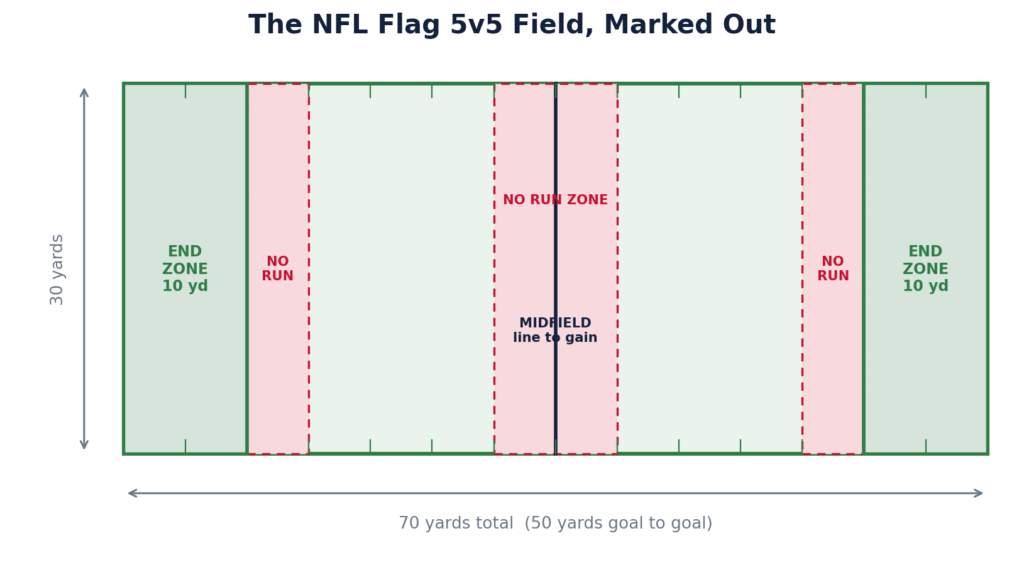
NFL Flag Field (5v5): 30 by 70 Yards
The nfl flag football field dimensions are the ones most families meet first, because NFL Flag runs youth leagues across the country. The field is 30 yards wide and 70 yards long, and that 70 includes two 10 yard end zones, so there are 50 yards of open field between the goal lines. There is no kickoff and there are no chains. The midfield stripe acts as the line to gain: a team starts on its own 5 yard line and gets four downs to cross midfield, then a fresh set to reach the end zone. A 30 by 70 field fits inside a soccer pitch or crossways on a tackle field, which is why leagues can run several games at once on one piece of grass. Some tight parks trim the width to 25 yards, but 30 by 70 is the standard to build around.
The 7v7 Field: 40 by 80 Yards
Step up to older youth, high school, or competitive adult play and the field grows. The 7v7 flag football field dimensions are 40 yards wide by 80 yards long, again including two 10 yard end zones, which leaves 60 yards goal to goal. The extra 10 yards of width matter more than the length: wider means receivers can separate, offenses can spread the field, and defenses have enough grass for real zone coverage. That is why the 7 on 7 flag football field dimensions produce the game that looks most like traditional football. If you are starting a league, check your governing body before you paint anything.
High School Flag Football Field (NFHS)
High school flag football uses the NFHS rules, and most states play 7 on 7. Under the 2025-26 rules book, each state picks one of three fields: 40 by 80 yards, 40 by 100 yards, or 53⅓ by 100 yards between the goal lines, plus two 10-yard end zones. In feet, that is 120 by 240, 120 by 300, or 160 by 300 feet, with 30-foot end zones. Check your state association’s handbook for the size it adopted.
The Two End Zones (10 Yards Each)
Both main formats use 10 yard end zones spanning the full width of the field. They are deeper than they look on a small field: 10 yards of end zone against a 50 yard playing surface is a big chunk of real estate, which is part of why passing offenses thrive. The youth flag football field dimensions are where this changes most, since the smallest divisions, roughly ages 5 to 8, often play on fields as short as 50 or 60 yards and sometimes shrink the end zones to 7 yards for little legs. End zone depth also sets your scoring math: a touchdown is 6 points, and the conversion comes from the 5 yard line for 1 point or the 10 yard line for 2.
The No Run Zone
This is the marking that separates flag football from every other version of the sport, and the one new coaches always argue about. A no run zone is a 5 yard strip before each end zone and a matching 5 yards on either side of midfield, forming a 10 yard band across the center. If the ball is spotted inside one, the offense must throw. No quarterback sneaks, no sweeps, no handoffs to grind out a yard. The reason is simple and honest: those are the spots where an offense would otherwise pile bodies into a short yardage scrum, and a pile of bodies is the one thing a non contact sport cannot allow. It frustrates coaches who want to punch it in from the 3 yard line, and it keeps children out of collisions, which is the entire point. It works alongside the single rusher rule, the flag football cousin of the blitz, to keep the game in the air.

Field Markings Parents Miss
A few more markings cause sideline confusion. There is no chain crew, so the midfield line doubles as the line to gain, and crossing it is your first down. Yard markers usually sit every 5 yards, often as cones rather than paint, since most flag fields go up in an hour and come down the same day. The rusher’s starting spot, 7 yards behind the line of scrimmage, is often a single cone rather than a painted line, which is why a referee points at the ground before a snap. One more thing: the flags are regulated too, and they must contrast with the shorts so a defender can see them, a detail our gear checklist covers alongside the rest of the kit.

Why Smaller Fields Produce Faster Games
Here is why any of this matters. A 30 by 70 flag field covers about 2,100 square yards. A full tackle field covers roughly 6,400. Flag squeezes a game into about a third of the space with half as many players, and the math does the rest. Every kid touches the ball more, gets open more, and stands around less, and since every player is an eligible receiver, nobody is stuck blocking on a line for an hour. The compressed field forces quick decisions and rewards speed and route running over size. That is why scores run high, games finish in about 40 minutes, and flag keeps growing as a youth sport. The small field is not a lesser version of football. It is a different game, and for a lot of kids a better one.
Once the field is measured and coned, the last piece is the team on it. From picking team names to the finished kit, we handle the part that shows up in the photos. Our flag football uniforms are designed in your team colors, with bold numbers a quarterback can spot across a 30 yard field. Order flag football jerseys for the roster with a free mockup within 12 hours, ready 2–3 weeks after design approval, or kit a whole league in matching flag football apparel and get league pricing on the full order.
Frequently Asked Questions
Q: How big is a flag football field?
A: Most are 30 yards wide by 70 yards long for 5v5, or 40 by 80 yards for 7v7, end zones included. High school fields can run up to a full 53⅓ by 100 yards between the goal lines.
Q: What are the dimensions of a flag football field?
A: An NFL Flag 5v5 field is 30 yards wide by 70 yards long, including two 10 yard end zones, leaving 50 yards goal to goal. A 7v7 field is 40 by 80 yards.
Q: What are the field dimensions in flag football for 7 on 7?
A: The 7v7 field is 40 yards wide by 80 yards long with 10 yard end zones, which leaves 60 yards between the goal lines. Some high school rulebooks allow wider.
Q: What are the youth flag football field dimensions?
A: They scale down by age. The youngest divisions, roughly ages 5 to 8, often play on 50 to 60 yard fields that are 20 to 25 yards wide, sometimes with 7 yard end zones.
Q: What is a no run zone in flag football?
A: A 5 yard area before each end zone and on either side of midfield. If the ball is spotted inside one, the offense must pass, which prevents pileups in tight spaces.
Q: What are the field dimensions for flag football compared to tackle? A: A tackle field is 120 by 53 yards. A 5v5 flag field is 70 by 30, so it covers roughly a third of the area with half as many players.



1 thought on “Flag Football Field Dimensions: Why Smaller Fields Make a Better Game”
Comments are closed.