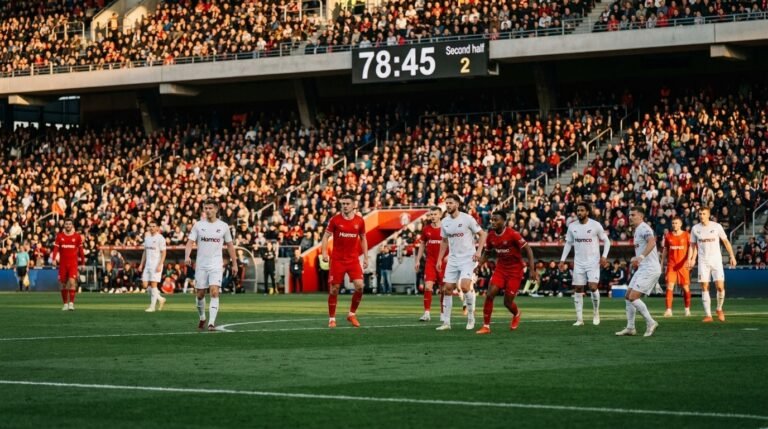
A full-size soccer field is 100 to 130 yards long and 50 to 100 yards wide under the Laws of the Game. International matches use 110 to 120 yards by 70 to 80. FIFA recommends 105 by 68 meters, about 115 by 74 yards. US high-school fields run 100 to 120 by 55 to 80 yards, and youth fields are smaller.
Hamco Sports makes custom soccer uniforms, so the end of this guide covers what field size means for your team’s order. The tables below give each level in yards, feet and acres, with the rule body that sets each figure.
How we made this guide: written by the Hamco Sports team. We used the IFAB Laws of the Game (Law 1, The Field of Play, and Law 4 on goalkeeper colors) and FIFA’s Football Stadiums Guidelines. For college, we used the NCAA 2026 and 2027 Men’s and Women’s Soccer Rules Book (Rule 1.1.1, updated August 10, 2026). For high school, we used the NFHS 2024 to 2025 Soccer Rules Book (Rule 1) and the NFHS Soccer Field Diagram. We also used U.S. Soccer’s age-appropriate game formats, and the US Youth Soccer field and goal standards as published by Eastern Pennsylvania Youth Soccer. Sources read October 31, 2026. Hamco facts checked October 30, 2026.
How long and wide is a soccer field?
A soccer field is 100 to 130 yards (300 to 390 feet) long and 50 to 100 yards (150 to 300 feet) wide. That range comes from Law 1 of the IFAB Laws of the Game, checked October 31, 2026. The touchline, the long side, must always be longer than the goal line.
International matches sit inside a tighter band: 110 to 120 yards long and 70 to 80 yards wide (100 to 110 by 64 to 75 meters). FIFA’s recommended size is 105 by 68 meters, which is about 115 by 74 yards (checked October 31, 2026).
There is no single soccer field size. Law 1 sets a range, and each competition picks its own size inside it. That is why two fields in the same town can differ by 20 yards and both be legal.
Law 1 prints meters and yards as rounded pairs: 90 meters is really 98.4 yards, but the Law prints “100 yds”. US fields are measured in yards, so this guide uses the yard figures.
Soccer field dimensions by level
College fields have a tighter range than the Laws allow. The NCAA 2026 and 2027 rules require 115 to 120 yards by 70 to 80 yards. For the 2026 and 2027 seasons, NCAA rules raised the maximum college field width from 75 to 80 yards.
| Level | Length | Width | Source |
|---|---|---|---|
| Laws of the Game (adult) | 100 to 130 yd (90 to 120 m) | 50 to 100 yd (45 to 90 m) | IFAB Law 1.3 |
| International matches | 110 to 120 yd (100 to 110 m) | 70 to 80 yd (64 to 75 m) | IFAB Law 1.4 |
| FIFA recommended | 105 m (about 115 yd) | 68 m (about 74 yd) | FIFA Football Stadiums Guidelines |
| College (NCAA, 2026 and 2027) | 115 to 120 yd; optimum 120 yd | 70 to 80 yd; optimum 75 yd | NCAA Rule 1.1.1 |
| High school (NFHS) | 100 to 120 yd; 110 yd recommended | 55 to 80 yd; 65 yd recommended | NFHS Rule 1, Section 1 |
Sources, all read October 31, 2026: IFAB Laws of the Game, Law 1 (theifab.com); FIFA Football Stadiums Guidelines, 5.3 Pitch dimensions (publications.fifa.com); NCAA 2026 and 2027 Soccer Rules Book, Rule 1.1.1, and the rules changes for Division I and Divisions II and III; NFHS 2024 to 2025 Soccer Rules Book, Rule 1, Section 1 (copy posted by the Pioneer Valley Soccer Officials Association), and the NFHS Soccer Field Diagram. That book is the newest edition we could read. NFHS lists no Rule 1 change for 2025 to 2026 or 2026 to 2027. Fields used for college soccer before 1995 are exempt from the NCAA size, as long as the width doesn’t exceed the length.
The NCAA’s optimum college field is 120 by 75 yards. If a home field is smaller than recommended, the rule book makes the home team tell the visiting team the real size before game day.
High-school fields follow the NFHS rule, which your state association adopts. A football field is 120 yards long with its end zones and only 53⅓ yards between its sidelines (NFL Rulebook, Rule 1, 360 by 160 feet, checked October 31, 2026), and the NFHS width range starts at 55 yards. So a soccer field lined in a football stadium needs space beyond the football sidelines.
Youth soccer field size by age group
U.S. Soccer sets the maximum game format for each youth age: 4v4 for U7 and U8, 7v7 for U9 and U10, 9v9 for U11 and U12, and 11v11 from U13. Smaller formats are allowed at every age, so your league may play 5v5 or 6v6 where the table shows 7v7.
| Age | Format (maximum) | Field length | Field width | Goal, maximum (height × width) |
|---|---|---|---|---|
| U7 and U8 | 4v4 | 25 to 35 yd (75 to 105 ft) | 15 to 25 yd (45 to 75 ft) | 4 ft × 6 ft |
| U9 and U10 | 7v7 | 55 to 65 yd (165 to 195 ft) | 35 to 45 yd (105 to 135 ft) | 6 ft 6 in × 18 ft 6 in |
| U11 and U12 | 9v9 | 70 to 80 yd (210 to 240 ft) | 45 to 55 yd (135 to 165 ft) | 7 ft × 21 ft |
| U13 and older | 11v11 | full size (table above) | full size | 8 ft × 24 ft |
Formats: U.S. Soccer, “Age-Appropriate Game Formats” (ussoccer.com, read October 31, 2026). Field and goal sizes: US Youth Soccer standards, as published by Eastern Pennsylvania Youth Soccer (epysa.org, read October 31, 2026). Age-group year: US Youth Soccer, “Updated Decision on Age Group Formation”, the joint US Youth Soccer, AYSO and US Club Soccer decision (usyouthsoccer.org, June 10, 2025, read November 8, 2026). Leagues may set their own.
A 9v9 field is 45 to 55 yards wide, about 19 to 29 yards narrower than a FIFA-size field.
Check how your league sets age groups, too. Age groups go by date of birth, not school grade. From the 2026 to 2027 season, US Youth Soccer, AYSO and US Club Soccer count the age year from August 1 to July 31; other leagues can set their own age rules.
State associations and leagues can publish their own small-sided sizes. Check yours before you line a field. A league can set one fixed size inside these ranges and expect every home field to match it.
How many acres is a soccer field?
A FIFA-size soccer field of 105 by 68 meters covers about 1.76 acres. The legal adult range runs from about 1.03 acres (100 by 50 yards) to about 2.69 acres (130 by 100 yards). The sum is length × width in square yards, × 9 for square feet, ÷ 43,560 square feet per acre.
| Field | Yards | Feet | Square feet | Acres (about) |
|---|---|---|---|---|
| Laws, low end | 100 × 50 | 300 × 150 | 45,000 | 1.03 |
| FIFA recommended (105 × 68 m) | about 115 × 74 | about 345 × 223 | about 76,850 | 1.76 |
| NFHS recommended (high school) | 110 × 65 | 330 × 195 | 64,350 | 1.48 |
| NCAA optimum | 120 × 75 | 360 × 225 | 81,000 | 1.86 |
| Laws, high end | 130 × 100 | 390 × 300 | 117,000 | 2.69 |
| 9v9, maximum size | 80 × 55 | 240 × 165 | 39,600 | 0.91 |
| 7v7, maximum size | 65 × 45 | 195 × 135 | 26,325 | 0.60 |
| 4v4, maximum size | 35 × 25 | 105 × 75 | 7,875 | 0.18 |
Math: FIFA 105 × 68 m = 7,140 m² ÷ 4,046.86 m² per acre = 1.76; every other row: square feet ÷ 43,560; 1 yard = 3 feet = 0.9144 meters; rounded.
The acre figure covers the lined field only. Runoff space, benches and spectator areas sit outside the lines, so a park needs more land than the table shows. Two 7v7 fields at maximum size take about 1.21 acres, less than one FIFA-size field. So a club can turn one full field into two 7v7 fields laid across its width.
Math: two 7v7 fields 65 × 45 yd side by side = 65 × 90 yd, inside a 115 × 74 yd field turned crosswise (65 ≤ 74, 90 ≤ 115); 2 × 26,325 ft² = 52,650 ft² ÷ 43,560 = 1.21 acres.
A standard running track is 400 meters around, and its infield has room for a 105 by 68 meter field, according to the World Athletics Track and Field Facilities Manual (2019 edition, section 2.2.1.1, checked October 31, 2026).
Soccer field markings: penalty area, goal area and center circle
The penalty area reaches 18 yards from the inside of each goalpost and 18 yards into the field: 44 by 18 yards in all. The goal area, inside it, reaches 6 yards from each post and 6 yards out, which makes it 20 by 6 yards.
| Marking | Size (IFAB Law 1) |
|---|---|
| Penalty area | 18 yd from each goalpost and 18 yd into the field (44 × 18 yd) |
| Goal area | 6 yd from each goalpost and 6 yd into the field (20 × 6 yd) |
| Penalty mark | 12 yd from the midpoint between the goalposts |
| Center circle | 10 yd radius |
| Penalty arc | 10 yd radius from the penalty mark |
| Corner arc | 1 yd radius |
| Line width | the same for every line, no more than 5 in |
| Goal (11v11) | 8 yd (24 ft) between the posts, 8 ft from the ground to the crossbar |
Source: IFAB Laws of the Game, Law 1.2, 1.5, 1.6, 1.7 and 1.10 (read October 31, 2026). Widths worked from the goal: 8 + 18 + 18 = 44 yd; 8 + 6 + 6 = 20 yd.
When you paint a grass field, measure the goal area and penalty area from the inside edge of each goalpost, as Law 1 does. Don’t measure from the center of the goal. Keep every line the same width, no more than 5 inches.
Field size sets the format, and the format sets your order
Field size decides the format. The format decides players a side, and players a side decide how many uniforms you need. A U10 club team playing 7v7 has 7 players on the field at once, but a roster of 12 still needs 12 jerseys. See how many players are on a soccer team for roster sizes by age.
Law 4.3 of the Laws of the Game requires each goalkeeper to wear colors that stand out from the other players and the referees (checked October 31, 2026). Hamco Sports makes goalkeeper jerseys with long or short sleeves and no padding, so you can choose by weather.
Small-sided training splits a squad into teams. Soccer pinnies come in a reversible two-color version, so one pinnie covers both sides of a scrimmage. See our soccer pinnies.
A club ordering for several age groups gets the price tier of the combined quantity across all teams. For example, three U10 teams of 12 players on one quote count as 36 jerseys toward the tier, even when each team has its own design.
There is no minimum order and no setup fee, and sublimated names and numbers are included in the price. Your free mockup comes back within 12 hours, and you get as many changes as you need. Nothing goes into production until you approve it. Your order is ready 2 to 3 weeks after you approve your design, then takes 3 to 5 days to reach US teams. Shipping is free anywhere in the USA. Canadian clubs are welcome and pay the shipping. We pay the tariffs, duties and import fees on US and Canada orders.
For example, for a first spring game on Saturday, March 13, 2027, approve your design by Monday, February 8, 2027. That date leaves room for the full production window, the longest shipping time and a week to spare.
Math: March 13, 2027, minus 21 days of production is February 20. Minus 5 days of shipping is February 15. Minus 7 days to spare is February 8, 2027.
One person on our team answers you from the first email to delivery. Tell us about your team and your first game date. Get My Free Quote
Frequently asked questions
Is a soccer field 100 yards?
Sometimes. But 100 yards is the shortest a full-size soccer field can be under Law 1 of the Laws of the Game. The legal length runs from 100 to 130 yards. International fields are 110 to 120 yards, and NCAA college fields are 115 to 120 yards. FIFA’s recommended field is about 115 yards long.
Is a soccer field bigger than a football field?
A FIFA-size soccer field is bigger in area but shorter. At 105 by 68 meters (about 115 by 74 yards) it covers about 1.76 acres. A football field, end zones included, is 120 by 53⅓ yards, about 1.32 acres. So the soccer field is about 5 yards shorter, 21 yards wider and about a third larger. See our football field dimensions guide.
Is a soccer field a mile long?
No. A FIFA-size soccer field is about 115 yards, or 345 feet, long. A mile is 5,280 feet, so about 15 soccer fields laid end to end make one mile (5,280 ÷ 345 = 15.3). Even the longest legal field, 130 yards, is under a tenth of a mile.
How big is a high school soccer field?
High school fields follow the NFHS rule: 100 to 120 yards long and 55 to 80 yards wide. The NFHS recommends 110 by 65 yards, which covers about 1.48 acres. Your state association adopts the rule, so check its handbook before you line the field. Hamco Sports makes custom soccer uniforms for high school teams and accepts school purchase orders.
Is a soccer field 400 meters?
No. A soccer field is 90 to 120 meters long under Law 1, and international fields are 100 to 110 meters. 400 meters is one lap of a standard running track. That is why a soccer field can sit inside a track: the field fills the infield, and the lap goes around it.