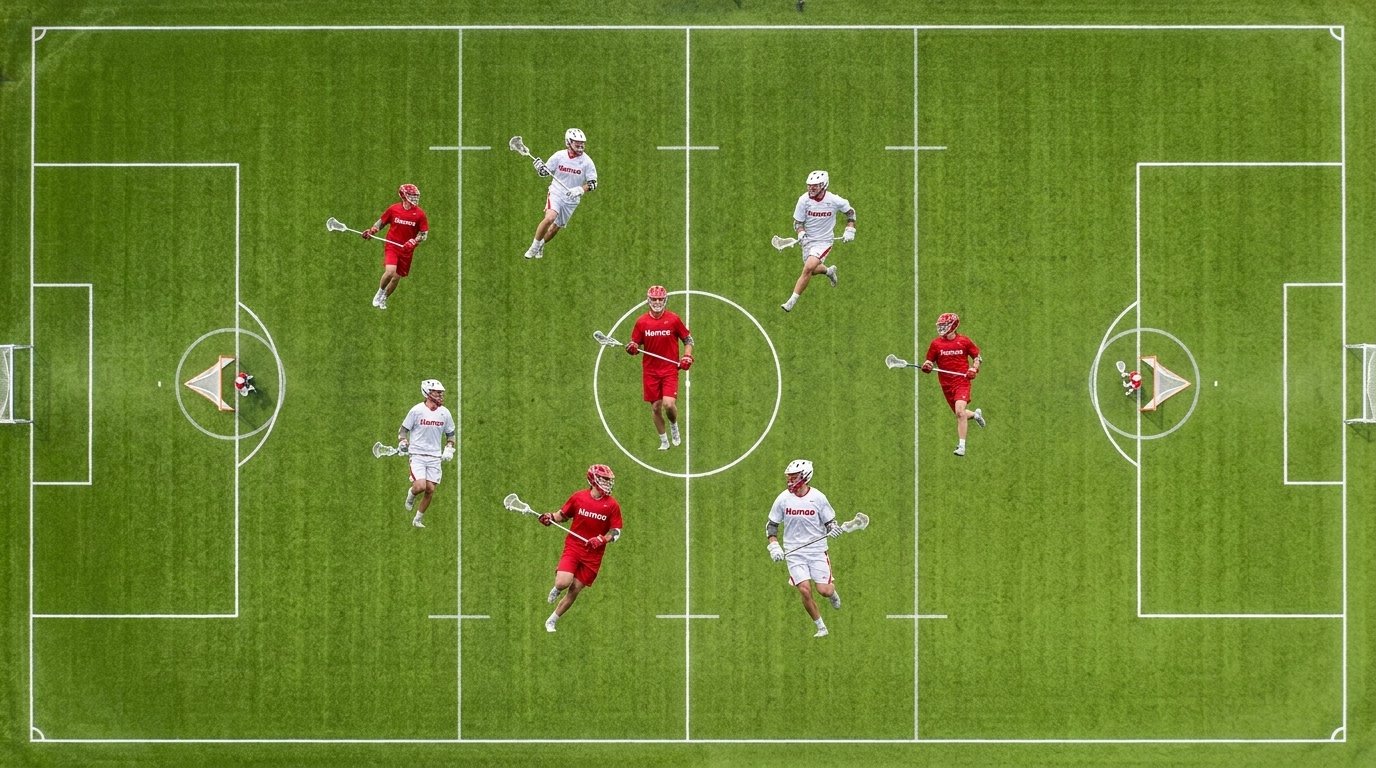
| Quick Answer A men’s lacrosse field is 110 by 60 yards at both the NCAA and high school level, with the goals 80 yards apart and an 18 foot crease circle around each. Women’s fields run larger, up to 120 by 70 yards, and add scoring arcs. Youth fields scale down by age, and box lacrosse is played in a hockey rink, about 180 by 80 feet, with a much smaller 4 by 4 foot goal. |
Ask what are the dimensions of a lacrosse field and the honest answer is that it depends. A college field, a youth field, a women’s field, and an indoor box rink are all different sizes, and the markings on each mean different things, which trips up new parents and coaches constantly. The biggest split is between the outdoor field game and the indoor box game, which our box vs field guide covers in depth. This is the full reference for every level, with the exact numbers and what each line actually does.
Here is the short version before the detail. The standard men’s lacrosse field dimensions are 110 yards long by 60 yards wide, the same at NCAA and high school. Everything on it, the creases, the restraining lines, the wing areas, exists to organize the ten players and their positions into attack, midfield, and defense zones. Get the field, and the flow of the game suddenly makes sense. The table lays out every level first, then we walk through each one.
| Level | Length | Width | Goal | Crease | Goals Apart |
| NCAA and high school (men) | 110 yd | 60 yd | 6 by 6 ft | 18 ft circle | 80 yd |
| Women’s (college) | 120 yd | 70 yd | 6 by 6 ft | circle plus arcs | 90 to 100 yd |
| Youth (scaled by age) | 60 to 110 yd | 30 to 60 yd | 6 by 6 ft | varies | varies |
| Box (indoor rink) | 180 to 200 ft | 80 to 90 ft | 4 by 4 ft | 9 ft radius | rink length |
NCAA and High School Field
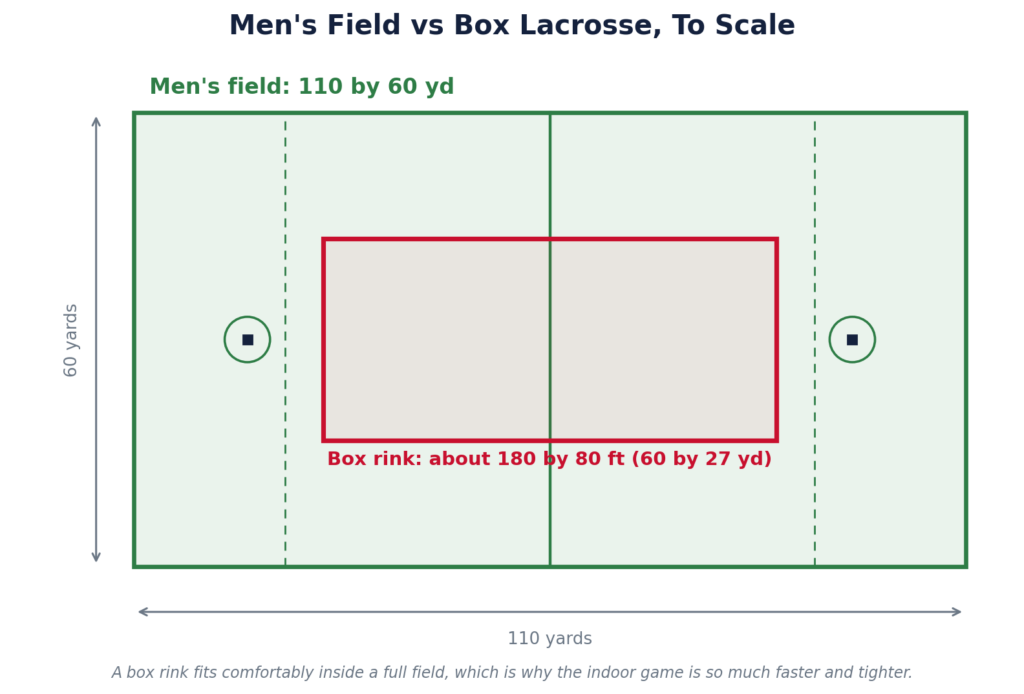
At the college and high school level, the men’s field is identical: 110 yards long and 60 yards wide, which works out to 59,400 square feet. The two goals sit 80 yards apart, each placed 15 yards in from the end line, and that setback matters, since lacrosse, unlike most sports, lets you play behind the goal. Each goal is 6 feet by 6 feet. A center line splits the field into an offensive and a defensive half, with a face off X painted at the middle, while the sidelines run the 110 yard length and the end lines run the 60 yard width. It is close enough to a soccer field that many schools paint both on the same grass, since lacrosse needs only about 10 extra yards of length. Getting a regulation field and matching kit ready for the opener is its own checklist, which our gear checklist walks through.
Youth Field Dimensions
Youth fields scale down with age, and this is where it gets loose, since local leagues set their own sizes. The youngest players, roughly kindergarten through second grade, often play small sided on fields as short as 60 yards, sometimes across a full field turned sideways. As players move up the field grows toward the full 110 by 60, and most travel and middle school programs are on full size fields by around age 12. Because the field and the gear both scale to the age, a good youth lacrosse gear checklist is worth reading before a first season. The honest advice for parents: do not assume your child’s field matches what you see on television, and always check the league rules.
Girls vs Boys Field Markings
Women’s and girls’ lacrosse uses a different field, and the markings are the biggest tell. The women’s lacrosse field dimensions are larger than the men’s, commonly around 120 yards by 70 yards at the college level and up to 140 by 70, with the goals set 90 to 100 yards apart. The defining feature is the pair of arcs in front of each goal: an 8 meter arc and a 12 meter fan that together form the critical scoring area, where fouls hand the attacker a free position shot. Men’s fields have no such arcs. Women’s lacrosse also replaces the men’s face off X with a center draw circle, and its restraining lines sit farther out, about 30 yards from goal rather than 20. Girls’ youth fields shrink from there and often drop the arcs at the youngest ages.
Box Lacrosse Arena Dimensions
Box lacrosse throws the outdoor rulebook out. It is played indoors in a hockey rink with the ice covered by turf or concrete, so the box lacrosse field dimensions are really rink dimensions: roughly 180 to 200 feet long by 80 to 90 feet wide, with 180 by 80 being the common size. Boards and glass surround the surface, and players bounce passes off them like hockey. The goal shrinks dramatically, to just 4 feet by 4 feet, which is why box goalies wear enormous padding and can cover almost the entire net. With less space and a smaller cage, box is faster, more physical, and higher scoring in tight quarters. Indoor and travel teams live out of their bags all winter, so a solid team bag earns its keep.

The Restraining Line and the Crease
Two markings matter more than the rest. The crease is the circle around each goal, 18 feet in diameter, and it is the goalie’s protected zone: attackers may not step inside it, and a goal scored while an attacker is in the crease does not count. The restraining lines are the pair of lines running across the field 20 yards out from each goal, and they create the restraining box at each end. Their job is spacing. During a face off most players must stay behind them, and only a set number of players may crowd each end during open play, which is what stops lacrosse from collapsing into one giant scrum around the ball. The crease diameter and the restraining line are the two numbers every coach should know cold.

Line Markings That Confuse Parents
A few more lines cause the most sideline confusion. The wing areas, or alleys, are the hash marked lanes 10 yards in from each sideline at midfield, where the non face off midfielders must stand until the whistle. The center line, with its painted X, is where face offs happen and the reference for the offside rule: a team must keep four players on its defensive half and three on its offensive half at all times. None of these are complicated once you know them, but they look like random paint the first time you watch. Learn the crease, the restraining lines, and the center line, and you can follow any lacrosse game at any level.
Whatever field your team plays on, the same rule applies: the players have to be visible from the far sideline, and that comes down to bold numbers and high contrast colors. That is where we help. From a fresh team names idea to the finished kit, our lacrosse pinnies are printed with daylight visible numbers on both sides for scrimmages, and you can outfit the whole roster in lacrosse apparel built for full field running and box board checks alike. Get a quote and kit every level, field or box, in one run.
Frequently Asked Questions
Q: What are the dimensions of a lacrosse field?
A: A men’s field is 110 yards long by 60 yards wide at both NCAA and high school level, with goals 80 yards apart. Women’s fields run larger, up to 120 by 70 yards.
Q: How big is a box lacrosse rink?
A: Box is played in a hockey rink, about 180 to 200 feet long by 80 to 90 feet wide, with a much smaller 4 by 4 foot goal.
Q: What is the crease in lacrosse?
A: The 18 foot diameter circle around each goal. Only the goalie and defenders may enter it, and attackers cannot step inside.
Q: Are women’s and men’s lacrosse fields the same size?
A: No. Women’s fields are larger, up to 120 by 70 yards, and add an 8 meter arc and 12 meter fan around each goal that men’s fields do not have.
Q: What is the restraining line in lacrosse? A: A line 20 yards from each goal that creates the restraining box and controls how many players can crowd each end, especially during face offs.