You are trying to plan dinner, or figure out whether you can catch the second half of another kid’s game, and you just want a straight answer: how long is a softball game? The honest answer is that it depends, but not in a vague way. A standard game has a clear length, and then a short list of specific rules can shrink it, stretch it, or stop it cold. Here is the real breakdown, so you can plan your evening with actual numbers instead of guesses. If you are still learning the basics of the diamond itself, our softball field guide covers the layout these games are played on.
The Seven Inning Standard
A regulation softball game is seven innings. That is the standard at high school, college, travel ball, and most adult leagues, and it is one inning shorter than the casual assumption that softball matches baseball’s nine.
In real time, a seven inning fastpitch game usually runs about 90 minutes to 2 hours. Slowpitch can move faster between pitches but often produces more offense, so it lands in a similar range or a little longer when the bats get hot. Youth games at the younger levels are sometimes scheduled for six innings instead of seven to keep them manageable. College softball holds firm at seven innings across NCAA, NAIA, and JUCO play, and our breakdown of college softball innings covers how each of those bodies handles format and length.
That 90 minute to 2 hour figure is the baseline. Everything below is a rule that moves it.
Here is the quick reference by level and format:
| Level or Format | Innings | Typical Length | Main Length Factor |
| High school fastpitch | 7 | 90 minutes to 2 hours | mercy rule or weather |
| College (NCAA, NAIA, JUCO) | 7 | about 2 hours | eight run mercy rule |
| Youth, younger divisions | 6 to 7 | 1 to 1.5 hours | time limit or mercy rule |
| Travel tournament pool play | 7 or time capped | 1 hour 15 to 1 hour 30 | time limit |
| Adult slowpitch | 7 | 1 to 1.5 hours | time limit or run rule |
Time Limits in Pool Play and Tournaments
The single biggest reason a game ends before seven innings is a time limit, and tournaments live on them.
To fit dozens of games onto a few fields in a weekend, tournament organizers cap games with a clock. The common formats are a flat finish time, often around 1 hour 15 minutes to 1 hour 30 minutes, or a no new inning rule, where no fresh inning starts after a set point on the clock even if the seventh has not been reached. Some use a hard drop dead time, where play stops at the buzzer and the score reverts to the last completed inning. These limits rarely apply in high school and college regular season games, which play the full seven, but they are the norm in pool play and youth tournaments. Because the rule varies from one event to the next, always read the tournament packet, and our guide to softball league rules explains how far local rules can drift from the official book. Pack for the long days too, since a tournament can mean four games before dinner, and our softball gear guide covers what belongs in the bag.

Mercy Rule Cutoffs, With the Score Differentials
The mercy rule, also called the run rule, ends a lopsided game early so nobody has to sit through a blowout. The exact run differentials depend on the governing body, and here is where being precise matters.
Under NFHS high school rules, the game ends if a team leads by 15 runs after three complete innings, 12 after four, or 10 after five. If the home team is ahead, it can end a half inning sooner. State associations adopt their own variations, so do not treat these as universal.
College softball under the NCAA uses a single lower threshold: eight runs after five complete innings, or four and a half if the home team leads. That eight run rule applies to every NCAA game, including the Women’s College World Series. Travel and recreation leagues sit somewhere in between, with slowpitch typically using higher differentials because it produces so many runs. The honest takeaway: a blowout can end a game in under an hour, and the number that triggers it is not the same everywhere.
Rain Delays and the Four and a Half Rule
Weather is the wildcard, and one rule decides whether a stopped game counts.
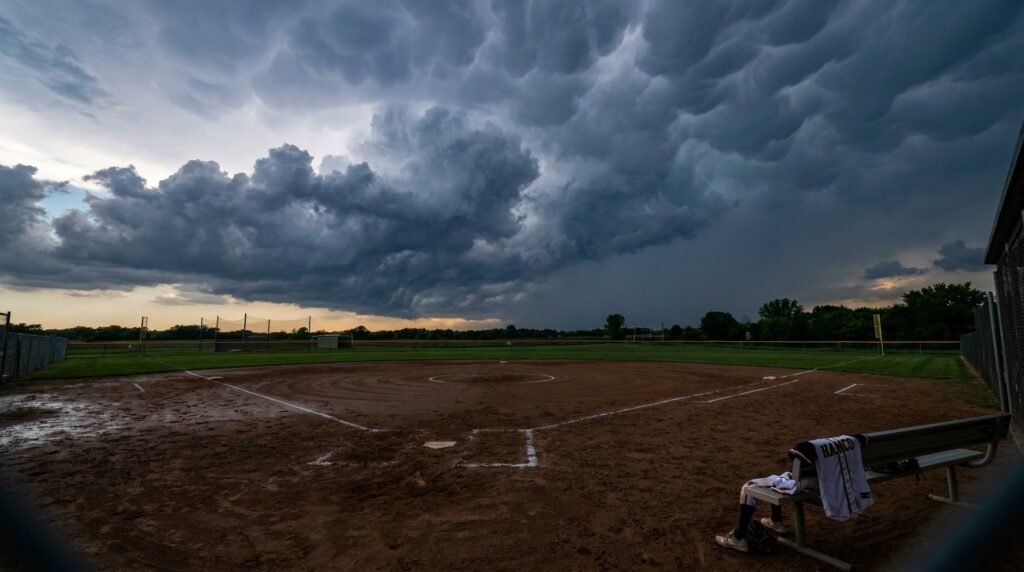
A softball game becomes official, or regulation, once the team that is behind has had at least five turns at bat, which usually means five complete innings, or four and a half if the home team is ahead and batting last. If rain or darkness ends the game after that point, the result stands. If it stops before that point, the game is not official and is typically suspended and resumed later, or replayed, depending on the league. This is why you will see teams and umpires racing to finish the top of the fifth before a storm hits, because crossing that line turns an unfinished game into a final score.
Extra Innings and the International Tiebreaker
If the score is tied after seven innings, the game goes to extra innings, and softball has a specific tool to keep those from dragging on forever.
It is called the international tiebreaker, sometimes the Texas tiebreaker. Starting with the first extra inning, each half inning begins with a runner already placed on second base, usually the player who made the last out of the previous inning. The idea is to manufacture scoring chances and end the game quickly rather than playing endless scoreless frames. It is used in college, USA Softball, and international play, and many tournaments adopt it to protect the schedule. Extra innings also mean a tired pitcher staying in the circle, and the rules that govern her delivery do not relax just because the game is long, as our pitcher rules breakdown explains.
The Short Version
A softball game is seven innings and roughly 90 minutes to 2 hours by default. A tournament time limit can cut it short, a mercy rule can end it in under an hour, rain can freeze it once five innings are in the books, and a tie sends it to extra innings with a runner spotted on second to speed things along. Know those five levers and you can predict almost any game’s length before the first pitch.
Frequently Asked Questions
How long is a softball game?
A regulation softball game is seven innings and usually lasts about 90 minutes to 2 hours. Time limits, mercy rules, and weather can make it shorter, while extra innings can make it longer.
How many innings are in a softball game?
Seven innings is the standard at high school, college, travel, and most adult levels. Some younger youth divisions play six, and slowpitch leagues occasionally adjust based on time limits.
What is the mercy rule in softball?
It ends a lopsided game early. High school commonly uses 15 runs after three innings, 12 after four, and 10 after five, while college uses eight runs after five. Exact numbers vary by governing body.
When does a softball game become official in a rain delay?
A game is official once the losing team has batted five times, which is five complete innings, or four and a half if the home team leads. If rain stops it before that, it is usually suspended or replayed.
What happens if a softball game is tied?
It goes to extra innings using the international tiebreaker, where each half inning starts with a runner on second base to create scoring chances and end the game faster.
Heading into a long tournament weekend, a sharp team look keeps morale up across all those games, and our softball uniform ideas post has design inspiration to start from.
When you are ready to order, our custom softball uniforms come in fastpitch and slowpitch cuts with a two week turnaround.
Need just the tops for the roster? Our custom softball jerseys are built for a full season of doubleheaders and tournament Saturdays.
Tournament season? Order team uniforms with a two week turnaround.