

People say “softball” like it is one thing. It is not. Fastpitch and slowpitch share a name, a yellow ball, and a diamond, and that is roughly where the similarity ends. The pitching is different, the lineups are different sizes, one lets you steal freely and the other limits or bans it, and you cannot even swing the same bat in both. If you are picking a league, signing up a kid, or coming back to the sport as an adult, choosing the wrong one wastes a season and a gear budget. Here is the honest comparison of fastpitch vs slowpitch softball, difference by difference, with nothing glossed over.
Fastpitch vs Slowpitch Rules, Side by Side
| Rule | Fastpitch | Slow-pitch |
| Pitch | Fast underhand, usually a windmill | Underhand at moderate speed with an arc 6 to 10 feet high (12 in senior play) |
| Pitching distance | 43 feet for women and girls 14U and up; 46 feet for men | 50 feet for adults |
| Bases | 60 feet | 70 feet for adults; 65 feet for girls 14U to 18U |
| Outfield fence (minimum) | 200 feet for women and girls 12U and up; 225 feet for men | 265 feet for women, 275 feet for coed and 300 feet for men; 225 feet for girls 14U to 18U |
| Fielders | 9 (10 in the lineup with the DP/FLEX) | 10, with four outfielders (11 bat with an extra player) |
| Stealing | Yes, once the pitch is released | Depends on the division: USA Softball allows it in adult men’s and women’s slow-pitch and boys 18U once the pitch reaches home plate; girls’ youth, boys 16U and under, coed, masters and senior slow-pitch don’t |
| Bunting | Yes | No: a batter who bunts or chops the ball is out |
| Home run limits | None | Yes, by class, from 12 a game in Class AA down to 1 in E/Rec |
| Ball | 12 inch from 12U up; 11 inch for 10U | 12 inch for men; 11 inch for women |
| Run rule at national championships | Women and girls: 15 after 3, 12 after 4, 8 after 5 (NCAA: 8 after 5) | 20 after 3, 15 after 4, 10 after 5 in most divisions |
Rules from the USA Softball Official Rules of Softball 2026 and the NCAA Softball Rules Book for 2026 and 2027, checked October 27, 2026. Bases, pitching distances and fence distances were checked again against Rule 2, Section 1 of the 2026 USA Softball rule book on November 1, 2026.
High school fastpitch also pitches from 43 feet and runs 60 foot bases under NFHS rules (NFHS rule differences chart, checked November 1, 2026). Your league can add its own rules on top.
The Pitching Motion: Windmill vs. Arc
This is the difference you notice first, and it defines everything else about each game.
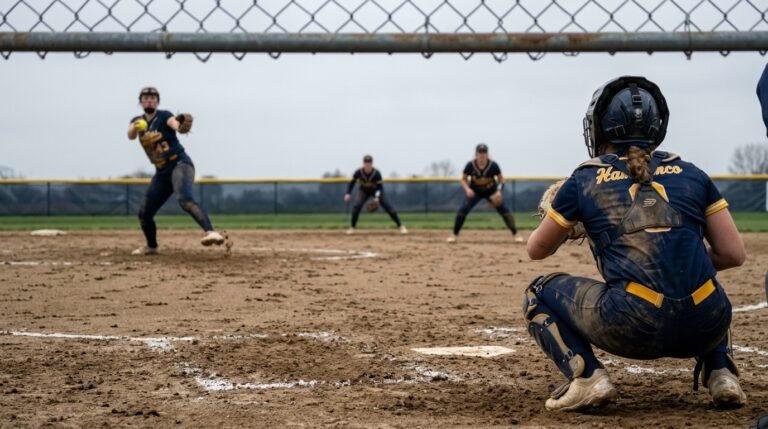
Fastpitch uses the windmill. The pitcher swings her arm in a full circle and releases underhand at the bottom, generating real velocity. Elite high school and college pitchers throw hard, and because the rubber sits just 43 feet away on a flat surface, the reaction time a hitter gets is comparable to facing a much faster overhand pitch in baseball. The ball comes in flat or rising, and movement pitches like the riseball and drop are weapons. Fastpitch pitching is a specialized, high skill position that takes years to develop.
Slowpitch is the opposite by design. The pitcher lobs the ball underhand in a required arc, sending it between 6 and 10 feet high under USA Softball’s 2026 rules (12 feet in senior play) so it drops down through the strike zone. There is no velocity and no intimidation. The whole point is to put a hittable ball in play, because slowpitch is built around offense and contact, not pitching dominance. A slowpitch pitcher competes through arc, spin, and placement, not speed. The rules that govern each legal delivery are stricter than newcomers expect.

The honest takeaway: fastpitch pitching is the hardest position in the sport, while slowpitch pitching is the least physically demanding. That single split shapes who is drawn to each game.
It is worth being blunt about the development gap, too. A competitive fastpitch pitcher spends years on mechanics, conditioning, and a pitch arsenal, often with private coaching, because the windmill is unforgiving and command at speed is rare. A slowpitch pitcher can learn a legal delivery quickly; the skill is in the arc control, spin and placement that keep hitters off balance rather than overpowering them. That is not a knock on slowpitch, it is just the reality of what each role asks of you before you are any good at it.
Lineup Size: Nine vs. Ten
Fastpitch fields nine defensive players, the same nine as baseball. Slowpitch fields ten.
That tenth player is a fourth outfielder; some rec leagues use a shallow rover or short fielder instead. Slowpitch needs the extra glove because the arc delivery and lively bats turn nearly every at bat into airborne contact, and four outfielders cover that flood of fly balls far better than three. Fastpitch, with its strikeouts and ground game, does not need the extra fielder and sticks to nine.

There is a roster wrinkle too. Many slowpitch and rec leagues let you bat more players than you field, adding extra hitters so more people get to swing, which suits the social nature of adult slowpitch. Fastpitch lineups stay tighter and more strategic. If you want each defensive role spelled out, including where that tenth fielder stands and what every position is responsible for, our softball positions guide covers them one by one.
Base Stealing and Base Running
This is where the two games feel completely different to a runner.
Fastpitch allows base stealing, but with a catch that baseball players hate: there is no leadoff. A runner cannot leave the base until the pitcher releases the ball. Once that happens, stealing is live and aggressive, and a fast runner who reads the release well is a constant threat. Steals, slaps, and short game pressure are central to fastpitch strategy.
Many slowpitch leagues ban base stealing. Where it is allowed, as in USA Softball adult men’s and women’s play, a runner still can’t leave until the pitch reaches home plate. Base running in slowpitch is straightforward and station to station, which keeps the focus squarely on hitting. The pace and rhythm of the two games diverge sharply because of this one rule, and the way innings and game length play out differs too, which our explainer on game length gets into.
Put simply: if you love the running game and the chess match of steals, fastpitch is your sport, while slowpitch keeps the bases simple so the game stays about hitting.
Slow-Pitch Rules That Surprise Fastpitch Players
Fastpitch players who join a slow-pitch league usually trip over the same five rules. All five below are from USA Softball’s 2026 rule book; other sanctioning bodies and local leagues can set their own.
- The arc. A legal pitch must reach at least 6 feet and no more than 10 feet from the ground (12 feet in senior play), and the umpire judges whether it is thrown at moderate speed. A flat, fast pitch is illegal.
- No bunting. A batter who bunts or chops the ball is out. Slap hitting and the short game stay in fastpitch.
- Limited stealing. USA Softball allows stealing in adult men’s and women’s slow-pitch and boys 18U, but a runner can’t leave the base until the pitch reaches the front edge of home plate, so there are no leads. Girls’ youth, boys 16U and under, coed, masters and senior slow-pitch don’t allow it: runners return to their base after each pitch.
- Home run limits. Adult divisions cap over-the-fence home runs per team per game, from 12 in Class AA to 3 in Class D and 1 in E/Rec. A home run over the limit is an out. USA Softball’s senior Major and Major Plus divisions (ages 50 to 65) add a one-up rule: once both teams reach the limit, a team may hit one more to go one ahead.
- A higher run rule. National championships end a slow-pitch game at 20 runs after three innings, 15 after four or 10 after five in most divisions, against 15, 12 and 8 in women’s and girls fastpitch.
Bat Regulations and Defensive Setup
Here is the difference that quietly costs people money, because the bats are not interchangeable.
Fastpitch and slowpitch bats are built and certified differently. Fastpitch bats are tuned for a balanced swing against speed, carry fastpitch certification stamps, and are marked specifically for fastpitch play. Slowpitch bats are often end loaded for power against the slow arc and carry their own separate slowpitch certifications. In sanctioned play, a fastpitch bat is illegal in slowpitch and a slowpitch bat is illegal in fastpitch. Do not assume the bat in your garage works for the league you just joined, because an illegal bat gets you called out or ejected, and you will be buying another one.
The certification stamps are the thing umpires actually check. Different sanctioning bodies, such as USA Softball, USSSA, and others, require their own approval marks, and a bat legal in one league can be banned in another even within the same style. Before you spend real money on a bat, confirm both the style and the specific certification your league requires, because the two leagues you might play in this year may not accept the same stick.
Under the 2026 NFHS, NCAA and USA Softball rule comparison (checked November 1, 2026), a high school fastpitch bat needs the USA Softball certification mark and can’t be on USA Softball’s non-approved list. For USA Softball championship play, a bat can be no longer than 34 inches, no heavier than 38 ounces and no wider than 2¼ inches. None of these rule books sets the drop (length in inches minus weight in ounces): it’s a buying choice, so pick it by the player’s size and strength.
Defensively, the two games line up differently as well. Slowpitch defenses set up for relentless contact, with that fourth outfielder and infielders positioned for hard hit balls rather than bunts or steals, since bunts are out and stealing is limited in slowpitch. Fastpitch defenses have to defend the whole toolbox: bunts, slaps, steals, and the short game, which demands quicker reactions and more situational positioning on the tight 60 foot diamond.
Who Plays Which: Youth, High School, College, and Adult Rec
This is the practical part, because the version you will actually find depends entirely on who you are.
For girls in the youth pipeline, fastpitch is the path. Travel ball, high school, and college softball are all fastpitch, governed by NFHS at the high school level and the NCAA in college, and the Olympics use fastpitch as well. If a young player has any ambition to play school or college ball, she plays fastpitch, full stop.
Adult recreational softball, on the other hand, is overwhelmingly slowpitch. Coed leagues, mens leagues, and the classic weeknight beer league are nearly all slowpitch, because the contact heavy, lower intensity game is more inclusive for mixed skill levels and more fun socially. Adult fastpitch leagues exist but are far less common and far more competitive. If you are a returning adult athlete signing up for a local league, expect slowpitch unless you specifically seek out fastpitch. Players arriving from baseball will also notice the uniform differences, which our baseball vs softball uniforms comparison breaks down.
A note for boys and men, since it comes up constantly: boys fastpitch exists but is rare in the United States, more common internationally, so most American boys who want a fast underhand game have limited local options. Mens fastpitch survives in pockets and is genuinely high level where it does, but the practical default for adult men in most towns is slowpitch. Knowing this up front saves a lot of fruitless searching for a league that may not exist near you.
Which Gear Transfers and Which Doesn’t
If you are switching between the two, some of your bag carries over and some does not, so know before you buy.
Gloves transfer fine. The same fielding glove works in both games, with only minor preference differences by position. One rule to check before you buy a pitcher’s glove: USA Softball, NCAA and high school (NFHS) rules all say a glove can be one color or several, but not the color of the ball (glove rules side by side, checked November 1, 2026). USA Softball writes this rule for the pitcher’s glove; NCAA and NFHS apply it to every player’s glove, and NFHS also bans markings that look like a ball.
Helmets, catcher’s gear and sliding gear carry over, and a good pair of softball pants works in either style too. Cleats may not. High school (NFHS) and NCAA rules permit metal cleats. USA Softball permits them in adult fastpitch, adult slowpitch and 14U, 16U and 18U fastpitch, but bans them in coed and senior slowpitch, youth slowpitch, and 10U and 12U fastpitch (USA Softball shoe rule, checked November 1, 2026). Your league can set a stricter rule, so ask before a player buys metal. Fastpitch uses a 12 inch optic yellow ball from 12 and under up, and men’s slow-pitch does too, but women’s slow-pitch uses an 11 inch ball under USA Softball rules. Every game ball must carry the certification mark your league requires, so buy the ball your league names.
The bat is the one that does not transfer, as covered above, and it is the expensive one. If you take nothing else from this section, take that: keep your glove, plan to buy a new bat. Uniform rules come next, and they change more by league than by format.
Uniform Rules for Fastpitch and Slowpitch Teams
Who runs your league decides your uniform rules. High school fastpitch follows the NFHS. Other leagues play under USA Softball, USSSA or NSA, and many rec leagues write their own.
Numbers come first. The NFHS softball uniform guide (checked November 1, 2026) needs a number on the back of every jersey, at least 6 inches high, in one solid color that contrasts with the jersey. It has no rule for a front number, so that one is your choice. From January 1, 2027, the same guide limits the names and logos on a high school uniform to the player’s name and the school’s name, nickname, mascot or logo, plus one small maker’s logo, so leave sponsor logos off a high school set. USA Softball asks for numbers at least 3 inches high and clearly visible, and counts 0 and 00 as different numbers (USA Softball number rule, checked November 1, 2026). High school rules count them as the same number.
In high school play, a visible undershirt must be one solid color (black, white, gray or a school color), the same for every player. Sliding shorts that show are treated the same way, though they don’t have to match the undershirts. The NFHS guide has no belt rule, so if your pants have belt loops, pick one belt color for the whole team. Other leagues set their own rules.
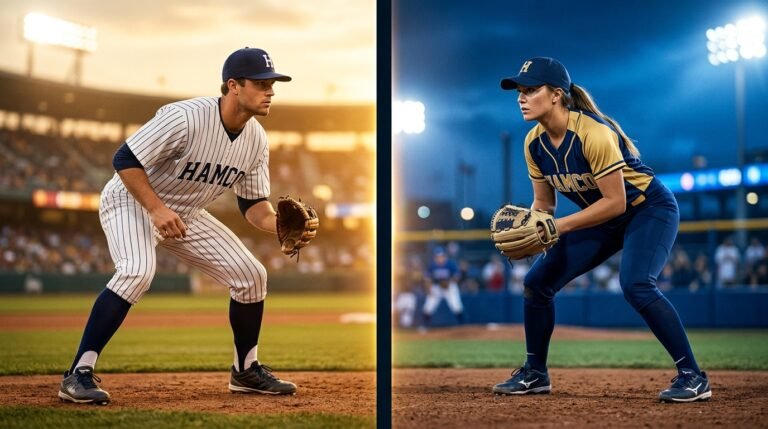
Pants are where the two rule books split. USA Softball allows long pants, shorts or a mix, as long as they are like in color. High school rules require every player’s uniform to be the same color and style, so a high school team can’t mix pants and shorts (pants rules compared, checked November 1, 2026). For the full list of pieces in a set, see what a softball uniform includes.
Before you order, confirm these with your league:
- Which body runs it: NFHS, USA Softball, NSA, USSSA or a local rec department.
- Whether your team plays one format or both. Playing both can mean two uniform sets.
- The number rules, including size and where numbers go.
- The policy on undershirts, compression shorts and belt colors.
- That your catcher’s gear meets your league’s certification standard.
Put your league’s number and color rules in your quote request. Your free mockup comes within 12 hours with unlimited changes, and nothing is made until you approve it.
The Short Version
Fastpitch and slowpitch are not two flavors of the same game, they are two different games wearing the same name. Fastpitch is fast, specialized, and built around pitching, speed, and the running game, and it is the competitive path for girls through high school and college. Slowpitch is contact driven, social, and built around hitting, with ten fielders, little or no stealing, and a lobbed pitch, and it is what most adults actually play. Pick the one that fits your goals, keep your glove, and buy the right bat.
Frequently Asked Questions
What is the difference between fastpitch and slowpitch softball?
Fastpitch uses a fast windmill pitch, nine fielders, and allows base stealing, and it is the competitive game for girls and women. Slowpitch uses a slow lobbed arc, ten fielders, limits or bans stealing, and is mostly adult recreational play.
Can you steal bases in slowpitch softball?
It depends on the league. USA Softball allows it in adult men’s and women’s slow-pitch and boys 18U once the pitch reaches home plate, but not in girls’ youth, boys 16U and under, coed, masters or senior slow-pitch, and many local leagues ban it. Fastpitch allows stealing once the pitch is released.
Can you use a fastpitch bat in slowpitch?
No. Fastpitch and slowpitch bats are certified and built differently, and using the wrong one in sanctioned play is illegal and can get a batter called out. Keep your glove when you switch, but plan to buy the correct bat.
Can you bunt in slowpitch softball?
No. Under USA Softball rules, a slow-pitch batter who bunts or chops the ball is out. Fastpitch allows bunting, though a bunt that goes foul with two strikes is a strikeout.
Are fastpitch and slowpitch balls the same?
Not always. Both are optic yellow with red stitches, but USA Softball’s slow-pitch ball has a livelier .520 limit against .470 for fastpitch. Women’s slow-pitch uses an 11 inch ball; men’s slow-pitch and fastpitch from 12U up use 12 inch.
How many players are on a slowpitch team?
Slowpitch fields ten defensive players, adding a fourth outfielder; some rec leagues use a shallow rover or short fielder instead. Fastpitch fields nine, the same as baseball.
How big is a softball field?
Under USA Softball Rule 2, Section 1 (checked November 1, 2026), fastpitch uses 60 foot bases and pitches from 43 feet for women and girls 14U and up, or 46 feet for men. The fence must be at least 200 feet out for women and girls 12U and up and 225 feet for men. Adult slowpitch uses 70 foot bases, a 50 foot pitching distance and a fence at least 265 feet out for women, 275 for coed and 300 for men.
Which is harder, fastpitch or slowpitch?
They demand different skills. Fastpitch is more physically demanding, with faster pitching, base stealing, and quicker reactions, while slowpitch rewards hitting and placement. Neither is simply harder, but fastpitch is the more athletically intense game.
Switching leagues this year? Our custom softball uniforms come in women’s and men’s cuts for either game, and a real person replies to your quote request within 1 hour, Monday to Saturday, 9am to 6pm ET.
Need just the tops? Our custom softball jerseys can be ordered without pants.


2 thoughts on “Fastpitch vs. Slowpitch: Same Sport, Different Game”
Comments are closed.