
Every coach has lived through it at least once. The season opener is ten days away, and the uniforms are still sitting in a production queue somewhere because the order went in three weeks late. Half the roster has not submitted sizes. The design proof sat in somebody’s email for a week before anyone approved it. And now you are paying rush fees that could have funded new batting helmets.
This is not a rare scenario. It is the single most common uniform-ordering problem across high school, travel, and recreational sports programs in the country. The fix is not complicated—it is a matter of knowing the timeline, working backward from your first game, and following a straightforward team uniform ordering checklist that keeps every step on track.
This guide is built specifically for coaches managing spring sport programs—softball, lacrosse, baseball—where the season starts in March and the ordering window is tighter than most people realize. But the system works for any sport at any level. Follow it once, and you will never scramble for uniforms again.
Why Coaches End Up Ordering Late (And Why It Costs Them)
The root cause is almost always the same: coaches underestimate how many steps sit between “I want to order uniforms” and “uniforms are in my players’ hands.” They assume the process takes a week or two. In reality, a custom uniform order involves design collaboration, mockup revisions, roster-wide size collection, payment processing, production, quality inspection, and shipping. Each of those stages takes real time, and any single delay cascades into the next one.
The second factor is seasonal demand. Manufacturers get slammed with orders in January and February as thousands of spring sport programs all try to beat the March deadline simultaneously. Production queues that take three weeks in October can stretch to five or six weeks in peak season. Coaches who order in December breeze through the process. Coaches who order in February are fighting for a spot in line.
The financial cost of late ordering is real. Rush production fees typically add 20 to 40 percent to an order. Expedited shipping from a domestic facility can add another $100 to $300 depending on roster size. And if the order truly misses the deadline, you end up with players in mismatched practice jerseys for the first two weeks of the season—which is not the first impression any program wants to make.
The Pre-Season Uniform Ordering Timeline: A Month-by-Month Breakdown
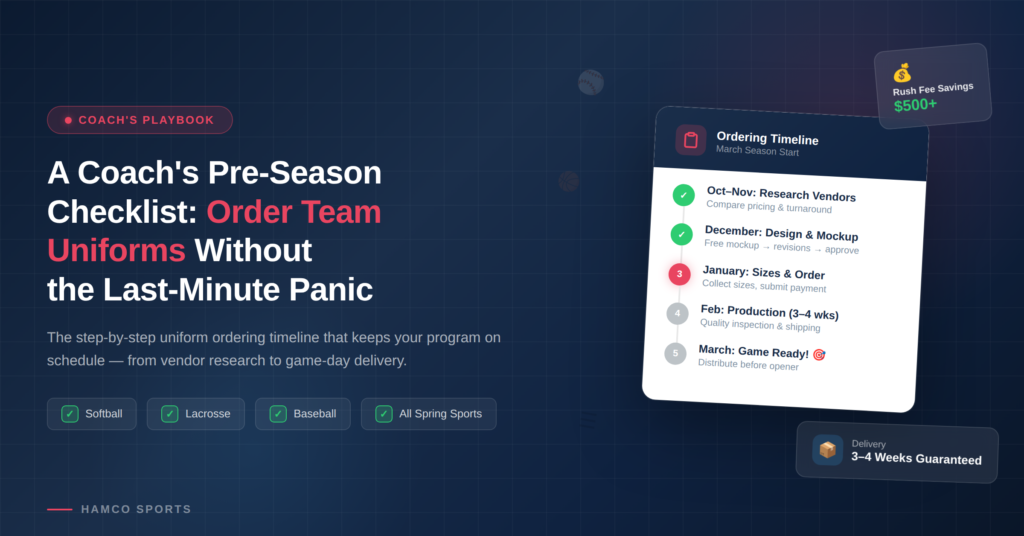
The following uniform ordering timeline is based on a March season start, which applies to most high school and travel softball, lacrosse, and baseball programs. If your season starts earlier or later, shift the dates accordingly, but keep the spacing between steps the same.
| Timeframe | Action Step |
| October–November | Research manufacturers. Compare pricing, turnaround times, customization options, and minimum order requirements. Collect design inspiration from your coaching staff and players. This is the zero-pressure window where smart decisions happen. |
| Early December | Select your manufacturer and initiate the design process. Share your team logo, colors, and any design ideas. Request a free mockup so you can see exactly what the finished product will look like before committing a dollar. |
| Mid-December | Review the first mockup proof. Check logo placement, font choices, number sizing, and color accuracy. Request revisions if anything is off. A good manufacturer offers unlimited revisions at this stage. |
| Late Dec – Early Jan | Finalize the design. Approve the mockup and lock in the look. Simultaneously, start collecting player sizes from your roster using the manufacturer’s specific size chart. |
| Mid-January | Complete size collection from all rostered players. Add 2–3 extra jerseys in common sizes for mid-season roster additions. Confirm your full quantity and submit the order with payment. |
| Late Jan – Mid Feb | Production period. Your uniforms are being printed, cut, stitched, and inspected. A standard custom sublimated order takes 3 weeks from approval. Stay in contact with your rep for status updates. |
| Late February | Uniforms ship. Track the shipment and plan your distribution day. |
| Early March | Uniforms arrive. Distribute to players with at least one week of buffer before the season opener. Handle any last-minute size exchanges if needed. |
The critical takeaway from this uniform ordering timeline is that the process takes roughly four to five months from first research to delivery. That sounds like a lot, but most of that time is low-effort—a few emails, a mockup review, a size-collection spreadsheet. The actual concentrated work takes maybe three to four hours total. The key is spreading it across the right weeks instead of cramming it into a two-week panic in February.
The Complete Team Uniform Ordering Checklist
Print this out and tape it to your office wall. Check off each item as you complete it. This is the exact pre-season uniform planning system that keeps programs on schedule year after year.
Phase 1: Research and Vendor Selection (October–November)
Identify 2–3 manufacturers that specialize in your sport. Compare their production timelines, pricing per piece, customization capabilities, and minimum order requirements. Verify that they offer free design mockups so you are not committing money before seeing what you are getting. Read reviews from other coaches. Contact each vendor with a basic inquiry and pay attention to their response time—a manufacturer that takes four days to reply to a quote request will likely be slow at every other stage too.
Phase 2: Design and Mockup Approval (December)
Share your team logo in the highest resolution file you have (vector formats like .AI or .EPS are ideal, but a high-resolution PNG works with most vendors). Specify your team colors using exact color codes if you have them, or provide a physical sample. Review the digital mockup carefully: check that numbers are legible from the stands, that the logo is centered, that the font matches your program’s existing branding, and that home and away colorways are clearly distinct. Get a second set of eyes on the proof—your assistant coach, athletic director, or a trusted parent.
Phase 3: Size Collection (Late December–January)
This is the step where most delays happen. Chasing down sizes from 15 to 25 players (or their parents) is tedious, and there is always someone who does not respond. Here is how to handle it efficiently: send a digital form (Google Forms works perfectly) with a hard deadline. Include the manufacturer’s size chart as an image directly in the form so nobody has to click a separate link. Follow up once at the halfway mark and once the day before the deadline. For any player who still has not responded, assign them a size based on last year’s uniform or their registration form, and note that exchanges may be needed.
Always order 2–3 extra jerseys in your most common sizes (typically Medium and Large for high school programs, Small and Medium for youth). Mid-season roster changes, damaged jerseys, and growth spurts among younger players are inevitable. Having spares on hand eliminates emergency reorders.
Phase 4: Order Submission and Payment (Mid-January)
Compile your final size breakdown, confirm quantities, and submit the order with payment. If you are working through a school’s purchasing system, factor in an extra one to two weeks for purchase order processing. Many coaches lose time here because they assume the school will process the PO immediately. Submit the paperwork early and follow up with your accounts payable department.
Phase 5: Production Monitoring (Late January–February)
You should receive a production confirmation within 48 hours of payment. If you do not, follow up. Ask for an estimated ship date and mark it on your calendar. A good manufacturer will proactively update you when production is complete and provide tracking information when the order ships. If you are not hearing from them, reach out—silence during production is not a good sign.
Phase 6: Delivery and Distribution (Late February–Early March)
When the uniforms arrive, inspect them immediately. Check a few jerseys at random for print quality, correct sizing labels, and accurate player names and numbers. Organize distribution day at practice—have players try on their jerseys and confirm the fit. If any sizes are off, contact the manufacturer right away to arrange exchanges.
What to Do If You Are Already Behind Schedule
If you are reading this in January or February and have not started yet, you are behind—but you are not out of options. Here is how to compress the timeline without sacrificing quality.
First, choose a manufacturer that specializes in fast turnaround for custom orders. At HAMCO Sports, for example, production runs 3 weeks from approval, and rush options can cut that further. Browse the full range of custom softball uniforms, custom lacrosse uniforms, or custom baseball uniforms to see what is available and start the design conversation immediately.
Second, collapse the design phase by coming to the table with a clear vision. Instead of exploring ten different concepts, give your manufacturer your logo, your two team colors, and a reference image of a jersey style you like. A focused brief means faster mockups and fewer revision rounds.
Third, set a 48-hour size collection deadline with your roster. Send the form, follow up once, and then finalize with your best estimates for anyone who has not responded. Perfect data collection is a luxury you do not have when the calendar is tight. Close enough and a spare jersey or two in reserve will cover you.
Fourth, ask about rush production. Most reputable manufacturers offer expedited timelines for an additional fee. If your custom lacrosse uniforms or baseball gear needs to arrive two weeks earlier than standard, a rush fee of 15–25 percent is generally worth it compared to the alternative of taking the field without matching uniforms.
Choosing the Right Manufacturer: What Coaches Should Prioritize
Not all uniform manufacturers are equal, and making the wrong choice can derail even a well-planned timeline. Here is what to evaluate when selecting a vendor for your program.
Production timeline transparency. The manufacturer should tell you exactly how long production takes—not a vague “a few weeks.” Look for specific commitments like “21 business days from design approval.”
Free design mockups with unlimited revisions. You should never pay to see what your uniforms will look like before ordering. If a manufacturer charges for mockups, find a different one.
No minimum order requirements or low minimums. Not every program has 25 players. You should be able to order 10 jerseys or 50 jerseys at the same quality level.
Sublimation printing as the default method. Sublimated designs are dyed directly into the fabric, so they never crack, peel, or fade—unlike screen-printed or heat-pressed alternatives. For any program that needs uniforms to last more than one season, sublimation is the only method worth considering.
**Responsive communication.** Test this during the quote phase. Send an inquiry and see how fast they respond. At HAMCO Sports, we respond within one hour during business hours because we know coaches are making time-sensitive decisions. Browse our custom baseball uniforms or any sport collection to start a conversation and see the difference firsthand.
Frequently Asked Questions
How far in advance should coaches order team uniforms?
For the smoothest experience, start the research and design process 4–5 months before your season opener. If your season begins in March, that means initial vendor research in October or November and placing the final order by mid-January. This allows comfortable time for design revisions, size collection from your full roster, production, and shipping without needing rush services. Even if you start late, most custom manufacturers can deliver within 3 weeks from approval, so ordering 6–8 weeks out is the minimum safe window.
How long does it take to get custom team uniforms made?
Standard production for fully sublimated custom uniforms typically runs 2–4 weeks from the date your design is approved, sizes are submitted, and payment is processed. Larger or more complex orders may take slightly longer. Shipping adds another 3–5 business days for domestic delivery. During peak ordering seasons—January through March for spring sports—production queues can stretch an extra week, so building buffer time into your timeline is always smart. Rush production is available from most manufacturers for an additional fee.
What is typically included in a team uniform package?
A standard team uniform package for softball, lacrosse, or baseball usually includes game jerseys (often home and away sets) and matching pants or shorts. Many programs also add coordinated socks, belts, caps or visors, warm-up jackets, and team bags to complete the look. The more items you bundle into a single order, the better your per-piece pricing tends to be. Always ask your manufacturer about package discounts—most offer them, and they can save several hundred dollars on a full roster order.
How many extra uniforms should I order beyond my current roster?
A good rule is 2–3 extra jerseys in your most common sizes (typically Medium and Large for high school, Small and Medium for youth). These cover mid-season roster additions, damaged or lost uniforms, and growth spurts among younger players. Some coaches also order one complete backup set for emergency situations. The small upfront cost of a few extra pieces is far less than the cost and delay of placing a separate reorder mid-season.
What is the best way to collect accurate sizes from an entire team?
Use a digital form—Google Forms or a simple shared spreadsheet—with a clear, non-negotiable deadline. Embed the manufacturer’s size chart directly into the form so players or parents can reference it immediately. Send the form at least two weeks before your ordering deadline, with a reminder halfway through and a final nudge the day before. For players who do not respond, use their previous season’s uniform size as a fallback. It is better to submit a complete order on time with a few estimated sizes than to delay the entire order waiting for one or two responses.
What is the difference between sublimation and screen printing for team jerseys?
Sublimation uses heat to bond dye directly into polyester fabric at a molecular level. The design becomes part of the fabric itself, which means it will never crack, peel, fade, or add weight to the jersey—no matter how many washes it goes through. Screen printing, by contrast, layers ink on top of the fabric surface. Over time and repeated washing, screen-printed designs tend to crack, peel, and degrade. For any team program expecting uniforms to last more than one season, sublimation is the clear winner in terms of durability and long-term value.
Can I order replacement jerseys mid-season that match my existing set? Yes, but only if your manufacturer keeps your design on file. This is one of the most important questions to ask before placing your initial order. Reputable manufacturers save your approved design, color codes, and logo files so that any future reorder—whether it is one jersey or twenty—matches the original batch exactly. Manufacturers with no minimum order requirements make mid-season replacements especially easy, since you can order a single piece without being forced into a bulk minimum.

1 thought on “A Coach’s Pre-Season Checklist: How to Order Team Uniforms Without the Last-Minute Panic”