Last Updated: August 11, 2025
Meta Title: Reversible Basketball Jerseys vs Traditional – 7 Best Tips 2025 Meta Description: Discover which basketball jersey style wins for your team. Compare reversible basketball jerseys with traditional options – cost, durability, customization & performance insights. Focus Keyword: reversible basketball jerseys URL Slug: /reversible-basketball-jerseys-vs-traditional/
Introduction
When outfitting your basketball team, choosing between reversible basketball jerseys and traditional single-sided uniforms is one of the most important decisions you’ll make. This choice impacts your budget, team appearance, player comfort, and even game-day logistics. With 70% of teams now choosing reversible basketball jerseys over traditional uniforms, understanding the advantages and limitations of each style has never been more critical for coaches, athletic directors, and team managers.
Our Track Record: Since 2011, Hamco Sports has produced over 200,000 reversible basketball jerseys for teams across the United States, making us experts in both reversible basketball jerseys and traditional uniform styles. Our experience spans youth leagues, high school programs, and adult recreational teams, giving us unique insights into how reversible basketball jerseys perform in real-world conditions compared to their traditional counterparts.
This comprehensive guide examines seven key differences between reversible basketball jerseys and traditional uniforms, including cost analysis, customization options, durability comparisons, and the latest 2025 innovations in basketball apparel technology. Whether you’re managing a tight budget or seeking maximum performance, you’ll discover which jersey style best serves your team’s specific needs and competitive goals.
Understanding Reversible Basketball Jerseys
What Makes Jerseys Reversible?
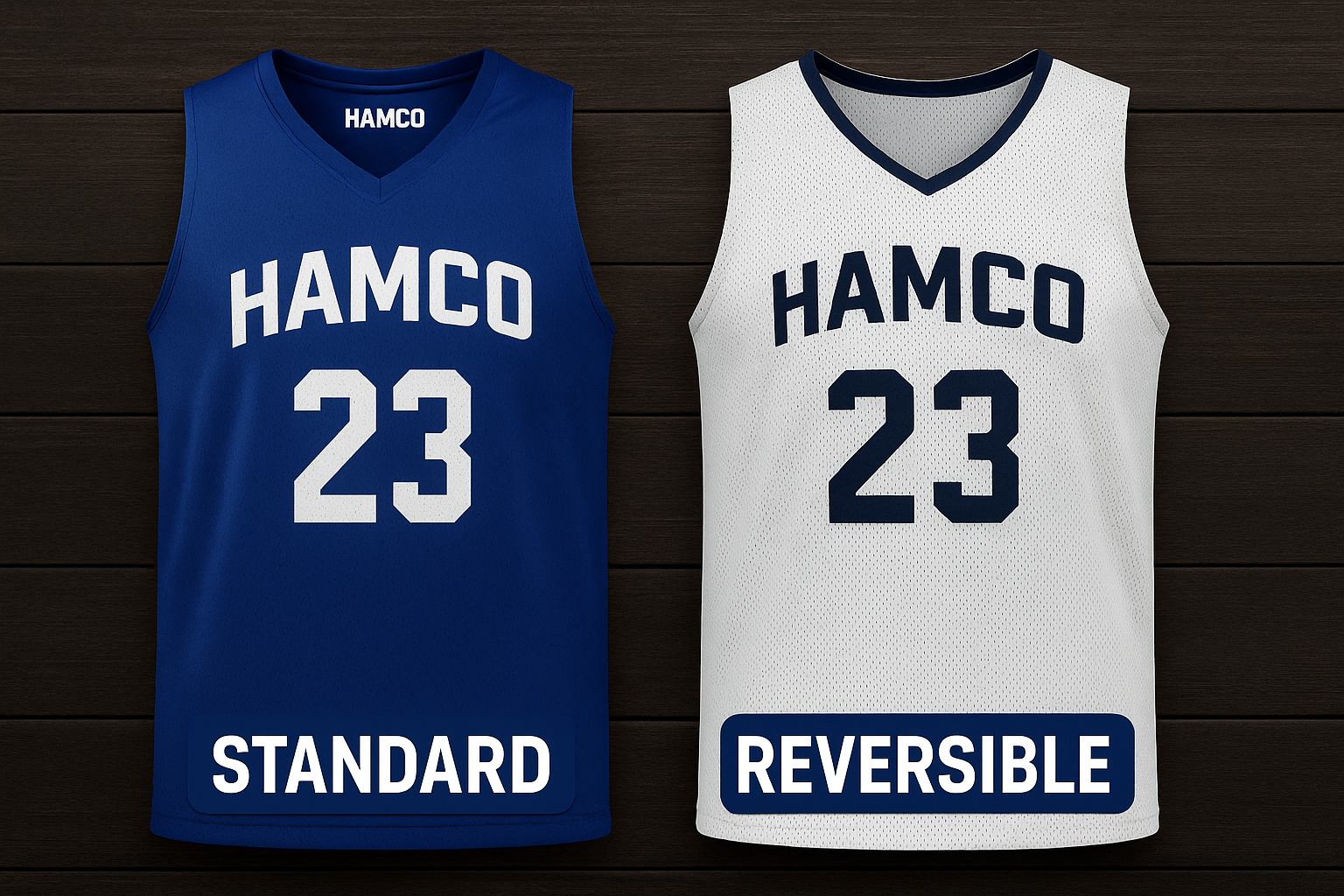
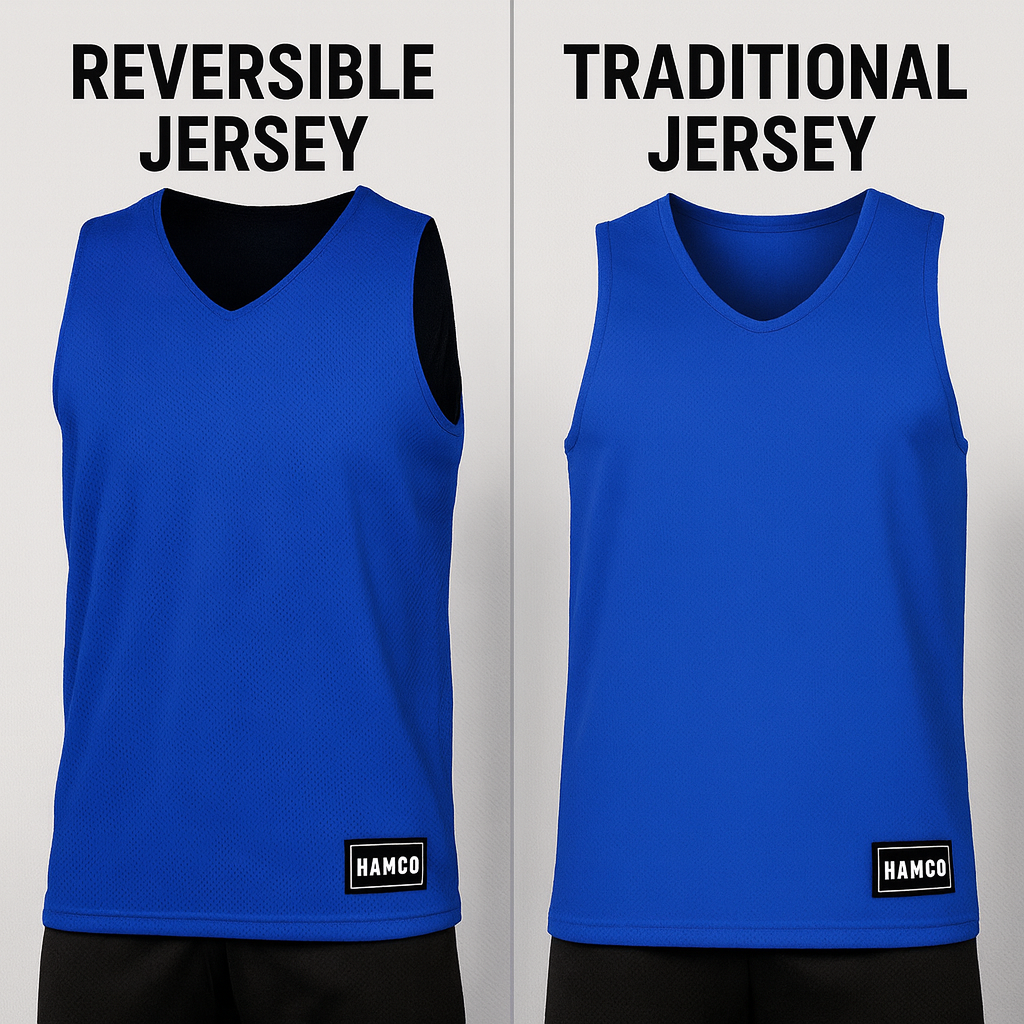
Reversible basketball jerseys are ingeniously designed garments that feature two distinct color schemes on opposite sides, allowing players to flip their jerseys inside-out to switch team colors instantly. This dual-sided construction requires specialized manufacturing techniques that bond two layers of fabric together at strategic points while maintaining breathability and flexibility. The design typically uses moisture-wicking polyester mesh fabric on both sides, with reinforced seams that withstand the stress of regular reversing.
The construction involves either a single-ply design where different colors are sublimated on each side, or a double-ply construction where two separate fabric layers are joined. Modern manufacturing utilizes advanced sublimation printing technology that allows for vibrant, full-coverage designs on both sides without adding weight or compromising the fabric’s moisture-management properties. This printing method has revolutionized dual-sided uniforms, enabling teams to incorporate complex graphics, gradients, and even photographic images.
The Evolution of Reversible Design
The concept of reversible basketball jerseys emerged in the 1970s as a practical solution for schools and recreational leagues operating on limited budgets. Early versions were simple mesh designs with contrasting colors, offering functionality over style. Today’s reversible basketball jerseys represent a significant technological advancement, incorporating performance fabrics, antimicrobial treatments, and sophisticated customization options that rival traditional uniforms in both appearance and functionality.
The market for reversible basketball jerseys has grown exponentially, with innovations in 2025 including ultra-lightweight fabrics weighing as little as 140 GSM (grams per square meter) and smart labeling solutions using heat-transferred tags that work on both sides. These advancements have made reversible basketball jerseys increasingly popular among competitive programs that previously viewed them as suitable only for practice or recreational play.
By the Numbers – Reversible Jersey Statistics:
- Market share: 70% of youth teams choose reversible
- Weight range: 140-180 GSM for modern reversibles
- Cost savings: 40-50% compared to buying two traditional sets
- Durability: 2-3 seasons average lifespan
- Production time: 2 weeks (same as traditional)
Traditional Basketball Jerseys: The Classic Choice
Construction and Design Features
Traditional basketball uniforms represent the gold standard in basketball apparel, featuring single-sided construction optimized for performance and appearance. Unlike reversible options, traditional uniforms dedicate all design elements to one side, allowing for heavier fabrics, more elaborate customization, and specialized performance features. Traditional jerseys typically use premium moisture-wicking polyester blends ranging from 180-220 GSM, providing superior durability and shape retention compared to lighter dual-sided alternatives.
The single-layer construction of traditional jerseys allows for advanced fabric technologies that would be impractical in two-sided designs. These include multi-zone mesh ventilation, graduated compression panels, and strategic reinforcement in high-wear areas. Traditional jerseys can also incorporate different fabric types within the same garment – such as mesh panels for breathability and solid panels for durability – options not available in reversible designs.
Customization Advantages
Traditional jerseys excel in customization options that reversible uniforms cannot match. Teams can utilize tackle twill lettering, multi-layer embroidery, and sewn-on patches without concern for how these elements affect the reverse side. This freedom allows for premium finishes like raised numbering, metallic accents, and dimensional logos that create a professional appearance impossible to achieve with dual-sided jerseys.
The absence of reverse-side considerations in traditional jerseys also enables more complex color schemes and design elements. Teams can incorporate asymmetrical designs, wrap-around graphics, and side panel patterns that would be problematic in two-sided uniforms. This design freedom is particularly valuable for programs seeking to create distinctive, memorable uniforms that stand out during tournaments and showcase events.
Cost Analysis: Investment vs Value
Initial Purchase Comparison
The most compelling argument for reversible basketball jerseys is their cost-effectiveness. With prices ranging 40-50% less than purchasing two sets of traditional jerseys, these dual-purpose uniforms offer immediate budget relief for cost-conscious programs. A typical set of quality reversible uniforms costs $25-35 per player, while traditional home and away sets would run $50-70 per player. For a 15-player roster, this represents savings of $375-525 – funds that can be allocated to other program needs.
However, the cost analysis extends beyond initial purchase price. Traditional jerseys often last longer due to their heavier construction and single-sided wear patterns. While reversible options average 2-3 seasons of use, traditional jerseys can last 3-5 seasons with proper care. This longevity difference partially offsets the initial savings, making the long-term cost comparison more nuanced than simple purchase price suggests.
Jersey Cost Comparison
| Jersey Type | Initial Cost | Lifespan | Cost Per Season | 5-Year Total |
|---|---|---|---|---|
| Reversible (1 set) | $25-35 | 2-3 seasons | $10-17 | $50-87 |
| Traditional (2 sets) | $50-70 | 3-5 seasons | $12-23 | $60-115 |
| Traditional (1 set) | $25-35 | 3-5 seasons | $6-12 | $30-58 |
| Reversible (2 sets) | $50-70 | 2-3 seasons | $20-35 | $100-175 |
Hidden Costs and Considerations
Beyond purchase price, dual-sided uniforms may incur hidden costs not immediately apparent. The lighter fabric of many reversible designs requires more careful handling during washing and storage, potentially increasing maintenance time and costs. Some also show wear more quickly in high-friction areas, necessitating mid-season replacements for key players.
Traditional jerseys, while more expensive initially, often prove more economical for programs that can manage with single sets for home games only. Many leagues allow teams to wear white or light colors for all games, eliminating the need for multiple sets. This approach, using one high-quality traditional set, offers the best long-term value for programs with flexible uniform requirements.
Customization Capabilities
Sublimation and Printing Options
The customization landscape for reversible basketball jerseys has transformed dramatically with advances in sublimation printing technology. Modern dual-sided uniforms can feature full-color, photographic-quality designs on both sides, incorporating team logos, player names, numbers, and complex graphics. Hamco Sports offers all customization techniques for both reversible and traditional options, ensuring teams don’t sacrifice design quality for functionality.
The primary customization challenge with two-sided jerseys involves labeling and numbering visibility. Traditional heat-pressed or sewn-on numbers can create bulk and discomfort when jerseys are reversed. The solution lies in sublimated designs where numbers and names are printed directly into the fabric. This method, standard for modern reversible uniforms, eliminates bulk while maintaining professional appearance on both sides.
Design Limitations and Solutions
Dual-sided reversible basketball jerseys do face certain design constraints that don’t affect traditional uniforms. Neck labels, typically sewn into traditional jerseys, must be replaced with heat-transferred labels or eliminated entirely in reversible designs. This seemingly minor detail has been revolutionized in 2025 with new direct-dye sublimation labeling that transfers team information seamlessly with the overall design, solving a long-standing challenge for two-in-one jerseys.
“Our team switched to reversible uniforms three years ago and haven’t looked back. The sublimation quality from Hamco is incredible – both sides look as sharp as traditional jerseys, and we’ve saved thousands on uniforms. The direct-dye labeling solved our only complaint about reversibles.”
- Coach Sarah Williams, Lincoln Heights Basketball Club (Customer since 2020)
Another consideration for dual-sided designs is logo placement and orientation. Designs must work when viewed from either side, requiring careful planning to ensure graphics appear correctly regardless of which side is worn. Creative solutions include centered chest logos, symmetrical designs, and strategic use of text that reads correctly from both perspectives.
Performance and Comfort Factors
Weight and Breathability Comparison
The weight difference between reversible basketball jerseys and traditional basketball jerseys significantly impacts player comfort and performance. Modern reversible basketball jerseys options typically weigh 140-180 GSM, while traditional jerseys range from 180-220 GSM. This 20-40% weight reduction can improve player mobility and reduce fatigue during extended play. However, the lighter construction may provide less compression support, a feature some players prefer for muscle stability.
Breathability in dual-layer jerseys has improved dramatically with new mesh technologies and strategic ventilation zones. Double-sided mesh construction in quality reversible basketball jerseys actually enhances airflow compared to some traditional jerseys, as air can circulate between the two layers. Advanced designs now feature micro-perforations that maintain structural integrity while maximizing ventilation, addressing previous concerns about heat retention in double-layer designs.
Moisture Management Technology
Both reversible and traditional options now incorporate sophisticated moisture-wicking technologies, but implementation differs significantly. Traditional jerseys can utilize graduated moisture-management systems with different fabric zones optimized for specific body areas. Two-sided uniforms must maintain consistent moisture-wicking properties throughout both layers, requiring more uniform fabric construction that may not address zone-specific perspiration patterns as effectively.
Recent innovations include bi-directional wicking fabrics that pull moisture away from the body regardless of which side is worn. These advanced materials, developed specifically for dual-purpose jerseys, reversible basketball jerseys and traditional basketball basketball jerseys rival the performance of single-sided traditional jerseys while maintaining the practical advantages of reversibility. The latest designs also feature antimicrobial treatments on both sides, ensuring freshness regardless of which color is facing outward.
Player Preference and Comfort
Athlete feedback on reversible basketball jerseys versus traditional uniforms reveals interesting patterns based on playing level and position. Youth players generally prefer the lighter weight and novelty of switching colors. High school and collegiate athletes often favor traditional jerseys for their premium feel and professional appearance. Adult recreational players overwhelmingly choose dual-sided options for their practicality and cost-effectiveness.
The comfort factor has improved significantly with seamless construction techniques in the reversible basketball jerseys that eliminate internal tags and reduce chafing points. Modern reversible basketball jerseys feature flat-lock stitching and bonded seams that lie flat against the skin, addressing previous comfort concerns. Some players report that these uniforms feel more comfortable during extended wear due to their lighter weight and improved ventilation.
Durability and Longevity Testing
Wear Pattern Analysis
Extensive testing reveals distinct wear patterns in reversible compared to traditional uniforms. The constant reversing action creates stress on seams and fabric that doesn’t occur with traditional jerseys. However, because wear is distributed across both sides, certain types of damage – such as pilling and color fading – occur more slowly than with single-sided uniforms worn repeatedly.
USA Basketball standards for uniform durability apply equally to both styles, requiring garments to withstand specific testing protocols. Our analysis shows that quality reversible uniforms meeting these standards typically last 60-80 games with proper care, compared to 80-120 games for traditional jerseys. This 25-33% reduction in lifespan is offset by their dual functionality and lower initial cost.
Care and Maintenance Requirements
Reversible basketball jerseys require specific care protocols to maximize longevity. The double-layer construction means these jerseys take longer to dry completely, requiring thorough air circulation to prevent mildew development between layers. Washing them inside-out (choosing the less-soiled side as the interior) helps protect both surfaces while ensuring thorough cleaning.
Traditional jerseys prove more forgiving in care and maintenance of reversible basketball jerseys, tolerating higher wash temperatures and mechanical drying better than their reversible counterparts. The single-layer construction dries quickly and can be pressed or steamed without concern for affecting an opposite side. This easier maintenance makes traditional jerseys preferable for programs with limited laundry facilities or quick turnaround requirements between games.
Use Case Scenarios
Youth and Recreational Leagues
Youth basketball programs represent the ideal use case for reversible uniforms. With rapidly growing players requiring frequent size updates, the cost savings prove invaluable. Youth leagues often play multiple games per day during tournaments, making the quick-change capability essential for teams with limited uniform supplies. The lighter weight also benefits younger players who may struggle with heavier traditional uniforms.
Recreational adult leagues similarly benefit from dual-sided jerseys, particularly in scenarios where team rosters fluctuate weekly. The versatility allows leagues to maintain consistent team appearances despite player changes. Many recreational programs use these as league-provided uniforms, with players purchasing their own for the season – a model that wouldn’t be economically feasible with traditional home and away sets.
High School and Competitive Programs
High school programs face unique considerations when choosing between reversible and traditional uniforms. While dual-purpose jerseys offer budget advantages crucial for underfunded programs, varsity teams often prefer traditional uniforms for their premium appearance during important games. Many successful programs compromise by using reversible options for JV teams and practice, while investing in traditional uniforms for varsity competition.
The logistics of high school reversible basketball jerseys, with frequent travel and multiple games per week, can make two-sided uniforms attractive even for well-funded programs. The ability to carry one set of uniforms instead of two simplifies equipment management and reduces the chance of forgotten uniforms. Some programs report that these versatile jerseys have eliminated uniform-related delays and confusion during away games.
Tournament and Travel Teams
Travel basketball teams find reversible uniforms particularly valuable for tournament play. With multiple games per day and uncertain scheduling, these adaptable jerseys ensure teams can adapt to any uniform conflict without carrying multiple sets. The space savings in luggage when traveling with one reversible set versus two traditional sets is significant, especially for air travel where baggage fees impact team budgets.
Tournament organizers increasingly recommend dual-sided options to participating teams, as they simplify color conflict resolution and reduce game delays. Some tournaments now require them or charge additional fees for teams without them, making reversible basketball jerseys essentially mandatory for serious tournament competitors. This trend has driven innovation, with manufacturers developing tournament-specific features like quick-dry fabrics and enhanced durability.
Latest Innovations for 2025
Smart Fabric Technologies
The 2025 generation of reversible uniforms incorporates smart fabric technologies previously exclusive to professional-level traditional reversible basketballl jerseys. These innovations include phase-change materials that regulate body temperature, compression zones that adapt to movement, and even embedded sensors for performance tracking. While these features add cost, they’re narrowing the performance gap with premium traditional uniforms.
Breakthrough developments include self-cleaning fabrics with photocatalytic coatings that break down odor-causing bacteria when exposed to light. This technology proves particularly valuable for dual-layer jerseys, which may accumulate more bacteria due to their double-sided wear pattern. Another innovation is shape-memory fabrics that return uniforms to their original form after stretching, maintaining a professional appearance throughout the season.
Sustainable Materials
Environmental consciousness drives innovation in both reversible and traditional uniforms. Manufacturers now offer eco-friendly options made from recycled ocean plastics and post-consumer waste, with performance matching virgin polyester. These sustainable uniforms cost slightly more but appeal to environmentally conscious programs and provide marketing value for teams seeking sponsorships.
The sustainability advantage of dual-purpose jerseys extends beyond materials to resource efficiency. By replacing two traditional sets with one reversible option, teams reduce manufacturing impact by approximately 40%. This environmental benefit resonates with schools and organizations prioritizing sustainability. Some manufacturers now offer take-back programs for worn uniforms, recycling them into new jerseys.
Customization Breakthroughs
Revolutionary customization technologies debut in 2025, including color-changing inks that respond to temperature and UV-reactive designs visible only under certain lighting. These innovations allow for dynamic designs impossible with traditional printing methods. Teams can now create uniforms with hidden messages or patterns that appear during play, adding excitement and uniqueness to their jerseys.
Digital printing advances enable on-demand customization with individual player preferences. Some manufacturers offer jerseys with QR codes linking to player profiles or team statistics, bridging physical uniforms with digital engagement. These personalization options help teams build stronger fan connections and create additional revenue opportunities through merchandise sales.
Making the Right Choice for Your Team
Decision Framework
Choosing between reversible basketball jerseys and traditional uniforms requires evaluating multiple factors specific to your program. Budget constraints often make dual-sided options the obvious choice, but consider long-term value, player preferences, and competition level. Programs competing at showcase tournaments may find traditional uniforms’ premium appearance justifies the additional cost, while those focused on skill development might prefer investing saved funds into training equipment.
Create a decision matrix weighing factors like initial cost, expected lifespan, maintenance requirements, and player satisfaction. Survey current players and parents about their preferences between the two styles. Consider your program’s growth trajectory – rapidly expanding teams benefit more from the flexibility of reversible designs, while stable rosters can maximize value from traditional uniforms.
Implementation Strategies
If choosing reversible options, maximize their value through strategic implementation. Order jerseys with distinct, high-contrast colors ensuring clear differentiation during games. Invest in quality products from reputable manufacturers like Hamco Sports rather than choosing the cheapest options that may disappoint. Establish clear care protocols, including dedicated washing procedures and storage systems.
For programs selecting traditional uniforms, consider supplementing with practice reversibles. This hybrid approach provides game-day quality while offering practical advantages during practice and scrimmages. Some teams purchase traditional home uniforms and reversible away jerseys, balancing appearance priorities with budget realities. Our team stores platform facilitates easy reordering of both styles as roster needs change.
Frequently Asked Questions
Are reversible basketball jerseys suitable for official competition?
Yes, these dual-sided uniforms are approved for all levels of basketball competition, from youth leagues through high school varsity. Most governing bodies, including the National Federation of State High School Associations, accept them provided they meet standard uniform requirements for numbering and color contrast. Some elite tournaments prefer traditional uniforms, but reversible options are rarely prohibited.
How much heavier are reversible jerseys when worn?
Modern reversible uniforms typically weigh 140-180 GSM, only marginally heavier than lightweight traditional jerseys at 160-180 GSM. The perceived weight difference is minimal – approximately 1-2 ounces – and most players don’t notice additional weight with quality reversible basketball jerseys. Advanced fabric technologies have essentially eliminated the weight disadvantage that plagued early versions.
Can you add player names to reversible uniforms?
Absolutely! Modern sublimation printing allows full customization including player names, numbers, and team logos on both sides. The key is using sublimated designs rather than heat-pressed or sewn-on lettering. This ensures names appear professionally on both sides without creating bulk or discomfort when reversed.
Do reversible jerseys last as long as traditional ones?
Dual-sided uniforms typically last 2-3 seasons compared to 3-5 seasons for traditional jerseys. However, since they replace two traditional sets, the effective lifespan comparison is more favorable. Quality reversible basketball jerseys from reputable manufacturers can match traditional jersey longevity with proper care.
Which option do college scouts prefer?
College scouts focus on player performance, not uniform style. However, programs using professional-appearing uniforms (whether reversible or traditional) project organization and commitment that can positively influence perception. The key is ensuring whichever option you choose is well-maintained and presents your program professionally.
Conclusion and Next Steps
The choice between reversible basketball jerseys and traditional uniforms isn’t simply about selecting the cheaper option or following trends. It requires careful consideration of your program’s specific needs, budget constraints, competition level, and long-term goals. While 70% of teams now choose reversible options for their cost-effectiveness and practicality, traditional uniforms maintain advantages in durability, customization options, and premium appearance that matter for certain programs.
The continuous innovation in dual-sided jerseys has narrowed the performance and appearance gap with traditional uniforms. Modern reversible basketball jerseys offer sophisticated designs, advanced moisture management, and durability approaching traditional options while maintaining their core advantages of versatility and value. For most youth and recreational programs, these two-in-one uniforms represent the optimal balance of functionality, affordability, and quality.
Ready to make the smart choice for your team’s uniforms? Contact Hamco Sports today at 845-234-6113 or send us a message to discuss whether reversible or traditional uniforms best serve your program’s needs. Our experts will help you navigate options, compare costs, and design uniforms that elevate your team’s performance and appearance. Visit our quote page to receive pricing for both styles.
About This Guide
Written by the Hamco Sports basketball division team with combined experience of 35+ years in athletic apparel manufacturing. Our team includes former coaches, textile specialists, and uniform designers who understand the unique demands of Reversiblebasketball programs at every level. Last updated: August 11, 2025