Your team’s jerseys are going to take a beating. Grass stains, machine washes, sweat, sun. A good uniform has to survive all of it and still look sharp on game day. That’s exactly why sublimation printing has become the go-to method for serious sports teams.
Quick Answer Sublimation printing is a process where heat turns special ink into a gas that permanently bonds with polyester fibers. The result: vibrant, full-color designs that don’t crack, peel, or fade, even after hundreds of washes. It’s the standard for custom sports jerseys because the design becomes part of the fabric, not just a layer sitting on top of it.
So what is sublimation printing, exactly? Here’s what every coach and team manager should know.
What Is Sublimation Printing, Really?
Most printing methods put ink on fabric. Sublimation printing puts ink in fabric.
Here’s what actually happens: a design is printed onto special transfer paper using sublimation ink. That paper is then pressed against the fabric under high heat (around 400°F / 204°C) and pressure. At that temperature, the ink skips the liquid stage entirely. It converts straight from solid to gas. Those gas molecules bond with the polyester fibers at a molecular level.
When it cools down, the ink is locked inside the fabric. There’s no layer on top. No texture. No edge to peel away. Just color that’s permanently part of the garment itself.
That’s what sublimated means, from the chemistry term for a substance converting directly from solid to gas. When someone describes a jersey as “sublimated,” they mean the design was applied through this process.
Why Sports Teams Choose Sublimation
Most printing methods weren’t built for athletic wear. Screen printing lays ink on top of fabric, which works fine for a casual t-shirt. But put that jersey through a season of weekly practices and washes? The ink starts to crack. The numbers peel at the edges. By spring, your team looks like they raided a thrift store.
Sublimation solves this because there’s nothing to crack or peel. The design is in the fabric, not on it.
For team sports, that matters for a few more reasons:
Full-color designs with no limits. Traditional printing methods charge more for each color you add, and gradients are nearly impossible. With sublimation, a gradient that fades from navy to white costs the same as a solid block of color. Your full team logo, every shade and every detail, prints exactly as designed.
Lightweight and breathable. Because there’s no ink layer sitting on top of the fabric, sublimated jerseys stay lightweight. There’s no stiff patch on the chest, no heavy numbering on the back. Players don’t notice the print at all. That’s exactly what you want.
Durability that outlasts the season. A sublimated jersey washed 200 times looks nearly identical to one washed twice. That matters for youth leagues where the same uniforms might be reused across multiple seasons, or for travel teams that wash gear constantly on the road.
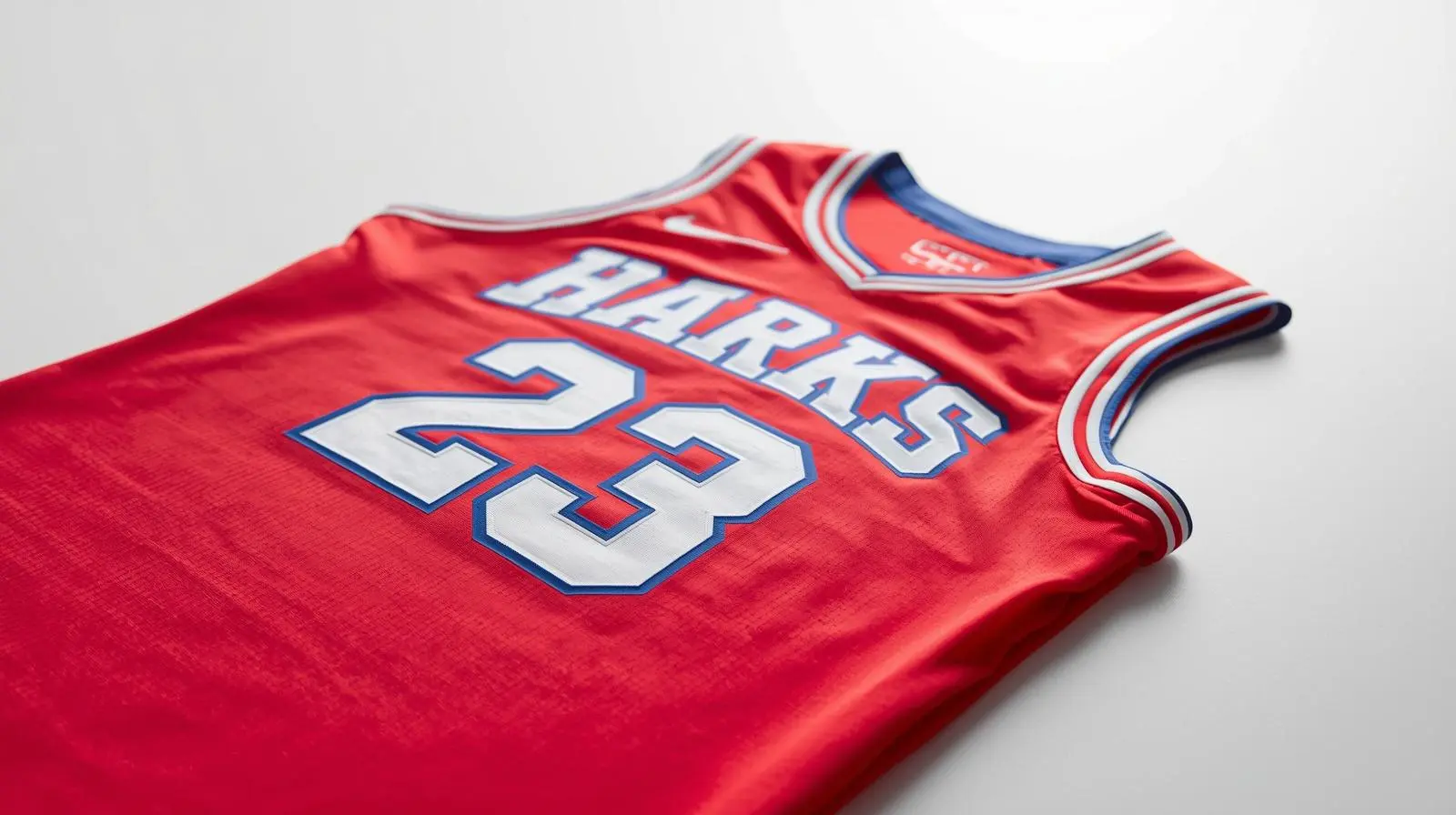
Take custom basketball uniforms as an example, fully sublimated graphics, no cracking, no peeling, even after a full season of weekly washes.
What Are Sublimation Shirts (and What Aren’t)?
A sublimation shirt, or any sublimated garment, is one where the design has been applied using this heat-transfer process. The term gets used loosely, so here’s what to actually look for:
The fabric must be polyester (or at least polyester-blend). Sublimation ink only bonds with synthetic fibers. On cotton, the ink doesn’t have anything to grip, so you’ll get a faded, washed-out print that degrades fast. This is the single most common mistake teams make when ordering: they choose a fabric blend that’s too low in polyester content and wonder why the colors look dull.
The standard for quality sublimation is 100% polyester. Some suppliers use blends of 80–90% polyester and still get excellent results. Below that, print quality drops significantly.
The fabric must also be light-colored, ideally white. Sublimation ink is transparent. It tints the fabric rather than coating it. On a white jersey, red prints as a clean, vivid red. On a dark navy jersey, that same red becomes almost invisible. If you need dark base colors, a good supplier will design around this by using dark fabric for the body and sublimation for lighter accent panels, for example.
Not a traditional sport? Sublimation covers that too. Take a look at Hamcospo’s custom esports jersey designs on Pinterest to see what’s possible for gaming teams and esports organizations.
Sublimated Jerseys vs. Screen-Printed Jerseys
You’ll often have to choose between these two when ordering team uniforms. Here’s the honest comparison:
| Feature | Sublimation | Screen Printing |
| Durability | Excellent, won’t crack or peel | Good initially, degrades over time |
| Color range | Unlimited, including gradients | Limited by number of screens |
| Best for | Polyester athletic wear | Cotton casual wear |
| Minimum order | Usually 1–6 pieces | Often 12–24+ pieces |
| Feel on fabric | None, completely smooth | Slight texture from ink layer |
| Dark base fabrics | Difficult | Works well |
For most sports teams ordering custom uniforms, sublimation wins on almost every count. The one case where screen printing makes more sense: cotton fan gear or casual team apparel where you want a vintage or worn-in look.
If sublimation sounds like the right fit for your team, start with Hamcospo’s custom uniform ordering page and get a free design proof before you commit.
Note: At Hamcospo, there’s no minimum order on any custom sublimated uniform, and every order comes with a free design mockup in 6 to 12 hours.
One Thing Most Articles Won’t Tell You
Every guide on sublimation printing talks about the process. What they skip is what to actually look for when a supplier says they use sublimation.
Ask these two questions before you place your order:
1. What’s the polyester content of the blank?
A supplier using 65% polyester and calling it “sublimation printing” is technically correct, but your colors will be noticeably duller than a 100% poly garment. Get this number in writing.
2. Do you print edge-to-edge?
True full sublimation prints across seams, onto every panel, all the way to the edge of the fabric, before cutting and sewing. This gives you that seamless, pro look. Some suppliers print post-sewing, which means you’ll see design breaks at the seams. It’s a subtle difference, but it’s the difference between a uniform that looks custom and one that looks like a heat transfer sticker.
At Hamcospo, every jersey is cut-and-sew sublimation, designed and printed before assembly so the design flows continuously across the entire garment.
Ready to Order Sublimated Jerseys for Your Team?
Now that you know what sublimation printing actually is, you’re in a much better position to order confidently. The short version: if you want uniforms your team will still be proud of at the end of a tough season, sublimation is the right call.
Hamcospo specializes in fully sublimated custom sports uniforms for teams of all sizes, from youth leagues to competitive travel teams. No minimums on most orders, free design proofs, and turnaround times that work with your schedule.
Get a free custom uniform quote at hamcospo.com
Frequently Asked Questions
What does sublimated mean on a jersey?
A sublimated jersey is one where the design was applied using sublimation printing, a heat-transfer process where ink bonds permanently with the polyester fibers. The design becomes part of the fabric rather than sitting on top of it, making it highly durable and resistant to cracking or fading.
What are sublimation shirts?
Sublimation shirts are garments, typically polyester or polyester-blend, where graphics and colors have been applied through the sublimation printing process. They’re common in sportswear because the process produces vibrant, long-lasting prints that don’t add weight or texture to the fabric.
Can you do sublimation printing on dark jerseys?
Sublimation printing works best on white or very light-colored fabric because the ink is transparent and tints the base color. For dark jersey colors, reputable suppliers design around this by using dark fabric for certain panels and sublimated panels for graphic elements, but you can’t print light colors directly onto dark fabric using sublimation alone.
What does sublimated jerseys mean in team sports?
In team sports, “sublimated jerseys” simply means the uniforms were produced using sublimation printing rather than screen printing or heat transfers. It’s become a quality signal. Teams that want durable, full-color custom uniforms typically specify sublimation.
Is sublimation printing the same as dye sublimation?
Yes. Dye sublimation and sublimation printing refer to the same process. “Dye sublimation” is the more technically precise term. It describes how the dye molecules convert from solid to gas and bond with the fabric, but in the sportswear industry, the two terms are used interchangeably.