If you have ever wondered how to start a youth flag football program, you are already in the right place. Flag football is one of the fastest-growing youth sports in the country, and for good reason. It is safe, inclusive, affordable, and loaded with fun for kids of all athletic abilities. Whether you are a parent who stepped up to coach your child’s team or a community organizer building something from the ground up, this guide walks you through every step of the process. Before you blow your first whistle, you will also want to make sure your team looks the part. Check out these custom flag football uniforms to give your players a sense of identity and team pride from day one. Now, let’s get into everything you need to know.
Why Youth Flag Football Is Growing So Fast
Youth flag football participation has surged over the past decade. Parents love it because it removes the collision risk of tackle football while still teaching kids real football fundamentals. Schools and community organizations love it because it requires minimal equipment and is easy to set up. Kids love it because it is fast-paced, action-packed, and everyone touches the ball.
Beyond the sport itself, youth flag football teaches life skills. Kids learn teamwork, discipline, communication, and how to handle both wins and losses with grace. As a new coach, you are not just teaching football. You are helping shape young people. That is a big responsibility, and this guide takes it seriously.
How to Start a Youth Flag Football Program: Step-by-Step
Starting a youth program might feel overwhelming at first. Break it down into manageable steps and it becomes very achievable. Here is your complete roadmap.
Step 1: Define Your Program Goals
Before anything else, get clear on what you want this program to achieve. Are you coaching recreational players who just want to have fun on Saturday mornings? Or are you building a more competitive travel team that plays in tournaments? Your goals will shape every decision you make going forward, from how you run practices to how you set up your flag football league.
Write down answers to these questions before you move on:
- What age group will you be coaching? (typically 5-7, 8-10, 11-14)
- Is the priority fun and participation, or competitive development?
- How many kids do you expect to have on your roster?
- How many days per week will you practice?
- Will you enter an existing league or create your own?
Step 2: Register, Get Certified, and Handle the Paperwork
This is the part many new coaches skip, and it can cause major headaches later. Take care of the administrative side of your program early.
USA Football and the NFL Flag program both offer coaching certifications that are free or low cost. Getting certified not only gives you credibility with parents, it genuinely makes you a better coach. You will learn age-appropriate practice structures, player safety protocols, and how to manage a team effectively.
On the paperwork side, make sure you have:
- Player registration forms with parent signatures
- Medical release forms and emergency contact information
- Liability waivers appropriate for your state or municipality
- Background checks completed for all coaches and volunteers
- Proof of insurance if you are running an independent program
Step 3: Secure Your Field and Equipment
One of the best things about flag football is that your equipment list is short and relatively affordable. A standard flag football field is 70 yards long and 30 yards wide, though you can adjust dimensions for younger age groups. Many public parks, school grounds, and recreation centers will allow you to reserve field time at low cost.
Here is your basic equipment checklist:
- Flag football belts and flags (one set per player)
- Foam or rubber footballs sized for your age group
- Pylons and cones for field markers and drills
- First aid kit
- Scoreboard or scoresheet
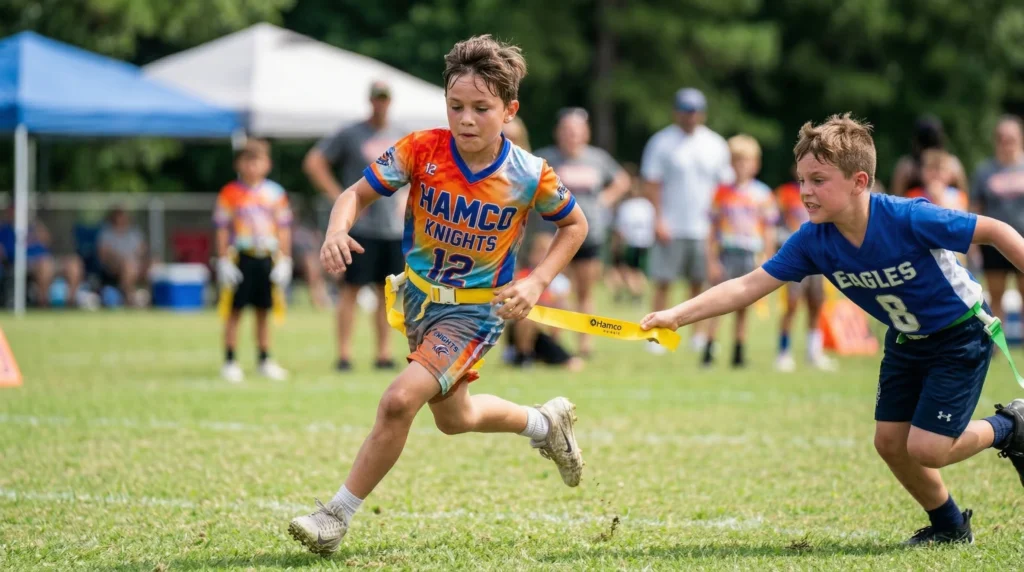
- Custom team uniforms — jerseys and matching shorts help build team identity
Do not underestimate the impact of a sharp uniform. When kids put on matching jerseys and feel like a real team, their confidence goes up and so does their commitment to showing up to practice.
Step 4: Recruit Players and Build Your Roster
Recruiting for a youth program starts in your own community. Post flyers at local schools, community centers, libraries, and sports stores. Use neighborhood Facebook groups, Nextdoor, and local youth sports networks. Word of mouth is still the most powerful tool you have. Ask every parent who signs up to spread the word.
When building your roster, aim for a manageable size. For practice purposes, 10 to 14 players per team is ideal. This ensures everyone gets enough reps during drills without practices becoming chaotic. If you end up with more interest than expected, consider splitting into two teams and running a small internal league.
Step 5: Set Up Your Flag Football League Structure
A solid flag football league setup keeps games organized, fair, and exciting for everyone involved. Whether you are joining an existing local league or creating your own from scratch, you need a clear structure before the season begins.
For a brand new league, here is what you need to define:
- Game format: 5-on-5 or 7-on-7 (7-on-7 works better for older age groups)
- Game length: Two 20-minute halves works well for most youth divisions
- Scoring system: Touchdowns worth 6 points, conversions worth 1 or 2
- Season length: 6 to 8 regular season games plus a playoff round
- Scheduling: Designate a consistent game day and stick to it
- Volunteer roles: Assign scorekeepers, referees, and a safety officer
If you are joining an established league like NFL Flag, USA Flag Football, or a local parks and recreation program, most of this structure will already be in place. Focus on understanding the rules thoroughly so you can explain them clearly to your players and parents.
Step 6: Plan Your Practice Sessions
Great games are won in practice. A disorganized practice wastes time, frustrates kids, and leads to poor performance. Build a practice plan before every session and stick to it. A solid one-hour practice for youth flag football should look something like this:
- 0:00 – 0:10: Warm-up and dynamic stretching
- 0:10 – 0:25: Individual skill drills (routes, flag pulling, throwing mechanics)
- 0:25 – 0:45: Team drills and play installation
- 0:45 – 0:55: Scrimmage or competitive team drill
- 0:55 – 1:00: Cool down, recap, and team huddle
Always end practice on a positive note. Give a shout-out to a player who worked hard, run a fun competitive drill, or bring the team together with a chant. Kids should leave practice excited to come back next time.
The Best Flag Football Drills for Beginners
You do not need a complicated playbook to coach beginner flag football well. Focus on drills that teach fundamentals while keeping kids engaged and moving. Here are the most effective flag football drills for beginners that you can use from your very first practice.
Flag Pulling Tag
This is the most fundamental skill in flag football and you can teach it in a fun way. Set up a 10×10 yard grid and have all players wear their flags. On your signal, every player tries to pull as many flags from other players as possible while protecting their own. The last player with a flag still on wins. This drill builds awareness, lateral quickness, and flag-pulling technique simultaneously.
Route Running Cones
Set up cones to mark out basic routes like the slant, out, and post. Have receivers run each route at 75 percent speed while you or an assistant QB throws to them at the break. This drill builds route precision and the timing relationship between quarterbacks and receivers. For younger kids, use foam balls and shorter distances.
4-Corner Passing Circuit
Place four cones in a square about 10 yards apart. One player stands at each cone. The QB in the center rotates and throws to each cone in sequence. After each catch, the receiver runs back to their cone. This drill builds throwing accuracy, soft hands, and conditioning all at once. Rotate who plays QB every 3 to 4 minutes.
Red Zone Situational Drill
Set up a miniature end zone 10 yards deep. Run 3-on-2 situational plays where offense runs a route concept against two defenders. Award points for successful touchdowns and flag pulls. This drill teaches decision-making under pressure and is one of the most game-realistic options in your practice toolkit.
Essential Youth Flag Football Coaching Tips
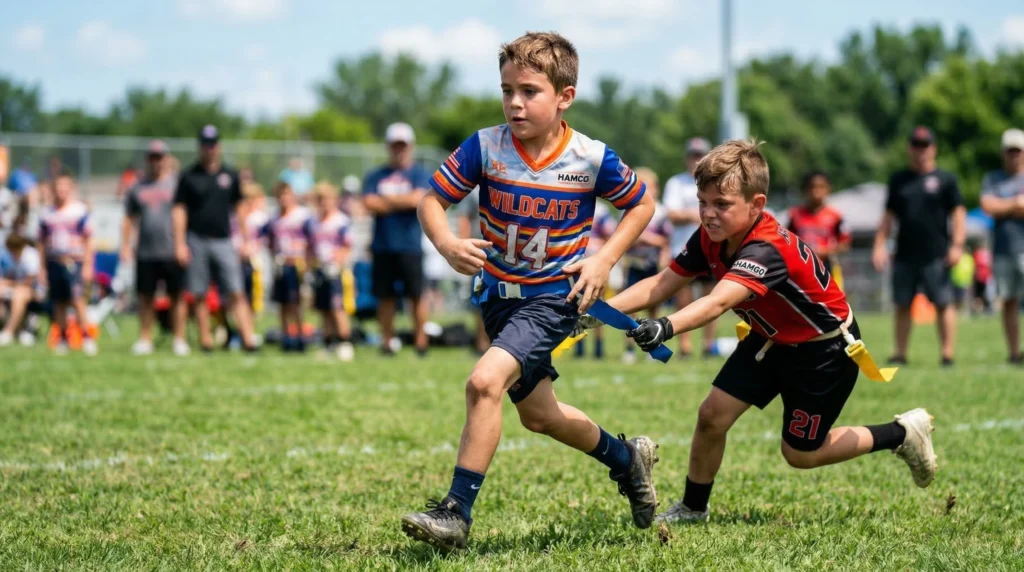
Knowing the Xs and Os of football is only part of being a great youth coach. The other half is knowing how to work with kids. Here are the most important youth flag football coaching tips that will make you effective from day one.
- Keep instructions short. Kids lose focus after about 30 seconds of listening. Give one instruction at a time, demonstrate it, and then let them do it. Never lecture during practice.
- Make everything a competition. Kids respond instantly when there is something to win. Whether it is a small prize, extra rest, or just bragging rights, adding competition to your drills multiplies engagement and effort.
- Praise effort, not just performance. Tell a kid their route was run with great energy even if they dropped the catch. Building confidence in young athletes matters more than being technically perfect at age eight.
- Communicate proactively with parents. Send a weekly text or email update about practice times, what the team worked on, and what they can expect next. Parents who feel included are your best advocates.
- Stay patient and consistent. Young athletes need to hear and see the same things many times before it clicks. Do not get frustrated if the team runs the same play incorrectly for the third week in a row. Keep teaching with energy and positivity.
- Film your practices. Even a smartphone video from the sideline gives you insight into what your players are actually doing versus what you think they are doing. Review footage and use it to adjust your coaching.
Common Mistakes New Coaches Make (and How to Avoid Them)
Even well-intentioned coaches make these missteps in their first season. Being aware of them now will save you a lot of headaches later.
- Running practices without a plan. Show up with a written practice plan every single time. Unstructured practices waste everyone’s time and signal to parents and players that you are not prepared.
- Using an adult-level playbook. Start with two to four simple offensive plays. Build complexity gradually as the season progresses. Young players need repetition and confidence before variety.
- Ignoring quieter players. The loud, athletic kids will always grab your attention. Make a conscious effort to give individual attention and encouragement to every player on your roster, especially the shy ones.
- Skipping the rules review. Take time at the beginning of the season to walk every player through the flag football rules specific to your league. Rules vary widely between organizations. Confusion during games creates conflict.
- Forgetting to have fun. Youth sports should be enjoyable above all else. If you are stressed, your players feel it. Take a breath, smile, and remember why these kids showed up in the first place.
Frequently Asked Questions
1. How much does it cost to start a youth flag football program?
A basic program can be started for as little as $200 to $500 covering flags, cones, and registration fees. If you add uniforms and equipment, expect a startup budget of $1,000 to $2,500 depending on team size. Many leagues also charge per-player registration fees that offset equipment costs.
2. What age is best to start flag football?
Most organized youth flag football programs begin at age 5 or 6. NFL Flag offers divisions starting at kindergarten age. The sport scales well across age groups, with rules and field sizes adjusted to match developmental stages. There is no age that is too early to introduce kids to the basics.
3. Do I need coaching experience to run a youth flag football program?
No prior coaching experience is required. A passion for the sport and a genuine interest in working with young people are the most important qualifications. Getting a basic certification from USA Football or NFL Flag is highly recommended and takes only a few hours online.
4. How many players do you need for a flag football team?
The minimum to field a team is typically 5 players for 5-on-5 formats or 7 for 7-on-7 formats. For a healthy practice environment, aim for a roster of 10 to 14 players so you can run competitive drills and cover for absences without scrambling.
5. What is the difference between NFL Flag and USA Flag Football?
NFL Flag is the official youth league program of the NFL and focuses heavily on the recreational and participation model. USA Flag Football is the national governing body that oversees competitive flag football, including travel and tournament programs. Both are excellent options. Your choice depends on whether your priority is recreational play or competitive development.
Final Thoughts: Your Program Starts Today
Now you have a clear blueprint for how to start a youth flag football program from the ground up. From defining your goals and handling paperwork to running sharp practices and building a competitive flag football league setup, every piece of the puzzle is here for you. The most important thing is to take that first step.
Youth flag football has the power to build confidence, develop leadership, and create memories that kids carry for the rest of their lives. You are not just coaching a sport. You are building something that matters. Use these youth flag football coaching tips, stay consistent, keep it fun, and trust the process. Your kids will thank you for it on and off the field. Ready to build your team’s identity? Explore our collection of custom flag football uniforms and give your players the look of a championship squad from their very first game.