
If you are a coach exploring the world of lacrosse, understanding the box lacrosse vs field lacrosse differences is one of the most important steps you can take to properly prepare your players. These two formats share the same basic concept but diverge dramatically in terms of playing environment, rules, gear, and game strategy. Whether your team is transitioning from outdoor to indoor competition, or you are simply trying to understand what makes each format unique, this guide will walk you through everything you need to know. And if you are thinking about outfitting your team for either format, starting with quality custom lacrosse uniforms is always a smart first step before diving into format specific equipment and training.
Lacrosse is one of the fastest growing sports in North America, and its two primary competitive formats attract coaches, players, and fans who are passionate about the game. Box lacrosse is typically played indoors on a smaller enclosed surface, while field lacrosse takes place on a large outdoor grass or turf field. The structural and strategic differences between these two versions of the game are so significant that a coach moving between them needs a thorough education before stepping onto the sidelines.
A Brief Overview of Each Format
Field lacrosse is the older and more traditional version of the sport. It is played on a large rectangular grass or artificial turf surface that measures roughly 110 yards long and 60 yards wide. Teams consist of ten players on each side, including a goalkeeper. The game moves in a wide open space with defined crease and attack zones, and it is governed by organizations such as US Lacrosse and the NCAA at the collegiate level.
Box lacrosse, often called box lax, was developed in Canada during the 1930s as a way to keep hockey arenas and their ice plants in use during the summer months. The playing surface is a hockey rink floor, enclosed by dasher boards, that measures roughly 180 to 200 feet long and about 85 feet wide. Teams field six players at a time, including the goalkeeper. The enclosed walls play a significant role in the game, as the ball can be played off the boards just like a puck in hockey.
Understanding these foundational differences is the starting point for any coach attempting to build knowledge about the sport in either format.
Box Lacrosse Rules Compared to Field Lacrosse Rules
The box lacrosse rules differ from field lacrosse in several important areas, and coaches need to internalize these distinctions before preparing a game plan.
Shot Clock and Possession Rules
One of the most significant rule differences involves the shot clock. In box lacrosse, teams have a 30 second shot clock to attempt a shot on goal once they gain possession. This aggressive time limit forces nonstop action and creative offensive play. Field lacrosse does not universally use a shot clock at all levels, though some leagues have introduced possession timing rules. The result is that box lax tends to be an extremely fast paced, high scoring affair compared to field lacrosse.
Penalty Rules and Physical Play
Box lacrosse is a notably more physical game. The enclosed walls and smaller surface mean contact happens constantly, and the penalty system reflects this reality. Box lacrosse borrows from hockey by placing penalized players in a penalty box rather than simply removing them from a single play as in field lacrosse. Teams can play shorthanded for two minutes or more depending on the severity of the infraction, which creates major power play opportunities for the opposing team. Coaches must build penalty kill and power play strategies that simply do not exist in most field lacrosse programs.
Crease and Goalie Rules
In field lacrosse, the crease is a circular area around the goal where offensive players may not enter. The box lacrosse crease is much larger relative to the total playing surface, and the rules around goalkeeper protection are stricter. Box goalkeepers wear significantly more protective equipment and are given added protections from charging. Understanding these crease rules is essential for coaches building offensive sets in either format.
Time of Game and Substitutions
Field lacrosse is typically played in four 15 minute quarters with substitutions made on the fly during dead balls and timeouts. Box lacrosse also uses three 20 minute periods, similar to hockey, and substitutions can be made on the fly while the clock runs. This flying substitution system in box lax demands that coaches prepare deep, well conditioned rosters who can rotate continuously without losing intensity.
Indoor Lacrosse Gear vs Field Lacrosse Equipment
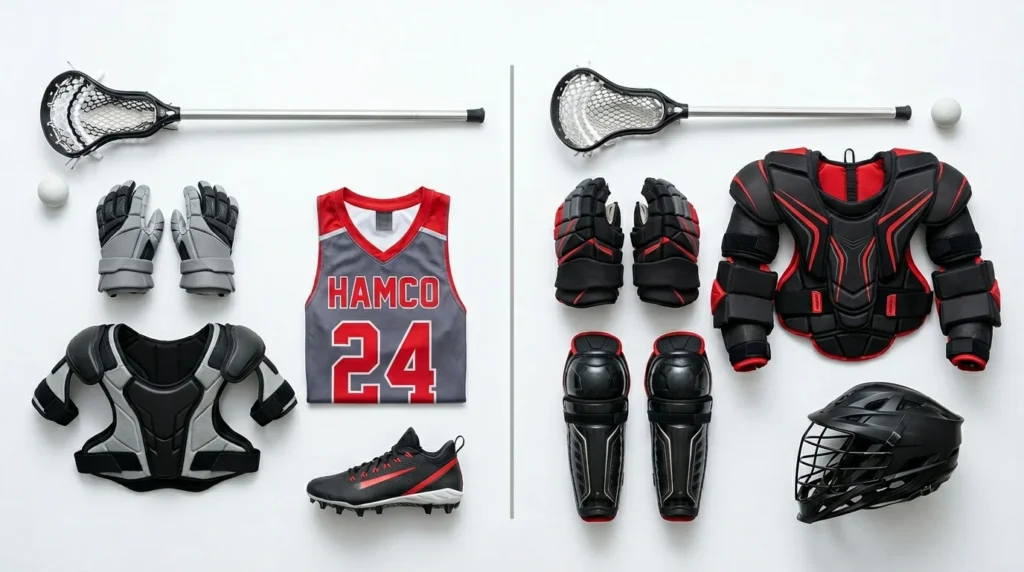
The equipment differences between the two formats are dramatic, and any coach serving as a box lax equipment guide for their players needs to be thorough. Wearing the wrong gear is not just a performance issue; it can be a safety concern.
Sticks and Pocket Design
The lacrosse stick is the most fundamental piece of equipment in both games, but the specifications differ significantly. Field lacrosse uses longer sticks, with attackers and midfielders using shafts around 30 to 42 inches and defenders using longer poles up to 72 inches overall. Box lacrosse sticks are universally shorter, with the entire stick typically measuring no more than 46 inches for all positions. The pocket design in box lax sticks is also considerably deeper, which helps players withstand the constant physical checks and the irregular bounces that come from playing the ball off the boards.
Helmets and Facial Protection
Both formats require helmets, but the helmet designs differ. Field lacrosse helmets are designed for open field play and offer protection appropriate for that environment. Box lacrosse helmets are constructed more like hockey helmets, with a full cage face guard and a harder shell designed to handle the impacts common in an enclosed, boards oriented game. Coaches transitioning players from field to box lax should ensure every player is fitted with a proper box lacrosse specific helmet before they step onto the floor.
Body Padding and Protective Equipment
This is where indoor lacrosse gear diverges most dramatically from field equipment. In field lacrosse, players wear shoulder pads, arm pads, gloves, and a helmet. In box lacrosse, the increased physicality of the game demands substantially more protection. Players are required to wear full shoulder and chest protection similar in design to hockey chest protectors, heavy duty elbow pads, hockey style gloves that offer greater wrist and hand coverage, throat protectors, and shin guards. Goalkeepers in box lacrosse wear protection that closely resembles a hockey goalie setup, including a large chest protector, oversized leg pads, and a blocker style glove.
Footwear
Field lacrosse is played in cleats designed for grass or turf surfaces. Box lacrosse is played on a concrete or rubberized arena floor, meaning players wear running shoes or court shoes rather than cleats. This affects not only footwear purchases but also how coaches teach cutting, stopping, and lateral movement, since the mechanics on a hard floor are very different from turf.
Strategic Differences Coaches Must Understand
Beyond equipment and rules, the most fascinating aspect of the box lacrosse vs field lacrosse comparison lies in game strategy. Coaches who understand both formats deeply often develop more well rounded tactical minds.
Offensive Concepts
Field lacrosse offenses are built around spacing, dodging lanes, and creating advantageous two on one situations in open space. Teams run set plays, work the ball around the perimeter, and look for cutters moving toward the cage. Box lacrosse offense, by contrast, is built around pick and roll plays, motion systems, and the creative use of the boards to extend possession and create shooting lanes. The 30 second shot clock means box lax offenses must be decisive and efficient. Hesitation in box lax gets punished far more harshly than in field lacrosse.
Defensive Systems
Man to man defense is foundational in both formats, but the way it is executed differs substantially. In field lacrosse, defenders have space to slide and recover because the field is wide. In box lacrosse, slides must be faster and more committed because the playing surface is so compact. Zone defenses are used in both formats, but the box lax zone requires a different understanding of spacing since the boards create unusual angles and rebounding situations that simply do not exist in outdoor play.
Goaltending Philosophy
Box lacrosse goalkeepers are arguably the most physically demanding position in either format. Because the cage is smaller relative to the shooting angles available on a compact floor, goalkeepers in box lax must have exceptional reflexes and be willing to absorb a significant volume of shots. Field goalkeepers work from a crease that gives them more room to position themselves. Coaches building a program that spans both formats should consider specialized goalkeeper training for each environment rather than assuming skills transfer directly.
Tips for Coaches Transitioning Between Formats
If you are a field lacrosse coach entering the box environment for the first time, or a box coach introducing players to the outdoor game, there are several practical steps that will ease the transition.
Study the rulebook specific to the format. Box lacrosse rules vary between organizations such as the National Lacrosse League, the Canadian Lacrosse Association, and various regional bodies. Make sure you are working from the correct rulebook for your specific competition.
Audit your equipment inventory. Do not assume that field equipment meets box lacrosse safety standards. Conduct a full review and replace items as needed. This is especially important for helmets and body protection.
Introduce the boards as a coaching tool. Box lax players need to learn how to use the boards intentionally. Run drills that incorporate deliberate passes and rebounds off the walls so players build comfort and instinct in the enclosed space.
Adjust your conditioning program. Box lacrosse demands constant motion with no natural breaks from a wide open field. Train your players with shorter, more intense interval sessions that mirror the demands of the 30 second shot clock.
Learn pick and roll concepts. If you are coming from field lacrosse, the pick and roll offense that dominates box lax will feel unfamiliar. Study film, attend clinics, and consult with experienced box coaches before designing your offensive system.
Which Format Is Right for Your Program?
The answer depends on your goals, your players, and the resources available in your community. Box lacrosse is an excellent developer of individual skills. The tight quarters, relentless pace, and physical demands force players to improve their stickhandling, footwork, and decision making far more rapidly than a wide open field game sometimes allows. Many elite field lacrosse programs actively encourage their players to compete in box lacrosse during the offseason precisely for this reason.
Field lacrosse, on the other hand, provides a more tactically complex environment from a positional standpoint. The longer field creates opportunities to develop specialized offensive and defensive systems, and it prepares players for the collegiate and professional levels of the outdoor game where those systems are most developed.
For coaches who have the opportunity to introduce their players to both formats, doing so will produce more complete, versatile athletes who can adapt to different competitive environments throughout their lacrosse careers.
Frequently Asked Questions
1. What is the main box lacrosse vs field lacrosse difference in team size?
Field lacrosse fields ten players per side including the goalkeeper, while box lacrosse fields only six players per side including the goalkeeper. The smaller team size in box lax creates a more intense and tightly contested game.
2. Can field lacrosse players use their sticks in box lacrosse?
No. Box lacrosse requires a shorter, deeper pocketed stick that is built for the physical demands of indoor play. Field lacrosse sticks do not meet the specifications required for box lax and should not be used in competition.
3. Is indoor lacrosse gear more expensive than field lacrosse equipment?
Generally yes. The additional body protection required in box lacrosse, particularly the chest protector, elbow pads, and hockey style gloves, makes a complete box lax setup more costly than a standard field lacrosse equipment package.
4. Do box lacrosse rules allow the same types of checks as field lacrosse?
Box lacrosse allows more aggressive body and stick checking than most levels of field lacrosse. However, checking to the head, from behind, and other dangerous contact is still penalized, and those fouls result in time in the penalty box rather than a simple restart.
5. Can playing box lacrosse make a field lacrosse player better?
Absolutely. Many coaches and player development experts consider box lacrosse the best offseason training format for field players. The tight space, shot clock pressure, and physical demands sharpen stickwork, footwork, and decision making skills that directly transfer to improved field lacrosse performance.
Conclusion
The box lacrosse vs field lacrosse differences run much deeper than simply playing indoors versus outdoors. From the box lacrosse rules and physical demands to the specialized indoor lacrosse gear required for safe competition, every aspect of the game changes when you move between formats. Coaches who take the time to master both environments give their players a significant development advantage and position themselves as more versatile and valuable members of the lacrosse community. Use this guide as your starting point, invest in the right equipment, study the rules carefully, and approach each format with the respect and curiosity that elite coaching demands.