
Introduction
Every great rugby season starts long before the first whistle blows. As a coach, your rugby season preparation guide begins with a clear preseason vision — one that covers fitness, tactics, culture, and gear. Whether you’re coaching a grassroots club or a competitive school side, the decisions you make in the weeks before the season directly shape what happens on the pitch. Equipping your players properly is part of that foundation, and you can explore professional-grade options at custom rugby uniforms, which offer teams the identity and quality they need to perform with pride. This guide walks you through a full preseason planning framework — from squad assessment and conditioning blocks to team building drills and game-day readiness — giving you every tool you need to build a competitive, cohesive rugby team.
1. Understanding the Preseason Planning Framework
Effective rugby preseason planning is not a single event — it is a structured, phased process. Most successful preseasons run over 8 to 12 weeks and are broken into distinct blocks, each serving a specific purpose. Rushing any one block leaves gaps that opponents will exploit during the competitive season.
A well-structured framework typically moves through three core phases:
- Assessment and Baseline Testing — Week 1 to 2
- Physical Development and Conditioning — Week 3 to 7
- Tactical Integration and Match Preparation — Week 8 to 12
Each phase must flow logically into the next. Coaches who skip the assessment phase often struggle to individualise training loads, leading to preventable injuries and inconsistent fitness levels at season start.
Setting Preseason Goals
Before week one, sit down and define what success looks like for your squad. Goal-setting should address:
- Physical benchmarks (e.g., 2 km time-trial targets, tackle test completion rates)
- Tactical benchmarks (e.g., set-piece accuracy percentage, defensive line speed)
- Cultural goals (e.g., squad attendance rate, peer leadership development)
Writing these goals down and sharing them with your players creates accountability from day one — a cornerstone of every effective rugby coaching tip.
2. Physical Conditioning: Building the Foundation
Rugby demands a unique mix of explosive power, aerobic endurance, and contact resilience. A thoughtful conditioning block addresses all three without overtaxing players early in the preseason, when injury risk is highest.
Weeks 1–3: General Fitness and Aerobic Base
Start with lower-intensity, higher-volume work. This phase builds the aerobic engine players will rely on during extended passages of play.
- Long interval runs (e.g., 6 x 800 m at conversational pace)
- Bodyweight strength circuits to identify weaknesses
- Mobility and flexibility sessions — often overlooked but crucial for injury prevention
Weeks 4–6: Rugby-Specific Conditioning
Once the aerobic base is in place, shift to rugby-specific work that mirrors match demands.
- Short sharp intervals (e.g., 10 x 40 m sprint sets with 30-second rest)
- Contact conditioning drills — bag work, tackle shield circuits
- Strength work with progressive overload on compound lifts: squats, deadlifts, bench press
Weeks 7–8: Taper and Match Readiness
Reduce volume while maintaining intensity. Players should feel fresh and sharp, not fatigued, going into the first game.
Coaching Tip: Track each player’s weekly training load using a simple RPE (Rate of Perceived Exertion) diary. Adjust individual programs based on this data to prevent overtraining.
3. Rugby Team Building Drills That Actually Work
Physical fitness only wins games when players trust each other. Purpose-designed rugby team building drills close the gap between individual talent and collective performance, fostering the communication and cohesion that define great teams.
The Trust Ladder Drill
Pair players from different positions — a prop with a winger, for example — and run a series of drills where one player must rely on the other’s decision-making. This breaks down positional silos and creates empathy across the squad.
Pressure Passing Grid
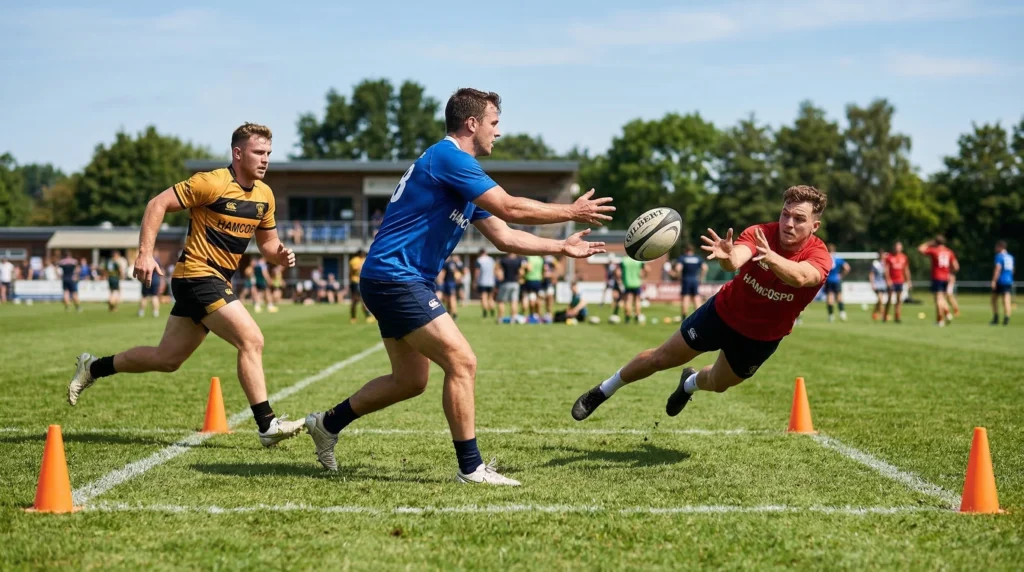
Set up a 10 m x 10 m grid with four players. One player acts as defender and must tag the ball carrier before a successful offload is made. This drill builds quick decision-making, accurate passing under pressure, and vocal communication — all at once.
Game Within a Game (Small-Sided Competitions)
Divide the squad into four teams and run a short week-long mini-competition with accumulated points. This builds healthy competitive spirit, encourages leaders to emerge naturally, and generates real game-intensity data on player performance.
Leadership Rotation Sessions
Designate a different player as session captain for each training day during preseason. This develops distributed leadership, ensures quieter voices are heard, and gives you valuable insight into who your natural leaders are before you name a captain.
| Key Insight for Coaches The most effective team building drills are those that create problem-solving situations under mild stress. Comfortable drills build comfort. Challenging drills build character and cohesion. |
4. Tactical Preparation and Game Planning
Tactical preparation in preseason is about building a simple, executable framework — not overloading players with a complex system they will forget under pressure. Great rugby coaching tips always prioritize clarity over complexity.
Establish Your Non-Negotiables First
Every team needs two or three defensive and attacking principles that remain consistent regardless of the opponent. Examples include:
- Defensive: Flat defensive line, never retreat until contact is made
- Attacking: Always look to go wide off turnovers, never kick from inside your own half without a catcher under the ball
Once these are locked in during preseason, tactical adjustments for specific opponents become minor additions to a stable system — not complete overhauls.
Set-Piece Mastery
Scrums and lineouts account for a significant proportion of possession in every match. Dedicate at least two sessions per week during mid-preseason exclusively to set-piece work. Introduce only two or three lineout calls initially; add variation only once base execution is consistent.
Video Review Sessions
Even one 20-minute video session per week during preseason pays significant dividends. Focus on showing clips that reinforce your non-negotiables — both when players execute them well and when they fail. This builds pattern recognition and speeds up on-field decision-making.
5. Building Team Culture and Mental Toughness
The most overlooked element of any rugby preseason planning process is culture. Physical conditioning and tactics are teachable in weeks. Trust, resilience, and collective identity take months to build — so preseason is your best opportunity to lay that groundwork.
Establish Team Values Together
Run a squad session in the first week where players collaboratively define three to five team values. When players create the values, they own them. Post them in the changing room, reference them in every team talk, and hold every player — including senior figures — accountable to them.
Mental Skills Training
Introduce basic psychological skills into preseason:
- Controlled breathing techniques for pre-match anxiety management
- Visualisation routines for key positional scenarios
- Mistake reset protocols — a simple phrase or gesture that lets players move on from errors quickly during games
Social Cohesion Activities
Schedule at least one off-field team activity during preseason — a meal together, a hike, or a community project. Research consistently shows that social bonds formed outside training translate directly into on-field trust and communication.
6. Squad Management: Selection and Rotation Strategy
Your squad is your most valuable asset. Managing it well across preseason protects player welfare and sets your starting XV up for success.
Conduct Honest Position Competitions
Create transparent position competitions using objective data — time-trial results, tackle completion rates, skill assessment scores. Players who know they earned their place perform with greater confidence and commitment than those who feel selection was arbitrary.
Plan Load Management From Week One
Identify players who carry injury history or are returning from long lay-offs. Build individualised load management programs for these players from the start of preseason. A player who arrives at game one at 90% capacity is more valuable than one who burns out chasing 100% and picks up a new injury.
Empower Your Squad Depth
Use preseason trial matches to give every squad member genuine game time. The players who provide cover for your starters must stay engaged and match-ready throughout the season. Preseason is the time to build that depth confidence.
7. Monitoring Progress and Refining Your Plan
A preseason plan that is never reviewed is just a document. The best coaches treat their rugby season preparation guide as a living framework — one that evolves in response to what the data and player feedback tell them.
Weekly Review Checkpoints
At the end of each training week, review three questions:
- Are players hitting their physical benchmarks on schedule?
- Are tactical concepts being executed correctly in opposed sessions?
- What is the overall squad mood and energy level?
If any of these three areas shows a red flag, adjust before the problem compounds. Great coaching is more often about early intervention than dramatic overhauls.
Trial Match Analysis
Use preseason trial matches as diagnostic tools, not just results occasions. Track:
- Tackle success rate per player
- Line break concession frequency
- Set-piece stability — scrums won/lost, lineout percentage
- Handling errors under pressure
This data informs your final squad selection and highlights any tactical areas that need remediation before your opening competition fixture.
Frequently Asked Questions
Q1: How long should a rugby preseason be for amateur clubs?
An 8 to 10-week preseason is ideal for most amateur clubs. This gives enough time to build fitness, develop tactical patterns, and run two or three trial matches before the season begins.
Q2: What are the most important rugby team building drills for a new squad?
Start with communication-focused drills like the Pressure Passing Grid and small-sided competitions. These build trust and speaking habits quickly among players who don’t yet know each other’s tendencies.
Q3: How many conditioning sessions should players do per week in preseason?
Three to four sessions per week is optimal for most squads, with at least one dedicated recovery day between high-intensity blocks. Monitor RPE scores to avoid overtraining.
Q4: How do I keep experienced players engaged during a preseason they see as routine?
Give senior players leadership roles — session captains, mentoring pairings, drill facilitation. Ownership and responsibility keep experienced players sharp and invested.
Q5: Should tactical systems be fully introduced in preseason or built gradually?
Build gradually. Introduce your core non-negotiables in weeks one through four, then layer in more complex plays once the fundamentals are consistently executed. Overloading players early creates confusion, not competence.
Conclusion
A great rugby season is built in the weeks before it begins. By following a structured rugby season preparation guide — one that integrates smart rugby preseason planning, proven rugby team building drills, and consistent rugby coaching tips — you give your squad the best possible foundation for success. Start with honest squad assessment, build fitness with purpose, develop tactics progressively, and invest in the culture that holds everything together when the pressure is on.
The coaches who plan well during preseason spend the season making small tactical tweaks. Those who don’t plan spend the season firefighting. The choice is yours — and now you have the framework to make it count.