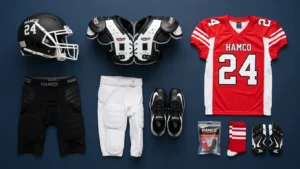
Choosing the right youth football helmet is the single most important safety decision in youth tackle football. The helmet stands between a player’s developing brain and the contact forces generated during blocking, tackling, and incidental collisions that occur throughout every game and practice. This youth football helmet guide covers NOCSAE certification requirements, Virginia Tech helmet safety ratings, proper sizing procedures, and the top helmet brands for youth players in 2026 so coaches, parents, and league administrators can make confident, evidence-based decisions.
Helmet technology has advanced significantly in the past decade. Multi-layered foam systems, independent-liner construction, and improved shell materials have meaningfully reduced certain types of head injury in laboratory testing. Understanding the current safety landscape helps you move past marketing language and focus on independently verified performance ratings that actually matter.
Why Youth Football Helmet Safety Is Priority One
Youth athletes face specific neurological vulnerabilities that adult players do not. Developing brains are more susceptible to injury from concussive and subconcussive impacts than fully developed adult brains. The growth plates and developing neural structures in children under sixteen experience trauma differently than adults, and the long-term consequences of repeated sub concussive impacts during development is an area of active and serious scientific research.
No helmet eliminates concussion risk. This is a fact that every parent, coach, and player needs to understand. Helmets are designed to reduce the likelihood of skull fractures and the most severe forms of traumatic brain injury. They attenuate impact forces. They do not prevent the brain from moving inside the skull during rapid deceleration, which is the mechanism behind concussions. This understanding should inform how seriously you take other concussion prevention strategies beyond helmet selection.
NOCSAE Certification: The Mandatory Safety Standard
NOCSAE (National Operating Committee on Standards for Athletic Equipment) certification is the baseline mandatory requirement for all helmets used in organized youth football in the United States. NOCSAE tests helmets against defined impact thresholds under controlled laboratory conditions and certifies models that meet minimum performance requirements. A helmet without NOCSAE certification may not be used in any organized youth football game or practice.
NOCSAE certification should be considered the floor, not the ceiling, of helmet safety evaluation. All NOCSAE-certified helmets have met minimum standards. Higher-performing helmets that exceed minimum standards significantly are identified through independent testing programs like the Virginia Tech Helmet Ratings system. Visit NOCSAE for complete certification standards and a searchable database of certified helmet models.
Virginia Tech Helmet Ratings: The Independent Benchmark
Virginia Tech’s Helmet Lab publishes an annual independent safety rating for football helmets, using a STAR (Summation of Tests for the Analysis of Risk) value derived from standardized laboratory testing. Helmets are rated from one star (poorest performance) to five stars (best performance). The ratings are independent of manufacturer affiliation or sponsorship, making them the most reliable third-party safety benchmark available to consumers.
For youth football helmets specifically, the Virginia Tech ratings provide comparative data that helmet marketing materials never reveal. A helmet with a five-star rating from Virginia Tech has been independently tested to reduce concussion risk more effectively than three- and four-star models. Prioritizing five-star or four-star rated helmets for youth players is the most evidence-based approach to helmet selection available in 2026.
Youth Helmet Sizing by Head Circumference
Correct helmet sizing is as critical as helmet quality. An expensive, highly-rated helmet that fits incorrectly provides far less protection than a properly fitted mid-range model. Always size helmets using head circumference measured around the widest part of the head just above the eyebrows.
Youth small helmets typically fit head circumferences of 20.5 to 21 inches. Youth medium fits 21 to 21.75 inches. Youth large fits 21.75 to 22.5 inches. Youth extra-large fits 22.5 to 23.25 inches. These ranges vary by manufacturer, so always use the specific sizing chart from the helmet brand you are purchasing.
Internal padding kits allow fine-tuning of fit within a shell size. Most quality youth helmets include multiple padding configuration options. Properly fitted helmets have the crown padding making light contact with the top of the head, facemask centering cleanly around the face opening, and chin strap fastening snugly without restricting breathing or jaw movement.
Riddell Youth Football Helmets
Riddell is one of the most established names in football helmet manufacturing with a long history in professional, collegiate, and youth football. Riddell’s SpeedFlex youth helmet features independent flex panels designed to manage impact forces more effectively than rigid shell designs. The Axiom system in higher-end Riddell models incorporates multiple layers of energy-absorbing material calibrated for different impact scenarios.
Riddell helmets are generally well-regarded in Virginia Tech ratings, with several models achieving four- and five-star status. Pricing for quality Riddell youth helmets ranges from one hundred fifty to four hundred dollars depending on the model tier. Many schools and competitive youth programs use Riddell as their primary helmet brand due to long-standing supply relationships and coaching familiarity.
Schutt Youth Football Helmets
Schutt Sports offers youth football helmets across several price points with strong safety credentials. The Schutt F7 and Vengeance lines have received positive Virginia Tech ratings and feature TPU cushioning systems that provide effective energy management across a range of impact angles.
Schutt helmets are known for their Ratchet-Loc facemask attachment system, which allows quick facemask removal for medical emergencies — an important feature at the youth level where emergency medical response may involve coaches rather than trained athletic trainers. Youth Schutt helmet pricing runs one hundred to three hundred dollars.
Xenith Youth Football Helmets
Xenith entered the football helmet market with an innovative approach based on shock absorbers rather than traditional foam padding. The Xenith X2E and Shadow XR youth models use independent pneumatic shock absorbers that compress on impact and return to original position, designed to manage repeated impacts more effectively than foam that stays compressed after absorbing energy.
Xenith helmets have earned strong independent ratings and are increasingly popular in well-equipped youth programs that prioritize independent safety research over brand familiarity. Xenith pricing runs one hundred fifty to three hundred fifty dollars for youth models.
Helmet Fitting Instructions
Proper helmet fitting takes about five minutes but significantly impacts a season’s worth of protection. Position the helmet so the front edge sits one to two finger widths above the eyebrows. The front and back padding should make even contact with the head. Rock the helmet gently from side to side and front to back — it should move no more than a half inch in any direction.
Fasten the chin strap and check that the bottom of the chin cup sits centered on the chin with approximately one finger of space between the strap and chin. Open the mouth wide — if the helmet moves up over the eyes, the chin strap needs tightening. Check the jaw pad fit on both sides to ensure even contact and stability during lateral movements.
When to Replace a Youth Football Helmet
Replace any helmet that has been involved in a severe impact even if no visible damage is apparent. Replace helmets that show visible cracks, deep dents, or structural compromise. Replace helmets more than ten years old regardless of appearance, as foam degrades with age and loses energy-absorbing properties. Have helmets reconditioned annually by a certified reconditioning service.
Frequently Asked Questions
Frequently Asked Questions
Q: Do all youth football helmets prevent concussions?
A: No helmet prevents concussions. Helmets reduce the risk of certain severe head injuries. Concussion prevention also requires proper tackling technique, contact limitation in practice, and immediate removal from play after any suspected head impact.
Q: What is the Virginia Tech Helmet Rating System?
A: It is an independent helmet safety rating published by Virginia Tech’s Helmet Lab that assigns one-to-five-star ratings to football helmets based on standardized laboratory impact testing. Five-star helmets perform best in reducing concussion risk in testing.
Q: How much should I spend on a youth football helmet?
A: Spend as much as your budget allows. Higher-rated helmets perform better in independent testing. A quality four-or-five-star-rated youth helmet costs one hundred fifty to three hundred fifty dollars. This is not an area to economize for young athletes.
Q: Can I use last season’s helmet for my child?
A: If the helmet is less than ten years old, has no visible damage, has been reconditioned, and still fits properly, it may be reused. Helmets involved in severe impacts or that have never been reconditioned should be replaced.
Q: What is the best custom football uniform to pair with a quality helmet?
A: Custom sublimated football jerseys in your team colors from HAMCO Sports at hamcospo.com/custom-football-uniforms/ complete the professional appearance of a well-equipped youth football program.
Helmet selection is the most consequential safety decision in youth tackle football. Use independent ratings, prioritize proper fit over brand loyalty, replace helmets that have sustained severe impacts, and ensure every player on your roster is wearing a properly fitted, NOCSAE-certified helmet before they take a single snap. No uniform, no trophy, and no winning record is worth a child’s long-term neurological health.