Flag football rules vary by organization and format, which creates confusion for coaches, parents, and players who participate in multiple leagues or transition between formats. This comprehensive guide to flag football rules covers 5v5, 7v7, NFL Flag, and the Olympic format being developed for the 2028 Los Angeles Games — everything you need to coach confidently, play by the book, and understand the calls being made on your sideline. With flag football’s explosive growth in 2026 and its imminent Olympic debut, having a clear understanding of the rules is more valuable than ever.
Despite format differences, flag football shares core principles across all versions: defenders remove flags attached to the ball carrier’s belt to end a play instead of tackling, scoring mirrors football with touchdowns, extra points, and safeties, and the game emphasizes passing skill and team strategy over physical domination. These common elements make transitioning between formats easier once you understand the foundational rules.
Flag Football Basics: What Every Player Must Know
A flag football belt carries two flags, one on each hip, secured by velcro or clips depending on the manufacturer. When a defender removes one or both flags from the ball carrier’s belt, the play ends at the point of the flag pull. Flag guarding — using the arm, elbow, or hand to prevent a defender from pulling the flag — is a penalty in all flag football formats and results in a loss of yards from the spot of the foul.
The no-contact rule distinguishes flag football most clearly from tackle football. Blocking is limited or prohibited depending on the format. Tackling, diving at the flag, and intentional body contact to prevent a flag pull are all fouls. Defensive players may only remove flags by reaching and pulling. Incidental contact during the flag-pulling motion is acceptable, but deliberate contact is penalized.
5v5 Flag Football Rules
5v5 flag football is the most popular recreational and youth format, particularly for ages five through ten. Each team fields five players — typically one center, one quarterback, and three eligible receivers on offense, with various defensive alignments. Fields are typically twenty to twenty-five yards wide and forty to fifty yards long, divided into end zones.
No offensive rushing is permitted from behind the line of scrimmage in most 5v5 recreational formats. The quarterback must throw the ball or be a scrambling runner after a prescribed time window, typically seven seconds after receiving the snap. All receivers are eligible. Motion is allowed before the snap. The quarterback cannot run past the line of scrimmage in some 5v5 formats — confirm this rule with your specific organization before coaching.
Games are typically played in two halves of fifteen to twenty minutes each with a running clock. The clock stops only for scores, penalties, and injuries. Possession changes after a touchdown or a failed first-down conversion. Most 5v5 formats use a no-punt system where teams face a conversion attempt rather than punting.
7v7 Flag Football Rules
7v7 flag football is the preferred format for older youth and adult competitive play. Seven-player teams create more positional complexity, more meaningful defensive assignments, and a game experience closer to eleven-on-eleven tackle football in strategic depth. Fields for 7v7 flag football typically run thirty yards wide and seventy yards long.
Offensive formations in 7v7 flag football generally feature a center, one to two running backs or receivers aligned in the backfield, and four to five eligible receivers spread across the formation. Rushing is allowed in most 7v7 formats, with one designated rusher permitted to blitz from behind a rush line typically seven yards behind the line of scrimmage. Multiple rushers or rushers who cross the line before the snap are penalized.
7v7 flag football seasons follow a structured format similar to tackle football with regular season standings, playoff brackets, and championship games. The format is the foundation of competitive adult flag football leagues and the Olympic development pathway for national team selection.
NFL Flag Format Rules
NFL Flag rules provide a standardized national framework used across thousands of leagues affiliated with the NFL Flag program. The NFL Flag format uses 5v5 or 7v7 depending on age division. Specific NFL Flag rules govern field size, quarter length, scoring values, and penalty enforcement to create a consistent experience that transfers across programs nationwide.
Key NFL Flag rules include: no intentional contact or blocking, all players are eligible receivers, the quarterback has a seven-second throw clock in most divisions, touchdowns are worth six points, extra points after touchdowns are worth one point from the five-yard line or two points from the ten-yard line, and safeties are worth two points. Interceptions may be returned for touchdowns.
NFL Flag programs emphasize positive coaching and player development alongside competitive play. The NFL Flag format connects youth participants to the NFL brand and provides a pathway to regional and national championship events.
Olympic Flag Football Format
The International Federation of American Football, recognized by the International Olympic Committee, oversees the development of the flag football format that will debut at the 2028 Los Angeles Summer Olympics. The Olympic format uses 5v5 play with standardized rules designed for maximum television viewability and global accessibility.
Olympic flag football matches consist of two twenty-minute halves on fields sized fifty meters long by twenty-seven meters wide. The format emphasizes passing and athletic performance designed to be compelling for audiences unfamiliar with American football. For more information about international flag football development, visit World Flag Football at www.worldflyfootball.com.
Scoring in Flag Football
Scoring in flag football follows the same structure as tackle football in most formats. Touchdowns are worth six points. Extra point attempts after a touchdown are worth one point from the five-yard line or two points from the ten-yard line depending on the team’s choice. Safeties are worth two points and result in possession change with a free kick. Interception and fumble recovery return touchdowns are awarded the standard six-point value.
Some youth recreational leagues modify scoring to emphasize development over competition — awarding points for completions, first downs, or other skill markers rather than pure scoring. These modifications are program-specific and are not standard in competitive flag football.
Common Flag Football Penalties Explained
Flag guarding: illegal use of arm or body to prevent flag removal, typically five to ten yard loss. Illegal contact: deliberate contact with an opponent, five to fifteen yard loss. Offsides: crossing the line of scrimmage before the snap, five yard loss. Pass interference: illegal contact with a receiver before the ball arrives, spot foul awarding the offense the ball at the point of the foul. Illegal formation: not lining up correctly at the snap, five yard loss.
Unsportsmanlike conduct penalties range from fifteen yards to ejection depending on severity. Flag football’s emphasis on positive behavior means unsportsmanlike conduct is penalized more strictly than in some other youth sports. Coaches are responsible for their players’ behavior and can face benching orders if their team accumulates excessive penalty flags.
Custom Flag Football Uniforms
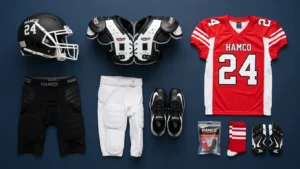
Custom flag football jerseys are the visual identity of your team in a sport where no pads or helmets obscure the uniform. Sublimated custom flag football jerseys allow unlimited color and design options, withstand the constant movement and contact with flag belts that characterizes the sport, and create the team unity that motivates players to compete harder.
Custom youth flag football jerseys should be lightweight, non-restrictive, and moisture-wicking to keep players comfortable in the fast-paced, continuous movement environment of flag football. Order custom flag football uniforms for your team or league at hamcospo.com/custom-football-uniforms/.
Frequently Asked Questions
Frequently Asked Questions
Q: Is rushing allowed in all flag football formats?
A: Rushing rules vary significantly by format. 5v5 recreational leagues typically prohibit running plays entirely. 7v7 and NFL Flag formats allow rushing with one designated blitzer per play. Always confirm your specific league’s rushing rules before coaching.
Q: What happens if a player’s flag falls off before the play?
A: If a flag falls off before a defender removes it, play continues and the ball carrier is considered downed by a one-hand touch. Most leagues cover this scenario specifically in their rulebook.
Q: Can the quarterback run with the ball in flag football?
A: In most formats, the quarterback can run once they cross the line of scrimmage. Scrambling rules vary — some formats allow unlimited scrambling while others require a throw to have been attempted first. Check your organization’s specific rules.
Q: Are there weight or size restrictions in youth flag football?
A: Age-based divisions are standard. Weight restrictions apply in some youth tackle football organizations but are rarely used in flag football since contact is prohibited by rule.
Q: What makes a good custom flag football jersey?
A: Lightweight sublimated polyester fabric, moisture-wicking properties, clear number and name lettering, and team colors that differentiate clearly from opposing teams are the most important features in custom flag football jerseys.
Understanding flag football rules completely before your season begins makes you a better coach, a more informed parent, and a more effective player. The format you choose — 5v5, 7v7, NFL Flag, or Olympic standard — shapes the rules framework you operate within, but the core principle is constant: outrun, outsmart, and out-execute your opponent to pull those flags and score those touchdowns.