

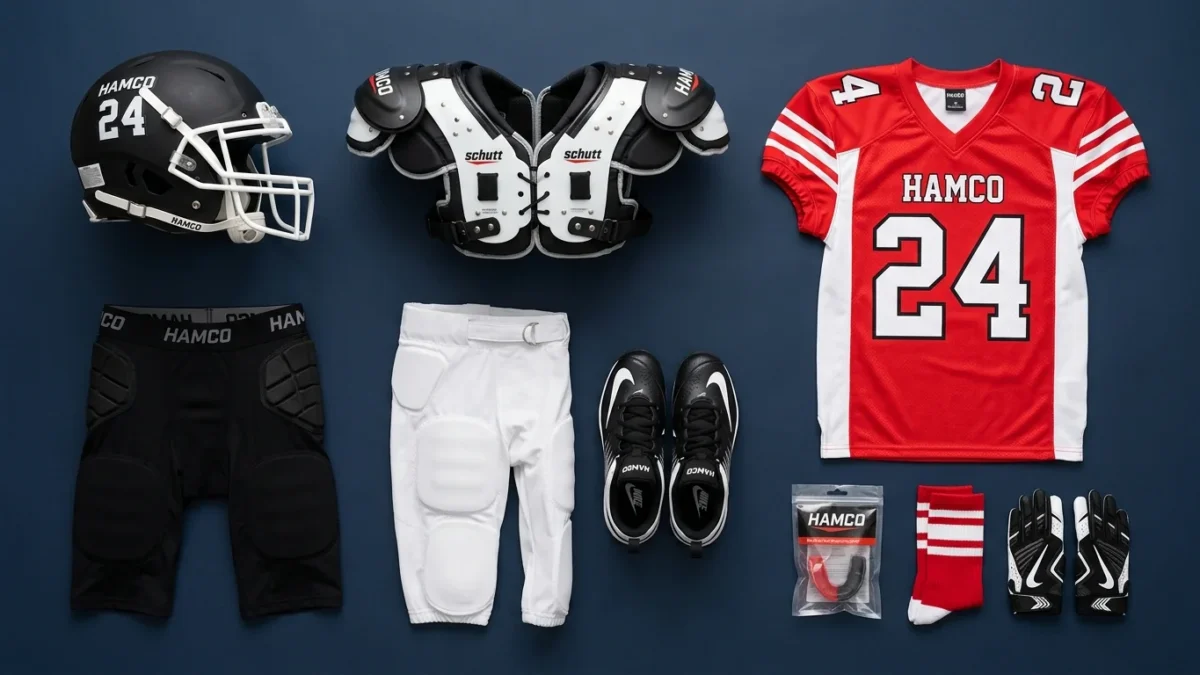
A thorough youth football equipment checklist ensures that every player takes the field properly protected and ready to perform. Whether you are outfitting a youth tackle football team, setting up a flag football program, or preparing a single player for their first season, understanding the equipment requirements, safety standards, and budget expectations saves time, money, and potential injury. This complete youth football equipment checklist covers every item for both tackle and flag football in 2026, including sizing guidance, safety certification requirements, and how to choose the right custom football uniforms that reflect your program’s identity.
Youth football equipment has evolved significantly, driven primarily by advances in helmet technology and growing scientific understanding of contact injury prevention. Parents and coaches have more options and more information available in 2026 than at any previous point in youth football’s history. Use this checklist to make confident purchasing decisions at every level.
Tackle Football vs Flag Football Equipment Differences
The equipment difference between tackle and flag football is the most dramatic divide in youth football gear. Tackle football requires a full protective equipment set: helmet, shoulder pads, hip pads, tailbone pad, thigh pads, knee pads, mouthguard, and cleats. Flag football requires only a flag belt, appropriate footwear, and optionally a mouthguard. This difference makes flag football programs dramatically more affordable to launch and sustain at the youth level.
Most tackle football programs provide helmets and some pads as shared equipment to reduce the burden on individual families. Confirm with your league or team which items are provided before purchasing. Avoid duplicating gear the league supplies unless you have a strong preference for a specific brand or fit.
Football Helmets: Safety Standards and Proper Sizing
The football helmet is the most critical safety investment in the youth football equipment checklist. NOCSAE certification is mandatory for all helmets used in organized youth tackle football. NOCSAE standards test helmets against impact thresholds that protect against the most common head injury mechanisms in the sport. Never use a non-NOCSAE-certified helmet in an organized game or practice.
Helmet sizing uses head circumference measured around the widest part of the head just above the eyebrows. All helmets from reputable manufacturers come with sizing charts. The helmet must fit snugly without rocking on the head. Padding kits allow fine-tuning of fit within the shell size. A properly fitted helmet has the crown padding making light contact with the top of the head, the facemask making a complete seal around the face opening, and the chin strap fastened comfortably and securely.
USA Football and sports medicine researchers recommend replacing helmets that are more than ten years old even if they appear undamaged, as the foam padding degrades over time and loses its energy-absorbing properties. Helmets that have taken severe impacts should be reconditioned or replaced even if structural damage is not visible. For youth player safety resources, visit USA Football at https://usafootball.com/.
Shoulder Pads and Upper Body Protection
Shoulder pads should cover the shoulder caps and upper chest without restricting arm movement or neck rotation. Youth shoulder pads come in sizes from youth small through youth large and must be matched to the player’s shoulder width, chest circumference, and playing position. Skill position players — quarterbacks, wide receivers, defensive backs — often prefer lighter, more streamlined pads for mobility. Linemen use larger, more protective pads appropriate for high-contact positions.
Rib protectors and flak jackets are optional additions that provide extra protection for players with recent rib injuries or who play high-contact positions. Quarterback rib guards are particularly common. Arm pads and forearm pads reduce forearm bruising from blocking and tackling contact.
Lower Body Protective Gear
Youth tackle football players must wear hip pads, tailbone pad, thigh pads, and knee pads as part of their complete protective set. These components are often sold as integrated girdle systems that incorporate all lower body padding into a single compression garment, simplifying dressing and eliminating the loose pad problem that plagues beginners who struggle to insert individual pads into football pants pockets.
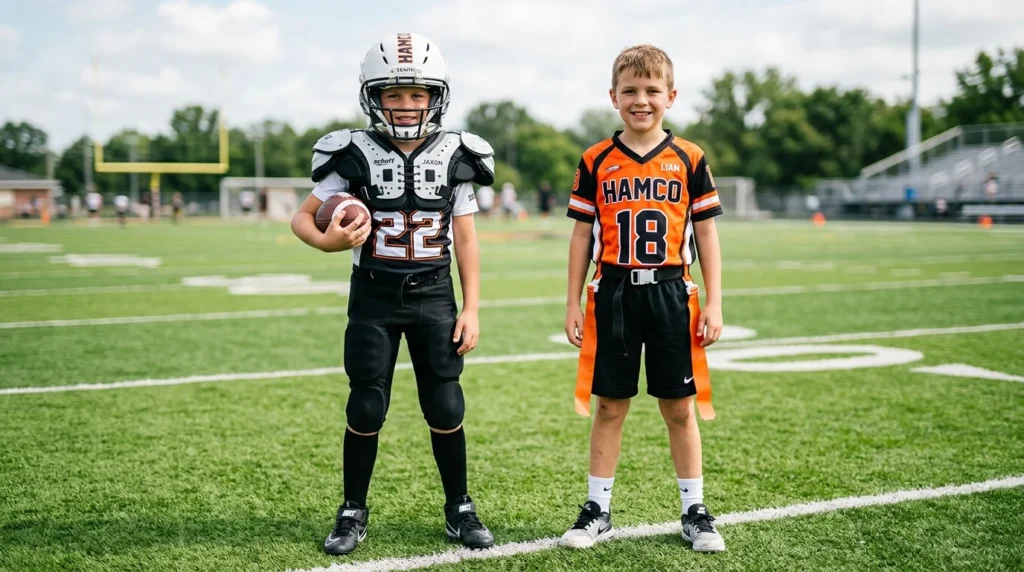
Integrated girdles with built-in padding are the preferred choice for youth programs because they stay in place during play, are easier for young players to manage independently, and reduce the risk of padding shifting out of position during contact. Look for girdles with NOCSAE-approved padding inserts for maximum protection.
Cleats and Footwear for Youth Football Players
Football cleats provide lateral stability and traction for the cutting, driving, and change-of-direction movements that define football. Youth football cleats come in molded and detachable stud configurations. Molded cleats are appropriate for most youth players on natural grass surfaces. Metal cleats are prohibited below high school level in most youth football organizations.
Low-cut cleats prioritize speed and lateral agility for skill positions. Mid-cut cleats provide more ankle support for linemen and tight ends who engage in frequent contact. Proper cleat fit should allow a thumb’s width of space between the longest toe and the cleat tip, with a secure heel cup and minimal side-to-side movement in the toe box.
Mouthguards and Dental Protection
Mouthguards are mandatory in virtually all organized youth tackle football programs and strongly recommended in flag football. The mouthguard protects teeth from impact and reduces the risk of concussive injuries by absorbing and distributing jaw impact forces. Custom-fitted mouthguards from a dentist provide the best protection and comfort but cost significantly more than boil-and-bite versions available at sporting goods stores.
Boil-and-bite mouthguards are entirely adequate for most youth players. Follow the fitting instructions carefully — a poorly fitted mouthguard that does not stay in place during play provides negligible protection. Replace mouthguards that show bite-through damage or visible deterioration.
Custom Football Uniforms for Youth Programs
Custom youth football uniforms complete the player’s game day presentation and create the team identity that motivates players throughout the season. A complete youth football uniform set includes the game jersey, football pants with integrated or separate padding pockets, and optional accessories like team-branded compression shorts.
Custom sublimated football jerseys provide the most design freedom and durability available at the youth level. Sublimated designs are infused permanently into the fabric and never crack, peel, or fade regardless of the physical demands of the season. Custom flag football jerseys are lighter-weight without the pocketing required for pad integration.
Order custom youth football uniforms for your program at hamcospo.com/custom-football-uniforms/ with free design mockups and bulk program pricing.
Equipment Budget Breakdown for Youth Football
Tackle football is one of the more expensive youth sports to equip properly. A complete tackle football equipment set for a youth player ranges from two hundred fifty to six hundred dollars or more depending on equipment quality. Flag football gear, by contrast, requires only flag belts and appropriate footwear — a total investment of twenty to fifty dollars per player excluding the uniform.
Many youth tackle football programs offer equipment loan programs for families with financial constraints. Ask your league coordinator about equipment assistance options before concluding that tackle football is financially out of reach for your family. Used equipment in good condition from previous seasons is also acceptable provided helmets meet current NOCSAE standards.
Frequently Asked Questions
Frequently Asked Questions
Q: Is tackle football safe for children under 10?
A: Medical and sports safety organizations including USA Football recommend flag football as the preferred format for children under ten. Tackle football programs for younger ages should implement strictly enforced contact limitations during practice.
Q: What is the most important piece of tackle football equipment?
A: The helmet is unambiguously the most critical safety item in the youth football equipment checklist. Invest in a properly fitted, NOCSAE-certified helmet before any other piece of equipment.
Q: How often should football helmets be reconditioned?
A: Football helmets should be reconditioned by a certified reconditioning service annually. Reconditioning includes inspection, replacement of worn padding and hardware, and recertification that the helmet meets current safety standards.
Q: Can flag football players wear shoulder pads?
A: Flag football does not require shoulder pads and most formats prohibit them because they impede the flag-pulling mechanic that defines the game. Mouthguards are recommended even in non-contact flag football.
Q: What custom football uniform features are most important for youth players?
A: Moisture-wicking sublimated fabric, secure number and name lettering, and proportional youth sizing that fits young bodies correctly are the most important features in custom youth football uniforms.
A properly equipped young football player is a safer, more confident, and more capable athlete. Use this youth football equipment checklist to ensure no critical safety item is missed, budget realistically for the level of play your program operates at, and complete the uniform experience with custom football jerseys that make every player proud to take the field.

Related Articles
Custom Baseball Jersey Ideas 2026: Colors & Trending Styles
Great custom baseball jersey ideas are the starting point for any team or league that wants to build a visual...

Best Travel Baseball Tournaments in 2026: USSSA, Perfect Game & State Guide
Travel baseball tournaments represent the highest level of youth competitive baseball outside of high school programs, and navigating the landscape...
Little League Rules Explained 2026: Ages, Innings, Pitch Counts & Field Sizes
Little League rules govern the most popular youth baseball organization in the world, serving over 2.5 million players across eighty...